Buyer-first futures comparison · reviewed July 25, 2026
Apex Trader Funding vs FundedNext Futures Buyer’s Scorecard
Compare the same account size and evaluation type. The decision is the complete route to an eligible payout: purchase price, resets or rebilling, activation, loss-limit math, funded rules, platform fit, and trust history. Product names only identify the plans.
| Decision point | Apex Trader Funding | FundedNext Futures |
|---|---|---|
| Matched product | 50K EOD, No Activation Fee | 50K Flex |
| Current entry price | $119 promotional / $1,190 reference | $69.99 promotional / $133.99 reference |
| Activation/subscription | $0 PA activation; 30-day eval access | No activation fee; no subscription |
| Profit target | $3,000 | Check current Flex card for the 50K target |
| Drawdown | $2,000 EOD; $1,000 DLL | EOD loss limit; no daily loss limit |
| Evaluation consistency | None | 40% |
| Funded payout | 5 qualifying days; 100% approved payout subject to gates | Up to 95%; five-day reward path |
Advanced checks before paying
- Model your normal losing streak against the actual daily and maximum-loss calculation, not the nominal account balance.
- Add evaluation, reset, rebill, activation, data, platform and withdrawal fees to get the real attempt cost.
- Check qualifying days, consistency, buffers, payout caps, number of payouts and any move-to-live rules.
- Confirm the contracting entity, country eligibility, platform, recent support record and a small first payout before scaling purchases.
Figures are tied to the products named in each row and were reviewed against linked official sources. Promotions and rules can change; recheck checkout before purchasing.
Choosing between FundedNext Futures and Apex Trader Funding comes down to one question: do you want a firm built entirely around futures evaluations with simple, repeatable payout math, or a newer futures program with several challenge models and flexible drawdown options? Both fund traders on simulated accounts, both use trailing drawdown, and both can pay out up to 100% of profits under the right conditions. The differences live in the details, and those details decide which one actually fits how you trade.
Apex Trader Funding is a futures-only firm with a long track record, a wide range of account sizes (25K through 300K), and a payout structure that rewards consistency over time. FundedNext Futures is a newer entrant from a well-known prop brand, offering multiple challenge models (Rapid, Legacy, Bolt, and Flex) and adaptable drawdown rules. Pick Apex if you want a proven, futures-first firm with straightforward 100% payout splits and lots of platform choice. Pick FundedNext Futures if you want challenge variety, flexible trailing drawdown, and the option to tune your evaluation to your style. Always confirm current pricing and rules on each firm’s official site before buying, because both update terms regularly.
Apex Trader Funding at a glance
Apex Trader Funding is a dedicated futures prop firm. It has built its reputation almost entirely on funded futures accounts, which means its rules, platforms, and payout system are all designed around futures traders rather than adapted from a forex product.
Apex offers account sizes of 25K, 50K, 75K, 100K, 150K, 250K, and 300K, plus a 100K Static option, with contract limits that scale by tier. Accounts are available across three platforms (Rithmic, Tradovate, and WealthCharts), so you can trade through the charting and execution stack you already prefer.
The evaluation uses a trailing drawdown that varies by account size. On Rithmic accounts the published trailing drawdown amounts are $1,500 (25K), $2,500 (50K), $2,750 (75K), $3,000 (100K), $5,000 (150K), $6,500 (250K), and $7,500 (300K), and the drawdown stops trailing once your threshold balance reaches your profit target. On Tradovate accounts the drawdown continues to trail throughout the evaluation. That platform-level difference matters: it changes how much room you have as your balance climbs.
Last verified: June 6, 2026, against Apex Trader Funding’s official help center. Rules and pricing change frequently, so confirm current terms before buying.
FundedNext Futures at a glance
FundedNext Futures is the futures arm of FundedNext, a prop brand best known for its forex and CFD challenges. The futures product brings that brand’s appetite for variety: rather than one evaluation path, it offers several.
FundedNext Futures account sizes include $25K, $50K, $100K, and $150K, and traders can hold multiple challenge accounts up to a combined allocation of $700,000. Funded accounts are capped at $300K in simulated capital. The firm offers four challenge models (Rapid, Legacy, Bolt, and Flex), each with different rules and trade-offs, plus 1-Step challenge options that remove the traditional multi-stage evaluation.
The Flex Challenge is the most adaptable of the four. It uses an end-of-day (EOD) trailing drawdown, applies no daily loss limit and no buffer rule, and carries a low profit target. A 40% consistency rule applies only during the Challenge Phase, and there’s an optional 90% Reward Split add-on. The Rapid model drops the consistency rule during the Challenge Phase entirely, while Legacy leans into structured risk management. Bolt is built around daily rewards after funding.
FundedNext Futures runs on dedicated futures platforms (Tradovate, NinjaTrader, and TradingView) rather than the MT4/MT5 stack used by FundedNext’s separate forex and CFD products. That’s an important distinction: this is a genuine exchange-routed futures offering, so it’s a like-for-like comparison with Apex rather than a CFD product tracking futures prices. If execution model matters to you, confirm the routing and any market-data fees directly with the firm.
Last verified: June 6, 2026, against FundedNext Futures’ official help center. Rules and pricing change frequently, so confirm current terms before buying.
Prop firm evaluation models compared

This is where the two firms diverge most clearly. Apex runs a focused, futures-first evaluation: pass the profit target without breaching the trailing drawdown, then move to a Performance Account. The path is consistent and well-documented, which many traders prefer because there’s less to second-guess.
FundedNext Futures instead gives you a menu. If you want speed, Rapid simplifies the conditions. If you want flexibility, Flex loosens the drawdown and removes daily loss limits. If you want maximum upside potential after funding, Bolt is built for that. The trade-off is decision overhead. You have to understand four models before you buy, and the right choice depends on your strategy and risk tolerance.
If you’re newer to evaluations and still deciding between a one-step challenge and an instant-funding style product, our guide on the instant funding vs challenge model for new traders breaks down the trade-offs in plain language.
Drawdown and risk rules
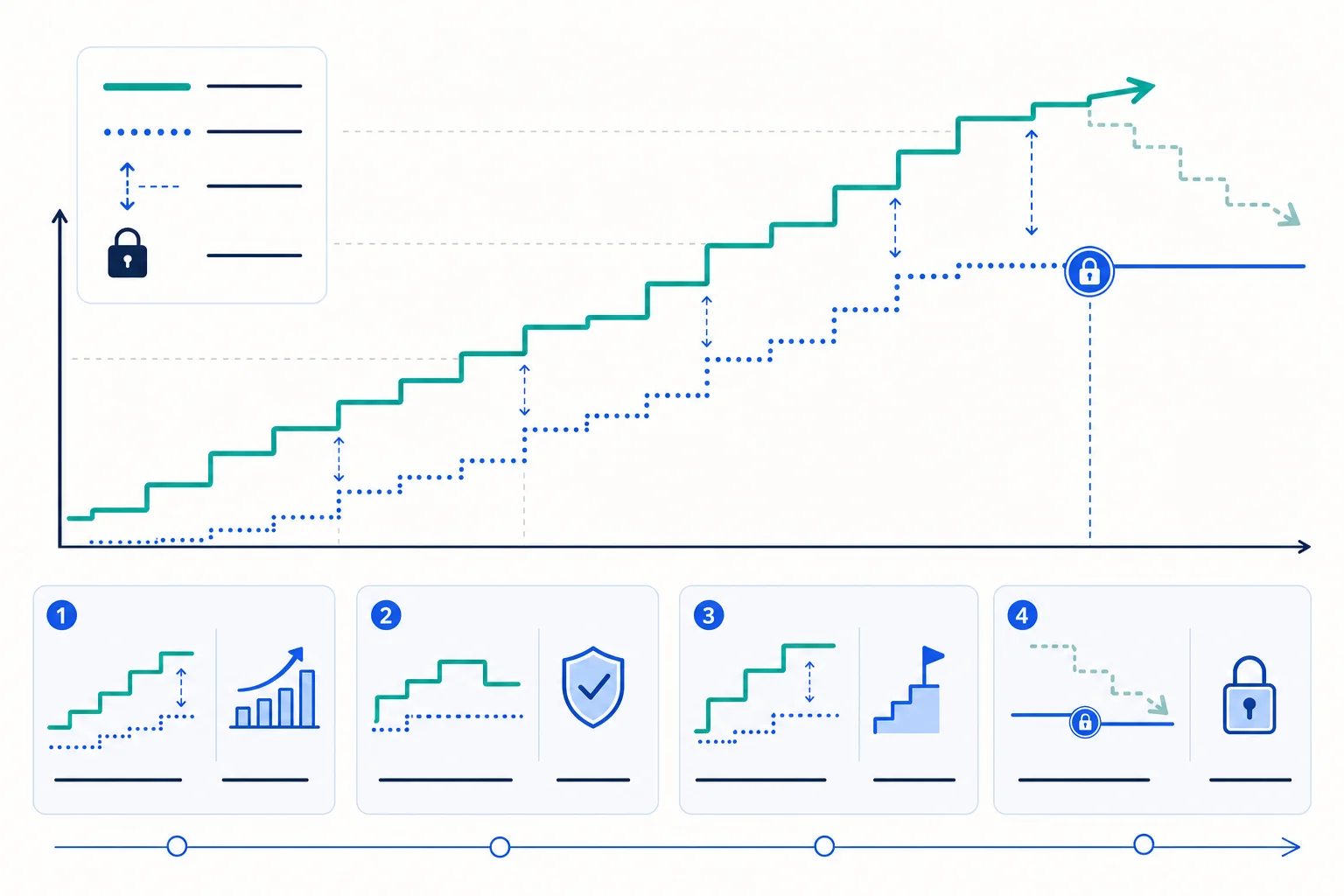
Both firms use trailing drawdown, but the mechanics differ.
Apex’s trailing drawdown is tied to account size and, on Rithmic accounts, stops trailing once your threshold reaches the profit target, effectively locking in a buffer as you approach a pass. On Tradovate it keeps trailing. Understanding which platform you’re on is essential, because it changes your real risk room mid-evaluation.
FundedNext Futures’ Flex Challenge uses an EOD trailing drawdown that adjusts based on your end-of-day balance, with no intraday daily loss limit and no buffer rule. That gives intraday traders more freedom during the session, but the EOD calculation still tightens your loss limit as your balance grows.
If trailing drawdown is the part that trips you up, it’s worth reading our explainer on how prop firm drawdown rules work and the firm-specific breakdown of how FundedNext drawdown rules work for new traders before you commit.
Payouts and profit splits

Apex issues approved payouts at a 100% split on its EOD and Intraday account types once eligibility is met. On Legacy accounts, traders keep 100% of the first $25,000 paid out per account and 90% after that. To request a payout you need at least five qualifying trading days (they don’t have to be consecutive), and a consistency rule prevents any single day from making up 50% or more of your total profit since your last payout. Apex also applies a Safety Net equal to your drawdown limit plus $100, and the minimum payout is $500 per request. On EOD accounts, a Performance Account is limited to six payouts before it closes.
FundedNext Futures advertises Performance Reward splits of up to 100%, with a baseline 80% reward share on requested withdrawals and a 90% split available as an add-on. On the Flex Challenge, traders can withdraw up to 50% of accumulated profit after every five benchmark days, and the firm states it processes payouts within 24 hours of a request.
The practical takeaway: Apex’s payout math is simple and consistency-driven, rewarding traders who build profit steadily across multiple days. FundedNext Futures offers faster, more frequent partial withdrawals on Flex but a lower baseline split unless you pay for the upgrade. If fast access to cash is your priority, compare both against the firms in our roundup of the best prop firm for a fast payout preference.
One caveat worth keeping in mind: published rules describe how payouts are supposed to work, but trader experiences on forums like Reddit don’t always match the marketing. Both firms have their share of community debate around denied payouts and rule interpretation, so treat official terms as the starting point and verify real-world payout behavior yourself. Our prop firm payout proof verification guide explains how to check before you commit money.
Quick prop firm comparison table
| Factor | Apex Trader Funding | FundedNext Futures |
|---|---|---|
| Focus | Futures-only, established | Futures arm of a multi-asset prop brand |
| Account sizes | 25K, 50K, 75K, 100K, 150K, 250K, 300K (+100K Static) | $25K, $50K, $100K, $150K |
| Platforms | Rithmic, Tradovate, WealthCharts | Tradovate, NinjaTrader, TradingView |
| Evaluation | Single futures-first path | Four models: Rapid, Legacy, Bolt, Flex (+1-Step) |
| Drawdown | Size-based trailing; stops trailing at target on Rithmic | EOD trailing on Flex; no daily loss limit, no buffer |
| Profit split | 100% on EOD/Intraday; Legacy 100% to $25K then 90% | Up to 100%; 80% baseline, 90% add-on |
| Payout cadence | After 5 qualifying days; $500 min; EOD capped at 6 payouts | Flex: up to 50% after every 5 benchmark days; 24-hour processing |
| Consistency rule | No single day ≥50% of profit since last payout | 40% rule during Challenge Phase only |
| Max funded capital | Up to 300K per account | Up to $300K simulated |
Figures reflect each firm’s published rules at the time of writing. Confirm current numbers on the official sites before purchasing.
Prop firm pricing compared
Apex moved to a one-time payment model, replacing recurring monthly fees with a single activation cost tied to account size. Before discounts, published activation fees have ranged from roughly $150 for a 25K Tradovate account up to about $360 for a 300K Tradovate account. Apex runs frequent promotions, so the price you pay at checkout is often well below list, so always confirm the current promotional price before buying.
FundedNext Futures prices each challenge model ($25K, $50K, $100K, and $150K) and account size separately, and like most prop firms it discounts regularly. Exact current pricing per model was not confirmed at the time of writing, so check the official FundedNext Futures pricing page for today’s numbers: On July 25, FundedNext’s Flex selector showed 50K at $69.99 promotional ($133.99 reference), 100K at $129.99 ($249.99), and 150K at $249.99 ($483.99); one-time fee, no subscription.
Because both firms discount often, the sticker price you see today may not match next week’s. For a broader sense of what evaluations actually cost across the industry, see our breakdown of how much funded trading programs cost.
Which one fits your trading style?
Choose Apex Trader Funding if you want a proven, futures-only firm with a wide range of account sizes, three platform choices, and a payout system that’s easy to understand. Its consistency-over-time model suits traders who grind out steady profits across many sessions rather than swinging for one big day. It’s also a natural fit if you trade primarily on Rithmic or Tradovate and want the drawdown behavior that comes with each.
Choose FundedNext Futures if you value flexibility and want to match your evaluation to your strategy. The Flex Challenge’s loose drawdown and absent daily loss limit reward active intraday traders, the Rapid model suits those who want fewer rules during the challenge, and the frequent partial payouts on Flex appeal to traders who want cash sooner. If you’re comfortable comparing four models to find your best fit, the variety is a feature rather than friction.
If you’re specifically hunting for the strongest all-around futures option, our roundup of the best prop firm for futures day traders puts both firms in context alongside their main competitors.
Frequently asked questions about these prop firms
Is FundedNext Futures or Apex better for beginners?
Apex’s single evaluation path is easier to understand for a first funded account, since there’s only one set of rules to learn. FundedNext Futures offers more flexibility but asks you to choose among four challenge models first, which can be more to absorb early on.
Which firm pays out faster?
FundedNext Futures states it processes payouts within 24 hours of a request and allows partial withdrawals after every five benchmark days on the Flex Challenge. Apex requires at least five qualifying trading days before your first payout and a $500 minimum. For speed-focused traders, FundedNext Futures’ Flex cadence is generally quicker, but always verify current processing times.
Do both firms use trailing drawdown?
Yes. Apex uses a size-based trailing drawdown that, on Rithmic accounts, stops trailing once your threshold reaches the profit target. FundedNext Futures’ Flex Challenge uses an end-of-day trailing drawdown with no daily loss limit or buffer rule.
What account sizes can I get?
Apex offers 25K, 50K, 75K, 100K, 150K, 250K, and 300K (plus a 100K Static option). FundedNext Futures offers $25K, $50K, $100K, and $150K, with combined challenge allocation up to $700,000 and funded accounts capped at $300K.
Are the funded accounts real money?
Both firms fund traders on simulated accounts and pay real profit shares based on simulated performance, which is standard across the modern futures prop industry. Read each firm’s terms so you understand exactly how payouts are calculated.
Does either firm have a consistency rule?
Yes, but they work differently. Apex prevents any single day from accounting for 50% or more of your profit since your last payout. FundedNext Futures applies a 40% consistency rule only during the Challenge Phase on certain models. Hidden consistency requirements are a common cause of denied payouts, and our guide to consistency rules that cause payout denials is worth a read.
Page-one comparison check · US desktop results reviewed August 6, 2026
What to verify before choosing Apex Trader Funding or FundedNext Futures
Decision summary: The headline account size and profit split do not identify the better fit on their own. Compare the complete cost, loss calculation, first-payout path, platform route, and restrictions for two specific programs before paying.
| Decision point | How to compare it |
|---|---|
| Strategy restrictions | Check news, weekend holding, copy trading, automated systems, scalping, HFT, hedging, and account-sharing rules for both the evaluation and funded stage. |
| Payment, refund, and tax details | Check accepted payment methods, refund eligibility, taxes, currency conversion, chargeback restrictions, and whether a promotion changes any refund term. |
| Country and identity access | Confirm eligibility for your residence and citizenship, accepted identity documents, payment method, platform availability, and payout provider before checkout. |
Promotions and program rules can change independently. Use this page to narrow the choice, then confirm every decision-critical term in each firm’s current official program document, checkout, and trader agreement. Screenshots or saved copies help if a rule changes after purchase.
The bottom line for traders
FundedNext Futures and Apex Trader Funding both fund futures traders, both use trailing drawdown, and both can pay 100% of profits under the right conditions, so neither is simply “better.” Apex wins on track record, platform choice, and payout simplicity. FundedNext Futures wins on flexibility and faster partial withdrawals. Your best move is to match the firm to how you actually trade: pick Apex for a proven, consistency-driven futures program, and FundedNext Futures if you want to tune your evaluation to your style. Whichever you lean toward, confirm the current rules, drawdown type, and pricing on the firm’s official site before you buy.
This article is for educational purposes only and is not financial, investment, or trading advice. Prop firm rules, pricing, and payout terms change frequently, so always verify the latest details directly with each firm before making a decision. Trading involves substantial risk.
Research and disclosure
How this comparison was reviewed
- Basis
- Document-based comparison of official product pages, trading objectives, and help-center material cited in this page.
- Scope
- Apex Trader Funding and FundedNext Futures programs and the exact account comparisons stated on this page. Other firms and changing checkout promotions are outside this comparison.
- Limitations
- BestProps did not purchase an account or perform first-hand trading, support, identity-check, or payout testing for this comparison. Recheck current terms before purchase.
- Commercial state
- BestProps currently has no active affiliate or sponsor relationship with Apex Trader Funding, FundedNext Futures, or any firm named on this page. Any future relationship will be disclosed next to affected links and in this record.