 Futures
 Forex
 Crypto
 Perpetuals
 Interactive
 Calculators
 Guides
 About BestProps
Every best-of guide on BestProps is built the same way, so a ranking in one guide means the same thing as a ranking in another. This page sets out the checks, the cost formula and the evidence rules the guides share.
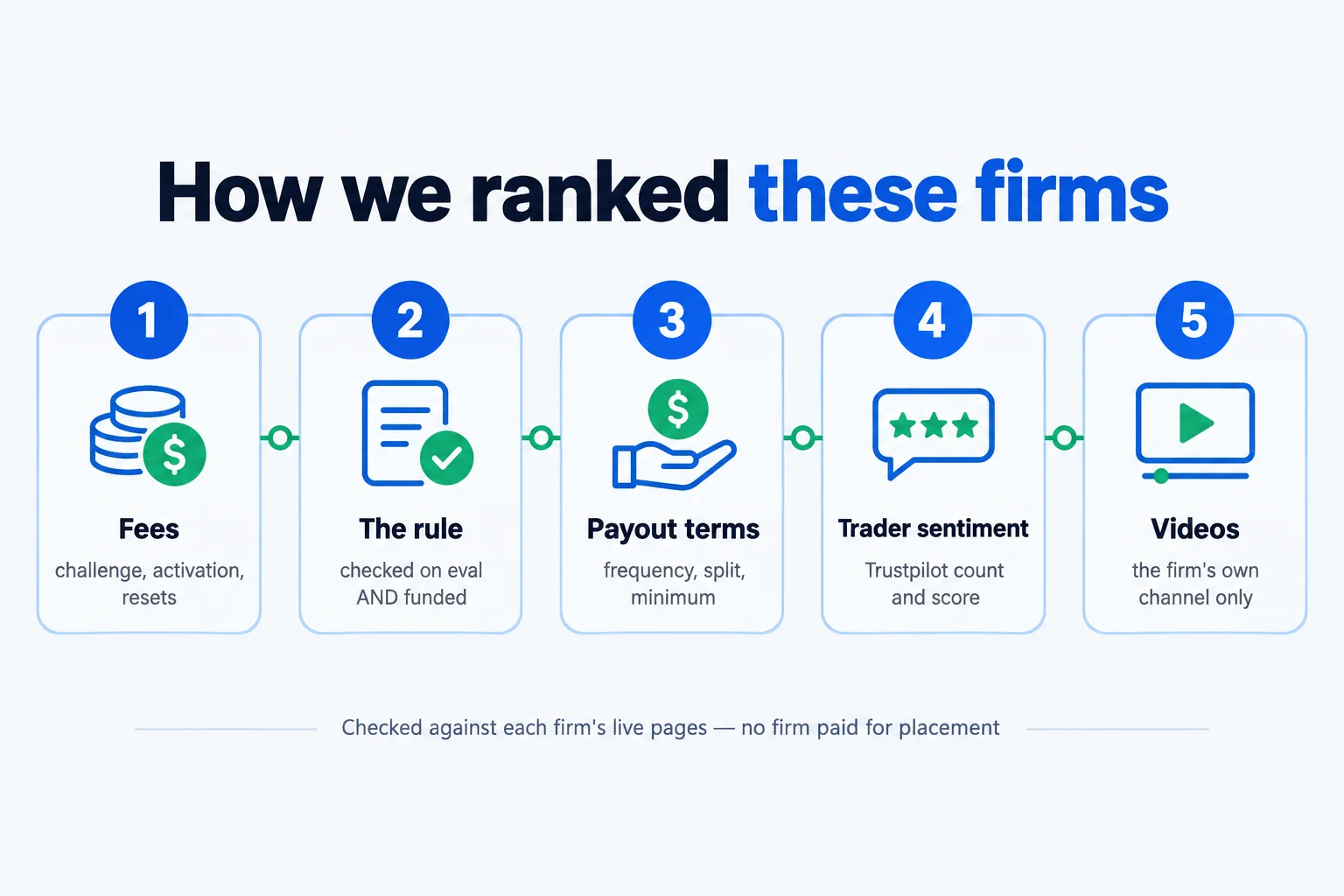
The five checks we use to rank prop firms
- Fees. The challenge price, any activation fee due after you pass, and the cost of a reset or a second attempt where the guide counts one.
- The rule, at both stages. The rule the guide is about is checked on the evaluation and again on the funded account, because many rules change once you are funded.
- Payout terms. How often you can be paid, the profit split, the minimum and any cap on a payout.
- Trader sentiment. The firm’s Trustpilot review count and score. A hidden rating is stated plainly.
- Videos. Only from the firm’s own channel, never from affiliates or reviewers.
Ranking on cost per $1,000 of loss room
A cheap account with very little room to lose is not cheaper than a pricier one with far more. So where a guide ranks on cost, it divides what you pay by the overall maximum loss the account allows, the floor that ends the account if you hit it:
Cost per $1,000 of loss room = (list price + activation fee) / overall max-loss floor in dollars x 1,000
For example, an account priced at $100 with a $50 activation fee and a $2,000 maximum loss costs $75 per $1,000 of loss room. The example is illustrative; each guide shows the real figures for every firm. Some guides add costs that matter to their question, such as data fees, a reset or a payout fee, and say so where they do.
When a firm’s own pages disagree
Firms sometimes state different figures on their pricing page, help centre and terms. When they conflict, we use the more conservative figure, the one that is worse for the trader, and name the conflict in the guide.
Fees a firm does not publish
If a firm’s pages say nothing about a fee, the guide marks it as not published. We never assume an unpublished activation fee is $0; only an explicit statement from the firm earns a $0.
What counts as evidence
- The firm’s own pricing page, checkout, help centre and terms
- Every figure quoted from the firm and dated with the day it was read
- Firm claims such as payout totals reported as the firm’s words, not as findings
- Public registers and Trustpilot for trust and reputation checks
Rankings use list prices. Where a guide also shows a public promo code, it names the code and its end date and keeps the list price alongside it.
Independence
BestProps has no affiliate or sponsor relationship with any prop firm, and no firm pays for placement in a guide. Every firm is judged on the same evidence and the same formula. That includes Tradeify, which gets no softer or harsher treatment than any other firm. See our affiliate disclosure.
How often guides are re-checked
Each guide states the date its figures were read. Fast-moving terms such as prices, promo codes and payout rules are due for a re-read within 7 days, and slower-moving terms within 14 days. When a firm changes a term, the affected guides are corrected and the date moves. Firms can still change terms without notice, so confirm the price at checkout before you buy.
Back to The Prop Trader’s Guide.