Buyer-first futures comparison · reviewed July 25, 2026
Apex Trader Funding vs Lucid Trading Buyer’s Scorecard
Compare the same account size and evaluation type. The decision is the complete route to an eligible payout: purchase price, resets or rebilling, activation, loss-limit math, funded rules, platform fit, and trust history. Product names only identify the plans.
| Decision point | Apex Trader Funding | Lucid Trading |
|---|---|---|
| Matched product | 50K EOD, No Activation Fee | 50K LucidFlex |
| Current entry price | $119 promotional / $1,190 reference | $140 one-time |
| Activation / reset | $0 activation; no resets; 30-day eval | $0 activation; $95 reset |
| Profit target | $3,000 | $3,000 |
| Drawdown / daily loss | $2,000 EOD / $1,000 DLL | $2,000 EOD / no DLL |
| Evaluation consistency | None | 50% |
| Funded payout gate | 5 qualifying days, 50% consistency, safety net; $500 minimum | 5 profitable days, positive cycle profit; $500 minimum; no buffer |
Advanced checks before paying
- Model your normal losing streak against the actual daily and maximum-loss calculation, not the nominal account balance.
- Add evaluation, reset, rebill, activation, data, platform and withdrawal fees to get the real attempt cost.
- Check qualifying days, consistency, buffers, payout caps, number of payouts and any move-to-live rules.
- Confirm the contracting entity, country eligibility, platform, recent support record and a small first payout before scaling purchases.
Figures are tied to the products named in each row and were reviewed against linked official sources. Promotions and rules can change; recheck checkout before purchasing.
Lucid Trading and Apex Trader Funding both fund futures traders through simulated evaluations, but they are built for different temperaments. Apex is the established, high-volume name with a one-time-payment evaluation model and a 100% payout split on its end-of-day accounts. Lucid is the newer, faster-moving challenger with a three-tier program lineup and a 90/10 split. This comparison breaks down how each firm handles pricing, drawdown, payouts, platforms, and rules so you can match the firm to the way you actually trade.
This article is educational and is not financial advice, and it may contain affiliate links. Both firms run simulated (evaluation and funded) accounts before any live capital is involved. Prop-firm rules, pricing, and payout terms change often; always verify the current terms directly with the firm before purchasing.
Last verified June 7, 2026: Lucid Trading (lucidtrading.com official FAQ) and Apex Trader Funding (apextraderfunding.com). Figures marked verification placeholders were not confirmed at the time of writing and must be filled from official pages before this goes live.
Quick comparison table
| Factor | Lucid Trading | Apex Trader Funding |
|---|---|---|
| Firm type | Futures prop firm (simulated → live path) | Futures prop firm (simulated funded accounts) |
| Programs | LucidPro (eval), LucidFlex (eval), LucidDirect (instant funding) | Evaluation → Performance Account (PA); EOD and intraday trailing options |
| Profit split | 90% trader / 10% Lucid | 100% of approved payout on EOD accounts |
| Drawdown | End-of-day drawdown (MLL) that trails, then locks | EOD trailing or intraday trailing drawdown options |
| Fee model | One-time fee, no monthly subscription | One-time payment (OTP) model, no recurring monthly fee |
| Account sizes / prices | LucidFlex one-time prices checked July 25: $100 (25K), $140 (50K), $225 (100K), and $420 (150K), all with $0 activation | Apex offers 25K, 50K, 100K and 150K. Its 50K EOD selector showed $49 promotional for Standard plus PA activation, or $119 promotional for the No Activation Fee route on July 25 |
| Minimum payout | $500; Flex also requires five profitable days at the account-size minimum and allows 50% of profit up to its payout cap | $500 per request |
| Payout cadence rules | 5 profitable days (Flex) / consistency + buffer (Pro/Direct) | 5 qualifying days, 50% consistency rule, max 6 payouts per PA |
| Payout speed | ~5–15 min via Plaid (US); up to 2 business days international | Apex says most users receive funds in 5–11 business days total after requesting |
| Markets | Futures only | Futures only |
| Resets | Available on evaluations, not funded accounts | No resets on current new-product evaluations; a failed or expired 30-day evaluation requires a new purchase |
Company overview
Apex Trader Funding is one of the most recognized futures prop firms and has funded a large trader base over several years. In its 2026 update, Apex moved to a one-time-payment (OTP) model, replacing recurring monthly evaluation fees with a single activation cost tied to account size. Apex offers evaluation formats that include a 5-trading-day path, end-of-day (EOD) drawdown options, intraday trailing drawdown options, and has signaled Instant PAs as a coming-soon option. Notably, an Apex evaluation can be passed in as little as a single day, with no minimum number of trading days required to clear the evaluation itself.
Lucid Trading is a newer futures firm built around a clear progression: evaluation, then a simulated funded account, and ultimately potential consideration for LucidLive, a real brokerage account. Lucid runs three programs: LucidPro and LucidFlex are evaluation-based, while LucidDirect is a straight-to-funded (instant funding) option for traders who would rather skip the evaluation by paying a premium. Lucid charges one-time fees with no monthly subscription on its trading accounts.
If you want deeper background on Apex’s withdrawal record, our Apex Trader Funding payout breakdown covers denials and timelines in detail.
Pricing and fee model
Both firms have moved away from recurring monthly fees, which is good news if you have ever been surprised by a subscription renewal. Apex’s 2026 OTP model charges a single activation cost based on the account size you choose. Lucid likewise uses one-time fees with no monthly subscription, and offers resets on evaluation accounts (but not on funded accounts).
Exact prices and account sizes shift frequently at both firms, often around promotions. Because of that, confirm the live numbers before buying: Apex account sizes and one-time prices are listed as Apex offers 25K, 50K, 100K and 150K. Its 50K EOD selector showed $49 promotional for Standard plus PA activation, or $119 promotional for the No Activation Fee route on July 25, and Lucid’s plan pricing and account sizes are LucidFlex one-time prices checked July 25: $100 (25K), $140 (50K), $225 (100K), and $420 (150K), all with $0 activation. For a broader look at what evaluations typically cost across the industry, see our guide on how much funded trading programs cost.
Drawdown and how each firm measures risk
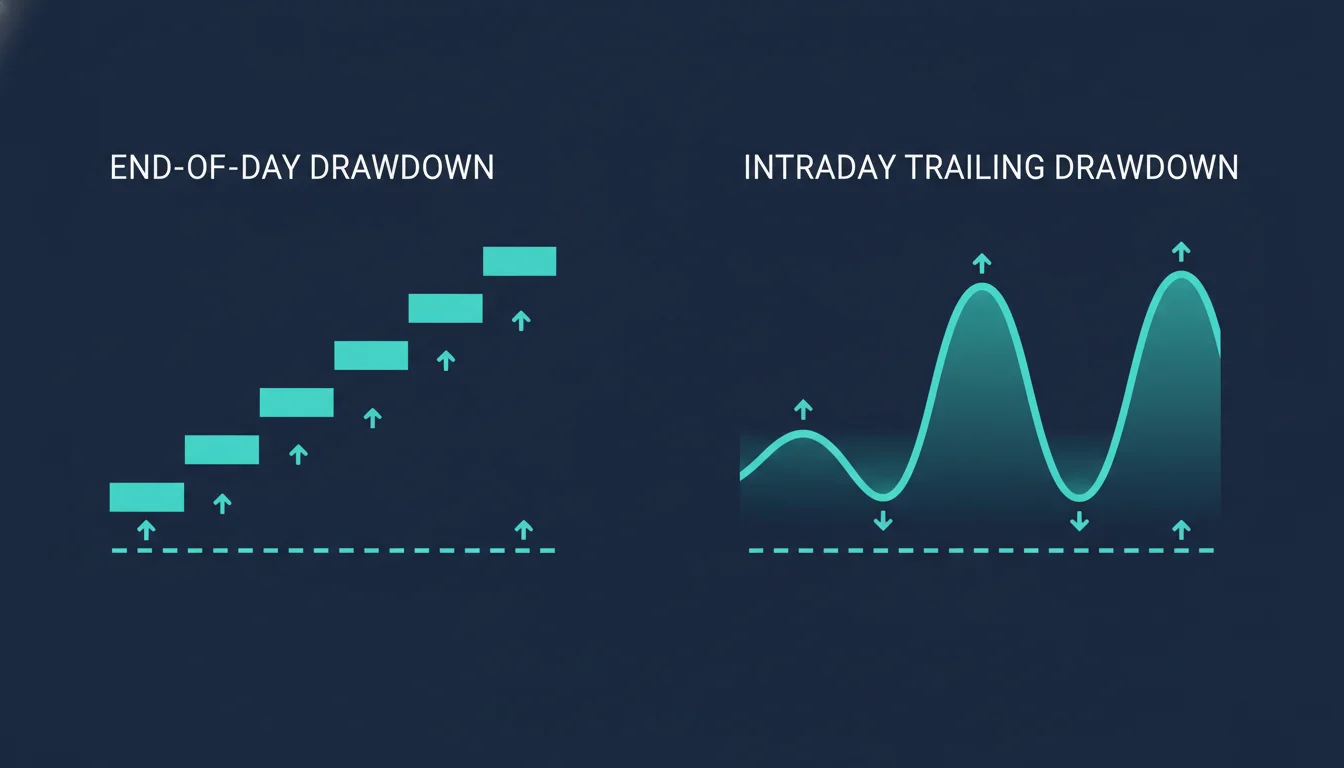
Drawdown is where the two firms feel most different in day-to-day trading.
Lucid uses an end-of-day (EOD) drawdown system to set your Max Loss Limit (MLL). The MLL increases as your balance grows, up to a defined point; once your account exceeds its Initial Trail Balance, the MLL locks and stops moving. An EOD-based trail is generally more forgiving intraday than a tick-by-tick trailing drawdown, because it is calculated on closing balances rather than your highest unrealized profit.
Apex offers a choice: EOD trailing drawdown accounts or intraday trailing drawdown accounts. The intraday option trails against your account’s high-water mark during the session, which demands tighter management of open profit, while the EOD option behaves more like Lucid’s closing-balance approach. The exact drawdown amounts for each account size are $1,000 / $2,000 / $3,000 / $4,000 for 25K / 50K / 100K / 150K EOD evaluations, with DLLs of $500 / $1,000 / $1,500 / $2,000 at Apex and $1,250/$1,000; $3,000/$2,000; $6,000/$3,000; and $9,000/$4,500 target/max-loss for 25K/50K/100K/150K Flex, with no DLL and 50% evaluation consistency at Lucid.
The practical takeaway: if you scalp and like to let winners run intraday, an EOD-style drawdown (Lucid’s default, or Apex’s EOD option) tends to give you more breathing room than an intraday trailing model.
Payouts and profit split
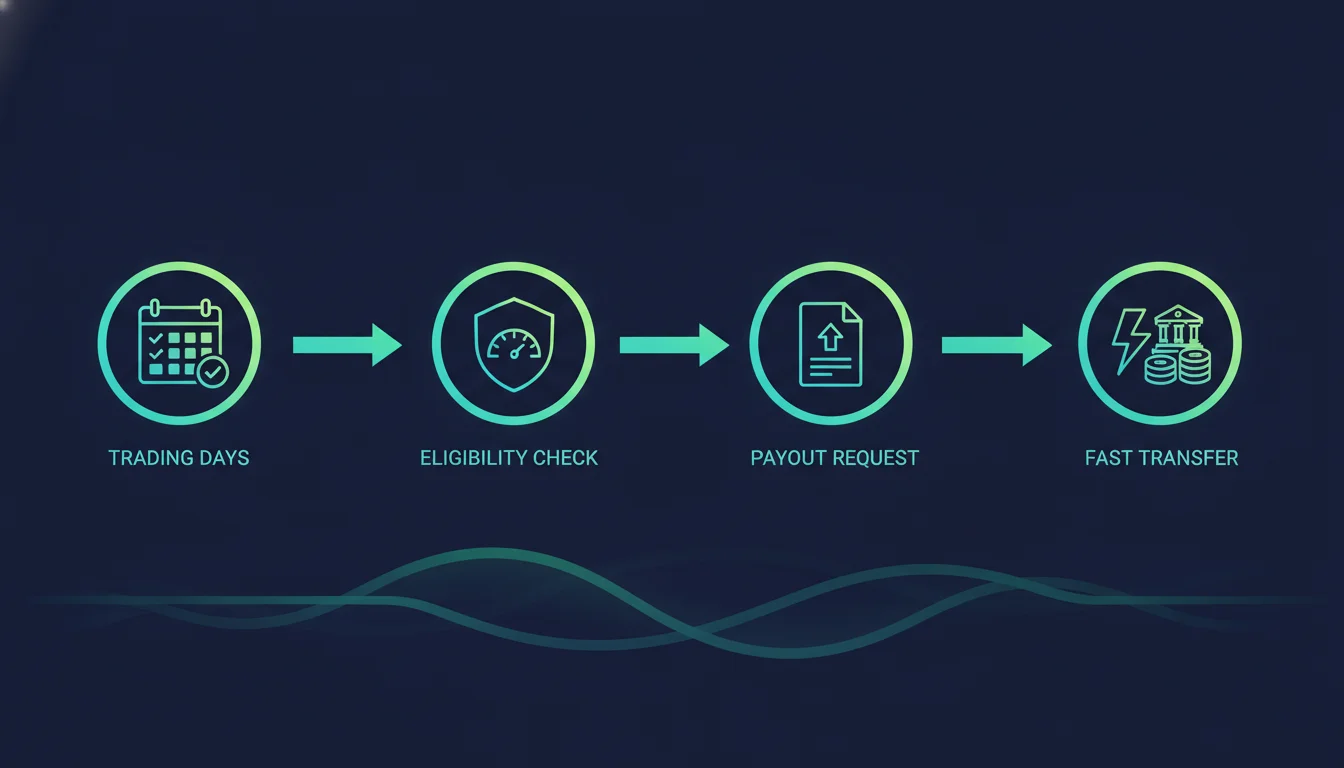
This is often the deciding factor.
Apex advertises a 100% payout split on its EOD accounts, meaning you receive 100% of the approved payout amount (confirm whether any first-threshold split or condition applies to your account type: Current EOD PAs advertise a 100% approved-payout split after all qualifying-day, consistency, safety-net and balance rules are met). Apex’s payout rules include a minimum of 5 qualifying trading days before your first request, a consistency rule (no single trading day may account for 50% or more of your total profit since your last approved payout), a minimum payout of $500 per request, and a cap of six payouts per Performance Account, after which the PA closes and you qualify for a new one. Apex also uses a Safety Net equal to your account’s drawdown limit plus $100; only profit above that safety net is eligible to be withdrawn.
Lucid uses a 90% trader / 10% firm split across LucidPro, LucidFlex, and LucidDirect funded accounts. Payout eligibility depends on the program: LucidFlex requires at least 5 profitable trading days (each meeting a required daily minimum) plus positive net profit for the cycle; LucidPro requires meeting a minimum profit goal, a consistency requirement (40% or less), and buffer thresholds; LucidDirect requires a profit goal plus a tighter 20% consistency requirement. Lucid pays out fast for US traders, typically within roughly 5 to 15 minutes via Plaid, with international payouts taking up to 2 business days through WorkMarket by ADP or crypto.
So the trade-off is straightforward: Apex lets you keep a larger share of each EOD payout (100% vs 90%), while Lucid emphasizes payout speed and offers crypto payouts for international traders. If fast withdrawals are your priority, compare both against our roundup of the best prop firm for fast payouts.
Platforms and markets
Both firms are futures-only, so equities, options, and spot crypto are off the table at both.
Lucid supports a wide platform list driven by its data providers (CQG and Rithmic), including NinjaTrader, Tradovate, Sierra Chart, Quantower, Bookmap, Jigsaw, ATAS, R|Trader Pro, and MultiCharts. Apex similarly supports a broad set of popular futures platforms across major data feeds. If platform choice matters to you, both firms cover the mainstream options most futures day traders use; confirm that your specific platform and data feed combination is supported before purchasing.
Trading rules to know
Lucid publishes a clear rule set: positions must be flat by 4:45 PM EST (Monday–Friday) and trading resumes at 6:00 PM EST (Sunday–Thursday); overnight holding is not allowed on simulated accounts due to a daily maintenance window. Lucid permits news trading, EAs/bots, and trade copiers, but prohibits hedging across accounts, microscalping (flagged when more than 50% of profits come from trades held 5 seconds or less), and high-frequency trading.
Apex’s rules center on its consistency requirement (the 50% single-day rule above), the qualifying-day structure for payouts, and the Safety Net threshold. As with any prop firm, read the current rulebook in full before you trade, because a rule violation can void a payout regardless of how profitable you were.
For traders who want the simplest possible rule set to start, our guide to the best prop firm for beginners who want simple rules is a useful companion read.
Gotchas worth knowing before you buy
Both firms have rules that can quietly cost you a payout or an account, so read these carefully:
- Apex’s 6-payout cap. Each Apex Performance Account allows a maximum of six payouts; after the sixth, the PA closes and you must qualify again through a new evaluation. Long-term traders should factor this into their plan.
- Apex’s Safety Net. Only profit above your Safety Net (drawdown limit plus $100) is withdrawable, and that threshold must be maintained for the life of the account.
- Apex’s consistency rule. No single trading day may represent 50% or more of your profit since your last payout, which discourages one-big-day trading.
- Lucid’s microscalping clause. Accounts can be flagged if more than 50% of profits come from trades held five seconds or less, so ultra-fast manual scalping carries review risk.
- Lucid’s consistency requirements. LucidPro caps at 40% consistency and LucidDirect at a tighter 20%, which shapes how evenly your profits must be distributed.
- One-time fee does not mean zero ongoing cost. Neither firm charges a monthly subscription on accounts, but data feeds, platform fees, resets, and taxes can still apply. Confirm the full cost structure before buying.
Which firm fits your trading style?
Pick Apex Trader Funding if you:
- Want a long-established, widely used futures firm
- Value keeping 100% of your approved EOD payout
- Prefer a one-time-payment evaluation you can potentially clear in a single day
- Want the choice between EOD and intraday trailing drawdown structures
Pick Lucid Trading if you:
- Want fast payouts, especially same-day Plaid transfers in the US
- Like having three program choices, including a straight-to-funded (LucidDirect) path
- Want a defined route toward a real live brokerage account (LucidLive)
- Are an international trader who values crypto payout options
For active futures day traders comparing more than these two, our list of the best prop firms for futures day traders in 2026 puts both in wider context.
What we couldn’t verify yet
Pricing, loss limits, payout gates, and reset terms in this comparison were checked against the linked official pages on July 25, 2026. Promotions and rules can still change, so confirm the exact account at checkout.
Page-one comparison check · US desktop results reviewed August 6, 2026
What to verify before choosing Apex Trader Funding or Lucid Trading
Decision summary: The headline account size and profit split do not identify the better fit on their own. Compare the complete cost, loss calculation, first-payout path, platform route, and restrictions for two specific programs before paying.
| Decision point | How to compare it |
|---|---|
| Trust and operating-history checks | Treat review scores and testimonials as sentiment, then verify company identity, current agreements, support routes, rule-change notices, and documented payout terms independently. |
| Country and identity access | Confirm eligibility for your residence and citizenship, accepted identity documents, payment method, platform availability, and payout provider before checkout. |
Promotions and program rules can change independently. Use this page to narrow the choice, then confirm every decision-critical term in each firm’s current official program document, checkout, and trader agreement. Screenshots or saved copies help if a rule changes after purchase.
Frequently asked questions
Is Lucid Trading legit?
Lucid Trading is an operating futures prop firm that runs simulated evaluation and funded accounts with a published rule set, a 90/10 profit split, and multiple payout methods including Plaid and crypto. As with any prop firm, your results depend on following its rules; verify current terms on Lucid’s site and read the rulebook before purchasing.
Does Apex Trader Funding actually pay out?
Apex processes payouts under defined rules: a minimum of 5 qualifying trading days, a 50% consistency rule, a $500 minimum per request, and a Safety Net equal to the drawdown limit plus $100. Payouts are approved when those conditions are met. For documented timelines and denial reasons, see our Apex payout proof and withdrawal timeline analysis.
What is the profit split at each firm?
Apex offers a 100% payout split on its EOD accounts. Lucid uses a 90% trader / 10% firm split across LucidPro, LucidFlex, and LucidDirect.
Which firm has the better drawdown for scalpers?
An end-of-day drawdown is generally more forgiving for active intraday trading than a tick-by-tick trailing drawdown. Lucid uses EOD drawdown by default, and Apex offers an EOD drawdown option alongside its intraday trailing accounts.
Can I get funded without an evaluation?
Yes, at Lucid via LucidDirect, a straight-to-funded (instant funding) option that skips the evaluation for a premium. Apex has signaled Instant PAs as a coming-soon feature; confirm availability on its site.
Are there monthly fees?
No. Apex uses a one-time-payment model and Lucid charges one-time fees with no monthly subscription on trading accounts.
Which one should I pick?
If keeping 100% of your EOD payout and using a well-established firm matters most, lean Apex. If payout speed, program flexibility, and a path to a live account matter most, lean Lucid. Match the drawdown type and payout rules to how you actually trade.
Final word
Apex Trader Funding and Lucid Trading solve the same problem, funding futures traders, from two angles: Apex with scale, a 100% EOD split, and a flexible one-time evaluation; Lucid with speed, program choice, and a live-account pathway. Your best next step is to pick the one drawdown structure and payout cadence that fits your style, confirm the current pricing and account sizes directly on the firm’s site, and read the full rulebook before you fund. Both are futures-only simulated programs, so size your risk and treat the rules as hard constraints.
This article is for educational purposes only and is not financial, investment, or trading advice. Trading futures carries substantial risk. Prop-firm terms change frequently; verify all current rules, pricing, and payout policies directly with each firm before making a decision.
Research and disclosure
How this comparison was reviewed
- Basis
- Document-based comparison of official product pages, trading objectives, and help-center material cited in this page.
- Scope
- Apex Trader Funding and Lucid Trading programs and the exact account comparisons stated on this page. Other firms and changing checkout promotions are outside this comparison.
- Limitations
- BestProps did not purchase an account or perform first-hand trading, support, identity-check, or payout testing for this comparison. Recheck current terms before purchase.
- Commercial state
- BestProps currently has no active affiliate or sponsor relationship with Apex Trader Funding, Lucid Trading, or any firm named on this page. Any future relationship will be disclosed next to affected links and in this record.