Buyer-first forex comparison · reviewed July 25, 2026
Lucid Trading vs Topstep Buyer’s Scorecard
Compare the same account size and the same evaluation type. Then compare total attempt cost, how daily and maximum loss are calculated, whether drawdown is static or trailing, the funded-account rules, platform fit, and evidence of trust. Branded challenge names identify products; they are not decision criteria by themselves.
| Decision point | Topstep | Lucid Trading (LucidFlex) |
|---|---|---|
| Drawdown type | End-of-day trailing Maximum Loss Limit | End-of-day trailing Max Loss Limit |
| Consistency rule | Yes (consistency target) | No consistency rule on LucidFlex |
| Payout caps | Capped on XFA, uncapped on Live Funded Account | Capped per request; live after 5 payouts |
| Profit split | 90/10 | 90/10 |
| Minimum payout | $125 | $500 |
| Payout cadence | Per payout policy; daily after 30 live winning days | Any day after eligibility met |
Advanced checks before paying
- Calculate all-in attempt cost: evaluation or subscription fee, resets, activation, data or platform fees, and payout charges.
- Convert drawdown into a per-trade loss budget and model your normal losing streak.
- Audit funded-stage consistency, qualifying days, minimum balance, payout cap, number of payouts, scaling, and live-account transition.
- Check the contracting entity, recent complaint themes, support answer for your strategy, and a smaller first payout before scaling purchases.
This scorecard surfaces only decision rows without unresolved verification placeholders. Keep each row tied to the exact account size and program described; verify current checkout and official rules before purchasing.
Lucid Trading and Topstep are two of the most talked-about futures prop firms, and on the surface they look similar: both fund futures traders, both pay a 90/10 profit split, and both use an end-of-day trailing drawdown. Look closer, though, and they are built for different kinds of traders. Topstep is the established name with a monthly evaluation and a long runway to uncapped live payouts. Lucid Trading is the newer challenger built around a one-time fee and a fast, simple payout cycle. This guide breaks down how the two compare on the things that actually decide your take-home: drawdown mechanics, payout caps, billing, and the rules that quietly cause denials.
All figures below reflect each firm’s official help center as of June 2026. Prop firm rules, pricing, and payout terms change frequently, so confirm current details on the firm’s own site before purchasing.
Lucid Trading vs Topstep at a glance
| Feature | Topstep | Lucid Trading (LucidFlex) |
|---|---|---|
| Account sizes | $50K, $100K, $150K | $25K, $50K, $100K, $150K |
| Evaluation model | Trading Combine (monthly subscription) | One-time fee, single-phase evaluation |
| Drawdown type | End-of-day trailing Maximum Loss Limit | End-of-day trailing Max Loss Limit |
| Profit split | 90/10 | 90/10 |
| Consistency rule | Yes (consistency target) | No consistency rule on LucidFlex |
| Minimum payout | $125 | $500 |
| Payout cadence | Per payout policy; daily after 30 live winning days | Any day after eligibility met |
| Payout caps | Capped on XFA, uncapped on Live Funded Account | Capped per request; live after 5 payouts |
| Pricing | Monthly subscription (Rendered No Activation Fee state with Responsible Trading Advantage on, captured July 25, 2026: 50K $85/month sale ($95 reference), 100K $129 ($149), and 150K $199 ($229), with $0 Express Funded activation (official pricing)) | One-time fee (Rendered LucidFlex tab captured July 25, 2026: 25K $100, 50K $140, 100K $225, and 150K $420 one-time, with $0 activation; reset fees were $60, $95, $140, and $280 (official pricing)) |
All figures above are drawn from each firm’s official help center and reflect the structure at the time of writing. Exact purchase prices are marked for verification because both firms run frequent promotions; confirm current numbers on each firm’s own site before purchasing.
Summary of the figures in the “Lucid Trading vs Topstep at a glance” section above.
How each firm works
Topstep runs a three-step path. You start in the Trading Combine, a simulated evaluation with one rule (do not hit the Maximum Loss Limit) and two objectives (reach a profit target and meet a consistency target). The Combine is a monthly subscription that rebills every 30 days until you pass or cancel, with no time limit on passing. Pass it and you activate an Express Funded Account (XFA), then graduate to a Live Funded Account (LFA) where the best payout terms live.
Lucid Trading offers several products, but its flagship is LucidFlex, a one-time-fee account with a single-phase evaluation. Instead of a recurring subscription, you pay once. After you meet the objectives, you can activate quickly, and the payout rules on LucidFlex are deliberately simple. Lucid also runs other tiers such as LucidPro, LucidDirect instant funding, and an invite-only top tier, but LucidFlex is the one most directly comparable to Topstep’s core program.
The headline structural difference is billing. Topstep’s Combine is a monthly cost that continues until you pass. LucidFlex is a one-time purchase. For a trader who expects to pass quickly, the monthly model can be cheaper. For a trader who needs several months of attempts, a one-time fee removes the meter that keeps running.
How the drawdown loss limit moves
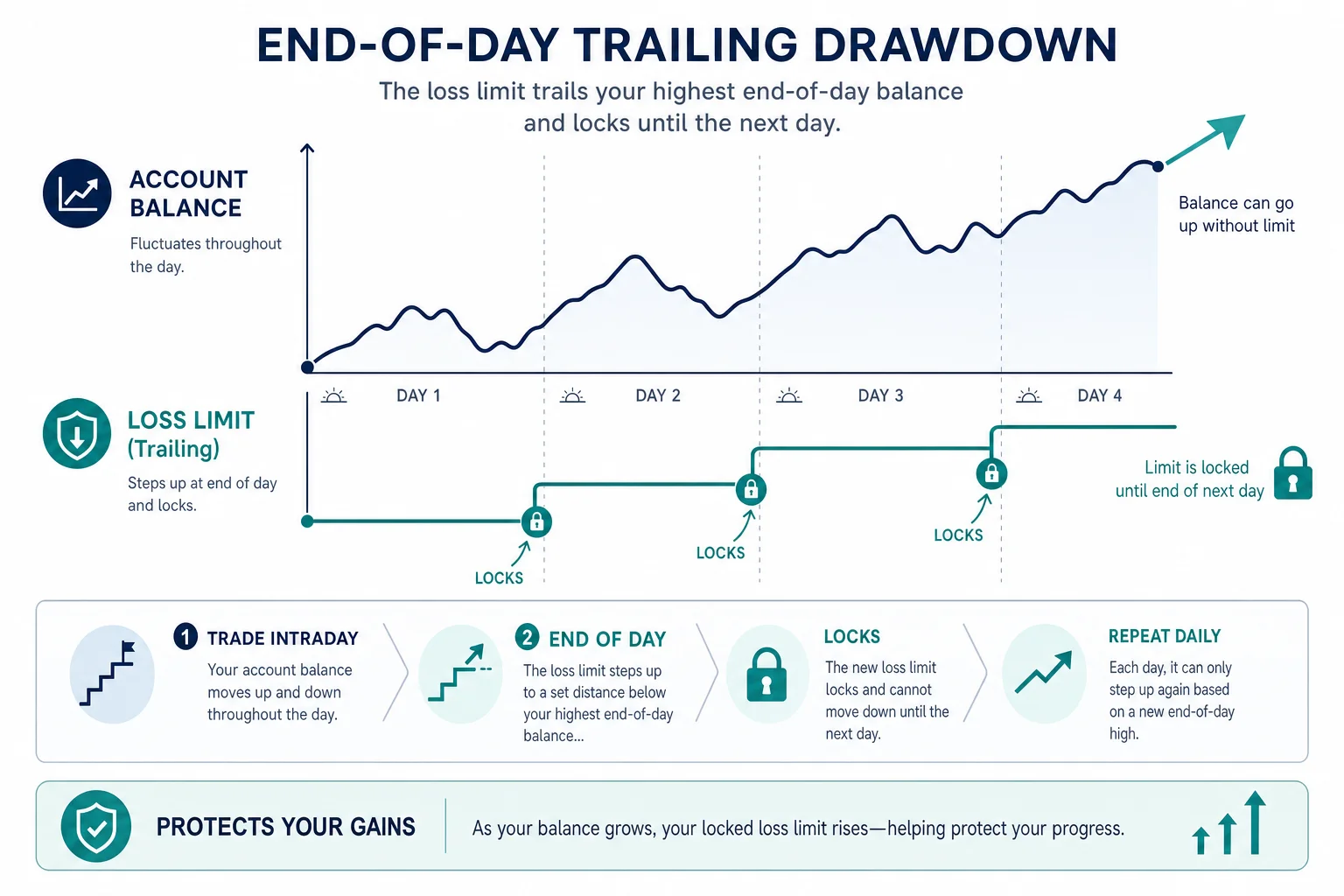
Both firms use an end-of-day trailing drawdown, which is friendlier than intraday trailing because your loss limit is recalculated only on your closing balance, not on every tick of unrealized profit.
At Topstep, the Maximum Loss Limit (MLL) trails your highest end-of-day balance and locks once it reaches your starting balance level. The MLL by account size is $2,000 on the $50K, $3,000 on the $100K, and $4,500 on the $150K. Importantly, after your first payout the MLL resets to $0 permanently, turning your remaining balance into your effective loss floor.
LucidFlex uses the same end-of-day logic. Its MLL is $1,000 on the $25K, $2,000 on the $50K, $3,000 on the $100K, and $4,500 on the $150K. The limit rises with your closing balance until your account passes the initial trail balance, at which point it locks at your starting balance plus $100. Once you request a payout, the MLL adjusts to a locked balance.
In practice, the $50K, $100K, and $150K drawdown amounts line up almost exactly between the two firms. Lucid’s advantage here is the extra $25K tier, which gives newer or smaller-capital traders a cheaper, lower-risk entry point that Topstep does not offer.
Payouts and caps that decide your take-home
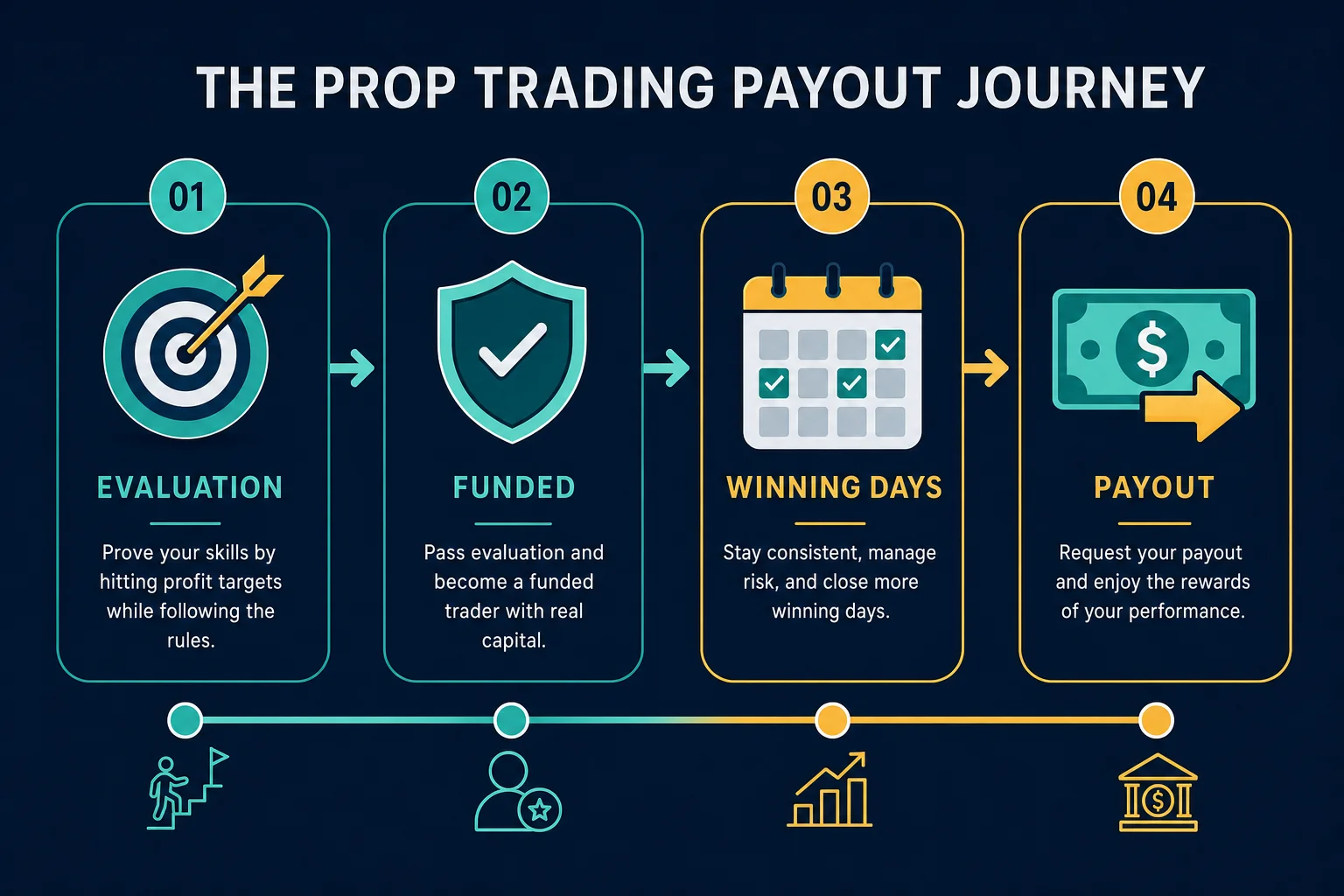
This is the section that decides which firm pays you more, and it is where the two diverge most.
Topstep pays a 90/10 split with a $125 minimum payout. On the Express Funded Account there are two payout paths. The Standard path requires five winning days of $150 or more and lets you request 50% of your account balance up to a cap. The Consistency path requires three trading days and keeping your largest single day at or below 40% of total net profit, with a higher cap. The XFA caps are $2,000 (Standard) or $3,000 (Consistency) on the $50K, $3,000 or $4,000 on the $100K, and $5,000 or $6,000 on the $150K. The key release valve is the Live Funded Account: LFA payouts are not capped, and after 30 winning days you gain access to daily payouts of up to 100% of your balance.
LucidFlex also pays a 90/10 split, but the cadence is simpler and the early caps are lower. To request a payout you need five separate days hitting a minimum daily profit ($100 on the $25K, $150 on the $50K, $200 on the $100K, $250 on the $150K) plus positive net profit for the cycle. There is no consistency rule and no fixed payout window, so you can request any day once you qualify. The minimum payout is $500. The maximum per request is 50% of profit up to $1,000 ($25K), $2,000 ($50K), $2,500 ($100K), or $3,000 ($150K). You can take up to five payouts from a LucidFlex account, after which you are moved to a live account. Approved funds arrive within two business days.
The trade-off is clear. Lucid gets you to a payout faster and with fewer rules, but its per-request ceiling is lower and capped for the first five payouts. Topstep makes you climb to the Live Funded Account, but once there the dollar cap disappears entirely. If your goal is the largest possible single payout over time, Topstep’s uncapped live stage wins. If your goal is the quickest, simplest first payout, Lucid wins.
Figures from the “Payouts and caps that decide your take-home” section above.
Consistency rules and the fine print that causes denials
The single biggest rule difference is consistency. Topstep enforces a consistency target: on the Standard path your best single day should stay below 50% of your profit target during evaluation, and the Consistency payout path caps your largest day at 40% of total profit. LucidFlex does not apply a consistency rule, which removes one of the most common reasons traders get a payout delayed or denied at other firms. If a single big winning day tends to dominate your week, Lucid’s no-consistency structure is more forgiving.
Both firms adjust your loss limit after a payout, but the mechanics differ. At Topstep, your MLL resets to $0 permanently after your first payout, which makes your remaining balance your effective loss floor. At Lucid, the MLL adjusts to a locked balance once you request a payout. The practical effect in both cases is that your room for error narrows after you withdraw, so plan your first payout around a balance that leaves you space to keep trading rather than withdrawing the moment you qualify. Consistency rules and post-payout resets are among the most common causes of prop firm payout denials, so read each firm’s current policy in full before you trade for a payout.
Pricing and billing model
The cost structures reflect each firm’s philosophy. Topstep’s Trading Combine is a monthly subscription that rebills every 30 days from your sign-up date and continues until you pass or cancel; resets and a daily-loss-limit add-on are available. LucidFlex is sold as a one-time fee with no recurring subscription on the flagship product.
For exact current prices, check each firm directly, since both run frequent promotions and adjust pricing. The structural takeaway is what matters for matching a firm to your style: a monthly model rewards traders who pass fast, while a one-time fee protects traders who need a longer, multi-attempt runway.
One caveat worth flagging before you treat any number as your total cost: an evaluation fee is rarely the only expense. Depending on the firm and the platform you use, you may encounter market-data charges, platform or activation fees, or reset fees, and these can apply once you are funded or trading live. A “one-time fee” describes the evaluation purchase, not necessarily every cost you will ever pay. Check each firm’s current data, platform, and activation fee schedule on its official site so you can compare true all-in cost rather than headline price. If cost is your deciding factor, our guide to how much funded trading programs cost walks through the full math, and traders working with limited capital may also want our list of the best prop firms for small starting capital.
Which firm fits your trading style?

Choose Topstep if you want an established firm with a long track record, you expect to pass the evaluation relatively quickly so the monthly cost stays low, and you are aiming for eventually uncapped payouts on a live account. The consistency rule suits traders who already book steady, evenly distributed gains rather than relying on one huge day. Topstep is also a natural pick if you are comparing it against other futures firms; see our breakdown of Topstep vs Apex Trader Funding.
Choose Lucid Trading if you want a one-time fee instead of a recurring meter, you value the simplest possible payout process with no consistency rule, or you want the smaller $25K entry to test the waters with less capital at risk. Lucid’s any-day payout requests and two-business-day funding also appeal to traders who prioritize speed, a theme we cover in our guide to the best prop firms for fast payouts.
Many active futures traders run both, using each firm for the situations where it is strongest. If you are still deciding which suits day trading specifically, our roundup of the best prop firms for futures day traders adds more context.
Frequently asked questions
Is Lucid Trading or Topstep better for beginners?
Lucid Trading’s $25K account gives beginners a lower-cost, lower-risk entry that Topstep does not offer, and the lack of a consistency rule removes one common hurdle. Topstep’s longer, well-documented program and large community can be reassuring for first-timers. The better fit depends on whether you value a cheaper entry point (Lucid) or an established, heavily supported program (Topstep).
Which firm has faster payouts?
LucidFlex lets you request a payout any day once you have five qualifying profit days and positive net profit, with funds arriving within two business days. Topstep offers instant payouts through Aeropay for eligible US traders and fast options like Wise, but its winning-day requirements and payout paths add structure. For sheer simplicity of cadence, Lucid is faster; for uncapped amounts over time, Topstep’s live stage wins.
Do Topstep and Lucid Trading use the same drawdown?
Both use an end-of-day trailing drawdown calculated on your closing balance. The dollar amounts on the $50K, $100K, and $150K accounts are nearly identical. Lucid adds a $25K tier with a $1,000 limit. Both tighten your loss floor after you take a payout.
What is the consistency rule difference?
Topstep enforces a consistency target during evaluation and on its Consistency payout path (largest day capped at 40% of profit). LucidFlex has no consistency rule, so a single large winning day will not block your payout.
How big are the payout caps?
Topstep’s Express Funded Account caps range from $2,000 to $6,000 depending on size and path, but its Live Funded Account has no dollar cap. LucidFlex caps each request at $1,000 to $3,000 by size for the first five payouts, after which you move to a live account.
Is Lucid Trading reputable, and does it pay out?
Lucid Trading is an active futures prop firm with a public help center, written payout policy, and a published profit split, and its LucidFlex payouts are documented as paying within two business days once eligibility is met. It is a newer entrant compared with Topstep’s longer operating history. “Reputable” is ultimately a judgment each trader makes: before buying, read the current official terms, look at recent first-hand payout experiences, and treat third-party reviews and forum posts as opinion rather than policy. Newer firms can change rules or terms more often than established ones, so re-check the official policy close to your purchase date.
Can I copy trade across Topstep and Lucid?
Topstep’s official documentation allows trade copiers to duplicate trades across multiple accounts, subject to its rules, and it automatically disables copy-trading connections while a payout processes. Copying trades between two different firms (one Topstep account and one Lucid account) is a different question and depends on each firm’s current terms and your copier software. Because copy-trading and multi-account rules change and can affect payout eligibility, confirm the current policy with each firm before relying on a copier.
What happens if I do not reach a payout or fail after some withdrawals?
At Topstep, if you hit the Maximum Loss Limit your account becomes ineligible for funding until it is reset, and the Combine subscription keeps rebilling until you pass or cancel. At Lucid, breaching the MLL ends that account. On LucidFlex specifically, you can take up to five payouts before being moved to a live account, so the funded stage is a step on the path rather than an unlimited withdrawal window. Always read each firm’s current breach and reset rules before trading for a payout.
Are both firms legitimate?
Both are active futures prop firms with published rules, payout policies, and help centers. Topstep is the more established name with a longer operating history, while Lucid Trading is a newer entrant that has grown quickly. As with any prop firm, verify current rules and payout terms on the official site before purchasing, and treat third-party reviews and forum posts as opinion rather than policy.
Page-one comparison check · US desktop results reviewed August 6, 2026
What to verify before choosing Lucid Trading or Topstep
Decision summary: The headline account size and profit split do not identify the better fit on their own. Compare the complete cost, loss calculation, first-payout path, platform route, and restrictions for two specific programs before paying.
| Decision point | How to compare it |
|---|---|
| Strategy restrictions | Check news, weekend holding, copy trading, automated systems, scalping, HFT, hedging, and account-sharing rules for both the evaluation and funded stage. |
| Platform and execution costs | Compare the actual platform route, device support, market data, commissions or spreads, overnight charges, copier compatibility, and whether an account can change platforms later. |
Promotions and program rules can change independently. Use this page to narrow the choice, then confirm every decision-critical term in each firm’s current official program document, checkout, and trader agreement. Screenshots or saved copies help if a rule changes after purchase.
The bottom line
Lucid Trading and Topstep share the same DNA, a 90/10 split and an end-of-day trailing drawdown, but they reward different habits. Topstep is the patient choice: a monthly evaluation, a consistency rule, and a climb toward uncapped live payouts. Lucid is the streamlined choice: a one-time fee, no consistency rule, a smaller entry tier, and the fastest path to a first payout, at the cost of lower early caps. Match the firm to how you actually trade and how quickly you expect to pass, and confirm every number on the firm’s own site before you commit.
This article is for educational purposes only and is not financial, investment, or trading advice. Prop firm trading involves risk, and rules, pricing, and payout terms change frequently. Verify all details directly with each firm before making a decision.
Research and disclosure
How this comparison was reviewed
- Basis
- Document-based comparison of official product pages, trading objectives, and help-center material cited in this page.
- Scope
- Lucid Trading and Topstep programs and the exact account comparisons stated on this page. Other firms and changing checkout promotions are outside this comparison.
- Limitations
- BestProps did not purchase an account or perform first-hand trading, support, identity-check, or payout testing for this comparison. Recheck current terms before purchase.
- Commercial state
- BestProps currently has no active affiliate or sponsor relationship with Lucid Trading, Topstep, or any firm named on this page. Any future relationship will be disclosed next to affected links and in this record.