 Futures
 Forex
 Crypto
 Perpetuals
 Interactive
 Calculators
 Guides
 About BestProps

Editorial disclosure. BestProps has no affiliate or sponsor relationship with any firm here (Alpha Capital Group, AquaFunded, Blue Guardian, City Traders Imperium, E8 Markets, FTMO, FundedNext, Funded Trading Plus, FXIFY, OneFunded, Phidias Propfirm, BrightFunded, Elite Trader Funding, AudaCity Capital, FundingPips, My Funded Futures, The5ers and ThinkCapital) and has received no money from any of them. Full policy: affiliate disclosure.
Quick answer, the best prop firms with static drawdown in 2026
- Static on closed balance (futures): Elite Trader Funding Static, a fixed $2,000 at $50K, no daily loss limit but a call-up watch-out; Phidias Express to Live is tighter at $650.
- Static on closed balance (forex/CFD): Funded Trading Plus 2-Step Classic, 8% / $4,000.
- Largest ranked static floor at $50K: 10% / $5,000: FundedNext, FTMO, FXIFY Two Phase Classic, City Traders Imperium, FundingPips Standard, Blue Guardian, OneFunded Core.
- Cleanest multi-product record: FundedNext, all three Stellar products static at both stages.
- Biggest trap: static on one product, trailing on the next (FTMO 2-Step vs 1-Step; Blue Guardian 2-step vs 1-step CFD).
“Static drawdown” is a per-PRODUCT, per-STAGE claim, not a brand-level one. The tables name the exact product and measurement basis.
How we ranked the best prop firms with static drawdown

- Sources: each firm’s rules page, help-centre article and live checkout, read September 30 to October 1, 2026.
- Definition: a floor calculated once from the initial balance, not rising on a new peak, resetting only on a named event.
- Order: closed-balance floors first, then equity floors (largest at $50K, visible Trustpilot before hidden), then eval-only.
- Severity: a firm’s own pages disagreeing on static vs trailing moves a firm to cautionary; a discretionary call-up is a named watch-out, not a reason to exclude it.
- Basis check: every floor is tested against closed balance vs open equity.
General concept (EOD vs intraday): static vs trailing drawdown explainer.
What “static drawdown” actually means
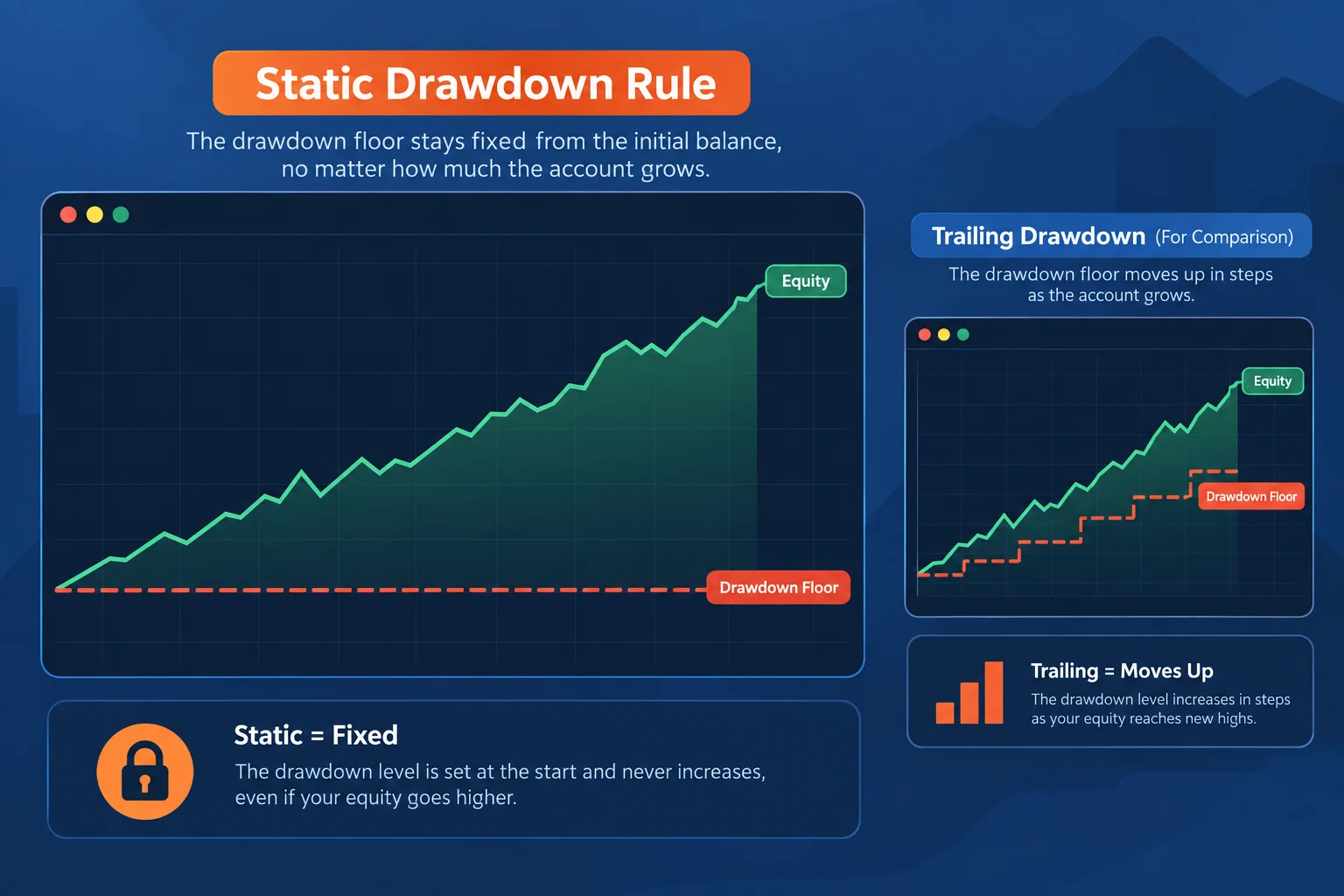
A rule is static only if: the floor is calculated once from the initial balance (or a fixed % of it); it resets only on a named event; and the firm’s own language says “static,” “fixed,” or “absolute drawdown.”
Look-alikes: EOD trailing locks a new floor daily at a fresh peak (FTMO’s 1-Step). Intraday trailing moves continuously with open equity (AquaFunded’s 1 Step). Trailing-with-lock trails until a point, then fixes (Alpha One, ThinkCapital’s Lightning). None are static from day one.
The determination is per PRODUCT and STAGE: a firm can be static at evaluation and silent at funded (BrightFunded), or static on one product and trailing on another at the same firm.
Balance or equity, the question every page skips
Every product below states whether its floor is measured against balance (realized P&L only) or equity (open P&L included). Of the 13 firms static at both stages, only three (Funded Trading Plus, Phidias, Elite Trader Funding) use closed balance; the rest use equity. City Traders Imperium: the VALUE is fixed from balance, but the stop-out TEST counts floating losses.
Worked example: on a $50,000 account with a 10% static floor, the dollar ceiling is $5,000 either way, and it never moves. The difference shows up mid-trade. On a balance-measured firm (Funded Trading Plus, Phidias, Elite Trader Funding), an open position that is currently down $6,000 does not breach the account as long as it has not been closed: only realized losses count. On an equity-measured firm (FundedNext, FTMO, FXIFY, Blue Guardian, OneFunded, AquaFunded, Alpha Capital, FundingPips, Elite Trader Funding’s peers in the CFD table), that same open $6,000 drawdown ends the account immediately, even though the position could recover the next minute. “Static” only promises the ceiling will not rise; it says nothing about whether an unrealized loss counts before you close it, and the two most commonly asked questions on this topic (“is static safer” and “how does static drawdown work”) both hinge on this one distinction.
Lock and reset events are the other thing a “never moves” headline can hide. Several floors here genuinely never move for the life of the account (Elite Trader Funding, FXIFY’s Two Phase products, FundingPips). Others move on a single named, published event: E8 Pro’s floor locks UP to the initial balance the moment the first payout is processed; FundedNext’s floor grows only with realized profit added to the account, not an equity peak; Phidias’ LIVE-stage floor only extends when a new E2L account is validated and its credit added; City Traders Imperium’s stop-out level falls by the amount of any payout taken. None of these contradict the static classification under this post’s definition, because each moves on a stated event rather than continuously trailing a balance or equity high, but a trader who assumes a single dollar figure holds forever at every one of these firms would be wrong at several of them.
Prop firms with static drawdown at both evaluation and funded, forex/CFD
All eleven products below are confirmed static at both stages: balance-measured first, then equity floors largest to smallest, ties broken by visible Trustpilot before hidden.
| Firm (product, $50K) | Model at evaluation | Model at funded | Floor at $50K | Measured against | What trips you first | Trustpilot |
|---|---|---|---|---|---|---|
| Funded Trading Plus 2-Step Classic | Static | Static | 8% / $4,000 | Balance (realized P&L only) | 4% daily loss + 3% symbol cap | rating hidden, 2,666 |
| FundedNext Stellar 2-Step | Static | Static | 10% / $5,000 | Equity (incl. floating losses) | 5% daily loss limit | 4.5/5, 80,485 |
| FTMO 2-Step Standard | Static | Static | 10% / $5,000 | Equity (incl. unrealized P&L) | 5% daily loss limit | 4.8/5, 53,448 |
| FXIFY Two Phase Classic | Static | Static, no lock on payout | 10% / $5,000 | Equity, checked every second | 4% daily loss limit | 4.3/5, 6,345 |
| City Traders Imperium 2-Step Challenge | Static | Static | 10% / $5,000 | Floor fixed on balance; stop-out test includes equity | 5% daily loss limit | 4.2/5, 1,627 |
| FundingPips 2 Step Standard | Static | Static | 10% / $5,000 | Equity (incl. unrealized P&L) | 3% or 5% daily loss limit | 4.5/5, 69,532 |
| Blue Guardian 2 Step Nano | Static | Static | 10% / $5,000 | Equity (incl. floating P&L) | 3% daily loss limit | rating hidden, 2,094 |
| OneFunded Core (2-step) | Static | Static | 10% / $5,000 | Equity (incl. floating P&L) | 4-5% daily loss limit | rating hidden, 158 |
| AquaFunded 2 Step Standard | Static | Static | 8% / $4,000 | Equity (incl. floating P&L) | 5% daily loss limit | rating hidden, 1,199 |
| E8 Markets E8 Pro | Static | Static, locks at first payout | 8% / $4,000 | Equity or balance, whichever falls first | 2.5% daily loss limit | rating hidden, 3,298 |
| Alpha Capital Group Alpha Pro 6% | Static | Static | 6% / $3,000 | Balance or equity (daily); equity-inclusive on overall | 3% daily loss limit | rating hidden, 21,810 |
Funded Trading Plus’ 2-Step Classic is measured on closed balance, not equity
Verdict: Static at both stages, measured on closed balance: an open losing trade does not count until it closes.
- Model at evaluation: Static, 8% of initial balance ($4,000 at $50K). 1-Step Express and Instant Funding are trailing-with-lock instead.
- Model at funded: Static, same 8%; the help article says the floor holds ‘throughout trading,’ with no separate funded section.
- Measured against: Balance, realized P&L only.
- What trips you first: A 4% daily loss limit ($2,000 at $50K) and a 3% symbol cap are hard breaches with no warning.
- Trustpilot: rating hidden (“breach of our guidelines” banner), 2,666 reviews. Funded Trading Plus rules, status.
Funded Trading Plus sells a third product worth naming because it is the cleanest same-firm trap in this whole list: Activation Accounts. Its challenge stage uses a genuinely static, balance-flavored floor (6% of $50,000 = $47,000 for the whole challenge, wherever equity gets to), but the moment the account is funded the floor switches to an equity-based trailing mechanic that locks only once equity reaches the original starting balance: the firm’s own help article walks through the math: “Your floor starts at $47,000. As your equity climbs, the floor follows 6% behind it. At $51,000 equity your floor is $48,000… Once your equity reaches $53,000 the floor reaches $50,000, and there it stops.” A trader who buys Activation Accounts because the challenge looked static gets a different, equity-measured floor the day they’re funded. 2-Step Classic, the product in the table above, does not do this: its floor stays on balance at both stages.
All three FundedNext Stellar products are static at both stages, the cleanest record here
Verdict: Static at both stages on Stellar 2-Step, 1-Step and Lite: every mainstream CFD product here uses the same model.
Video: “The Ultimate No Time Limit Challenge: FundedNext Stellar Model Explained | Prop Trading Guides,” FundedNext official YouTube channel, 2023-11-25. Source type: vendor-produced. Why selected: FundedNext’s own Stellar-model overview; no dedicated drawdown video exists on the channel.
- Model at evaluation: Static, 10% of initial balance ($5,000 at $50K) on Stellar 2-Step (6% on 1-Step, 8% on Lite).
- Model at funded: Static, same figure; resets once the Challenge is passed and the FundedNext Account issues.
- Measured against: Equity, including floating losses.
- What trips you first: The 5% daily loss limit ($2,500 at $50K) is the more common account-ender.
- Trustpilot: 4.5/5 on 80,485 reviews. FundedNext rules, payouts.
FundedNext’s floor is static in the strict sense (it never trails a new equity high), but it is not frozen at the opening number either: the firm’s own help article gives a worked example where realized profit raises the ceiling: “If you make a $4,000 profit on a Stellar 2-Step $100,000 Challenge, your new Maximum Loss Limit increases to $14,000 (original $10,000 limit + $4,000 profit).” That is growth from closed profit added to the account, never from an unrealized equity peak, so it still passes this post’s static test, but a trader reading only the headline percentage would not expect their dollar cushion to widen as they bank profit. All three Stellar sizes share this same mechanic, which is why FundedNext earns the cleanest every-product record on this list.
FTMO’s 2-Step is static, but its own 1-Step trails end-of-day
Verdict: Static at both stages on the 2-Step: the 1-Step at the same firm is EOD-trailing from day one, the clearest same-brand trap here.
- Model at evaluation: Static, 10% of Initial Simulated Capital ($5,000 at $50K). FTMO’s 1-Step recalculates daily and can only rise.
- Model at funded: Static, unchanged: the rule applies to both the 2-Step and the subsequent FTMO Account.
- Measured against: Equity (Balance + Open Positions P/L).
- What trips you first: The 5% daily loss limit ($2,500 at $50K), recalculated daily, is the more common account-ender.
- Trustpilot: 4.8/5 on 53,448 reviews. FTMO profile, rules.
FTMO’s own Trading Objectives page spells out exactly why the 1-Step is not static, and the mechanic is worth understanding because other firms use the same pattern: “The Maximum Loss Limit is recalculated daily at 00:00 CE(S)T as the difference between the highest account balance achieved at 00:00 CE(S)T of any preceding trading day… and the Maximum Loss Amount… The limit can only increase, but never decrease.” So a 1-Step trader who banks a good week sees their floor ratchet upward and stay there even after a losing week: stricter over time than the static 2-Step, despite being marketed as the simpler, cheaper single-phase route. The only way the 1-Step’s floor resets lower is withdrawing a Reward and starting a brand new FTMO Account, which resets it to 90% of the new account’s initial capital.
FXIFY sells three static products, from 5% to 10%
Verdict: Static at both stages on Three Phase (5%), Two Phase Classic (10%) and Two Phase Pro (8%): the marketing claim holds up.
- Model at evaluation: Static, 10% of initial balance ($5,000 at $50K) on Two Phase Classic; 5% on Three Phase, 8% on Two Phase Pro.
- Model at funded: Static, same figure; both Two Phase products state ‘Drawdown Lock Upon Payout No.’
- Measured against: Equity, checked ‘even for a single second.’
- What trips you first: The 4% daily loss limit ($2,000 at $50K) is a hard breach.
- Trustpilot: 4.3/5 on 6,345 reviews. FXIFY rules, payouts.
FXIFY’s FAQ is unusually explicit about enforcement speed, and the wording matters for every equity-measured firm in this post, not just FXIFY: “If your equity falls below the Daily or Max Loss Limit equity breach level, even for a single second, the system will trigger a breach.” That single-second standard is why the firm pairs the static claim with payout-side trade-offs instead of a drawdown catch: Two Phase Classic’s fee is not refunded on a pass (unlike Three Phase, which refunds at first payout), and Two Phase Pro caps the first two payouts at 5% of the initial balance regardless of how much profit is sitting in the account. Both Two Phase products explicitly state “Drawdown Lock Upon Payout No,” meaning taking money out does not move the static floor either up or down: a contrast with firms like E8 Pro, where the first payout locks the floor permanently higher.
City Traders Imperium’s 2-Step is static, but its 1-Step keeps rising and never locks
Verdict: Static at both stages on the 2-Step and Instant Funding: the 1-Step recalculates upward on every new balance high.
- Model at evaluation: Static (‘Max Static Drawdown’), 10% of initial balance ($5,000 at $50K). Instant Funding is static at 6%. The 1-Step is NOT.
- Model at funded: Static, same 10% figure continues unchanged after passing.
- Measured against: The floor’s dollar value is fixed from balance, but the stop-out test includes floating losses.
- What trips you first: A separate 5% daily loss limit usually arrives before the static floor.
- Trustpilot: 4.2/5 on 1,627 reviews. City Traders Imperium payouts.
CTI’s own help centre describes the 2-Step’s floor with language worth quoting directly, because it is the clearest statement in this entire dataset of the balance-vs-equity split that most firms leave implicit: “We measure the drawdown limit based on your initial balance (not equity). But your trades will be closed and your account will be stopped out if your equity (balance + floating losses) drops below the maximum allowed loss level… even though we use your balance to set the drawdown limit, your open (floating) losses do count toward your stop-out condition.” In plain terms, the $5,000 ceiling on a $50,000 account never moves, but an open losing trade can still end the account before it’s closed: the floor’s VALUE is fixed, the BREACH TEST is not. Instant Funding, CTI’s no-evaluation product, uses the identical static mechanic at 6% with no daily loss limit at all; the 1-Step next to both of them has no evaluation-phase static floor whatsoever and instead recalculates upward on every new closed-balance high, for the life of the account, with no lock point ever published.
FundingPips’ three 2 Step products are static at both stages, measured on equity
Verdict: Static at both stages on 2 Step Pro, Standard and Flex: 6% to 12%.
Watch out: FundingPips’ Prime is a mandatory, non-declinable live call-up once invited. Unpaid Master-account profit converts into Prime’s starting size instead of being paid out.
- Model at evaluation: Static, 10% of initial balance ($5,000 at $50K) on 2 Step Standard. Pro is 6% ($3,000); Flex is 12% ($6,000).
- Model at funded: Static, same figure and basis; the Max Loss Limit card applies across all phases, including the Master Account.
- Measured against: Equity, including unrealized P&L.
- What trips you first: A 3% or 5% daily loss limit (chosen at purchase) is a hard breach with no grace.
- Trustpilot: 4.5/5 on 69,532 reviews. FundingPips profile, rules.
FundingPips prices the three 2 Step variants close together ($249 for Pro’s 6% floor, $299 for Flex’s 12%, $349 for Standard’s 10%, all one-time at $50K), so the real choice is how much room you want before the static floor, not price. The firm also lets a trader pick the daily loss limit percentage (3% or 5%) at purchase on Standard, which changes the price slightly but not the overall static floor itself. The watch-out named above sits entirely on the payout side: a Prime invite is automatic and non-declinable once triggered, and any unpaid profit sitting on a Master account converts into Prime’s starting capital instead of staying withdrawable: worth knowing before you build a large unpaid balance on a Master account.
Blue Guardian’s 2 Step Nano is static, while its own 1-step CFD product is not
Verdict: Static at both stages on 2 Step Nano and 2 Step Standard: the overview labels the 1-step CFD products ‘trailing.’
- Model at evaluation: Static, 10% of initial balance ($5,000 at $50K). 2 Step Standard is static at 8%; 1 Step products are NOT.
- Model at funded: Static, same section covers evaluation and funded, no separate funded-stage percentage published.
- Measured against: Equity, including unrealized positions.
- What trips you first: The 3% daily loss limit ($1,500 at $50K) ends the account before the static floor.
- Trustpilot: rating hidden (“breach of our guidelines” banner), 2,094 reviews. Blue Guardian profile, payouts.
2 Step Nano is Blue Guardian’s cheapest static entry: $127.00 list, $95.25 with the live promo code, a one-time fee with no activation cost. The firm’s own help article measures the floor on equity including unrealized positions: “Your account equity including unrealized/floating positions must not hit/exceed below $90,000” on a $100,000 worked example, so an open losing trade counts immediately, not just once it’s closed. 2 Step Standard sits one tier up at 8%, same mechanic, slightly higher entry price. Neither product states a separate funded-stage percentage; the help article covers both the challenge and the funded account under one continuous section with no stage split, which this post treats as the floor applying unchanged rather than silent.
OneFunded’s Core plan uses the equity-based static rule this post tests
Verdict: Static at both stages on all three sizes tested: Core (10%) leads; Value (8%) and Flash (6%) are also static.
Video: “How Is Drawdown Calculated at OneFunded? | Rules Breakdown,” OneFunded official YouTube channel, 2026-06-10. Source type: vendor-produced. Why selected: OneFunded’s own explainer on an equity-based max-loss floor that never resets.
- Model at evaluation: Static, 10% of initial balance ($5,000 at $50K) on Core; Value is 8%, Flash is 6%.
- Model at funded: Static, same figure and basis as evaluation: the pages do not distinguish the stages.
- Measured against: Equity, including unrealized P&L.
- What trips you first: A separate daily loss rule (4-5% equity) can end the account in one bad day; help articles disagree on the allowance’s base.
- Trustpilot: rating hidden (“breach of our guidelines” banner), 158 reviews. FTMO vs OneFunded, FundedNext vs OneFunded.
OneFunded publishes its max-loss rule in blunt terms: “Your account equity may never fall below a defined threshold from the initial account balance, regardless of any profits earned in between. This is a hard, permanent drawdown cap… Includes floating losses / Applies continuously / Never resets.” That never-resets language applies identically to all three sizes (Core 10%, Value 8%, Flash 6%), and Value at $199 one-time ($159.20 with the current month’s code) is the cheapest static-drawdown product checked anywhere in this post. The separate Max Exposure rule caps combined floating loss on one correlated trade idea at 3% of equity (2% on $100K/$200K accounts), which can end an account through concentration even while the overall static floor is nowhere close to being hit.
AquaFunded’s 2 Step Standard is static, but its more marketed 2 Step Pro and 1 Step are not
Verdict: Static at both stages on 2 Step Standard and 3 Step: naming the exact product matters here.
- Model at evaluation: Static, 8% of initial balance ($4,000 at $50K). 3 Step is static at 8%; 2 Step Pro (10%) and 1 Step (6%) are NOT.
- Model at funded: Static, same 8% figure and basis as evaluation; no stage-specific change published.
- Measured against: Equity, including unrealized P&L.
- What trips you first: The 5% daily loss limit ends the account first; a funded-only open-loss circuit breaker is a watch-out.
- Trustpilot: rating hidden (“breach of our guidelines” banner), 1,199 reviews. AquaFunded profile.
AquaFunded’s own help article uses almost identical language to Blue Guardian’s: “If your account equity, including any floating trades, falls below 92% of the initial balance, your account will breach,” applying the same test to both 2 Step Standard and 3 Step at 8%. The firm’s funded-only Wave Stop rule is a separate circuit breaker worth naming on its own: it auto-closes all open trades once combined floating loss hits 2% of equity, cuts the profit split to 50% on the first trigger, and breaches the account on a second trigger: a rule the static 8% floor itself does not test for, and one that is absent from the 2 Step Standard and 3 Step rule articles (it lives on a separate Wave Stop page). 2 Step Pro and 1 Step Standard, AquaFunded’s more heavily marketed products, are both intraday-trailing on equity at both stages and do not qualify for this list at all: naming the exact product matters more here than almost anywhere else in this post.
E8 Pro is static, but E8 One, the firm’s flagship, is trailing-with-lock under a different name
Verdict: Static at both stages on E8 Pro, branded ‘E8 Static Drawdown’: E8 One (‘Dynamic Drawdown’) and E8 Signature (EOD) are not.
- Model at evaluation: Static, 8% of initial balance at the configurator default ($4,000 at $50K; customizable 6-10%).
- Model at funded: Static at 8% until the first payout, when the floor locks permanently: a named event, not a trail.
- Measured against: Equity or balance, whichever falls first.
- What trips you first: A 2.5% daily loss limit ($1,250 at $50K) ends the account first; 50% of each payout’s profit is withheld as a buffer.
- Trustpilot: rating hidden (“breach of our guidelines” banner), 3,298 reviews. E8 Markets profile, rules.
E8 Pro is customizable at checkout between 6% and 10% (the configurator default used in this table is 8%), and the firm’s own article states the breach test plainly: “A permanent violation occurs if your account’s Equity or Balance falls below this level at any point.” The lock event is unusually trader-friendly: “When you request the first payout, the static drawdown is moved to the initial balance level… After your first payout, the Static Drawdown loss level is permanently set to your initial balance level,” so the floor moves favorably, not unfavorably, the first time you get paid. E8 One (“Dynamic Drawdown”) and E8 Signature (“EOD Dynamic Drawdown”) sit at the same firm and use the word “drawdown” just as confidently, but both are trailing-with-lock patterns, not static from day one: E8 One’s floor rises on every closed profit until it locks at the initial balance, and E8 Signature recalculates once per day at market close instead of continuously.
Alpha Pro 6% keeps a 6% static floor at both stages, but Alpha One is not static
Verdict: Static at both stages on Alpha Pro (and Alpha Swing): Alpha One (1-step) is trailing-with-lock.
- Model at evaluation: Static, 6% of initial balance ($3,000 at $50K). Alpha Pro 8%/10% and Alpha Swing (10%) are also static; Alpha One is NOT.
- Model at funded: Static, same 6% figure; no separate funded-stage percentage is published.
- Measured against: Balance or equity, whichever is greater.
- What trips you first: The 3% daily loss limit closes trades well before the 6% floor is threatened.
- Trustpilot: rating hidden (“breach of our guidelines” banner), 21,810 reviews. Alpha Capital Group payouts, status.
Alpha Capital Group sells five plans, and the static-vs-trailing line runs straight through the middle of the lineup: Alpha Pro (6%, 8% and 10% variants) and Alpha Swing (10%) are all static, each confirmed by the firm’s own ‘Maximum Total Loss’ article stating the floor stays fixed ‘even if the balance grows.’ Alpha One (1-step, in 6%/10%/12% variants) is different: it trails the account’s high-water mark until the balance reaches the initial-balance-plus-drawdown level, then locks permanently, and the firm’s help article warns that withdrawing all profits after that lock point closes the account entirely. A buyer comparing “Alpha Pro” to “Alpha One” by name alone could easily assume they share a drawdown model; they do not.
Prop firms with static drawdown at both evaluation and funded, futures
Two futures products are static at both stages here, both on closed balance: Elite Trader Funding’s Static plan (larger floor, no daily loss limit) and Phidias’ Express to Live (tighter floor).
| Firm (product, $50K) | Model at evaluation | Model at funded/live | Floor at $50K | Measured against | What trips you first | Live call-up? |
|---|---|---|---|---|---|---|
| Elite Trader Funding Static | Static | Static | $2,000 fixed | Balance (realized P&L only) | No daily loss limit | Discretionary, no decline |
| Phidias Express to Live (E2L) | Static | Static, extends on new E2L credit | $650 fixed | Balance (realized P&L only) | No reset on a breach (full repurchase) | Not published |
Elite Trader Funding’s Static plan holds a fixed dollar floor on closed balance, with no daily loss limit
Verdict: Static at both stages on closed balance: a fixed $2,000 at $50K that never trails, no daily loss limit.
Watch out: Its terms let it move traders to a LIVE ELITE account “at our discretion”; the sim accounts close and no payout is owed.
- Model at evaluation: Static, a fixed $2,000 at $50K: ‘Max Drawdown $2,000.00 Drawdown Type: Static Minimum Balance Never Trails.’
- Model at funded: Static, the same $2,000 carried from evaluation: ‘The minimum allowed balance is static: it does not trail or move with unrealized profit.’
- Measured against: Balance, realized P&L only.
- What trips you first: No daily loss limit, but its Loss Limit Rule ends the account if you give back more than 35% of total profit after a 20% gain.
- Trustpilot: 3.8/5 on 1,152 reviews. BestProps pages: Apex vs Elite Trader Funding.
Elite Trader Funding’s plan picker spells the model out in plain English on the card itself: “Max Drawdown: $2,000.00 Drawdown Type: Static Minimum Balance Never Trails.” The help article backs it with a worked example: “If you make a trade and close for a profit of $1,000, your minimum account balance stays at $48,000” on a $50,000 account. Payouts here are not a simple percentage of profit: a trader must log 8 Active Trade Days in the first reward cycle (10 in later cycles), each with at least $200 realized profit and at least 23% of the best day’s P&L, before a reward can be requested at all: on top of the Loss Limit Rule named as the first watch-out, and a Weekly Trading Requirement that closes the account and voids rewards if a full week passes with no trade.
Phidias’ Express to Live is static in dollars at every stage, the tighter of the two balance-measured futures picks
Verdict: Static at both stages on Express to Live (E2L) 50K: a $650 fixed-dollar floor, computed once and never trailing.
Video: “Why You Keep Failing Your Prop Firm Evaluation (50,000 Traders Data),” Phidias Propfirm official YouTube channel, 2026-07-29. Source type: vendor-produced. Why selected: Phidias’ own evaluation-failure data video, the closest official explainer to the E2L static rule available on the channel.
- Model at evaluation: Static, a fixed $650 at $50K: ‘Liquidation Threshold = Initial Capital minus Static Drawdown. The static drawdown never trails.’ Fundamental/Premium are EOD trailing instead.
- Model at funded: Static, the same $650 formula continues on CASH; on LIVE the floor extends only on a new validated E2L account: a named event, not a trail.
- Measured against: Balance, realized P&L only.
- What trips you first: No daily loss limit, but also no reset on a failed evaluation: a breach is a full repurchase, $650 is tight for a few contracts.
- Trustpilot: rating hidden (“breach of our guidelines” banner), 334 reviews. static vs trailing drawdown, concept explainer.
Phidias computes the floor with a published formula rather than a worked example: “Liquidation Threshold = Initial Capital minus Static Drawdown. The account is liquidated if the balance reaches or falls below this threshold. The static drawdown never trails.” The One-Time Payment path at 50K costs $144.60 with the live code against a $723 list price and carries no activation fee at all; the alternative Evaluation path is cheaper up front at $139 but adds a $149 activation fee once passed. The LIVE stage’s “extensible” floor only grows when a trader validates a new E2L account and its credit is added (up to 5 accounts), a named event rather than a continuous trail, so it still passes this post’s static test even though the word “extensible” sounds trailing-adjacent. Fundamental and Premium, Phidias’ other products, are EOD trailing instead and are not part of this ranking.
Static at evaluation only, funded stage not published
One firm’s pages confirm a static floor at evaluation but go silent on funded: a disclosure gap, not a confirmed trail.
BrightFunded’s 2-Step is static at evaluation, but never restates the rule for funded
Verdict: Static confirmed at evaluation only. BrightFunded never repeats the static percentage, or the word ‘static,’ for funded: a disclosure gap.
- Model at evaluation: Static, 10% of initial balance ($5,000 at $50K) on 2-Step Classic (8% on 2-Step Bright). ‘If your balance or equity hits this level at any point during the day, your account will be considered breached and terminated.’
- Model at funded: Not published for the funded stage on either 2-Step product. BrightFunded’s separate 1-Step product IS confirmed intraday-trailing at both stages.
- Measured against: Equity (incl. unrealized P&L) at evaluation: not restated for funded.
- What trips you first: The 5% daily loss limit is a hard breach with no warning; a firm-authored Trustpilot reply has disputed the funded-stage drawdown value too.
- Trustpilot: rating hidden (“breach of our guidelines” banner), 573 reviews. BrightFunded profile.
BrightFunded’s own help article is unambiguous at evaluation: “The maximum drawdown is static: it is fixed from the account’s initial balance and does not change throughout the evaluation.” The sentence is explicitly scoped to the evaluation phase, and no page anywhere on the site restates the 10% figure, or the word “static,” for the funded account specifically: the How It Works page only says funded accounts face “a standard 5-minute restriction on trading high-impact news events,” which implies continuity without confirming it. 2-Step Bright carries an extra wrinkle: a firm-authored Trustpilot reply states the drawdown as “4% on the evaluation phase and 8% once funded,” a different split than the help article’s flat 8% static figure, which this post treats as a watch-out rather than a settled fact. BrightFunded’s separate 1-Step product is confirmed intraday-trailing at both stages, with the floor locking at the initial balance once equity grows 6% above it, so the firm clearly does use non-static models elsewhere on its own site.
Cautionary prop firms for a static-drawdown search
Each firm below sells at least one genuinely static product, but carries a flaw serious enough to keep it out of the lead tables. Same reason as our most trusted prop firms guide: a trader should not have to guess which page is current.
| Firm | Static product(s) | Non-static product(s) at same firm | Why cautionary | Trustpilot |
|---|---|---|---|---|
| AudaCity Capital | Ability Challenge, Ability One (eval only) | FTP (mixed: static max + trailing daily) | Firm-confirmed discretionary payout withholding on risk review | rating hidden, 293 |
| My Funded Futures | none | Builder, Rapid, Rapid EOD (trailing); Pro (locks after payout) | No static product at any stage on any current page | 4.9/5, 22,110 |
| The5ers | Bootcamp, High Stakes, Hyper Growth (both stages) | none: all tested products are static | High Stakes: own pages disagree on the floor value (8% vs 10%) | 4.7/5, 38,859 |
| ThinkCapital | Dual Step (both stages) | Lightning (trailing-with-lock) | Flagship product is not static; floor value disputed; unrelated serious trust flag | rating hidden, 611 |
AudaCity’s Ability programs are static at evaluation, but the firm withholds payouts at its own discretion
Verdict: Cautionary for a firm-confirmed discretionary payout hold, on top of an unresolved funded-stage disclosure gap.
Ability Challenge and Ability One both use a ‘Static’ label on the evaluation-stage drawdown. But no AudaCity page states a funded-stage drawdown figure for either program. A firm reply on Trustpilot confirms a partial payout withholding after a discretionary Risk review. Trustpilot: rating hidden (“breach of our guidelines” banner), 293 reviews. BestProps pages: AudaCity Capital profile.
AudaCity’s own trading-guidelines page labels both drawdown components ‘Static’ (Ability Challenge: 7.5% daily / 15% max at Phase 1, narrowing to 5% / 10% at Verification; Ability One: 3% daily / 6% max), but the daily component is not purely balance-anchored the way the word implies: it resets every 24 hours at rollover (00:00 GMT+2) off whichever is higher, balance or equity, at that exact moment. That means an unrealized profit sitting open at midnight can raise that day’s dollar loss allowance, a nuance the ‘Static Drawdown, Clear Rules’ marketing line does not surface. The firm’s separate FTP instant-funding product mixes models within a single stage: its 5% daily limit is intraday-trailing, continuously ratcheting to the day’s running equity high and never resetting down, while its 10% overall maximum is genuinely static on balance: the same account, two different mechanics, at the only stage FTP has.
My Funded Futures does not sell a static-drawdown product on any current page
Verdict: Cautionary: a likely false-positive click for “futures prop firms with static drawdown,” not a static-drawdown pick.
Builder and Rapid EOD trail end-of-day at both stages. Rapid, the homepage’s own ‘Most Popular’ pick, is EOD-trailing at evaluation and intraday-trailing off the open equity high-water mark once funded: the riskiest variant this post’s rule covers. Even Pro’s post-first-payout floor only fixes after a named event, not static from day one. Trustpilot: 4.9/5 on 22,110 reviews. BestProps pages: My Funded Futures rules, payouts.
Every one of My Funded Futures’ four current products uses a floor that moves. Builder and Rapid EOD lock at starting balance plus $100 once a new end-of-day high is hit, never static from day one. Rapid itself switches mechanics mid-life: EOD-trailing during evaluation, then intraday-trailing off the real-time equity high-water mark once sim-funded, with the firm’s own article stating “Your Max Loss trails your account equity high-water mark during the day.” Pro comes closest to a static claim of any MFFU product: “After first payout, MLL moves to $50,100 and remains static,” but that fixed number only arrives after a named event (the first payout), which this post’s own definition of static classifies as trailing-with-lock, not static from day one: so even Pro does not qualify for the lead table. A reader who searched specifically for a static floor and lands on MFFU’s homepage will not find one.
The5ers’ three programs are genuinely static, but High Stakes carries an unresolved floor-value conflict
Verdict: Cautionary for a floor-value conflict its pages have not resolved, not a model-type problem.
Bootcamp, High Stakes and Hyper Growth are all static at both stages, measured on equity: clean classification on all three. High Stakes has a dollar-value conflict unresolved: its size table states an 8% max loss, while a current FAQ states 10% for the same product. Trustpilot: 4.7/5 on 38,859 reviews. BestProps pages: The5ers profile.
The5ers’ drawdown FAQ gives the clearest worked example in this post of a static floor widening with retained profit rather than a trailing peak: “If the initial balance is $10,000 and the maximum drawdown 5% is $500, the account will be closed below the equity level of $9,500. Let’s say your account goes up to $10,300, the maximum drawdown is now $800.” That mechanic applies identically to Bootcamp (5% per step, narrowing to 4% once funded on the $20K Pro Trader tier) and Hyper Growth (a flat 6% at both stages). High Stakes is where the firm trips over its own documentation: the $50K/$100K size table states 8% max loss / 4% daily, re-verified live, while a separate program-wide FAQ modified weeks later states 10% max loss / 5% daily for the identical product. Both pages agree the MODEL is static, so this is a value dispute rather than a type conflict, but a buyer genuinely cannot tell from The5ers’ own site whether a $50,000 account ends at -$4,000 or -$5,000.
ThinkCapital’s flagship Lightning is not static, and its one static product has a disputed floor value
Verdict: Cautionary: only one of four programs is static, that floor value is disputed, and the firm carries an unrelated trust flag.
Dual Step is static at both stages on the product pages, FAQ and homepage card: 7% at evaluation, 8% funded. But clause 6.2 of ThinkCapital’s Terms of Service states 8% for BOTH stages, and an 8% Phase-1 target vs 9% on the live pages, an unresolved conflict. Lightning, the most-promoted product, is trailing-with-lock, not static. The firm also confirmed in a July 6, 2026 Trustpilot reply that it closed active challenge accounts in Pakistan and did not process pending payouts, refunding fees only. Trustpilot: rating hidden (“breach of our guidelines” banner), 611 reviews. BestProps pages: ThinkCapital profile.
ThinkCapital sells four programs and only one, Dual Step, is static. Lightning’s own FAQ confirms the trailing-with-lock pattern directly: “The maximum loss allowed is 6% of the highest balance your account has reached. This drawdown follows your account upward until it reaches your initial/starting account balance. Once it reaches the starting account balance, it stops trailing and becomes fixed.” Nexus, a third program, is also static at 8% but the firm never publishes whether that floor is tested on balance or equity, so it is recorded here with a measurement-basis caveat rather than a clean claim. Bolt, the instant-funding product, is intraday-trailing on equity and additionally contradicts itself on the SAME page about when its floor locks (one block says it locks after 6% growth, another says it locks after the first withdrawal): a reset-event discrepancy, not a type conflict, but one worth asking support to confirm in writing. Separately, ThinkCapital’s parent entity, Think Markets, appears as entry #81 on the Reserve Bank of India’s Alert List (as of November 19, 2025): a regulator flag unrelated to the drawdown question but worth knowing alongside the confirmed Pakistan payout cancellations.
Hidden Trustpilot ratings among static-drawdown prop firms
Trustpilot hides the star rating of ten of eighteen firms checked here behind a “breach of our guidelines” banner, still showing the count: Alpha Capital Group (21,810), AquaFunded (1,199), AudaCity Capital (293), Blue Guardian (2,094), BrightFunded (573), E8 Markets (3,298), Funded Trading Plus (2,666), OneFunded (158), Phidias (334), ThinkCapital (611). A hidden rating is a trade-off, not a reason to discount it.
Prop firms without trailing drawdown at any stage
A trailing floor rises every time the account hits a new balance or equity high, so it gets tighter the more the account earns. The 13 products below never do that at either stage: the floor is fixed once from the starting balance and only moves on a named event the firm publishes, never on a new high. Two are measured on closed balance (futures), eleven on equity (forex/CFD).
- Elite Trader Funding Static
- Phidias Express to Live (E2L)
- Funded Trading Plus 2-Step Classic
- FundedNext Stellar 2-Step
- FTMO 2-Step Standard
- FXIFY Two Phase Classic
- City Traders Imperium 2-Step Challenge
- FundingPips 2 Step Standard
- Blue Guardian 2 Step Nano
- OneFunded Core (2-step)
- AquaFunded 2 Step Standard
- E8 Markets E8 Pro
- Alpha Capital Group Alpha Pro 6%
The trap sits one step away from this list. BrightFunded’s 2-Step is static at evaluation but never restates the rule once funded, so it cannot be confirmed to belong on this list at the funded stage: see the static-at-evaluation-only section above. Several brands also sell a second product that trails from day one next to the static one named here: FTMO’s 2-Step above has no trailing drawdown, but FTMO’s own 1-Step recalculates its floor every day at a fresh balance high (EOD trailing) from the very first day. The same split holds at Blue Guardian (2 Step Nano static, its 1-step CFD product is not) and at Alpha Capital Group (Alpha Pro static, Alpha One trailing-with-lock). Always confirm the exact product name, not just the firm, before assuming no trailing drawdown applies.
Verify a static-drawdown claim yourself before you buy

- Read the funded-stage rule, not just evaluation: several firms state the eval floor and go silent on funded.
- Confirm balance or equity: an equity floor can be breached by an open trade before you close it.
- Check for a lock or reset event: a payout or new account can still move a “static” number.
- Look for a daily loss limit: it often ends the account before the static floor is threatened.
- Check whether the firm’s pages agree: a static-vs-trailing conflict is the biggest trust flag this post tracks.
- Re-check before you buy: every figure here was read from each firm’s page on the date below; rules change without notice.
Daily loss rules: prop firms with no daily loss limit.
Final picks among the best prop firms with static drawdown
Top pick, balance-measured futures: Elite Trader Funding Static (no daily loss limit; note its call-up). Tighter floor: Phidias Express to Live. Top pick, balance-measured CFD: Funded Trading Plus 2-Step Classic. Cleanest multi-product record: FundedNext Stellar. Related: most trusted prop firms, cheapest prop firms and cheapest futures prop firms. Spot an error? Tell us at corrections.
Prop firms with static drawdown, FAQ
Which is better, static or trailing drawdown?
Neither is universally safer, and the right answer depends on your trading style, not the label. A static floor never rises, so a big early run of profit does not shrink your room to breathe: but most static floors here are measured on equity, so an open losing trade can still end the account mid-trade, before anything closes. A trailing floor gives up room as the account grows, which punishes early profit, but it can also mean your floor locks in at a profit once it reaches the initial balance (E8 One, Alpha One, ThinkCapital’s Lightning all do this). If you trade with wide stops and expect occasional big floating drawdowns on winning trades, a balance-measured static floor (Funded Trading Plus, Phidias, Elite Trader Funding) protects you from an intraday scare that an equity-measured static floor would not.
Which prop firm has the biggest static drawdown?
Among the static products checked here, seven allow a 10% floor at $50K ($5,000): FundedNext’s Stellar 2-Step, FTMO’s 2-Step, FXIFY’s Two Phase Classic, City Traders Imperium’s 2-Step, FundingPips’ 2 Step Standard, Blue Guardian’s 2 Step Nano and OneFunded’s Core. A bigger number is not automatically better: it means more room before a hard breach, but also a bigger realized loss before the account ends, and none of these seven differ meaningfully on price or payout terms because of the floor size alone. On the tighter end, Phidias’ Express to Live (futures, $650 fixed at $50K) and Alpha Capital’s Pro 6% ($3,000 at $50K) give the least room; FundingPips’ 2 Step Flex, at 12% ($6,000), is the widest static floor in this entire post.
How does static drawdown work?
A static floor is calculated once, usually as a fixed percentage (or, for a few futures firms, a fixed dollar amount) of your starting balance. It does not rise when your account hits a new balance or equity high, and it only moves on a named event the firm publishes: a payout (E8 Pro locks the floor up to the initial balance on the first payout), a new account issued after a reward, or a scaling-plan step. Most of the firms here test the floor against equity, meaning an open losing trade counts immediately, not just once it’s closed: see the balance-vs-equity section above for the worked $50,000 example. A handful of firms (Funded Trading Plus’ 2-Step Classic, Phidias, Elite Trader Funding) test it against closed balance instead, so an open loss that later recovers never counts against the floor at all.
Which futures prop firms have static drawdown?
Two futures products are ranked here, both measured on closed balance: Elite Trader Funding’s Static plan (a fixed $2,000 at $50K, no daily loss limit at all, but a discretionary live call-up named as its first watch-out) and Phidias’ Express to Live (a fixed $650 at $50K, tighter but with no reset on a failed evaluation). Most other futures firms trail instead: My Funded Futures sells no static product on any of its four current plans; Blue Guardian’s futures arm (Standard, Direct) is EOD trailing or trailing-with-lock, separate from its static CFD 2-Step Nano; E8 Markets’ futures-adjacent E8 One and E8 Signature trail too, with only E8 Pro (a CFD/forex product) genuinely static. A reader who searched the futures-specific variant of this keyword and expects a long list will find a short one: static is rarer on the futures side than on forex/CFD.
Does a static drawdown reset after a payout?
It depends entirely on the firm, and this is one of the most commonly skipped details on competing pages. E8 Pro’s floor locks UP to the initial balance the moment the first payout is processed, a favorable move. FXIFY’s Two Phase products explicitly state “Drawdown Lock Upon Payout No”: a payout changes nothing about the floor. Phidias’ LIVE-stage floor extends only when a new, separately validated Express to Live account’s credit is added, not on every payout. City Traders Imperium’s stop-out level actually falls by the amount of any payout taken, on top of the static dollar ceiling staying fixed. Funded Trading Plus, FundingPips and BrightFunded publish no reset rule at all for their static products, which this post records as “not published” rather than assuming either outcome.
Is a static floor ever actually trailing in disguise?
Yes, and it is the single most common trap in this space. Elite Trader Funding’s plan is literally named “Static” and is, on verification, genuinely static: but at several other firms a “static” marketing claim describes only the evaluation stage, with the funded-stage rule going unpublished (BrightFunded’s 2-Step products) or quietly switching to a trailing mechanic once you’re funded (ThinkCapital’s Lightning, several of My Funded Futures’ products, Funded Trading Plus’ own Activation Accounts switches from a balance-flavored challenge floor to an equity-trailing funded floor). Always confirm the SAME product at the FUNDED stage, not just the evaluation page, and watch for a brand selling multiple products where only one carries the word “static” (Alpha Pro vs Alpha One at Alpha Capital Group; 2-Step Nano vs 1-Step at Blue Guardian).
Does static mean safer?
Not automatically. Ten of the eleven CFD/forex winners in our lead table measure their static floor against EQUITY, meaning an unrealized loss on an open trade counts against the floor immediately, before you ever close the position. A daily loss limit layered on top, present at every firm in this post, usually ends an account well before the overall static floor is ever threatened: FundedNext’s 5% daily limit, FTMO’s 5%, FXIFY’s 4%, and so on are all tighter in practice than the headline static percentage. “Static” describes how the floor moves (or doesn’t), not how easy it is to breach, and a trader with wide stops or frequent overnight holds should weigh the daily limit and the measurement basis at least as heavily as the static label itself.
Which prop firms have a truly static drawdown at both evaluation and funded?
Thirteen products, one firm each, pass this post’s strict per-product, per-stage test: Funded Trading Plus, FundedNext, FTMO, FXIFY, City Traders Imperium, FundingPips, Blue Guardian, OneFunded, AquaFunded, E8 Markets and Alpha Capital Group on the forex/CFD side; Elite Trader Funding and Phidias on futures. BrightFunded is confirmed static at evaluation only, with the funded-stage figure unpublished rather than confirmed either way. My Funded Futures, AudaCity Capital, The5ers and ThinkCapital each fail on a product, a stage, or an unresolved document conflict: not because their drawdown TYPE is wrong, but because a trust issue, a disclosure gap, or a value dispute on the firm’s own pages keeps them out of the lead tables.
Why do some prop firms hide their Trustpilot rating?
Trustpilot can hide a star rating behind a “breach of our guidelines” banner after removing fake reviews, while still showing the review count publicly. Ten of the eighteen firms checked here show a hidden rating: Alpha Capital Group (21,810 reviews), AquaFunded (1,199), AudaCity Capital (293), Blue Guardian (2,094), BrightFunded (573), E8 Markets (3,298), Funded Trading Plus (2,666), OneFunded (158), Phidias (334) and ThinkCapital (611). Six of our eleven CFD/forex static-at-both-stages winners carry a hidden rating, which is a real trade-off against an otherwise clean drawdown record, not a reason to discount a firm on its own: several hidden-rating firms (Blue Guardian, E8 Markets) still have thousands of reviews and largely positive themes underneath the banner.
What happens if I withdraw profit on a static-drawdown account, does the floor move?
Usually the dollar floor itself does not move on a withdrawal, since it is set once from the initial balance: but a few firms attach a side effect to taking money out. City Traders Imperium’s stop-out level falls by the amount of any payout taken, on top of the static ceiling (“New Stopout Level = (Highest Balance – Last Withdrawal) – MTD” on its 1-Step article, a mechanic that also applies to the firm’s funded 2-Step). ThinkCapital’s Bolt product states on one part of its page that the trailing floor locks after the first withdrawal, while another part of the same page says it locks after 6% growth: an unresolved internal conflict, not a type change. Elite Trader Funding’s Loss Limit Rule can end an account after a large profit give-back following a 20% gain, independent of any withdrawal. Always read the specific product’s payout article, not just its drawdown article, before assuming a withdrawal is neutral.
Can a static drawdown floor ever get smaller instead of staying fixed?
On the firms checked here, no current product’s static floor shrinks on its own: every static mechanic either stays fixed or moves favorably (up or wider) on a named event. The closest thing to a floor narrowing is a daily loss limit resetting to a smaller allowance than the overall static ceiling (AudaCity’s Ability programs reset the daily figure every 24 hours off the higher of balance or equity, which can occasionally produce a smaller next-day allowance than the day before if the account lost value overnight), but that is the separate daily rule, not the overall static maximum-loss floor itself. If a firm’s page ever describes its static floor shrinking after a loss, treat that as a red flag inconsistent with every static mechanic recorded in this post and ask support to confirm in writing before buying.
Which prop firms don’t have trailing drawdown?
Thirteen products, one per firm, never use a trailing floor at either stage: Funded Trading Plus’ 2-Step Classic, FundedNext’s Stellar 2-Step, FTMO’s 2-Step, FXIFY’s Two Phase Classic, City Traders Imperium’s 2-Step, FundingPips’ 2 Step Standard, Blue Guardian’s 2 Step Nano, OneFunded’s Core, AquaFunded’s 2 Step Standard, E8 Markets’ E8 Pro and Alpha Capital Group’s Alpha Pro 6% on forex/CFD, plus Elite Trader Funding’s Static plan and Phidias’ Express to Live on futures. Each firm’s floor is fixed once from the starting balance rather than rising on a new balance or equity high. The same firms often sell a second product that does trail: check the exact product name, not just the brand, before buying.
Is there a futures prop firm without trailing drawdown?
Yes, two: Elite Trader Funding’s Static plan (a fixed $2,000 at $50K, measured on closed balance, no daily loss limit, but a discretionary live call-up named as its first watch-out) and Phidias’ Express to Live (a fixed $650 at $50K, also on closed balance, tighter but with no reset on a failed evaluation). Both stay fixed at both the evaluation and funded stages. Most other futures products trail instead: My Funded Futures sells no static product on any of its four current plans, and E8 Markets’ futures-adjacent E8 One and E8 Signature both trail (only E8 Pro, a CFD/forex product, is static).
Keep comparing. This post is part of our best prop firms guides. Related pages:
Part of The Prop Trader’s Guide. More in Prop Firms by Rules.