
Key takeaways
We opened each firm’s own symbol list or contract specs, not its marketing copy, to check which named index products (NAS100, US30, S&P 500-class CFDs, or ES/NQ/YM futures and their micros) survive to the funded stage and what they specifically cost.
Read the full summary
We opened each firm’s own symbol list or contract specs, not its marketing copy, to check which named index products (NAS100, US30, S&P 500-class CFDs, or ES/NQ/YM futures and their micros) survive to the funded stage and what they specifically cost. FXIFY ($75.80 per $1,000 of loss room) tops the index CFD table and FundingPips ($49.83) is the cheapest firm on this list once you count both ranked groups; Topstep ($47.50) is the cheapest index futures route on ES, NQ, YM and RTY, with Apex Trader Funding, E8 Markets and Purdia also confirmed. Blue Guardian and Goat Funded Trader both market “indices” but name no actual symbol on their own pages and are checked, not ranked, alongside FundingTicks and The Funded Trader, which are not currently purchasable. Checked October 3, 2026.

The quick answer on the best prop firms for indices
If you specifically want NAS100, US30 or S&P 500 exposure on a prop firm account, the question that matters is not whether a firm’s homepage says “indices”, it is whether that firm’s own symbol list or contract spec names the instrument, whether it survives into the funded account, and what it costs beyond the sticker price. We checked 18 firms against that test. Eleven pass on index CFDs and four pass on index futures; two name only a generic “indices” category with no symbol behind it, and two are not currently purchasable.
Cheapest for NAS100
FundingPips, 2 Step Flex $50K, $49.83 per $1,000 of loss room.
Cheapest index futures
Topstep, Trading Combine $50K, $47.50 per $1,000 of loss room.
Lowest index commission
City Traders Imperium ($0.50/lot) and Alpha Capital Group / Hola Prime / FundingPips (all $0/lot on indices) all publish $0 or near-zero per-lot commission on indices specifically.
Most index symbols named
City Traders Imperium names 14 index symbols on its own platform page, the longest list any firm in this guide publishes.
Index CFDs vs index futures for prop traders
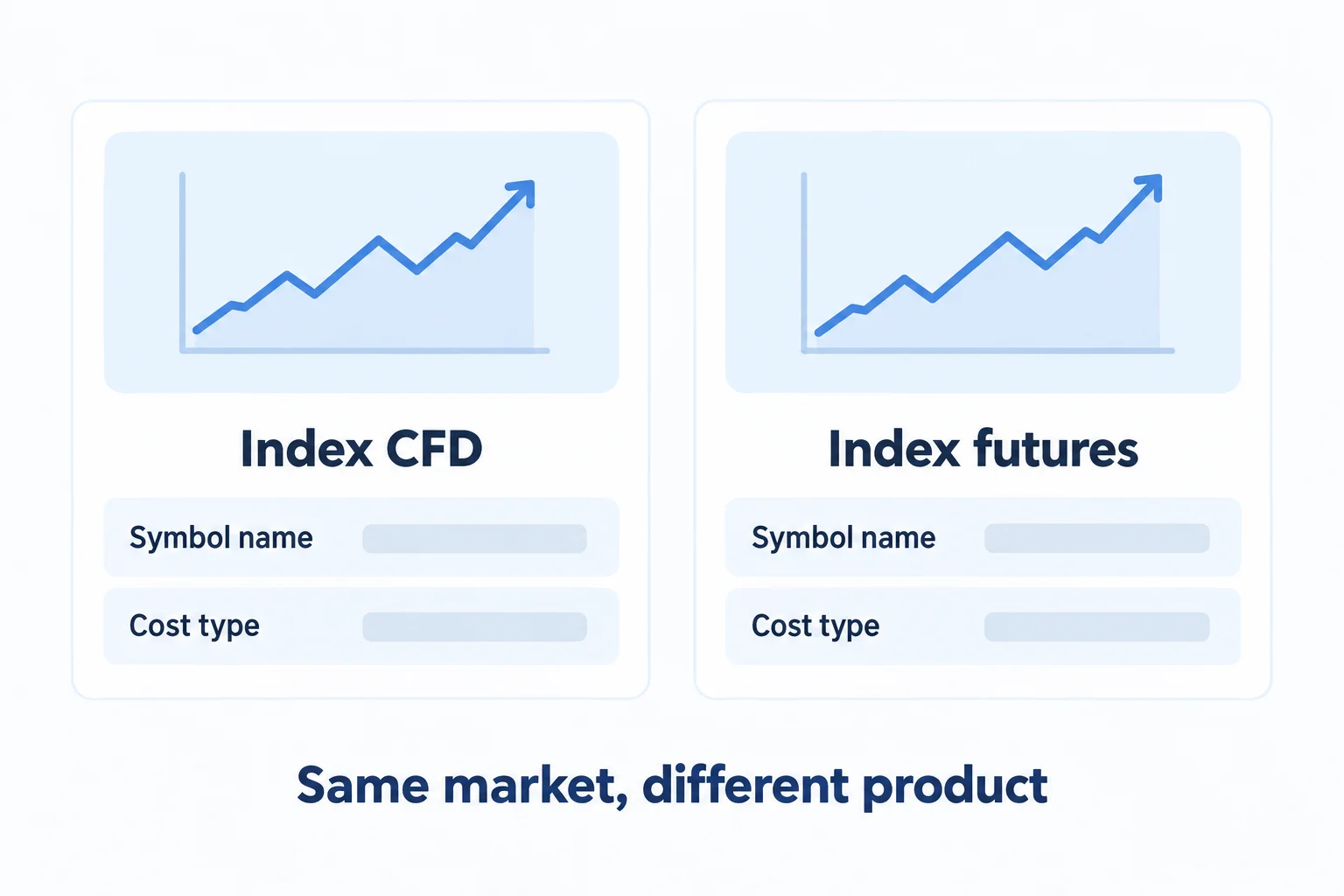
An index CFD and an index future track the same underlying basket of stocks, but the product you trade changes the math on every point of movement. A CFD symbol like NAS100 usually quotes a dollar-per-point value set by the broker (FXIFY’s USTEC.r moves $2 per point on a 10-unit contract per its own instrument table), priced on spread and sometimes a per-lot commission, with no expiry date. A futures contract like NQ tracks the same Nasdaq-100 basket on a listed exchange, with a fixed, published tick value (E8 Markets’ own contract-size note: NAS100-class NQ moves in $5 increments per point on a full contract, $0.50 on the micro MNQ) and a per-side or round-turn commission, and it expires and rolls on a schedule.
Worked example, a 100-point NAS100/NQ move: on FXIFY’s Two Phase Classic, a 100-point move in USTEC.r at a 10-unit contract size is worth $200 before the $6/lot RAW commission. On Topstep’s Trading Combine, the equivalent 100-point move on one full NQ contract is worth $2,000 before the $3.78 round-turn commission, or $200 on the micro MNQ before $1.22. The futures contract moves far more dollars per point because its tick value is fixed by the exchange, not by a broker’s chosen leverage; a trader sizing an index position has to convert between the two conventions rather than assume they behave the same way.
How we checked each prop firm’s index access
For each firm we read the live symbol list, contract specification, or instrument page on the firm’s own site, never a marketing sentence claiming “indices” with nothing behind it. A firm passes only when it names at least one real market index (a CFD symbol such as NAS100/US30/SPX500-class, or a listed index future such as ES/NQ/YM or a micro), that instrument is confirmed tradable at the funded stage and not only during the evaluation, and any index-specific extra cost or restriction (commission, swap, leverage cut, news window, weekend-gap rule) is published, not inferred. A firm that only says “trade indices” with no symbol list, that confirms index access only during the evaluation, or that names only synthetic indices (Boom, Crash, Jump, Step or Volatility-style markets, not a real market index) fails the test and is checked, not ranked. A firm that is not purchasable today (orders paused, checkout down, site unreachable) is also checked, not ranked, with the observed status and date, never called closed without a cited source.
We also cross-checked BestProps’ own device:Indices tag, applied to 23 of 72 firm profiles, against each firm’s live symbol list. The tag is a blanket yes/no with no backing symbol list, and this check found gaps in both directions: FTMO, Topstep and Apex Trader Funding carry no Indices tag at all despite all three confirming live index access, while Blue Guardian and Goat Funded Trader carry the tag despite naming no specific index symbol anywhere on their own sites.
Best prop firms for index CFDs NAS100 US30 and S&P 500
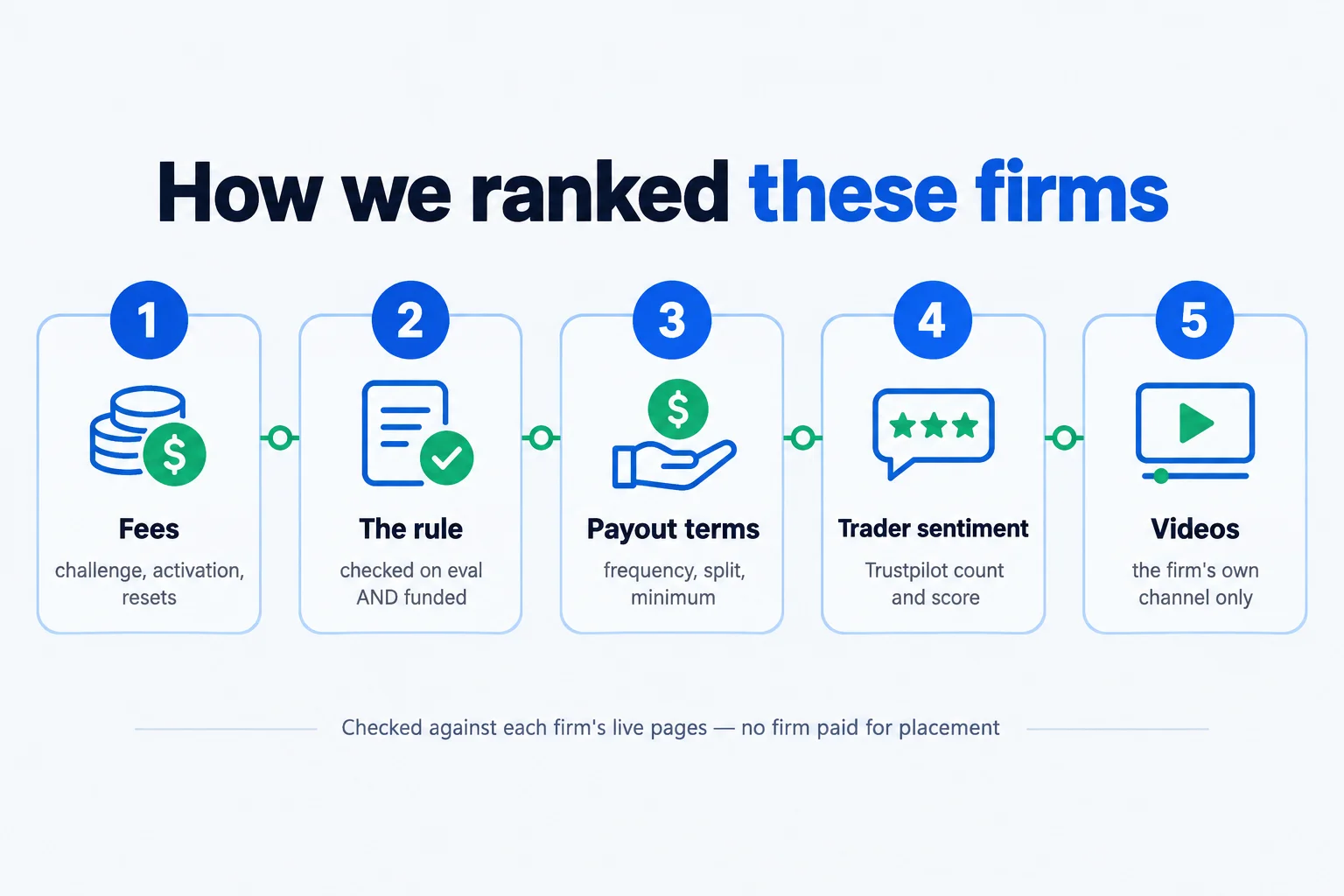
Eleven firms name a real NAS100, US30, or S&P 500-class CFD symbol on their own live pages and confirm it survives to the funded account. They are sorted below by cost per $1,000 of loss room on the cheapest variant that passes the test, computed from each firm’s published LIST price plus any activation fee, divided by the overall max-loss floor in dollars at its smallest stage (never a daily loss limit).
| Firm and product | Index symbols named | At funded stage | Index cost | Index limits | Cost per $1,000 | Live stage |
|---|---|---|---|---|---|---|
| 1. FXIFY Two Phase Classic $50K | USTEC, DJ30, US500 (+10 more) | Yes, one symbol sheet, both stages | $6/lot RAW; All-In no fee | No published leverage cut or news rule | $75.80/$1,000 | No live stage (simulated) |
| 2. FundingPips 2 Step Flex $50K | NDX100, DJI30, SPX500 (+4 more) | Yes, Master-stage leverage notice confirms | $0/lot; swap-free add-on excludes indices | 1:20 leverage (1:5 swap-free) vs 1:100 forex | $49.83/$1,000 | No live stage (simulated) |
| 3. Alpha Capital Group Alpha Pro 10% $50K | NAS100, US30, US500 (+5 more) | Yes, one instrument list, both stages | $0/lot commission, both account types | 1:20/1:10 leverage vs 1:100/1:30 forex | $53.40/$1,000 | Discretionary call-up (decline keeps a payout) |
| 4. FundedNext Stellar Lite $50K | US30, SPX500, NDX100 (+10 more) | Yes, same list on Challenge and Account | Not published (spread or commission figure) | 1:10 indices leverage vs up to 1:30 forex | $57.50/$1,000 | No live stage (simulated) |
| 5. The5ers High Stakes NEW $50K* | NAS100, US30, SP500 (+3 more) | Yes, platform-wide asset list, no stage split | $0 commission; 3x weekend swap on indices | 3x weekend-swap multiplier on index positions | $62.25/$1,000 | Discretionary review (warning, not a disqualifier) |
| 6. FunderPro Classic 2-Phase $50K | NAS100, SPX500, US30 (+6 more) | Yes, funded-only commission names indices | $7/lot once funded; $0 during evaluation | 1:30 leverage; 20% funded margin cap per class | $63.80/$1,000 | No live stage (simulated) |
| 6. Hola Prime 2-Step Prime $50K† | NAS/USD, SPX/USD, U30/USD (+7 more) | Yes, one leverage table spans both stages | $0 commission on indices and crypto | 1:10 indices leverage vs 1:50 forex | $63.80/$1,000 | No live stage on this forex/CFD arm |
| 7. FTMO 1-Step $50K | US100.cash, US30.cash, US500.cash (+2 more) | Yes, one unified symbols API, both stages | 0% commission; symbol-specific swap points | 1:50/1:15 leverage vs up to 1:100/1:30 forex | $71.62/$1,000 | No live stage (simulated) |
| 8. E8 Markets E8 Pro $50K (Classic Markets)‡ | US30, NAS100, SP500 | Yes, leverage confirmed unchanged by stage | No index-specific commission published | 1:15 indices leverage vs 1:30 forex | $72.67/$1,000 | No live stage (simulated) |
| 9. Instant Funding One-Phase Pro $50K | US100(NAS100), US30, SPX500 (+8 more) | Yes, one account used through both stages | ~$2/lot RAW; $0 on Commission-free accounts | Funded-only 1:5 leverage cap (temporary notice) | $106.00/$1,000 | No live stage (simulated) |
| 10. City Traders Imperium 1-Step Challenge $50K | S&P500, NASDAQ, DowJones (+11 more) | Yes, no limitation across funding programmes | $0.50/lot commission on indices | Friday triple swap on indices, not Wednesday | $119.60/$1,000 | Discretionary broker transfer (warning only) |
Notes on this ranking: * The5ers’ own pages disagree on the High Stakes max-loss floor (8% on the live product table vs 10% in a separate drawdown FAQ); this guide ranks on the smaller, more conservative 8% reading ($4,000 at $50K), which gives $62.25 per $1,000 of loss room instead of $49.80 under the 10% reading. † Hola Prime does not publish an activation fee anywhere on its forex/CFD arm, so this guide treats the figure as unconfirmed rather than assuming it is zero. ‡ E8 Markets’ own checkout configurator defaults to a 6% max-loss floor at $50K while a help article preset shows 8%; this guide ranks on the smaller, more conservative 6% reading ($3,000), giving $72.67 per $1,000 of loss room instead of $54.50 under the 8% reading. All figures use each firm’s LIST price plus any published activation fee; FTMO’s euro price is converted at the ECB EUR/USD reference rate of 1.1225 for October 2, 2026.
FXIFY prices the cheapest funded route to USTEC, DJ30 and US500
A single symbol sheet covers every FOREX-plan product at FXIFY, naming USTEC, DJ30, US500 and ten more indices with no evaluation-only carve-out, and the same $6/lot RAW commission applies whether you trade indices or forex. Cheapest funded NAS100/US30/SPX500 route via Two Phase Classic static 10%.
Watch out for: FXIFY does not publish an index-specific commission, swap or news-embargo rule separate from its general FX/metals pricing, so a trader cannot confirm from the page whether indices carry any cost difference at all.
Product priced: Two Phase Classic static 10% evaluation, $379 one-time at $50K. Trustpilot: 4.3 from 6,345 reviews. Read the full FXIFY profile for every other rule.
FundingPips sells the cheapest index-qualifying 50K on this list
FundingPips bundles seven indices, NDX100, DJI30, SPX500, FTSE100, GER40, JP225 and STX50, into the same 41-instrument sheet it sells across every evaluation model, and a help article confirms dynamic leverage was recently applied to Indices specifically on funded Master Accounts. Cheapest funded NDX100/DJI30/SPX500-class route on FundingPips’ own 5-asset-class symbol list.
Watch out for: Indices carry a meaningfully lower leverage cap than forex (1:20 vs 1:100 standard), plus an unpublished dynamic-leverage adjustment on indices at the Master stage, and the Swap-Free add-on does not cover indices at all.
Product priced: 2 Step Flex, $299 one-time at $50K, 12% static floor. Trustpilot: 4.5 from 69,734 reviews. Read the full FundingPips profile for every other rule.
Alpha Capital Group names eight indices at zero commission
Eight Cash Indices sit on Alpha Capital Group’s own Trading Symbols page, NAS100, US30, US500, GER30, UK100, JPN225, EUSTX50 and HK50, and the firm’s help center states plainly that indices are commission-free across both of its account types. Cheapest funded NAS100/US30/US500 route among this firm’s $50K variants, commission-free on indices.
Watch out for: Indices trade at a cut leverage (1:20/1:10) against FX at 1:100/1:30, and the same 5-10 minute high-impact-news window and 2% max-risk-per-asset rule apply to index trades as to everything else.
Product priced: Alpha Pro 10% 2-Step, $267 one-time at $50K, 10% static floor. Trustpilot: 21,810 reviews, score hidden. Read the full Alpha Capital Group profile for every other rule.
FundedNext names the widest index list on this list before cost
Thirteen index symbols sit under FundedNext’s “Indices and Commodities” heading, US30, SPX500, NDX100, AUS200, UK100, GER30, JP225 and more, and a help article requires traders to keep using the same asset classes after funding as they used to pass the challenge, which locks in continuity rather than narrowing the list. Cheapest multi-index CFD evaluation per dollar of loss room among FundedNext’s own products.
Watch out for: No index-specific spread, commission table or news-embargo window was found anywhere on the firm’s own pages, only a general Indices 1:10 leverage figure.
Product priced: Stellar Lite, $229.99 one-time at $50K, 8% static floor. Trustpilot: 4.5 from 80,485 reviews. Read the full FundedNext profile for every other rule.
The5ers charges zero commission on NAS100 but triples the weekend swap
The5ers’ own asset-specifications page prices NAS100 at $0 commission with a note reading “carrying over the weekend is allowed but involves high swap costs”, and a live-verified NAS100 row shows exactly that: a 3x swap multiplier applied only when a position is held into the weekend. Funded-stage NAS100/US30/SP500/DAX40/UK100/JPN225 access on a static-floor $50K account with $0 commission on indices.
Watch out for: The firm’s own pages disagree on the High Stakes max-loss floor value (8% on the live product table vs 10% in a separate drawdown FAQ); this guide ranks on the smaller, more conservative 8% reading, which raises the cost per $1,000 of loss room.
Product priced: High Stakes 2-Step NEW, $249 one-time at $50K. Trustpilot: 4.7 from 38,828 reviews. Read the full The5ers profile for every other rule.
FunderPro ties a 20% margin cap specifically to its Indices group
A FunderPro commission article states plainly that commissions apply only once an account is funded, and indices are billed as their own class at $7/lot, confirming NAS100, SPX500 and US30 trade on the funded account, not just during the Classic 2-Phase evaluation. Cheapest funded NAS100/US30/SPX500 route at $50K on cost per $1,000 of loss room.
Watch out for: Index trading at FunderPro carries its own 20% margin cap once funded (first breach deducts profit with a warning, second breach fails the account) and a $7/lot commission against $5/lot for forex, both invisible during the free-margin evaluation phase.
Product priced: Classic 2-Phase, $319 one-time at $50K, 10% static floor. Trustpilot: 1,560 reviews, score hidden. Read the full FunderPro profile for every other rule.
Hola Prime lists eleven indices under live MT5 price feeds
Hola Prime’s live MT5 price feed names eleven index symbols under its own non-standard tickers, NAS/USD, SPX/USD and U30/USD among them, each refreshing every five seconds, and a leverage table ties Indices at 10:1 into the same rules document that governs the funded, Sim.-Funded stage. Cheapest verified NAS100/US30/SPX500-class index access on MT5 with zero index commission.
Watch out for: Leverage on indices is capped at 10:1 against 50:1 on forex pairs, and the forex arm’s activation fee is not published anywhere; this guide’s cost figure treats it as unconfirmed rather than assuming zero.
Product priced: 2-Step Prime, $319 one-time at $50K, bi-weekly 80% split. Trustpilot: 4.5 from 3,879 reviews. Read the full Hola Prime profile for every other rule.
FTMO’s own symbols API names five index CFDs at zero commission
FTMO’s public symbols API, not a marketing page, lists US30.cash, US100.cash, US500.cash, UK100.cash and US2000.cash with a 0% commission flag on every row, and the same API feeds both the Challenge and the funded FTMO Account. Cheapest funded NAS100/US30/SPX500-equivalent CFD route among the most reviewed global brands.
Watch out for: Index CFDs carry lower leverage than FX pairs (1:50 standard/1:15 swing against up to 1:100/1:30), and funded Standard accounts may not trade an affected instrument for 2 minutes either side of a high-impact release.
Product priced: FTMO Challenge 1-Step, list EUR319 one-time at $50K (EUR/USD 1.1225, October 2, 2026) = $358.08. Trustpilot: 4.8 from 53,448 reviews. Read the full FTMO profile for every other rule.
E8 Markets sells both a CFD and a futures route to the same three indices
On its Classic Markets side, E8 names US30, NAS100 and SP500 with exact per-lot dollar values (a 1-dollar move in SP500 is worth 20 dollars per lot), and the firm’s own leverage article confirms the rate “won’t change” once a trader moves from the Simfi Challenge into the Simfi Performance Stage. A CFD-style route to US30, NAS100 and SP500 with a higher per-lot dollar value than its own futures line.
Watch out for: E8’s own checkout configurator defaults to a 6% max-loss floor at $50K while a help article preset shows 8%; this guide ranks on the smaller, more conservative 6% reading. Indices also run at a reduced 1:15 leverage against 1:30 on forex.
Product priced: E8 Pro, $218 one-time at $50K, 6% configurator-default floor. Trustpilot: 3,298 reviews, score hidden. Read the full E8 Markets profile for every other rule.
Instant Funding currently cuts funded index leverage to one-fifth
Instant Funding groups its index list into “6 Major Indices” and “7 Minor Indices”, naming US100(NAS100), US30 and SPX500 among the majors, on one account that carries through from the One-Phase evaluation into the funded stage with no platform switch. Cheapest funded NAS100/US30/SPX500 CFD route among evaluation-model firms at $50K.
Watch out for: A live temporary notice caps leverage on indices (plus metals and oil) at 1:5 on funded accounts only, tighter than the evaluation-stage 1:20 figure, and this cut is not restated on the instrument sheet itself.
Product priced: One-Phase Pro, $424 one-time at $50K, 8% static floor. Trustpilot: 4,372 reviews, score hidden. Read the full Instant Funding profile for every other rule.
City Traders Imperium names the longest list of indices here
A CTI help article dated August 5, 2026 lists fourteen index symbols, S&P500, NASDAQ, DowJones, DAX, FTSE100 and ten more, and states outright that traders are “free to trade any instrument available on our platform across all our funding programs, no limitations.” Broad major-index CFD access (14 named indices) with no limitation between evaluation and funded stages.
Watch out for: Indices and crypto carry the triple-swap charge on Friday instead of the Wednesday day other instruments use, so an overnight index position held into the weekend costs more than a mid-week hold.
Product priced: 1-Step Challenge, $299 one-time at $50K, 5% trailing floor. Trustpilot: 4.2 from 1,627 reviews. Read the full City Traders Imperium profile for every other rule.
Best prop firms for index futures ES NQ YM and micros
Four firms confirm real CME-listed index futures, ES, NQ, YM, RTY, and their micro-sized equivalents, tradable from evaluation through to a funded account. Futures firms price per round-turn contract commission rather than spread, so the same cost-per-$1,000 metric applies to a different unit of cost.
| Firm and product | Index symbols named | At funded stage | Index cost | Index limits | Cost per $1,000 | Live stage |
|---|---|---|---|---|---|---|
| 1. Topstep Trading Combine $50K | ES, NQ, YM, RTY (+4 micros) | Yes, one product list, Combine to Funded | $3.78 ES round turn; $1.22 MES round turn | No index-only news window; day session rule | $47.50/$1,000 | Discretionary, cannot decline (warning only) |
| 2. Apex Trader Funding EOD Trail Standard $50K | ES, NQ, YM, EMD, RTY (+4 micros) | Yes, same table at the Performance stage | $1.99-3.98 round turn per contract (Rithmic) | Combined contract cap, not index-specific | $359.50/$1,000 | Discretionary (decline keeps $3,000, warning only) |
| 3. E8 Markets E8 Zero Starter $50K (Futures) | ES, MES, NQ, MNQ, YM, MYM (+2 more) | Yes, same contract specs, Challenge & Performance | $2.58 ES round turn; $0.78 MES round turn | Forced flat daily 15:10 CT; bots banned | $118.67/$1,000 | No live stage (simulated) |
| 4. Purdia 50K EOD Instant Funded | ES, MES, NQ, MNQ, RTY, M2K, YM, MYM | Yes, same table, Evaluation through LFA | $5.76 ES/NQ/YM/RTY round turn; $1.82 micros | Broker can raise margin up to 400% around news | $366.00/$1,000 | Rule-triggered at $10,000 profit (warning only) |
Notes on this ranking: index futures price in per-contract round-turn commission, not spread, so the cost-per-$1,000 figure reflects each firm’s evaluation or instant-funding fee plus any activation fee over its smallest published max-loss floor at $50K, never a daily loss limit. Apex Trader Funding also sells an Intraday Trail Standard product at a lower sticker price, but that product’s floor trails open positions intraday rather than at end of day, so it is named here for context and not ranked above the EOD product.
Topstep is the cheapest route to ES, NQ, YM and RTY on this list
TopstepX names ES, NQ, RTY and YM plus their four micros under one “every tradeable CME Group product” article that covers the Trading Combine, the Express Funded Account and the Live Funded Account alike, with no separate funded-stage instrument list anywhere on the site. Cheapest funded route to full ES/NQ/YM index futures and their micros on a single platform.
Watch out for: There is no index-specific cost or news-window rule; the real watch-out is the day-trading-only session (flat by 3:10pm CT) and a discretionary, non-declinable live call-up with a published 0.71% promotion rate in 2025, named here as a warning, not a reason this product fails the indices test.
Product priced: Trading Combine, No Activation Fee path, $95/month at $50K. Trustpilot: 3.6 from 14,892 reviews. Read the full Topstep profile for every other rule.
Apex also trades European index futures, Tradovate only
Apex’s own instrument and commission table names ES, NQ, YM, EMD and RTY (plus their micros) with exact per-side pricing on both its Rithmic and WealthCharts routes, and even adds EUREX contracts like DAX and Euro Stoxx 50 futures, though those are published as Tradovate-route only. The full standard CME equity-index futures set (ES/NQ/YM/EMD/RTY) and their micros at both stages on a one-time-fee product.
Watch out for: No BestProps Indices tag exists on Apex’s profile despite the firm naming the full ES/NQ/YM/RTY set live, and EUREX European index futures (DAX, Euro Stoxx) are only available on the Tradovate route, not Rithmic or WealthCharts.
Product priced: EOD Trail Standard, $590 + $129 activation at $50K. Trustpilot: 4.2 from 21,181 reviews. Read the full Apex Trader Funding profile for every other rule.
E8’s futures line force-closes every index position by 1510 CT
E8’s futures help center publishes a per-contract commission table for ES, MES, NQ, MNQ, YM and MYM that applies identically to the Simfi Challenge and the Performance Stage, with one rule tied specifically to every position on the line: a mandatory flat close at 15:10 CT daily. Micro or mini index futures (MES/MNQ/MYM or full ES/NQ/YM) with a published per-contract commission.
Watch out for: Every index position is force-closed daily at 15:10 CT, so no overnight index exposure is possible on E8 Zero or Signature Futures, and semi- or fully-automated trading is banned outright on all futures products.
Product priced: E8 Zero Starter, $178 one-time at $50K, 3% EOD-trailing floor. Trustpilot: 3,298 reviews, score hidden. Read the full E8 Markets profile for every other rule.
Purdia names every standard CME index future but no CFD tickers
Purdia’s rules article names ES, NQ, YM and RTY plus their micros (MES, MNQ, MYM, M2K) with exact round-turn commissions under general account-wide rules, not an evaluation-only table, and a separate news-trading article states index-moving releases are “fully permitted” with no blackout at any stage. Trading the standard CME equity-index futures (S&P 500, NASDAQ 100, Dow Jones, Russell 2000, full size or micro) through a Tradovate-routed funded account with no index-specific news blackout.
Watch out for: Purdia names index futures (ES/NQ/YM/RTY and micros), not CFD-style NAS100/US30/SPX500 tickers, and at the live stage the broker can raise margin on these same contracts by up to 400% around FOMC, CPI or NFP, exactly when index futures move most.
Product priced: 50K EOD Instant Funded, $549 one-time. Trustpilot: 3.8 from 88 reviews. Read the full Purdia profile for every other rule.
Prop firms checked for indices but not ranked
Two firms market an “indices” category with no symbol list behind it, and two firms are not currently purchasable. All four are checked and dated below rather than silently dropped.
| Firm | Date checked | Why it is not ranked |
|---|---|---|
| Blue Guardian | Checked October 3, 2026 | Names only “Indices”; no NAS100/US30/SPX500 symbol found. |
| Goat Funded Trader | Checked October 3, 2026 | States only “CFD indices”; no index symbol named anywhere. |
| FundingTicks | Checked October 3, 2026 | In wind-down; not purchasable, so not index-tested. |
| The Funded Trader | Checked October 3, 2026 | Every host returns HTTP 402; not purchasable, not index-tested. |
Blue Guardian (Checked October 3, 2026)
Blue Guardian’s Platform Rules article prices “Indices” at $0 commission and 1:10 funded-stage leverage as one of four asset-class categories, alongside Forex, Gold and Commodities, and Cryptocurrencies. No page, help article or search result names a single real index symbol, so a reader cannot confirm from the firm’s own site whether NAS100, US30 or S&P 500 specifically is included.
Goat Funded Trader (Checked October 3, 2026)
Goat Funded Trader’s commission article says indices trade at a flat $0 per lot alongside crypto, commodities and stocks, but neither that article nor the firm’s instruments page backs the claim with a symbol list. This guide did not use the firm’s own blog post on indices, since that post is itself a page-one search competitor for this exact topic, not firm evidence.
FundingTicks (Checked October 3, 2026)
FundingTicks’ homepage carries a wind-down notice reading, in part, “trading activity has been halted” and “all active Evals and Master accounts will be refunded in full, irrespective of profit or drawdown status.” No buy or start-challenge button exists anywhere on the site.
The Funded Trader (Checked October 3, 2026)
thefundedtrader.com, www.thefundedtrader.com and dashboard.thefundedtrader.com all returned the same HTTP 402 error on the date checked, and app.thefundedtrader.com did not resolve at all. No independent closure announcement was found, so this guide states the observed status and date rather than calling the firm closed.
Synthetic indices explained for prop traders
Synthetic indices (Deriv-style Boom, Crash, Jump, Step and Volatility series) are not real markets. They are continuously generated price feeds built on a published algorithm, not a basket of listed company shares, and they trade around the clock including weekends because there is no underlying exchange to close. None of the 18 firms checked for this guide name a real market index built only from synthetic instruments, though a trader can make or lose money on a synthetic index the same way as any other priced instrument, the price simply tracks a published algorithm instead of company earnings, economic data, or the stocks inside S&P 500, NAS100 or US30. A reader searching specifically for “indices” in the retail CFD sense (NAS100, US30, SPX500) or the futures sense (ES, NQ, YM) is asking about a different, exchange-linked product than a synthetic index, and the two should not be confused when comparing firms.
Index trading rules every prop firm trader should watch
- Leverage is usually cut on indices.