Key takeaways
ICT’s July 5, 2020 Part 1 of 4 is a chart-free lesson on trading discipline, emphasizing independent judgment, predefined percentage risk, limited trade frequency, protected family time, and patient documentation of one approach.
Read the full summary
ICT’s July 5, 2020 Part 1 of 4 is a chart-free lesson on trading discipline, emphasizing independent judgment, predefined percentage risk, limited trade frequency, protected family time, and patient documentation of one approach. He recounts losing roughly half his account overnight in an orange-juice options trade and advises defining the setup, invalidation, holding period, and maximum risk before entry, never widening stops, trading merely because markets are open, converting short-term trades into long-term positions, or continuing after an unusually profitable day or week. He recommends ignoring external approval, avoiding dependence on gurus, signal services, lifestyle marketing, and social-media reactions, scheduling periods without charts or market news, matching trading style to personality, selecting one asset class and one market, writing exact long and short criteria, journaling successful and failed examples, and learning through observation, paper trading, or a demo account before risking live funds. Part 2 is previewed as covering optimal trade entry, but Part 1 focuses solely on behavior, risk control, consistency, patience, and preserving life outside trading.
How we researched this article
BestProps used document-based research from primary firm sources, checked September 25, 2026. The complete source list, scope, limitations, and commercial-state record appear near the end of this article.
What ICT Covers in Part 1
In “If I Could Go Back & Tell Myself What I Know Now… Part 1 of 4”, uploaded July 5, 2020, ICT frames the lesson as a hypothetical conversation with his younger self. This installment is intentionally not chart-based. Instead, he reflects on the behavioral, financial, and personal mistakes he says shaped his early trading development.
The discussion is less about finding an entry pattern than about building the conditions under which a person can study and make decisions responsibly. Its recurring themes are independence, risk control, patience, consistency, and protecting life outside the markets.
What ICT Would Tell Traders About Seeking Approval
ICT’s first lesson begins at 4:53: do not base a trading pursuit on approval from family, friends, co-workers, or strangers. He recounts telling people about his ambitions and then becoming discouraged or distracted by their reactions.
His broader point is that trading decisions (and responsibility for their consequences) cannot be outsourced. At 11:49, he argues that depending on praise or reassurance makes it harder to withstand disagreement and losses. His suggested alternative is to evaluate progress through personal study, acknowledge mistakes, and allow development to take time.
What ICT Would Tell Traders About Risk Management
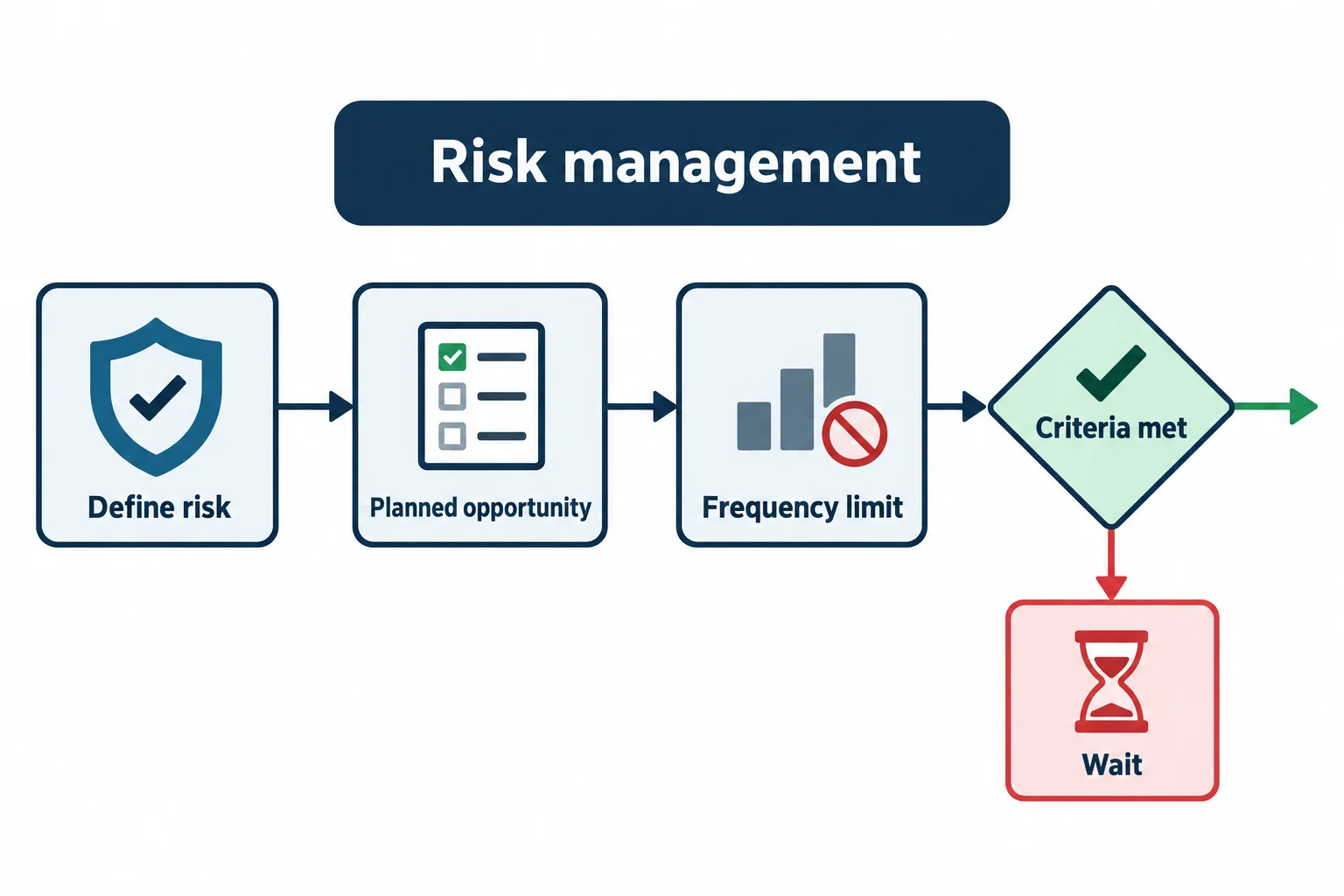
At 13:08, ICT turns to risk management. He describes an early orange-juice options trade that, according to his account, lost roughly half of his account overnight. The transcript provides his recollection, not brokerage records or independently verified results, but the story illustrates the lesson he wants viewers to retain: losses are possible immediately, even when a book or setup creates confidence.
Several practical principles follow:
- Think in percentages, not just dollars. At 15:53, he explains that a dollar loss can look modest while representing a damaging share of a small account.
- Define risk before entering. He recalls using extremely wide stops or mental stops while unable to monitor the market consistently.
- Limit trade frequency. Beginning at 18:16, he describes repeatedly entering because the market was open, rather than because a planned opportunity existed.
- Do not change the holding period mid-trade. At 20:08, he warns against turning a short-term trade into a long-term position after becoming attached to an unrealized gain.
- Know when enough is enough. He suggests that continuing to trade after an unusually good day or week can lead to giving gains back.
These are ICT’s interpretations from his experience, not proof that a particular method has an edge. The educational takeaway is narrower: write down the intended setup, invalidation, holding period, and maximum acceptable risk before exposure can influence the decision.
What ICT Would Tell Traders About Family Time
The most personal section starts near 24:26. ICT says his focus on markets, businesses, and money caused him to miss time with his wife and children. He rejects his former justification that constant market attention was necessarily “for” his family.
His proposed safeguard is scheduling. At 28:27, he recommends reserving family periods in which charts, market news, reports, and social media are off limits. He then extends that structure to study and trading: decide in advance when each activity occurs, and treat off days as genuinely off.
What ICT Would Tell Traders About Independent Decisions
From about 33:48, ICT criticizes indiscriminate spending on trading books, tools, gurus, and signal services. He mentions a small group of books and authors he personally found useful, but he also makes sweeping claims about “retail” material that the video does not test or substantiate.
The more supportable lesson is his warning about codependence. Around 37:29, he says copying another person’s trades prevents a learner from understanding why a decision was made. Later, at 41:49, he describes how online reactions caused him to alter targets and surrender control of his original plan.
He similarly cautions against lifestyle marketing and comparing results with social-media personalities. Claims in this section about other traders, public records, or the authenticity of displayed wealth are ICT’s assertions and are not independently established by the transcript.
What ICT Would Tell Traders About Documenting One Approach
ICT closes with a more concrete development framework. At 52:38, he recommends matching trading style to personality rather than copying a mentor’s style. He then argues against repeatedly abandoning a method after a few losses.
His proposed starting process appears at 55:54:
- Select one asset class and one market.
- Write detailed criteria for potential long and short setups.
- Build a study journal containing examples where the idea appeared to work and where it failed.
- Use observation, paper trading, or a demo account while learning rather than assuming immediate readiness for live funds.
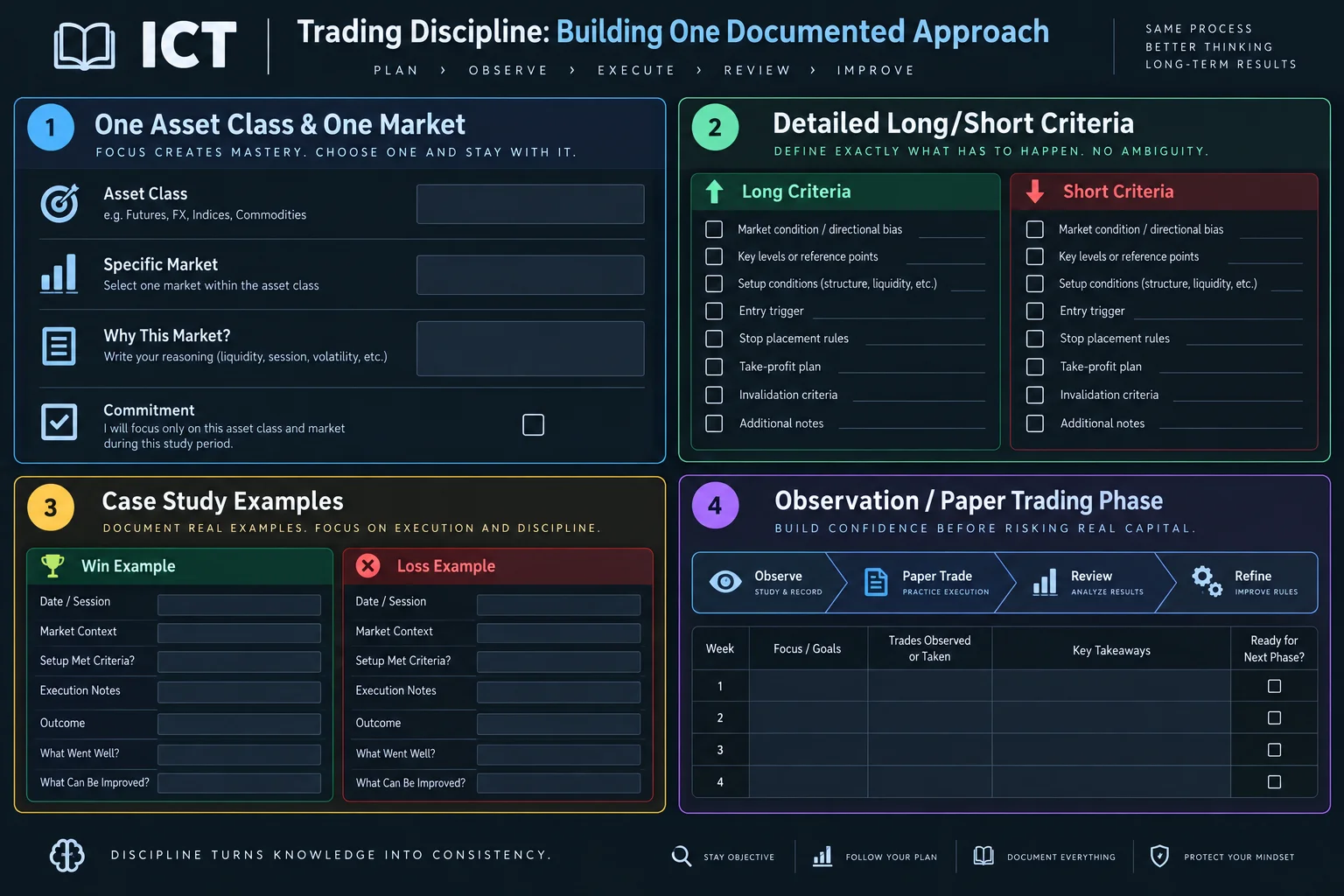
Part 1 therefore serves as a behavioral foundation for the series. ICT previews “optimal trade entry” as the subject of Part 2, but this video itself does not teach that chart setup. Its central message is to reduce external noise, control risk and frequency, preserve personal balance, and develop a documented process patiently. This summary is educational commentary, not investment advice or a promise of trading performance.