Key takeaways
ICT’s Weekly Summary and Discussion from November 10, 2017 teaches that a proposed draw on price and directional thesis should precede any entry pattern.
Read the full summary
ICT’s Weekly Summary and Discussion from November 10, 2017 teaches that a proposed draw on price and directional thesis should precede any entry pattern. Using EUR/USD, ICT measures impulse legs from candle bodies rather than wicks, prefers buying down-close candles and selling up-close candles, and evaluates late entries by checking whether price remains below the referenced swing high, whether the destination remains valid, and whether sufficient room remains for first and second targets or a symmetrical price swing. At 11 minutes, movement beyond the swing high makes the illustrated entry unattractive. Stops protect predefined risk while profit objectives guide management, and a stopped-out USD/CAD execution does not automatically invalidate the broader thesis. ICT says he closed one EUR/USD position near break-even but warns followers not to copy another trader’s exit without understanding its reasoning. For GBP/USD, he interprets visible prior highs or a perceived double top as a possible liquidity pool price may revisit, while cautioning that experience, psychology, execution, and management prevent students from assuming they can reproduce his pip results. The core process is to define context, destination, timeliness, invalidation, staged objectives, and review criteria without chasing price or depending on social media commentary. The session describes demo-account demonstrations and a paid mentorship available at the time, offers no profitability guarantee, and provides no verifiable charts, fills, account size, complete performance record, or independently established trading edge.
How we researched this article
BestProps used document-based research from primary firm sources, checked September 25, 2026. The complete source list, scope, limitations, and commercial-state record appear near the end of this article.
In Weekly Summary & Discussion – 11/10/17, uploaded November 10, 2017, ICT reviews several currency-market examples while emphasizing a broader lesson: an entry pattern is of limited value unless the trader first has a reasoned view of where price may be drawn. The discussion also covers entering after a move has begun, managing exits, accepting stopped-out ideas, and learning to make decisions without copying a commentator.
This is an educational summary of ICT’s interpretations and terminology, not verification of a trading edge. The transcript describes charts that are not available for independent inspection here, so exact levels, entries, fills, and outcomes should not be inferred from the audio alone.
ICT Discussion of When an Entry Is Too Late
At 1:40, ICT frames the week around a practical question: if a trader misses the preferred entry because of work, family, or another interruption, can the idea still offer a reasonable opportunity?
Using EUR/USD as his example, he describes measuring an impulse leg from candle bodies rather than wicks and locating what he calls an “optimal trade entry.” His stated preference is to buy while price is moving down and to sell while it is moving up, rather than reacting after price has already accelerated in the intended direction. These are ICT’s execution rules and interpretations; the recording does not establish that institutions universally transact according to the same framework.
The key distinction appears at 4:11: ICT argues that traders often concentrate on obtaining an exact entry price before determining the expected destination. In his framework, the proposed “draw on price” (a level or liquidity area he believes price may seek) comes first. The entry technique is then used to express that directional thesis.
How ICT Handles a Late Entry
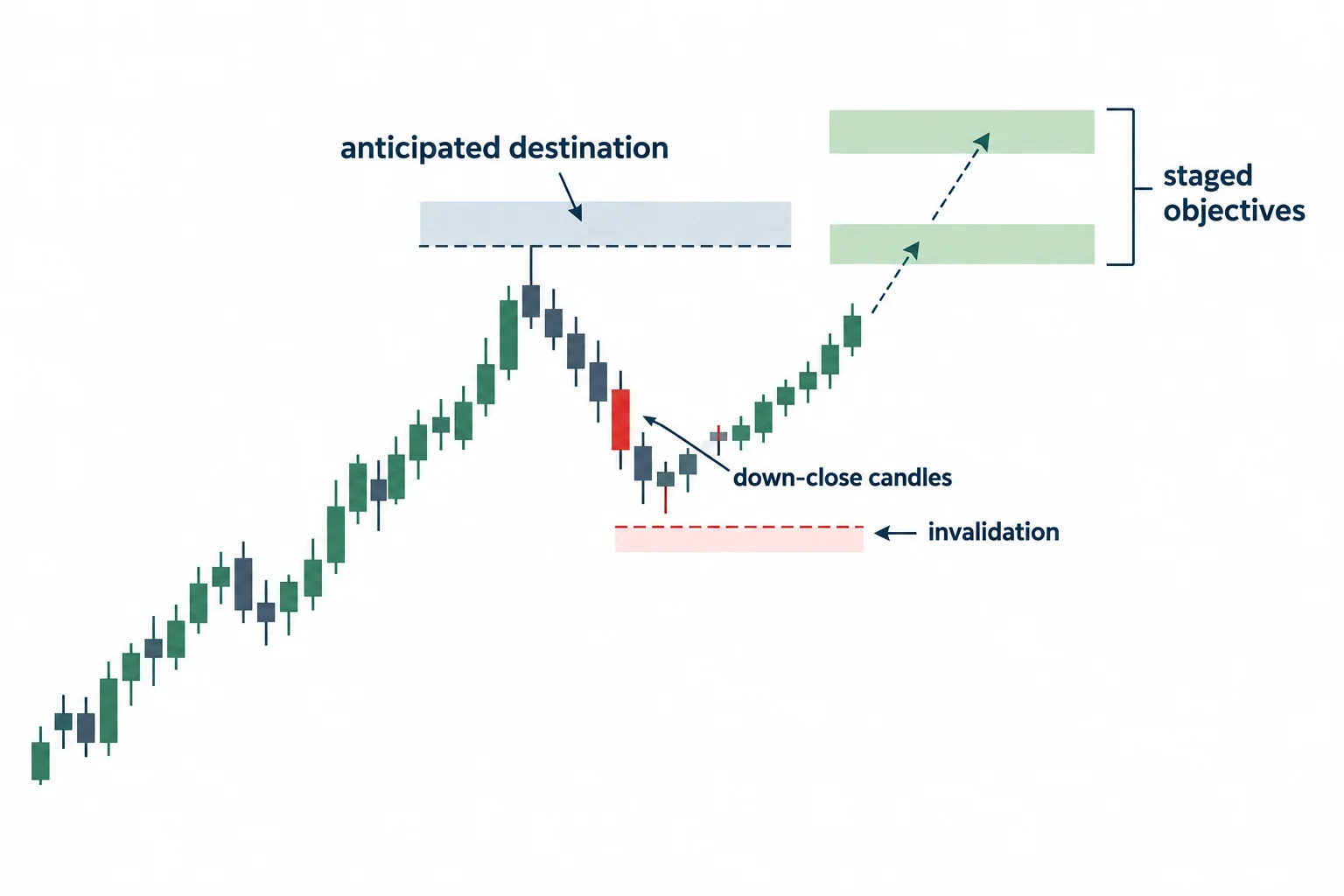
Beginning around 8:42, ICT explains that he intentionally used the week’s EUR/USD discussion to illustrate a late-entry problem. He says there will be occasions when the ideal setup has already occurred before a trader reaches the chart. In that situation, he considers whether price remains below a previously identified swing high and whether the original destination is still relevant.
- Start with context: Define the anticipated destination before searching for an entry.
- Avoid reflexive chasing: ICT says his long entries were associated with down-close candles rather than buying solely because price was rising.
- Identify invalidation: A later entry is not automatically acceptable merely because the directional forecast remains unchanged.
- Use staged objectives: He mentions looking for a first and second target, with possible extension toward a symmetrical price swing or another identified objective.
At 11:00, he identifies movement beyond a referenced swing high as the point at which he would no longer regard that particular entry as attractive. Because the chart cannot be verified from the transcript, this should be understood as a description of his reasoning rather than a reproducible setup with known prices.
ICT Entry Management and Direction Invalidation
ICT says he closed one EUR/USD position around break-even, then observed that some followers apparently exited only because he did. At 15:49, he turns this into a lesson about dependence: another person’s exit does not necessarily invalidate the analysis that originally justified a trade.
He also discusses the role of a stop at 13:15. In his account, the stop is protection, while his attention remains on the profit objective. If the stop is reached, he says it has performed its protective function. Later, while reviewing USD/CAD, he explicitly reports being stopped out and argues that one failed entry did not automatically erase the larger market thesis.
This is one of the more useful general educational distinctions in the session: an individual execution can fail even when a broader directional idea remains under consideration. Conversely, retaining a directional opinion does not justify ignoring predefined risk. The transcript provides no account size, verified fill data, or complete performance record from which to assess the financial impact of the examples.
ICT Discussion of GBP/USD Direction and Liquidity
At 21:06, ICT moves to GBP/USD, commonly called “cable.” He says prior highs could be perceived by retail participants as resistance or a double top. His interpretation is that orders accumulating around such visible highs can form a liquidity pool that price may revisit after a buying opportunity.
He presents this alongside a short-term scalping approach. However, he directly warns listeners not to extrapolate his reported weekly activity into an expectation that they can reproduce a particular pip total. At 22:27, he says differences in experience, psychology, execution, and management will lead to different results.
Independent Thinking for Better ICT Entry Decisions
The strongest recurring theme is independence. ICT cautions that social media can cause traders to replace their own analysis with the opinion of someone they respect. He argues that copying an entry or exit creates dependency without revealing the other person’s full reasoning, emotional state, or changing assumptions.
At 17:51, he asks what happens when the commentator stops publishing. His preferred outcome is for students to recognize setups, document observations, and make decisions without needing continuing confirmation. He also says experience cannot be transferred instantly: tutorials may provide concepts and structure, but learners still need sustained chart study and practice.
ICT Entry Practice and Discussion Limits
Near 30:20, ICT discusses his paid mentorship as it was offered at the time and distinguishes his public educational material from live-account advice. He states that his demonstrations use a demo account, that profitability is not guaranteed, and that demo trading cannot generate or lose real money. Historical pricing and enrollment details in the video should not be assumed to remain current.

For study purposes, the session can be reduced to a process: form a directional hypothesis, identify the proposed draw on price, define conditions under which an entry is still timely, establish invalidation and objectives, and review the decision without outsourcing responsibility. Those ideas are presented as ICT’s market framework, not as proven facts or a promise of results.