Key takeaways
ICT recommends rebuilding trading education by limiting attention to one or two closely related markets, mastering one repeatable setup, accepting a potentially years-long learning process and using explicit binary rules for entry, waiting, stops and profit-taking.
Read the full summary
ICT recommends rebuilding trading education by limiting attention to one or two closely related markets, mastering one repeatable setup, accepting a potentially years-long learning process and using explicit binary rules for entry, waiting, stops and profit-taking. At 4 minutes 59 seconds he describes adopting a personal 20-year horizon, at 6 minutes 52 seconds he prioritizes recurring price behavior by day, week and session over indicators, and around 27 minutes 35 seconds he proposes reviewing historical weekly range expansion, formation timing, medium- and high-impact calendar events and variations among examples, then recording observations in a study journal as pseudo experience. At 37 minutes 39 seconds he defines a trading model as a complete routine and selects his optimal trade entry, later described as a 62% to 79% retracement, with higher-time-frame direction, a predefined stop, a simple target and consistent execution. The seasonal lesson at 46 minutes 49 seconds compares 15-year and 40-year average paths for Canadian-dollar futures, highlighting typical strength from roughly March through May and weakness from October through December, with USD/CAD generally showing the inverse. Seasonal tendencies must align with the prevailing higher-time-frame direction and may disappear as conditions change, as acknowledged at 54 minutes 29 seconds. The article stresses that the video provides no formal backtest, verified results, controlled evidence of profitability or universal timeline, so its durable value is a focused study process rather than proof of a trading edge.
How we researched this article
BestProps used document-based research from primary firm sources, checked September 25, 2026. The complete source list, scope, limitations, and commercial-state record appear near the end of this article.
In “If I Had To Restart As A Trader, At 20 Years Old?”, ICT outlines how he says he would rebuild his trading education from square one. The May 6, 2021 video combines advice about attention, study habits and specialization with a lesson on seasonal tendencies.
The central message is not to learn everything at once. ICT recommends narrowing the field to one or two markets, studying one repeatable model and accepting that developing competence may take years. These are ICT’s educational views, not evidence that his methods provide a reliable trading edge.
ICT Restart Advice on Focus and Patience
ICT begins by describing his younger self as eager to trade every market and capture every setup. His first corrective principle is therefore to take control of your attention. In his account, trying to follow numerous assets, systems and commentators diluted his focus and consumed time.
He pairs this with what he calls submission to time. At 4:59, he recalls giving himself a 20-year horizon rather than expecting rapid wealth. That number is his personal framing, not a standard timetable. His broader point is that beginners do not yet know which market, holding period or style will suit them.
He also warns against assembling a strategy from fragments gathered in chat rooms and from multiple educators. Instead, he recommends selecting a limited course of study and allowing enough time to understand it before adding anything else.
ICT Restart Advice on Price Behavior and Failure
At 6:52, ICT recommends concentrating on price action, including recurring behavior by day, week and trading session. He dismisses indicator-based theories because indicators process historical information. That dismissal is ICT’s opinion; the transcript does not provide comparative testing of indicators or price-action methods.
Another theme is learning why traders fail rather than copying isolated winners. ICT argues that a profitable outcome can occur without a sound process, while losing periods reveal weaknesses in expectations, execution and psychology. He emphasizes that individual losses, missed moves and losing streaks are not automatically proof that the entire learning effort has failed.
The practical lesson is to plan for frustration. ICT says beginners may repeatedly feel as though they are making no progress. He rejects the idea that opening a small account should permit someone to leave employment within a few months. Although he later makes optimistic statements about developing self-sufficiency, the transcript supplies no verified results or basis for a universal timeline.
ICT Restart Advice on Backtesting and Specializing
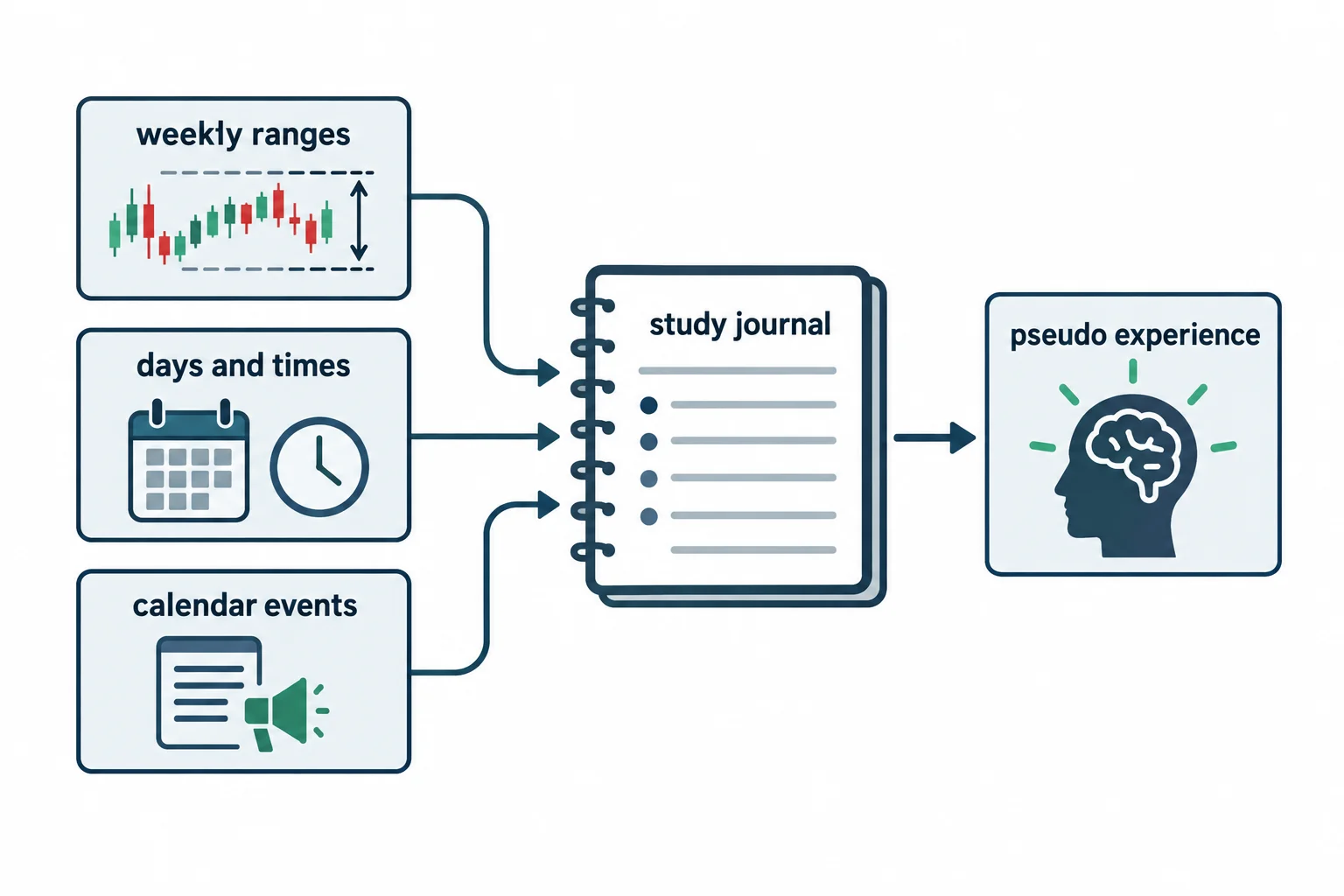
The most actionable study routine begins around 27:35. ICT proposes reviewing historical charts to examine:
- how weekly ranges expanded upward or downward;
- which days and times produced recurring formations;
- whether medium- or high-impact calendar events coincided with those formations;
- how similar examples differed from one another.
He calls this “pseudo experience”: historical review cannot recreate live decisions, but it can build familiarity with recurring structures. He then recommends keeping a study journal containing observations and examples. The video does not present a formal backtest, performance statistics or rules for avoiding hindsight and selection bias, so this should be understood as a study proposal rather than validation.
ICT further recommends becoming a specialist in one market or two at most. He says monitoring too many commodity positions overwhelmed him when he was younger. His preferred alternative is to focus on closely related markets and wait for a defined context rather than seeking a trade every day.
ICT Restart Advice for Building One Trading Model
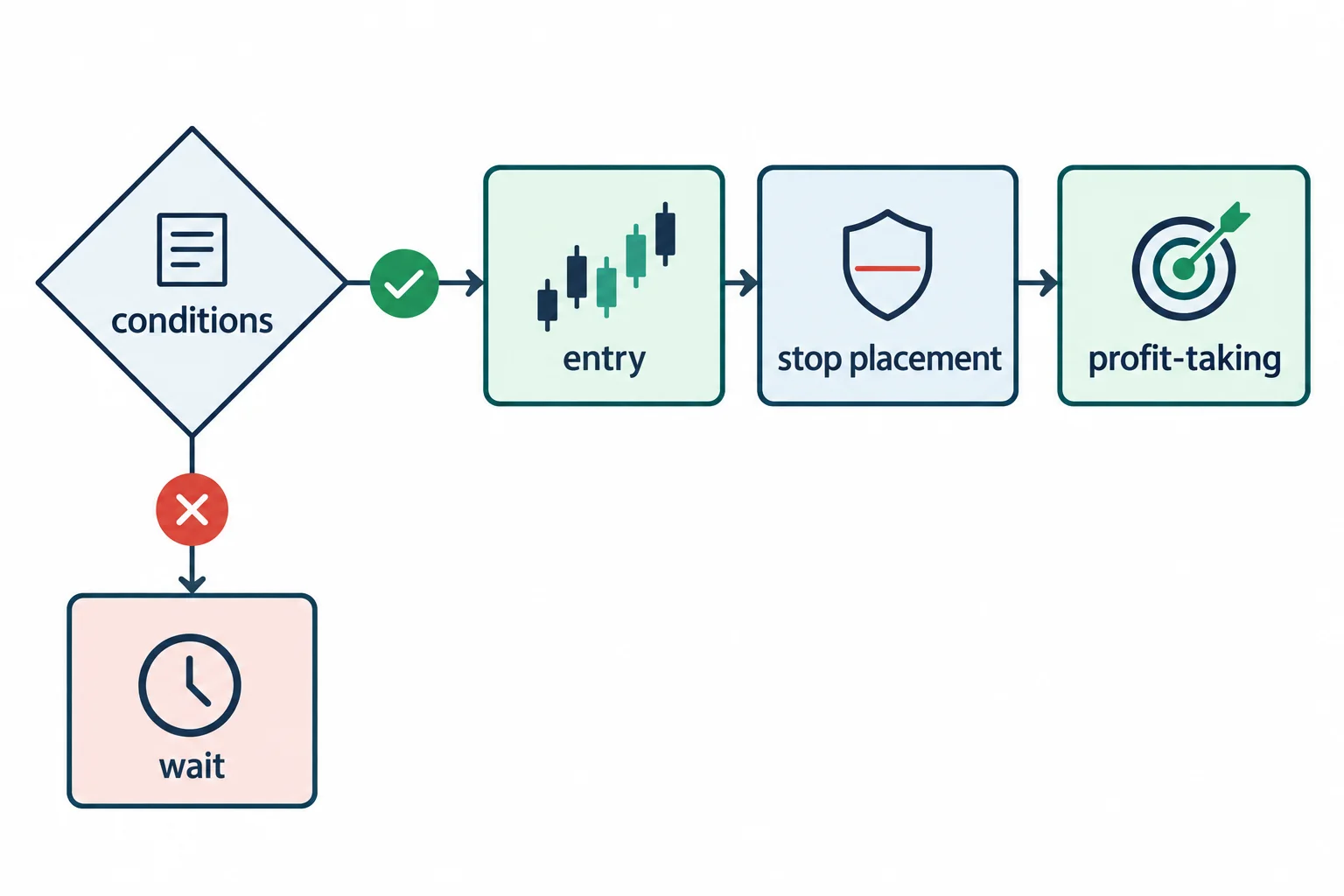
At 37:39, ICT defines a model as a specific routine covering conditions for entry, waiting, stop placement and profit-taking. He favors binary rules (if specified information appears, take the next prescribed step; otherwise, wait).
For a beginner, he suggests:
- one setup rather than a model intended to catch every move;
- a directional framework based on a daily or other higher-time-frame chart;
- a predefined stop and uncomplicated target;
- consistent execution rather than unusually large reward-to-risk claims.
ICT names his “optimal trade entry” as the model he would study first. Later captions describe it using a 62%–79% retracement range, but the video does not establish its profitability through controlled testing. References to probability and profitability remain the speaker’s interpretations.
ICT Restart Advice on Seasonal Tendencies
The chart lesson starts at 46:49. ICT describes a seasonal-tendency chart for Canadian-dollar futures containing 15-year and 40-year average paths. He treats these averages as a contextual roadmap, not as a guarantee that each year will follow the historical pattern.
His example identifies a tendency for Canadian-dollar futures to strengthen from roughly March into May and weaken from around October into December. Because USD/CAD quotes the US dollar against the Canadian dollar, he explains that the forex pair would generally appear as the inverse of Canadian-dollar futures in this comparison.
Crucially, ICT says the seasonal pattern should agree with his assessment of the prevailing higher-time-frame direction. At 54:29, he acknowledges that a seasonal tendency can disappear when market conditions change. He later states explicitly that it is not a magic solution and can still accompany losing trades.
ICT Restart Advice and Educational Context
Stripped of ICT-specific terminology, the video presents a restrained curriculum: reduce information overload, choose a narrow field, document historical observations, formulate explicit rules and recognize uncertainty. Seasonal averages can be treated as hypotheses about recurring behavior, but they require careful out-of-sample evaluation and risk controls before drawing conclusions.
The transcript cannot verify the charts shown, any trades, account results or later outcomes. The durable educational takeaway is therefore the structure of the proposed learning process, not a promise that a particular setup, seasonal window or market narrative will be profitable.