Key takeaways
ICT proposes a study-first restart plan centered on personality fit, one-market specialization, six months of historical review, and repeated journaling rather than immediate demo or live trading.
Read the full summary
ICT proposes a study-first restart plan centered on personality fit, one-market specialization, six months of historical review, and repeated journaling rather than immediate demo or live trading. He would focus on EUR/USD with the dollar as a benchmark, capture each Monday-to-Friday range on hourly charts, mark breaches and rejections of prior highs or lows, inspect the setup on 15-minute charts, and save clean and annotated screenshots with timing, hypothetical risk, adverse movement, and targets. The pattern involves a prior high or low breach, an ICT-defined shift in market structure, and an optimal trade entry retracement during the 8 thirty a.m. to 11 a.m. New York window using 62% and 79% retracement levels. Hypothetical rules include a minimum 10-pip stop, a three-to-one reward-to-risk target, no stop adjustment before a favorable move of 1.5 times initial risk, and possible break-even movement after twice initial risk. ICT distinguishes scalping, day trading, short-term, swing, and position trading, recommends matching the horizon to temperament, and cites The Mental Edge in Trading by Jason Williams. The framework is hindsight-based pattern-recognition practice, not documented profitability research, verified execution, or evidence that targets will be reached, and it remains vulnerable to selection and hindsight bias.
How we researched this article
BestProps used document-based research from primary firm sources, checked September 25, 2026. The complete source list, scope, limitations, and commercial-state record appear near the end of this article.
ICT Trader Restart Priorities
In “If I Had To Restart Again As A Trader, At 20 Years Old – Part 2”, ICT outlines a study-first path built around personality, specialization, historical chart review, and repetition. The lesson is not presented as a documented profitability study. It is ICT’s account of how he believes he could have organized his early development more efficiently.
The central message is to delay the pressure of live decision-making and first learn to recognize a narrowly defined pattern in historical data. ICT recommends concentrating on one market, maintaining a structured journal, and reviewing the same type of setup for six months.
Match the ICT Trader Plan to Your Personality
ICT begins by discussing the relationship between personality and trading style. At 2:04, he distinguishes among scalping, day trading, short-term trading, swing trading, and position trading. He describes himself as quick to change his view and interested in lower-time-frame opportunities, which he says makes short-term and intraday trading a better personal fit than holding positions for months.
This is framed as self-assessment rather than a rule that everyone should day trade. A learner could interpret the broader educational point as follows:
- Consider how frequently you want to make decisions.
- Assess whether long holding periods create unnecessary stress.
- Avoid adopting a style merely because another trader promotes impressive results.
- Choose a study routine compatible with your temperament and available time.
ICT also recommends the book The Mental Edge in Trading by Jason Williams near 0:45. His discussion connects the recommendation to the idea that traders may struggle when their chosen approach conflicts with their personality.
ICT Trader Restart Plan for Market Specialization
At 7:06, ICT advises focusing on one market rather than moving from market to market whenever no setup is available. He recounts switching among commodity markets early in his career and characterizes that behavior as a destructive cycle driven by the desire to remain active.
His proposed alternative is specialization: learn what favorable and unfavorable conditions look like in one instrument, then wait when the desired condition is absent. He compares this with an Olympic athlete concentrating on one event. ICT says he would start with EUR/USD and compare its behavior with the dollar as a benchmark. References in the transcript to relationships between markets reflect his analytical framework and should not be treated as fixed correlations under all conditions.
ICT Trader Restart Plan for a Six-Month Journal
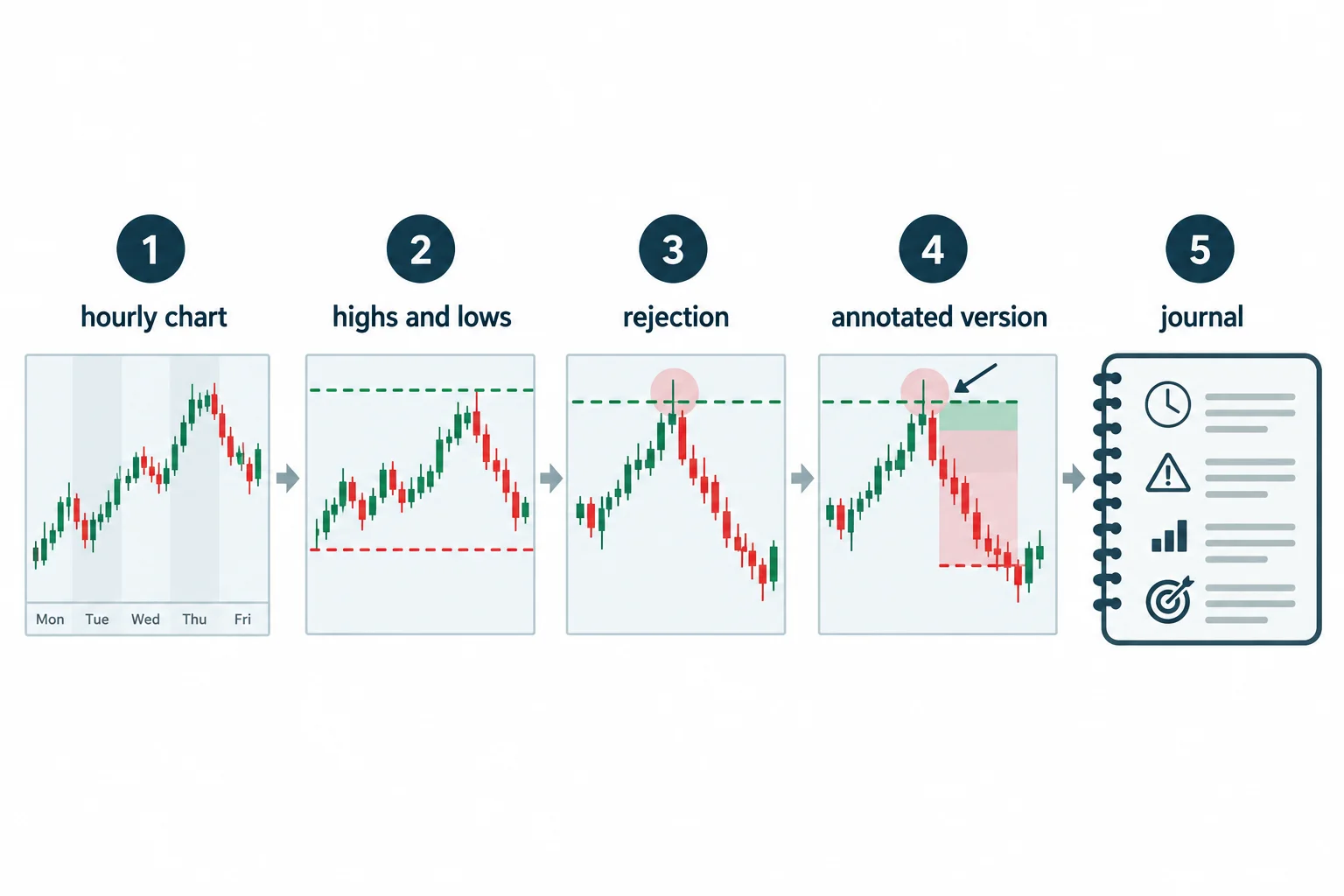
The practical curriculum begins around 10:41. ICT proposes reviewing one market retrospectively for at least six months. His journal process uses:
- An hourly chart showing the full Monday-to-Friday range.
- Previous highs and lows that price traded beyond.
- Evidence of rejection after one of those levels was exceeded.
- A 15-minute chart for closer examination.
- A clean screenshot followed by an annotated version.
- Notes about timing, hypothetical risk, adverse movement, and targets.
He explicitly describes this as after-the-fact analysis, not live or simulated execution. At 18:14, he uses a May 10, 2021 example to demonstrate how he would preserve a “naked” chart and then add annotations. Because the transcript cannot display the chart, its exact price levels and visual markings cannot be independently reconstructed here.
The Trading Pattern in ICT’s Restart Plan
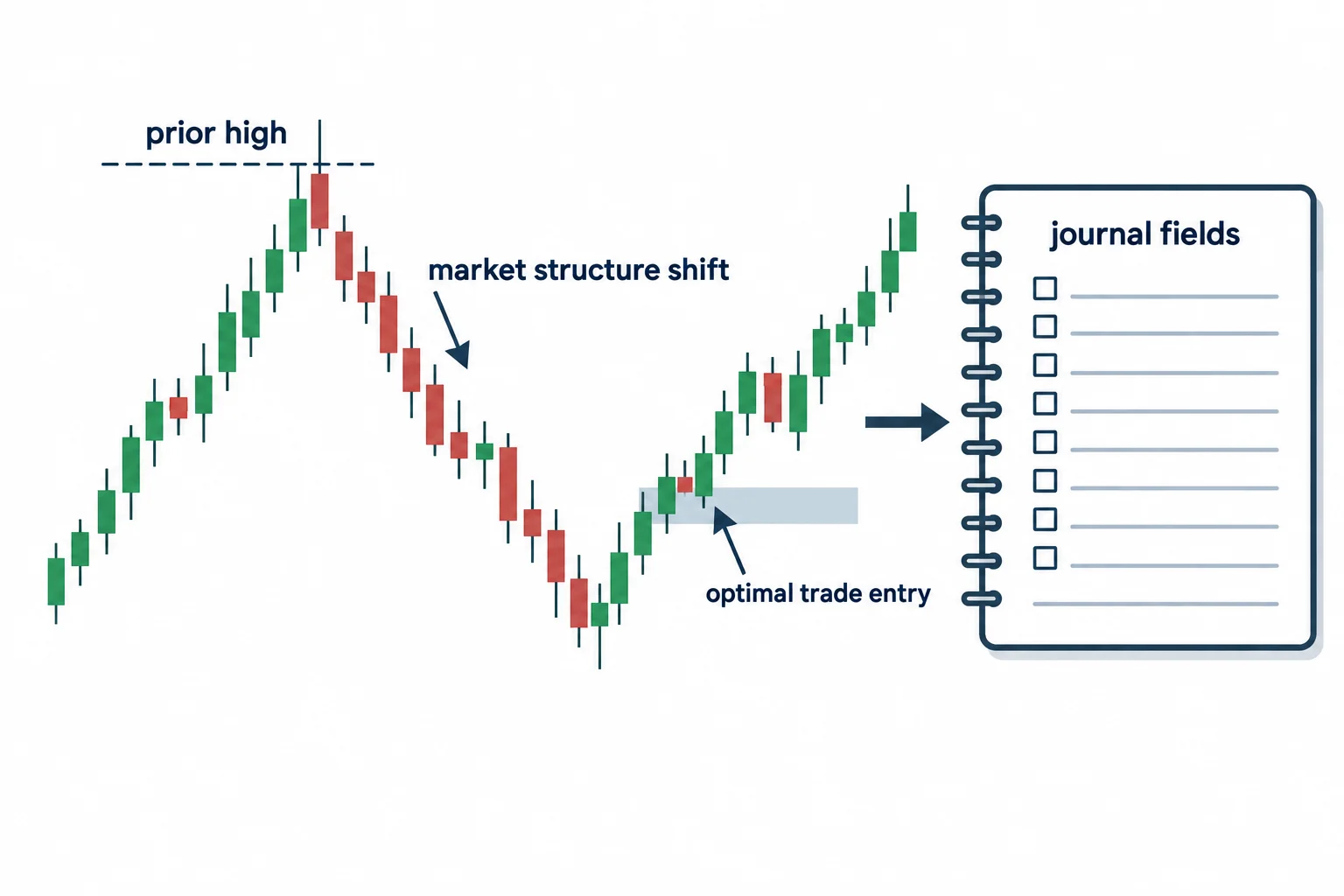
In the example, ICT looks for a prior high or low to be breached, followed by what he calls a “shift in market structure.” He then studies a retracement during the 8:30 a.m. to 11:00 a.m. New York window. Beginning at 20:10, he labels the retracement an “optimal trade entry” and references the 62% and 79% retracement levels.
These are ICT-specific labels and interpretations, not proof that the pattern predicts future prices. A useful general exercise is to define every journal field in advance so that examples are recorded consistently rather than selected or relabeled opportunistically.
For his hypothetical examples, ICT applies a minimum 10-pip stop assumption and discusses seeking a three-to-one reward-to-risk framework. He also says a stop would not be adjusted until price had moved 1.5 times the initial risk in the favorable direction, with a break-even adjustment considered after a move of twice the initial risk. Importantly, at 22:05, he acknowledges that no planned ratio guarantees that the market will reach the corresponding target.
The transcript later gives specific timing and drawdown figures for the displayed hindsight example. Those figures are ICT’s chart annotations, not verified trade fills or evidence of a live result. The captions alone also cannot establish transaction costs, spread behavior, or whether an order would have been executed as assumed.
ICT Restart Plan for Pattern Recognition
The final section explains why ICT favors historical review before demo or live trading. Around 28:11, he argues that hindsight study temporarily removes fear, greed, and the need to be correct. He compares repeated chart annotation with learning to write letters of the alphabet: repetition is initially elementary, but its purpose is recognition.
ICT suggests recording not only the setup but also how long price took to move by specified increments, which weekdays produced examples, and how each day related to the weekly or monthly range. The broader educational value lies in creating a repeatable research routine. However, reviewing historical examples is vulnerable to hindsight and selection bias, so recognition in old data should not be confused with validated forward performance.
ICT Trader Study Plan from Part 2
- Choose a trading horizon that fits your personality.
- Specialize in one market rather than searching constantly for action.
- Collect six months of hourly weekly charts.
- Use 15-minute charts to inspect ICT’s specified structure and retracement pattern.
- Keep both clean and annotated versions of every example.
- Log examples under consistent hypothetical rules without treating them as actual trades.
- Study repetition and context before introducing financial or performance pressure.
This video is educational commentary from ICT, not investment advice. Its numerical rules and market interpretations are the speaker’s proposed study framework, and the transcript provides no basis for promises about profitability or future outcomes.