Key takeaways
TradingView paper trading is used to demonstrate a bullish EUR/USD thesis on a 15-minute chart, with ICT arguing that credible proof of concept should document the forecast, setup logic, entry, stop management, invalidation and internal dialogue before and during a move rather than show an MT4 screenshot afterward.
Read the full summary
TradingView paper trading is used to demonstrate a bullish EUR/USD thesis on a 15-minute chart, with ICT arguing that credible proof of concept should document the forecast, setup logic, entry, stop management, invalidation and internal dialogue before and during a move rather than show an MT4 screenshot afterward. The December 1, 2020 video identifies a bullish EUR/USD outlook and lower dollar outlook, then discusses a bullish order block, imbalance terminology, pipette-level candle readings and five possible entry techniques, including an order-block reaction, retracement, buy stop and reclaimed order block. ICT says he waited through the New York session and compressed the recording into faster playback, so it was neither live-fund trading nor normal-speed real-time footage. His recommended standard is a relatively clean chart, advance identification of direction and relevant areas, TradingView execution and continuous recording from setup through management. The example remains one selected simulation, not independently verified proof of a durable edge, and cannot establish expectancy, drawdown, transaction costs, loss frequency or long-run profitability. Generated captions also omit the detailed chart playback after about 1 hour 21 minutes 38 seconds, preventing full verification of annotations, orders, fills, stop changes and results.
How we researched this article
BestProps used document-based research from primary firm sources, checked September 25, 2026. The complete source list, scope, limitations, and commercial-state record appear near the end of this article.
In ICT Rant & EurUsd Example For “Proof” of concept, uploaded December 1, 2020, ICT combines a lengthy critique of online trading education with a EUR/USD paper-trading demonstration. His central argument is that an educator should explain a market idea before or while it unfolds, rather than relying on a screenshot of an already-open trade.
The video presents ICT’s own interpretation of price action, not independently verified proof of a durable trading edge. The generated captions also omit the detailed playback near the end, so the transcript alone cannot establish every annotation, order, fill, stop adjustment, or result visible on the chart.
ICT Proof of Concept Standards for Trading Demonstrations
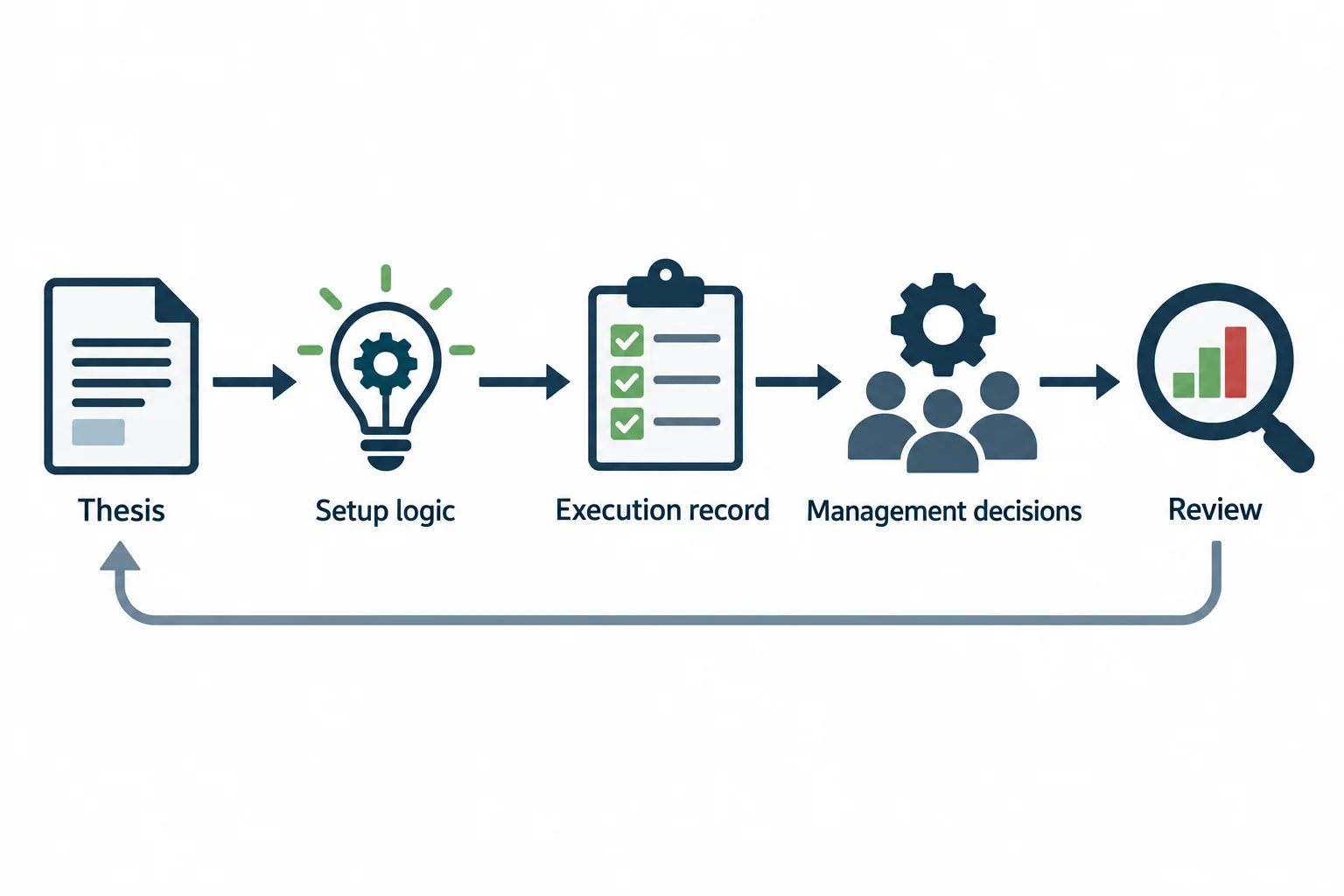
ICT begins by criticizing social-media posts that show profitable-looking positions without documenting the reasoning or execution. At 2:59, he distinguishes an MT4 screenshot from a demonstration that records the setup logic, entry process, management decisions, and internal dialogue.
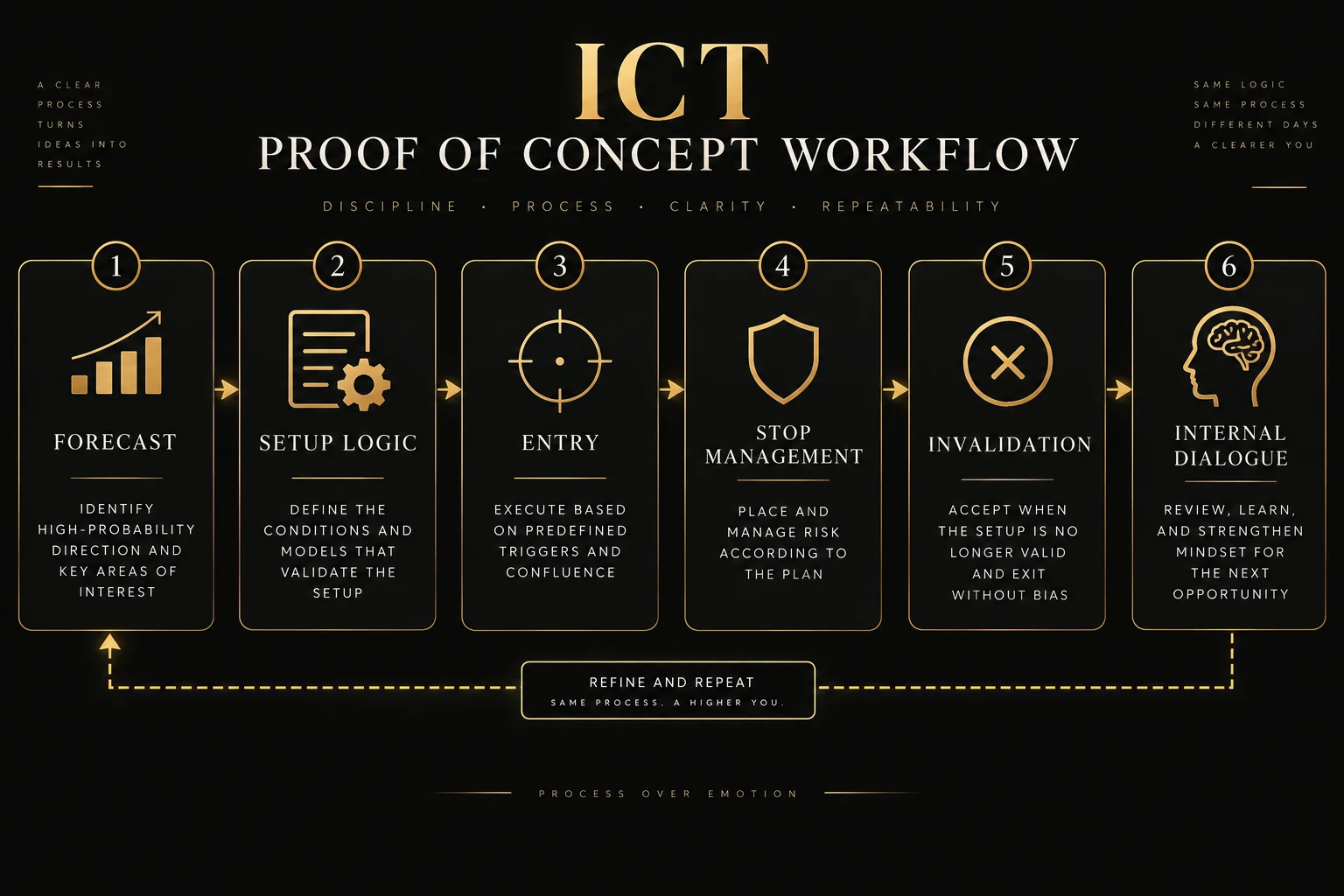
He later proposes a more demanding format: start with a relatively clean chart, identify the anticipated direction and relevant areas in advance, and record the subsequent management from beginning to end. At 29:53, he specifically asks to see execution on TradingView and continuous recording rather than a selected after-the-fact image.
This is a useful general lesson in evaluating educational claims: an annotated forecast is more informative than a winning screenshot because it exposes the original thesis to possible failure. It still does not prove profitability. A single selected example cannot reveal selection bias, transaction costs, the frequency of losing setups, or long-run risk-adjusted performance.
ICT EURUSD Proof of Concept Example
At 7:55, ICT introduces a 15-minute EUR/USD chart and says the pair is moving upward aggressively. He identifies the platform as TradingView and says he is using its paper-trading feature, not presenting the exercise as live-fund trading.
His stated objective was to answer viewers who wanted to see him begin with a fresh chart and document what he expected before the move developed. At 36:43, he says he spent the New York session waiting for the setup and adding the drawings and written commentary shown on the chart. He also says the original recording was compressed into a faster playback, meaning the demonstration was not shown in real time at normal speed.
ICT Concepts Used in the EURUSD Example
- Bullish directional premise: Near 58:18, ICT says his existing outlook for EUR/USD was bullish while his outlook for the dollar was lower.
- Order blocks: He discusses a bullish order block and later describes several possible entries associated with the same broader setup.
- Imbalance terminology: Around 40:58, the generated captions render terms resembling “sell-side imbalance, buy-side inefficiency” and its reverse. Because the captions are imperfect and the terminology is spoken quickly, the exact phrasing should be checked against the recording.
- Precise chart levels: At 43:05, he reads several EUR/USD candle levels and emphasizes differences measured in pipettes. These are his readings from the displayed chart; the transcript cannot independently verify the chart data.
- Multiple entry models: From approximately 59:15, he counts five possible entry techniques during the upward move, including an order-block reaction, a retracement, a buy-stop approach, and what he calls a reclaimed order block.
ICT asks viewers to pay attention not only to direction but also to why he moves a stop, how he holds a position, and what would invalidate an expectation. That emphasis on documenting decisions is more educationally useful than reducing the example to “EUR/USD went up.” However, the captions do not transcribe the chart-playback segment after approximately 1:21:38, so they do not provide a complete textual record of those decisions.
ICT EURUSD Example Paper Trading and Risk
ICT repeatedly identifies the exercise as paper trading. At 1:11:48, he says he teaches recurring price-action patterns rather than live-fund trading. He then warns that live trading can produce real losses and argues that simulation offers a safer way to learn.
His practical study recommendation appears at 38:16: watch with a notebook, record questions, and note the source video and timestamp. He also favors developing an independent decision process instead of relying indefinitely on signals or chat rooms.
Limits of the ICT EURUSD Proof of Concept Video
The video’s strongest educational point is methodological: record a thesis before the outcome, define the reasoning, preserve contrary possibilities, and review the management afterward. That creates a better learning record and makes hindsight reconstruction harder.
It should not be treated as conclusive proof of ICT’s broader claims about market structure, algorithms, other educators, or his own consistency. Those are ICT’s assertions. The transcript supplies one selected EUR/USD discussion and his description of a paper-trading playback; it does not provide an independently audited performance history or enough information to calculate expectancy, drawdown, or profitability.
Resources
- How to turn on Bar Replay in TradingView — TradingView's replay feature lets you simulate historical price action for practice and study.
- TradingView Pine Script Strategies — Documentation for backtesting trading strategies on TradingView.
- ICT explains why MT4 screenshots are insufficient (2:59) — The full critique of after-the-fact trade proof.
- ICT counts five possible entry techniques (59:15) — The segment where he demonstrates multiple entry concepts on the EUR/USD setup.
This commentary is for education and source analysis only. It is not investment advice or a recommendation to trade EUR/USD.