Key takeaways
ICT’s June 13, 2022 index futures review presents a conditional journaling method for E-mini S&P and Nasdaq morning sessions, using a gap-lower daily context, SMT divergence between a lower high in one market and a higher high in the other, and sell-side liquidity below an old low to support a bearish premise.
Read the full summary
ICT’s June 13, 2022 index futures review presents a conditional journaling method for E-mini S&P and Nasdaq morning sessions, using a gap-lower daily context, SMT divergence between a lower high in one market and a higher high in the other, and sell-side liquidity below an old low to support a bearish premise. At 1 minute 46 seconds, the plan was to seek a sell near the opening gap only if the referenced low remained intact before New York, but because the low was taken beforehand, ICT instead expected continued downside expansion. Five-minute confirmation included relative divergence, prior daily lows, the 8 thirty and 9 thirty opening prices, and a Judas swing. From 3 minutes 9 seconds, the one-minute bearish model consisted of a relative high, a short-term low being taken as an internal market-structure shift, formation of a fair value gap, a retracement into that gap for entry, and a protective stop above the nearby high. ICT says the stops were not reached and both markets continued lower, though missing charts and price data prevent verification of exact entries, fills, exits, risk, or realized results.
How we researched this article
BestProps used document-based research from primary firm sources, checked September 19, 2026. The complete source list, scope, limitations, and commercial-state record appear near the end of this article.
In ICT Index Futures AM Session Review – 06/13/2022, ICT introduces a daily review format for studying morning and afternoon index-futures sessions. This brief lesson focuses on how he interpreted a gap lower, relative behavior between E-mini S&P and Nasdaq futures, and a lower-time-frame bearish setup.
The presentation is primarily a chart-journaling exercise. Because the transcript does not show the charts, exact price levels and every visual annotation cannot be independently verified from the audio alone.
ICT Index Futures Session Review Purpose
At 0:01, ICT explains that these reviews are intended to help viewers identify which setup, if any, deserves attention in each session. He encourages traders to record their own observations in the open areas of their charts rather than copying his annotations mechanically.
That distinction is important for useful journaling. A journal should document what the trader could identify at the time, including context, invalidation conditions and mistakes. Reproducing a finished chart after the move does not establish that the same analysis could have been made prospectively.
ICT Index Futures Gap-Lower Daily Context
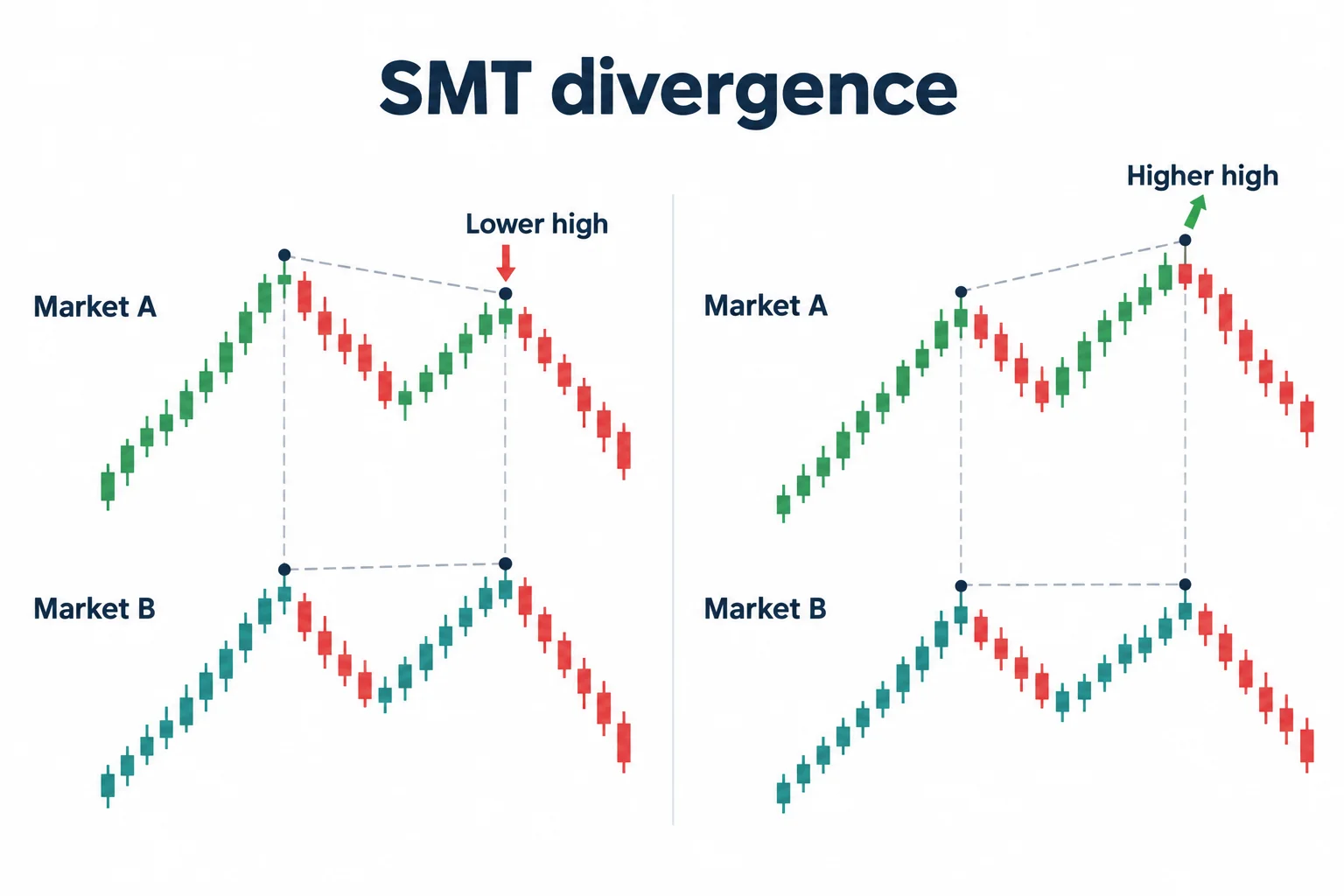
Beginning around 0:45, ICT refers to an earlier live session in which he anticipated a gap-lower opening. He compares daily charts of the E-mini S&P and Nasdaq and identifies what he calls an SMT divergence: one market forms a lower high while the other forms a higher high.
In ICT’s framework, this relative disagreement supported a bearish interpretation. He also points to an old low and what he describes as sell-side liquidity below it. These are ICT-specific market-structure concepts, not independently validated signals in the transcript.
ICT then reviews a conditional plan for the opening gap at 1:46:
- If the referenced low remained intact before the New York session, he would watch for price to move back toward the opening gap and then look for a potential sell.
- If price took the low before the New York session, he would not expect the same move toward the gap.
According to ICT, the low was taken before the New York session, so the first condition did not apply. He characterizes the subsequent behavior as continued downside expansion rather than a retracement toward the gap.
ICT Index Futures Five-Minute Confirmation
At 2:25, the review moves to five-minute charts. ICT again highlights relative divergence: a lower high in the E-mini S&P alongside a higher high in Nasdaq. He marks prior daily lows and mentions the 8:30 and 9:30 opening prices.
He also labels the initial opposing move a “Judas swing,” a term he uses for a short-lived move that precedes the directional move he expects. The transcript does not provide enough visual information to reconstruct the exact candles, prices or boundaries of these chart markings.
ICT Index Futures One-Minute Bearish Setup
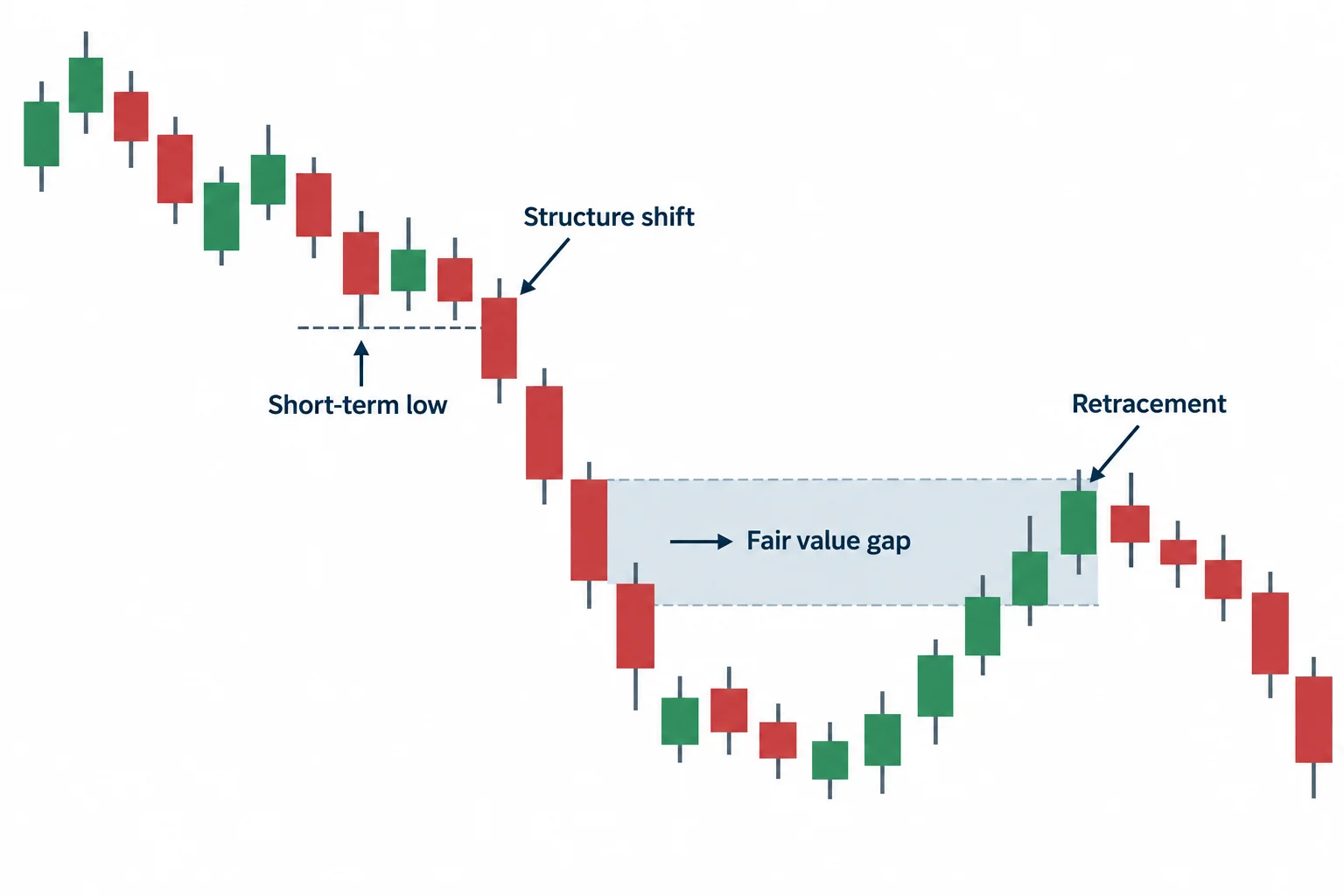
The most specific setup appears on the one-minute charts beginning at 3:09. ICT invites viewers to pause the video and attempt to locate it before hearing his explanation.
His stated sequence is:
- A relative high creates the divergence between Nasdaq and the E-mini S&P.
- Price takes a short-term low, which ICT interprets as an internal market-structure shift.
- A fair value gap forms during that shift.
- Price retraces into the fair value gap, providing the area he identifies for a bearish entry model.
- The protective stop, in his example, would be placed above the nearby marked high.
At 3:48, ICT summarizes this as the morning-session setup on both markets. He says the illustrated stops were not reached and that price continued lower. This is his retrospective account of the charts; the transcript alone does not establish exact entries, fills, risk, exits or realized results.
ICT Index Futures Session Takeaways
The broadly applicable lesson is the use of a conditional journal rather than a single fixed prediction. The review separates higher-time-frame context, a condition that could invalidate the initial gap scenario, relative behavior between correlated markets, and a lower-time-frame execution pattern.
A practical journal entry could therefore record the session premise, the condition that changes it, the time when that condition occurs, and whether the lower-time-frame pattern is identifiable without hindsight. That process can improve consistency of observation, but it does not demonstrate that the terminology or setup offers a reliable trading advantage.
Primary source: ICT Index Futures AM Session Review – 06/13/2022, uploaded June 13, 2022.