How we researched this article
BestProps used document-based research from primary firm sources, checked September 25, 2026. The complete source list, scope, limitations, and commercial-state record appear near the end of this article.
In The Illusion of Choice, uploaded August 4, 2019, ICT delivers a critical-thinking talk rather than a trading model, chart setup, entry technique, or market forecast. The presentation examines how social expectations, education debt, employment norms, retirement planning, home ownership, and social media can frame decisions that still feel independent.
The structure of the talk
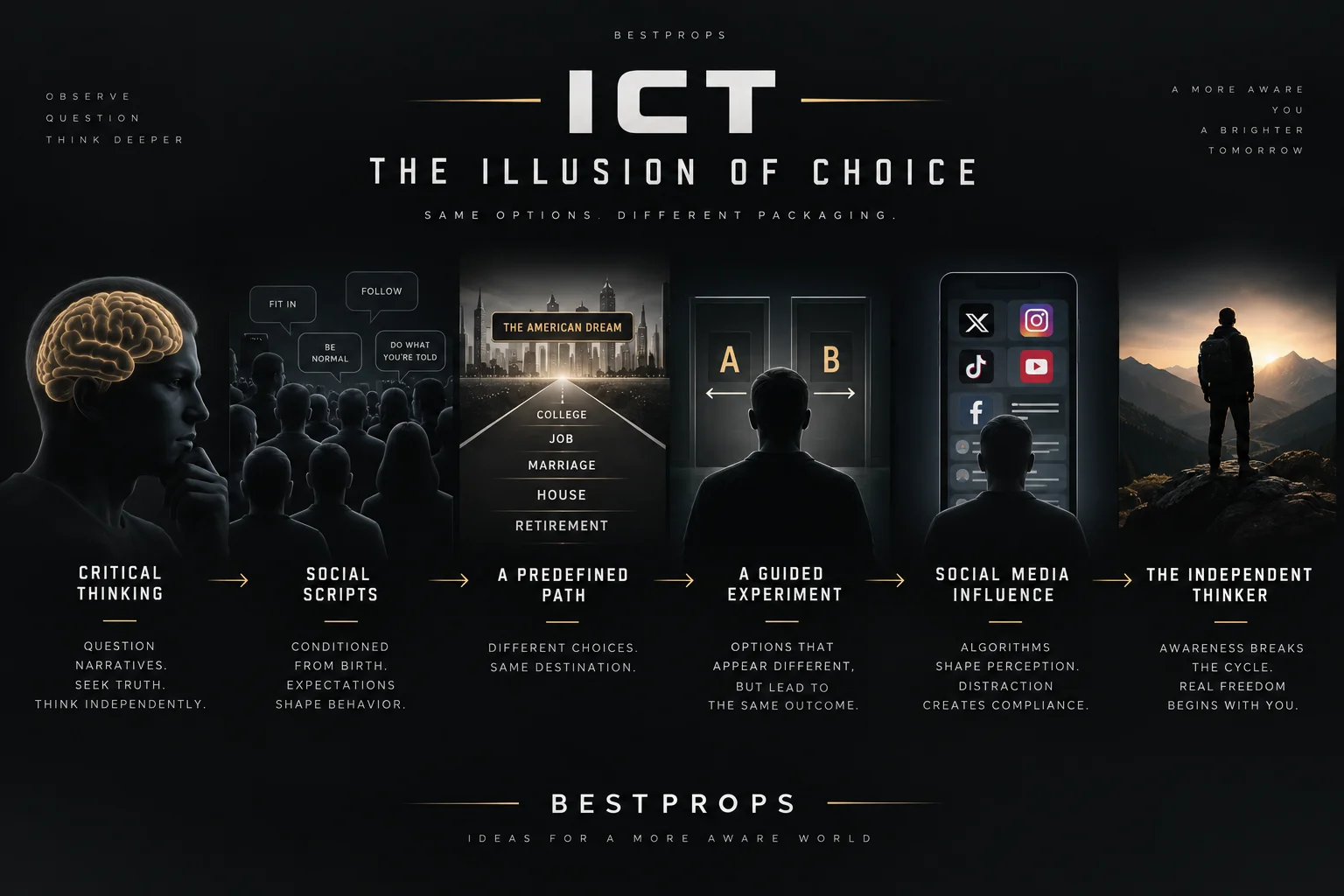
ICT opens by asking whether choices are truly objective and free from outside interference. He traces a familiar path: childhood encouragement to “be whatever you want,” pursuit of defined ambitions or entry into adulthood without a clear plan, the routine of work and family, and the gradual realization of limited freedom and time for oneself. Around 1:34, he describes how depression can slip in and time “sifts folks into the same place — slavery of your mind.” Near 2:34, he outlines the conventional “American Dream” script: school, debt, job, IRA, 30-year mortgage, family, taxes — and asks what if those choices were not really your own.
The guided-choice demonstration
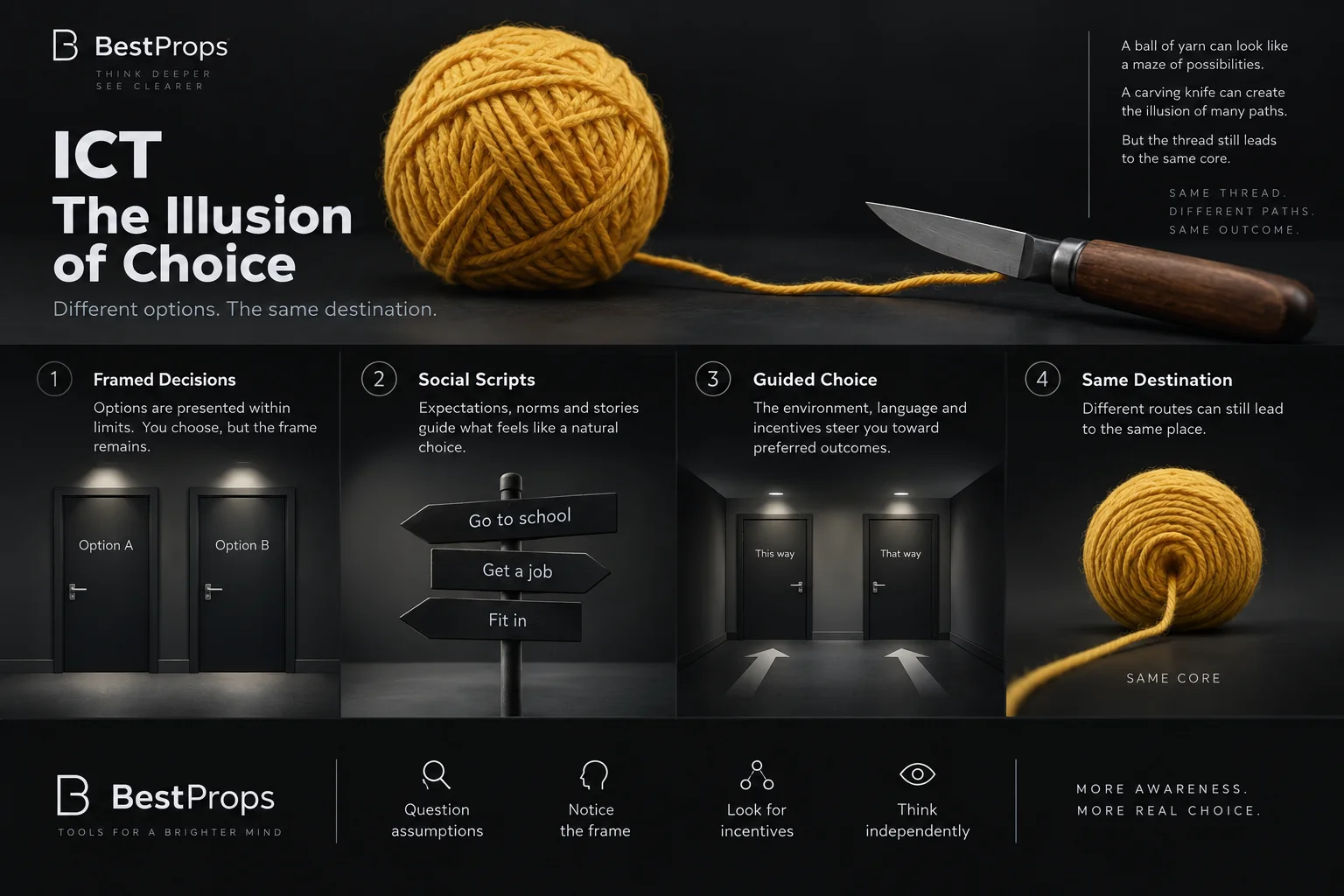
At 4:08, ICT runs a live demonstration: women are asked to think of an even number 1–10, men an odd number. He then reads ten descriptive phrases (e.g., “precious metal,” “yarn,” “cutlery,” “golden in color,” “highly polished,” “a ball,” “sharp,” “a cat’s toy,” “hand tool,” “around”) and ten random objects (“gentleman’s top hat,” “blue felt-tip pen,” “postage stamp,” “carving-knife,” “yellow ball of yarn,” “oil painting,” “antique clock,” “horse-drawn buggy,” “Caribbean island,” “old dusty book”). At 6:15, he reveals the intended result: the descriptive phrases are designed so that women tend to select the “yellow ball of yarn” and men the “carving-knife.” ICT presents this as an illustration of guided choice, not as a controlled psychological experiment with reported participant data.
Application to social media and independent thinking
From 6:37, ICT extends the idea to social media, arguing that platforms shape everyday thoughts and that the feeling of independent thought can be an illusion when options and language are pre-framed. The talk closes at 7:10 with a call to “be an independent thinker, choose wisely” by examining who defined the available options, how wording and expectations frame them, and whether the underlying objective reflects personal priorities or a borrowed definition of success.
Educational takeaway
The talk does not present a trading model, chart setup, or market forecast. Its value is as a prompt for critical self-examination: identify where your “choices” may have been pre-framed by social scripts, debt structures, employment expectations, or algorithmic feeds. The demonstration is illustrative rather than evidential — no participant responses or statistical controls are reported — and the transcript alone cannot verify psychological mechanisms or real-world decision outcomes.