How we researched this article
BestProps used document-based research from primary firm sources, checked September 25, 2026. The complete source list, scope, limitations, and commercial-state record appear near the end of this article.
In High Probability Forex Day Trading, ICT narrates a single one-minute chart example recorded on the morning of September 16, 2019. The lesson demonstrates a conditional scalp plan for the New York open window rather than a statistically validated trading model.
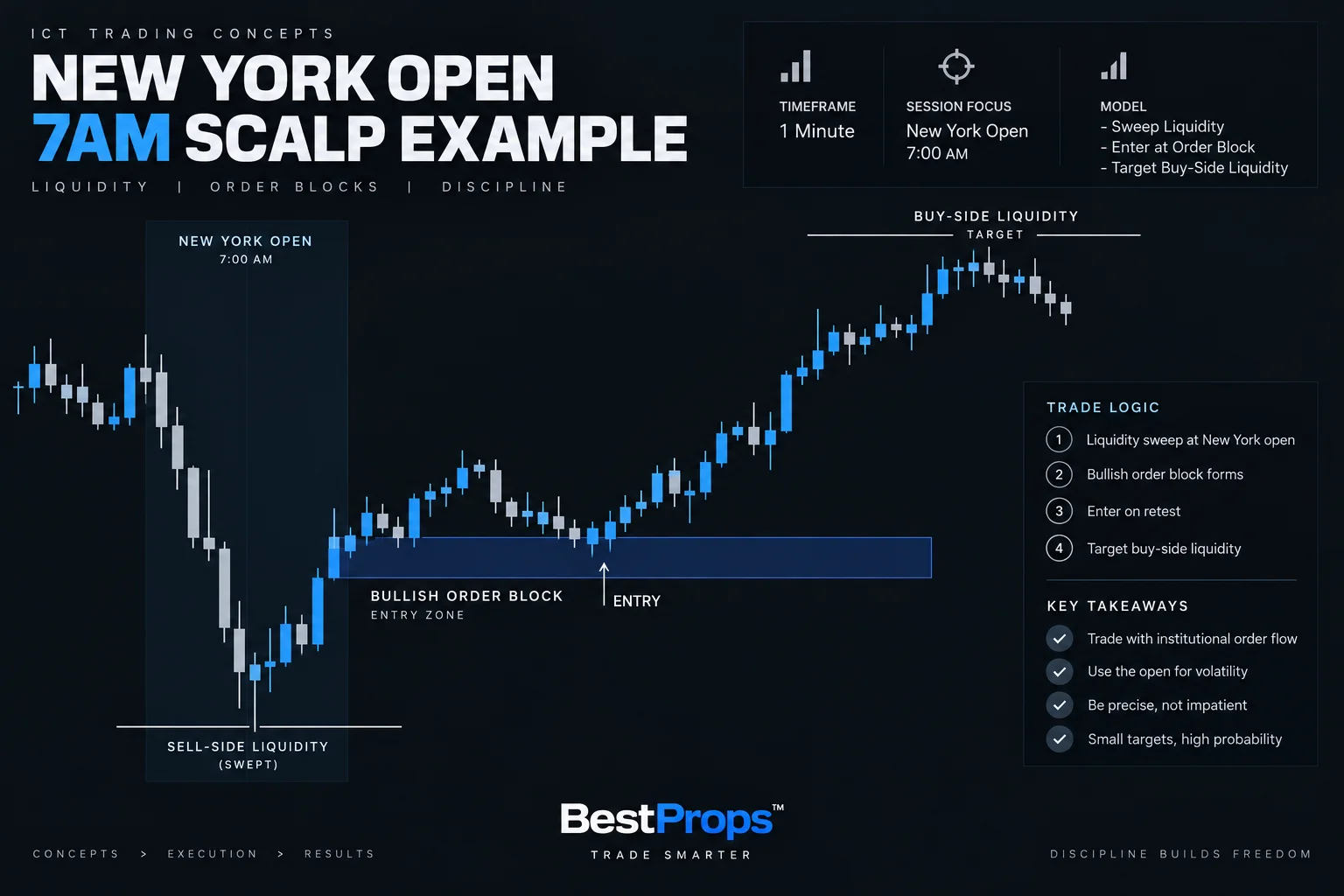
The example shows a bullish bias formed around a marked “blue” order block with a buy-side liquidity objective above (the “orange” area). A smaller bearish opportunity from a “yellow” bearish order block at equal highs is identified but declined because the pip potential is too small for the time frame. ICT emphasizes that the larger anticipated move is from the blue zone up to the orange zone.
The narrated sequence
Around 1:25, equal highs form. Near 2:12, price declines and violates relative equal lows. At approximately 2:28, ICT prepares a market buy order with a simultaneous stop and limit as price enters the predefined blue zone. He states that the stop will only be moved if price trades above a short-term high. Near 3:41, a partial exit is taken around the projected highs, a smaller remainder is retained, and a trailing stop is adjusted until it is eventually hit. ICT notes that roughly 80% of the hypothetical position was exited near the highs.
What the example illustrates
The presentation frames the example as a paper-study exercise in defining the session, entry zone, objective, entry sequence, invalidation control, partial exits, and stop-adjustment conditions before acting. ICT explicitly describes this as a “typical exercise” for one-minute charts and a conditional plan—not a statistically proven edge. The single recorded instance cannot verify chart levels, fills, execution quality, repeatability, or profitability after spreads and slippage.

Educational takeaway
The transferable lesson is the value of a pre-defined conditional framework: identify the session window, mark the relevant liquidity areas and order blocks, define entry and invalidation rules, and plan scaling and stop management in advance. The example is best studied by annotating the chart alongside the narration and evaluating the structure through repeated historical review or simulation, not by treating the narrated outcome as evidence of a reliable strategy.