Key takeaways
ICT reviews a EUR/USD paper trade on a one-minute TradingView chart in which an initial Monday long targeting hourly equal highs and a partial exit near 1.1675 was stopped out after 2 minutes 1 second for a reported $200 loss, which he attributes to tightening the stop too soon.
Read the full summary
ICT reviews a EUR/USD paper trade on a one-minute TradingView chart in which an initial Monday long targeting hourly equal highs and a partial exit near 1.1675 was stopped out after 2 minutes 1 second for a reported $200 loss, which he attributes to tightening the stop too soon. He re-entered at the same comparatively small size because the bullish thesis remained intact, citing London strength, a New York retracement into his optimal trade entry area near 62%, and hourly relative equal highs as the objective. After price crossed the first monitored level around 5 minutes 44 seconds, he adjusted the stop and scaled out, leaving 200,000 units, then later reduced the position to 100,000 units before the remainder was stopped out. He says he should have taken another 100,000 units near a prior high rather than after the retracement. Core lessons are to separate thesis, execution and risk management, plan partial exits, avoid insisting on an exact high or low, reassess rather than revenge trade, and evaluate cumulative risk across attempts. A hypothetical first trade risking 2% could require a smaller re-entry under a daily loss limit. ICT confirms at 26 minutes 20 seconds that the displayed balance is paper money, while fills, spread, slippage and the complete net result cannot be independently reconstructed, so the video demonstrates a review process rather than live profitability.
How we researched this article
BestProps used document-based research from primary firm sources, checked September 25, 2026. The complete source list, scope, limitations, and commercial-state record appear near the end of this article.
In “ICT Forex Trade Review & Losing Trade”, uploaded September 29, 2020, ICT reviews a EUR/USD paper-trading example in which an initial long entry is stopped out. He then re-enters because he believes the underlying bullish premise remains valid. The lesson is less about presenting a flawless trade than about separating analysis, execution and risk management.
The recording uses a one-minute TradingView chart, followed by a review of the hourly and one-minute context. ICT explicitly says near the end that the displayed balance is paper money, so the example should not be interpreted as evidence of live-account performance.
ICT Forex Losing Trade and Stop-Out
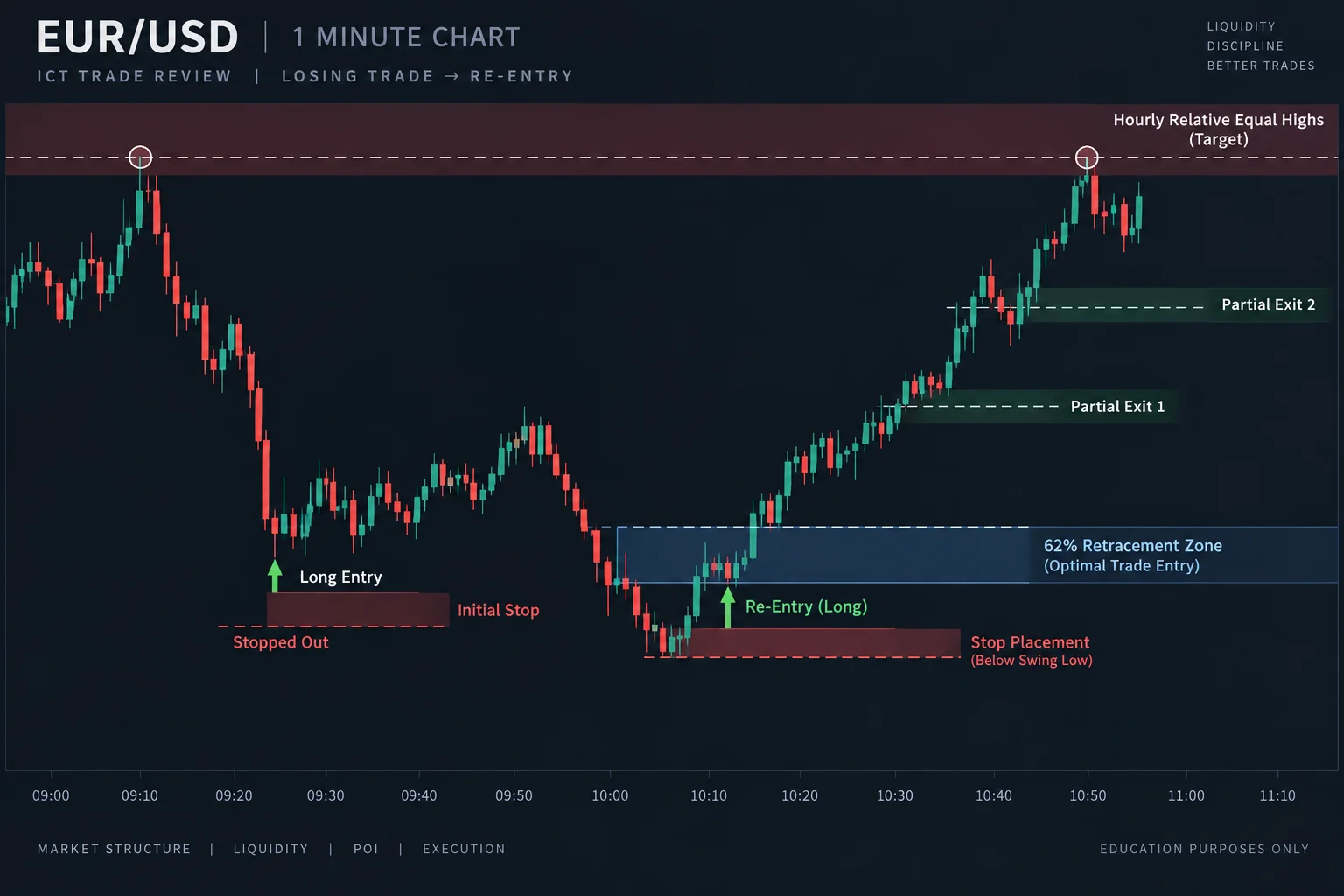
At 0:15, ICT announces a EUR/USD long position. He says he is looking for price to move above an area around 1.1675, where he plans to take an initial partial exit. He also explains that he is using comparatively low exposure because it is Monday and he does not yet have strong conviction in the direction.
The first entry is stopped out at 2:01. ICT describes the result as a $200 loss and attributes it to bringing the stop too close too soon. That diagnosis is his interpretation of the trade; the transcript alone cannot independently verify whether a wider stop would have produced a better risk-adjusted decision.
His principal distinction is that an invalid execution does not necessarily invalidate the market thesis. He still expects a move toward what he calls hourly “equal highs,” so he considers another entry using the same general framework.
Why ICT Re-Entered the Forex Trade
From 2:08, ICT says the chart conditions he was watching had not materially changed. He argues that a trader should reassess the setup rather than letting embarrassment over a stop-out dictate the next decision.
During the later chart review, he describes the higher-time-frame logic in more detail:
- The London session had moved higher.
- He did not want to chase that advance during New York trading.
- He waited for a retracement within the prior upswing.
- He characterized that pullback as reaching his “optimal trade entry” area near a 62% retracement.
- He continued to use the hourly relative equal highs as the upside objective.
This explanation begins around 11:19, while the one-minute execution review begins at 18:46. Terms such as “optimal trade entry,” “sell-side liquidity” and “run on stops” belong to ICT’s own analytical framework. They describe how he reads price action, not a demonstrated or guaranteed market mechanism.
Managing ICT Forex Trade Partials and Stops
After the re-entry, price reaches the first area ICT is monitoring. At approximately 5:44, he says price moves through the level, after which he adjusts the stop and takes a partial exit. He reports that this leaves 200,000 units open.
ICT later identifies a management decision he would change. Between 6:44 and 7:50, he explains that he considered removing another 100,000 units near a prior high but did not do so. He subsequently took that partial after price had retraced. The recording was not running for that later action, although he says its execution marker appears in the chart history.
In the detailed recap at 20:05, he says a later partial left 100,000 units, which were eventually stopped out. The captions support his narration of these actions, but they do not provide enough independent information to reconstruct fills, spread, slippage or the complete net result.
ICT Forex Trade Lessons for Imperfect Exits
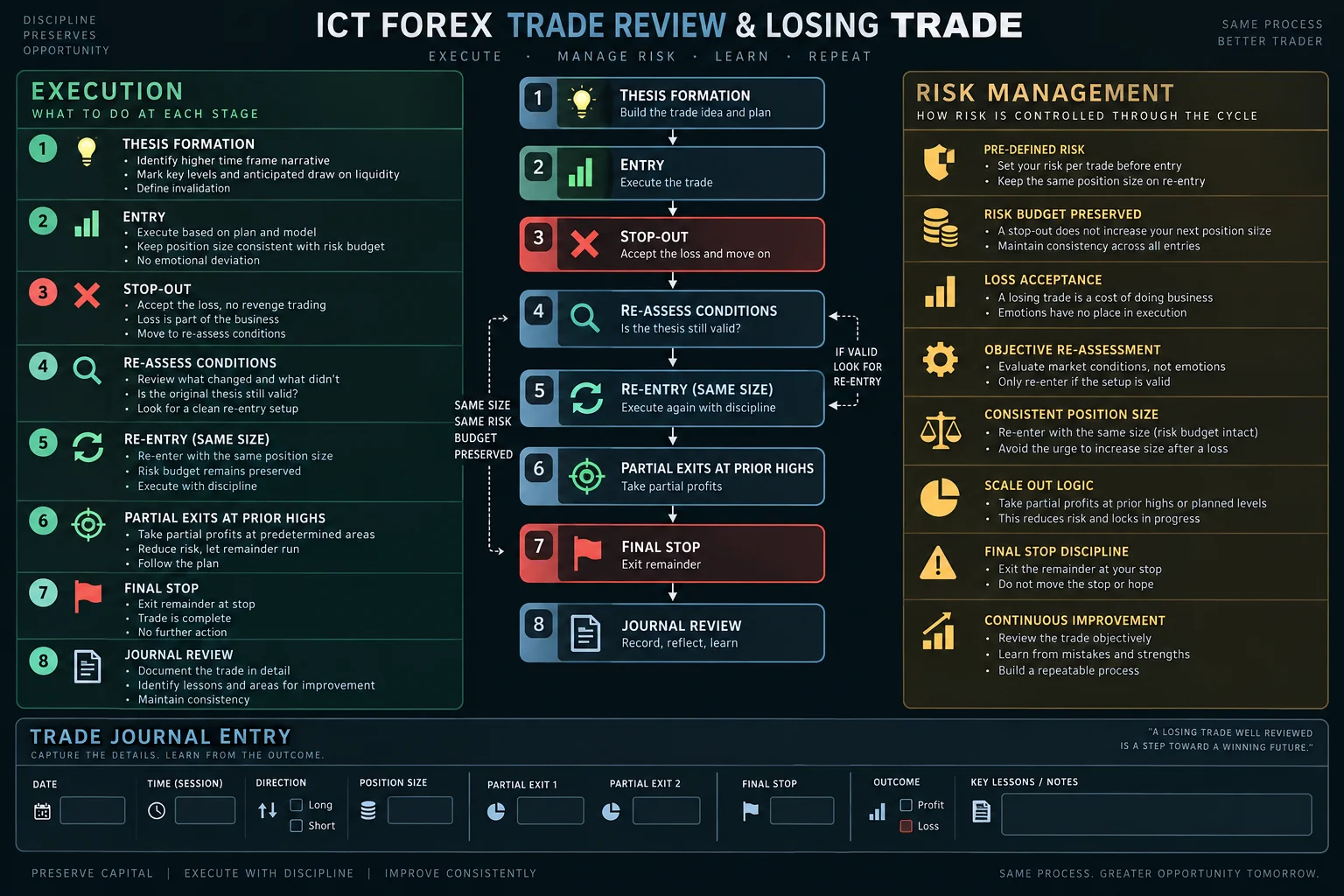
A substantial part of the discussion concerns the temptation to hold every position for an exact target. Starting around 7:52, ICT argues that traders should be willing to take profit while price is moving toward an objective rather than insisting on capturing the precise high or low.
He connects this to ego: being analytically close to the eventual destination is different from managing an open position well. A target can be approached without filling a limit order, or price can reverse before reaching it. His stated response is to scale out along the expected path and accept that execution will be imperfect.
ICT Forex Trade Risk and Re-Entry
At 14:02, ICT explains why position size matters after a loss. Because he says the initial exposure was small, he felt able to re-enter at the same size without breaching his risk constraints. He contrasts this with a hypothetical trade risking 2%, in which a second attempt might need to be smaller under a daily loss limit.
The percentages and limits in that passage are illustrative rather than universal recommendations. The broader educational point is that the first loss and any potential second trade should be considered together. A re-entry should not become an emotional attempt to recover money, and repeated attempts can quickly compound risk.
A Practical ICT Forex Trade Review
ICT closes by encouraging traders to leave room for error in their journals. Around 21:50, he advises against turning a missed move or stopped position into harsh self-criticism. A useful general review can instead ask:
- Was the original thesis still valid after the stop?
- Was the stop moved according to a rule or discomfort?
- Did total exposure remain within a predetermined limit?
- Were partial exits planned before the trade?
- What evidence would have invalidated the re-entry?
Finally, at 25:56, ICT reiterates that the example includes a losing transaction and visible executions. He clarifies at 26:20 that the account uses paper money. The video is therefore best treated as a narrated study of his decision process, not proof of profitability and not a template that removes the risks of leveraged forex trading.
Source and transcript notes
This article was reconstructed from the video’s timestamped transcript. Claims about ICT’s personal trades, losses, and decision process are attributed to the speaker and not independently verified. The video demonstrates a review process, not live profitability. No financial advice is given.
Primary source
Watch the full lecture: “ICT Forex Trade Review & Losing Trade”
Verified original-source resources
- Inner Circle Trader official website (ICT’s official site for courses and community)
- The Inner Circle Trader YouTube channel (primary-source lectures and mentorship episodes)
- CFTC: Forex Fraud FAQs (regulatory context for retail forex risk)
- CFTC Forex Fraud Advisory (official advisory on retail forex risks)