How we researched this article
BestProps used document-based research from primary firm sources, checked September 25, 2026. The complete source list, scope, limitations, and commercial-state record appear near the end of this article.
In ICT Forex – Trading The Key Swing Points, uploaded on December 14, 2017, ICT discusses how significant daily highs and lows may form around four recurring parts of the trading day: the Asian open, London open, New York open, and London close. The lesson presents these periods as contextual reference points rather than fixed rules.
ICT’s central message is that traders should not assume one session must always produce a particular high or low. Instead, he suggests combining time-of-day tendencies with a directional premise and higher-timeframe price levels. These are ICT’s market interpretations; the video does not provide statistical testing or establish that the patterns offer a reliable trading edge.
The four key swing-point periods
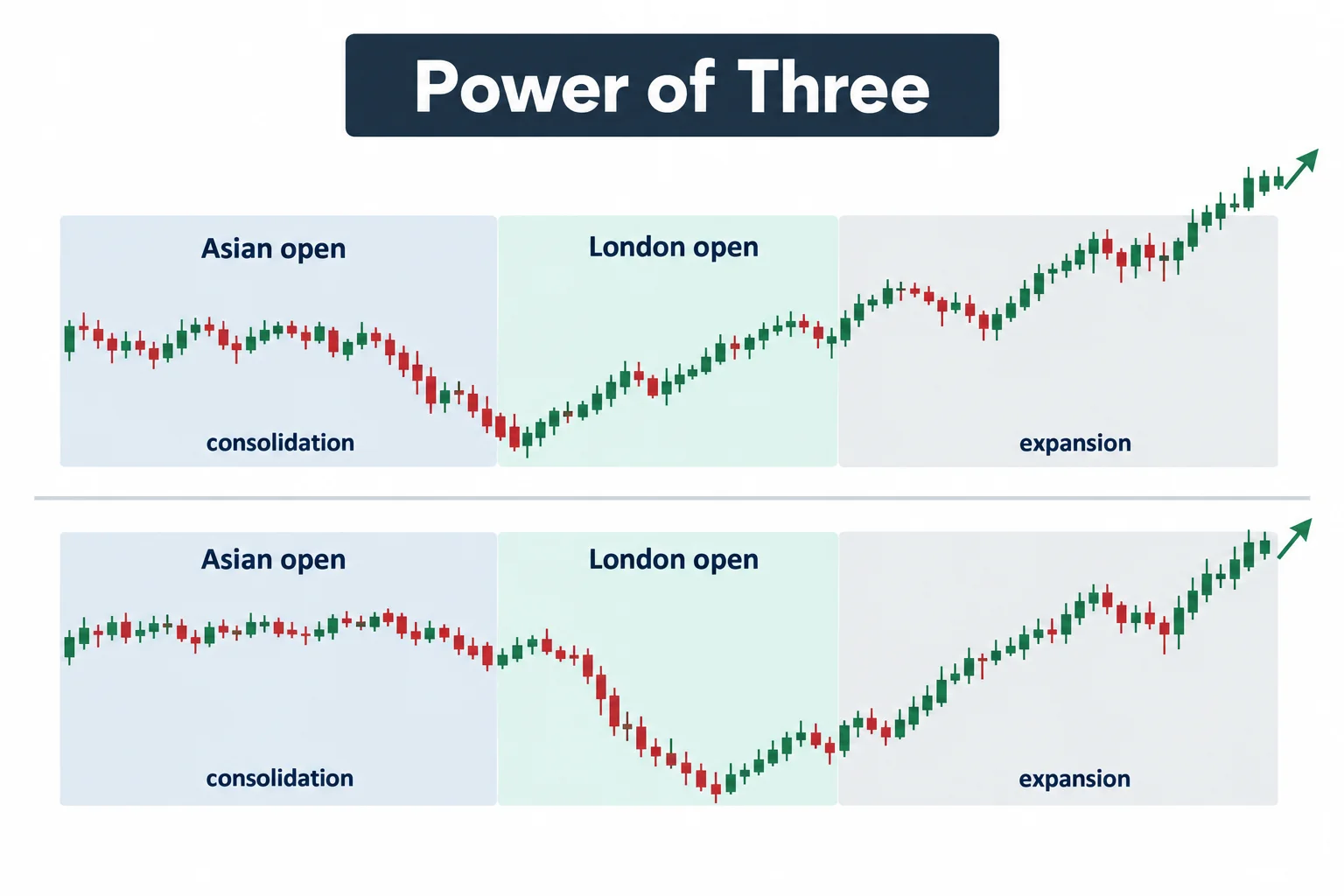
At 0:23, ICT introduces the four periods covered in the lesson. He relates them to his “Power of Three” framework, in which a daily range may progress through consolidation and expansion. However, he immediately emphasizes that the commonly taught sequence does not occur every day.
1. Asian open
ICT describes Asian trading as a period that may consolidate before later expansion. In one version of his framework, London subsequently forms the day’s high or low and the market expands from there. In another, the Asian session itself establishes the daily extreme.
The contrast is explained at 0:35. For example, ICT says a bullish day could establish its low during Asia and then rise through later sessions. This is presented as one possible daily-range structure, not a condition that can be known solely from the clock.
2. London open
Beginning around 1:34, ICT explains two possible roles for the London open. London may create the day’s high or low, or it may retrace an earlier move that began during Asia.
In his bullish example, Asia forms a low and price moves beyond the Asian range. A decline during London may then be interpreted as a retracement of that initial upward impulse rather than the beginning of an entirely new bearish move. ICT associates this retracement idea with what he calls an “optimal trade entry,” although the transcript does not define its measurements or entry rules.
3. New York open
At 2:39, ICT says the New York open can also establish a daily extreme. One scenario involves price moving above equal highs in what he characterizes as a run on liquidity, forming the high of the day before declining.
Alternatively, New York may retrace a move that originated in London. In the bullish illustration, London forms a low and produces an upward impulse; price retraces approaching New York and then resumes higher. ICT calls this continuation structure one of his classic New York-open setups. At 3:40, he notes that the same logic can be reversed for a bearish premise: a London high, a decline, and then an upward New York retracement before potential continuation lower.
4. London close
The London-close discussion starts at 4:40. ICT says this period often corresponds to the opposite side of a range whose first major extreme formed earlier in the day. For instance, if Asia or London established a bullish day’s low, London close might coincide with the high side of the range.
He again gives alternatives. After prolonged consolidation, price could move through equal highs or lows near London close and then reverse. ICT also suggests that a London-close turn can occasionally matter beyond the same trading day. The longer-term example in the captions is not fully clear, and no unseen chart values or subsequent results can be verified from the transcript alone.
Higher-timeframe context is the main filter
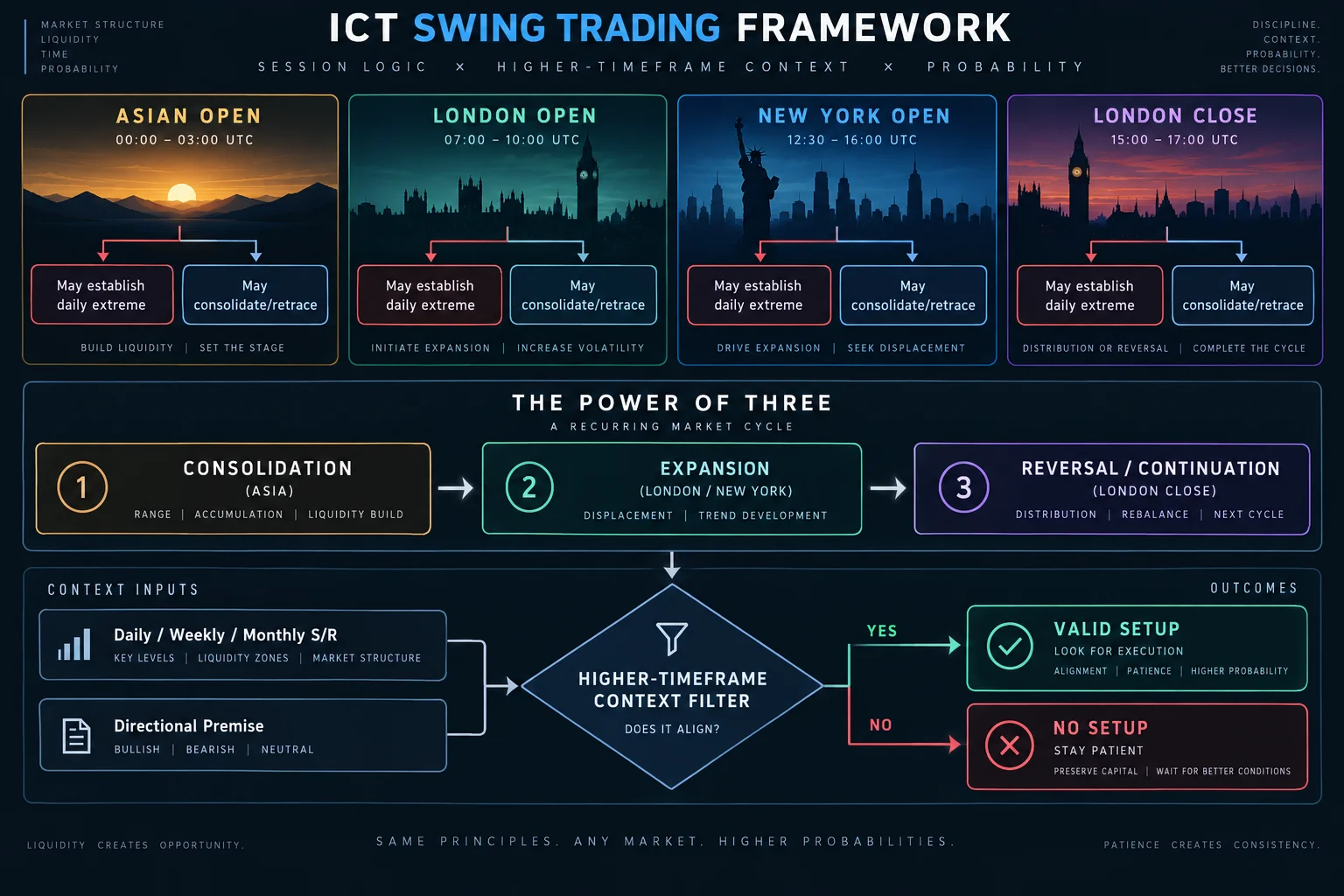
The practical section begins at 6:06. ICT advises relating these intraday periods to higher-timeframe support or resistance. His hypothetical example is a market reaching daily resistance around London close. Even if the day had previously been bullish, he says that overlap could support looking for a bearish turning point.
This qualification is important: the session label alone is not the complete thesis. Within ICT’s framework, the proposed setup comes from an intersection of:
- a higher-timeframe directional premise;
- a relevant support or resistance area;
- the market’s behavior earlier in the day;
- an impulse followed by a retracement, where applicable.
Chart review exercise
Near 7:47, ICT proposes a historical chart-review exercise:
- Open 15-minute or 30-minute charts.
- Mark significant daily highs and lows.
- Review intrawweek, weekly and monthly extremes.
- Record which session or time window produced each turning point.
- Compare those turns with higher-timeframe support and resistance levels.
The generated caption appears to render one phrase as “intro and weekly highs and lows”; from context, it may refer to intrawweek or intraweek highs and lows, but the exact spoken wording is uncertain. The broader assignment is clear: study when major extremes form and how they align with larger reference levels.
Understanding ICT Forex swing point concepts
A useful way to organize the lesson is as a conditional map rather than a rigid schedule. First identify the higher-timeframe context. Next observe whether Asia consolidates or establishes an extreme. Then assess whether London and New York are extending the move, retracing it, or producing a reversal near a relevant level. Finally, evaluate London close as either the opposite boundary of the daily range or another possible turning window.
This is a summary of ICT’s teaching, not investment advice. The video does not provide statistical testing, risk parameters, or evidence that these patterns are consistently profitable. Any practical evaluation would require clearly defined rules, historical testing, and appropriate risk controls.
Watch the original lesson
Additional resources
- The Inner Circle Trader YouTube channel – Official channel for ICT’s full video library.
- ICT Trading: What Is Inner Circle Trading Strategy? (Forex Tester) – Third-party overview of ICT concepts; not produced or endorsed by ICT.
- ICT Trading Strategy: Order Blocks, FVGs and Killzones (ThinkMarkets) – Third-party educational article; not produced or endorsed by ICT.
- ICT Trading: What Are the Main ICT Concepts? (FXOpen) – Third-party summary of session timing and kill zones; not produced or endorsed by ICT.