Key takeaways
ICT’s Asian Killzone is an educational forex framework for observing setups around the Asian open, using New York time and an approximately two-hour opening window that shifts between roughly 7 p.m.
Read the full summary
ICT’s Asian Killzone is an educational forex framework for observing setups around the Asian open, using New York time and an approximately two-hour opening window that shifts between roughly 7 p.m. and 8 p.m. with daylight saving time, while the broader study range runs from the Asian open to midnight. ICT focuses on AUD, NZD and JPY exposure through AUD/USD, NZD/USD, USD/JPY and especially non-USD crosses such as AUD/JPY, GBP/AUD, EUR/AUD and GBP/CHF. Price may move soon after the open and form ICT’s optimal trade entry retracement pattern, ideally aligned with higher-time-frame bias, or consolidate before midnight and potentially inform analysis of the later daily range. ICT favors matching relatively strong and weak currencies whose home markets are active, arguing that crosses can move more than USD pairs while the US dollar consolidates. The lesson offers selected chart illustrations rather than complete setup rules, independently verified performance or a guaranteed trading edge, and ICT presents the window mainly as a niche for traders available during North American evening hours.
How we researched this article
BestProps used document-based research from primary firm sources, checked September 25, 2026. The complete source list, scope, limitations, and commercial-state record appear near the end of this article.
In ICT Forex – The ICT Asian Killzone, Inner Circle Trader (ICT) explains how he organizes the early Asian trading session by time, currency activity and price behavior. The lesson presents the “Asian Killzone” as ICT’s own label for a period in which he looks for setups, not as an official exchange session or a guarantee that a trade will appear.
The discussion is introductory and relies heavily on charts shown in the video. Because the transcript does not reveal their exact prices or independently verify the examples, the most useful takeaway is the framework ICT describes for observing the session.
ICT Asian Killzone Meaning
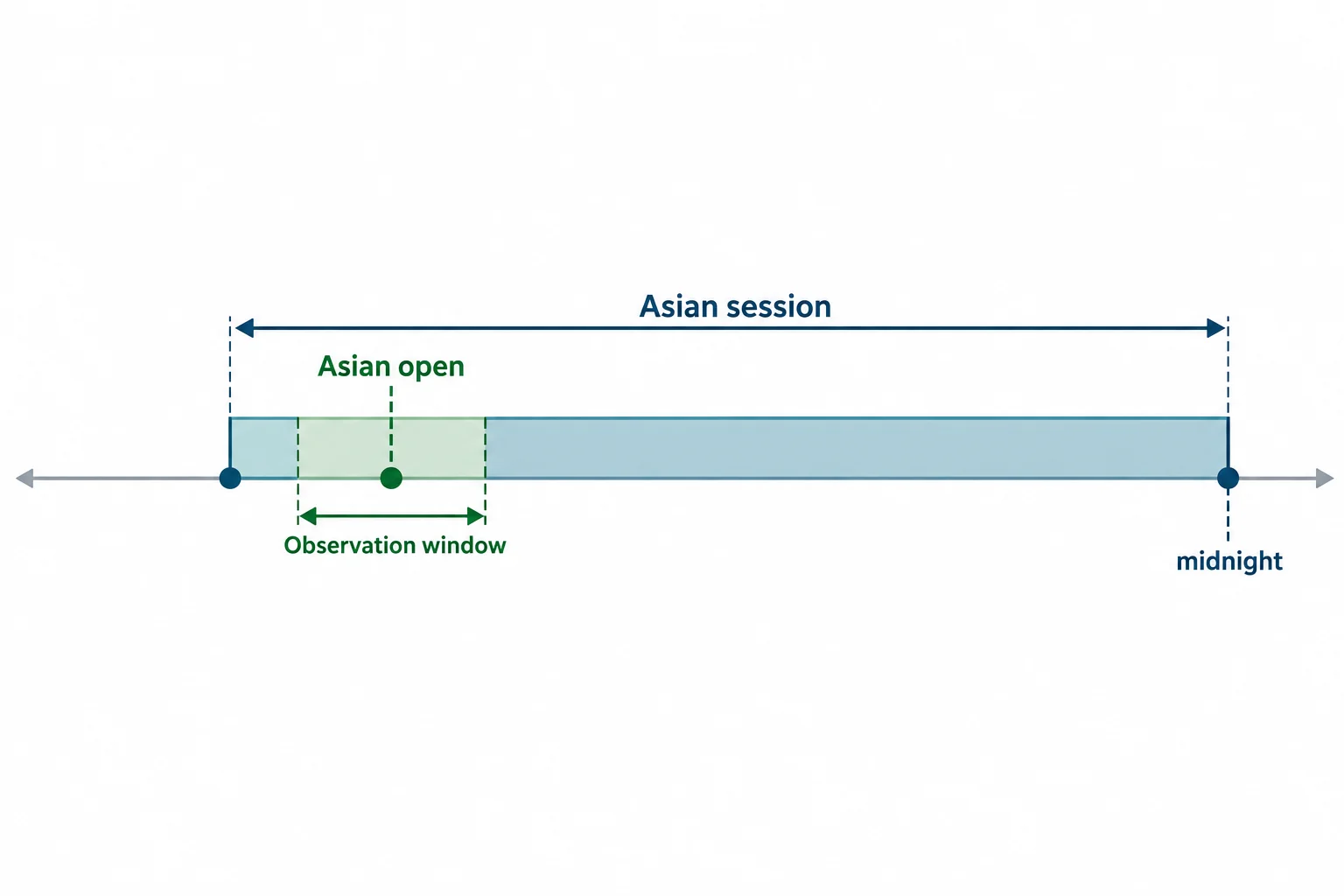
ICT opens the lesson by emphasizing the relationship between time and price. At 0:38, he identifies the Asian open, the broader Asian session and the session’s recurring characteristics as the main subjects.
His analysis is expressed in New York time because he was based on the east coast of North America. Rather than depend on one rigid clock reading, he describes using an approximately two-hour window around the Asian open to accommodate daylight-saving-time changes. At 3:06, he explains that the displayed opening marker can shift between roughly 7:00 p.m. and 8:00 p.m. New York time. His interest is in movement that forms shortly after that open.
This initial window should not be confused with his full study range. Later, at 4:57, ICT says that his working definition of the Asian session extends from the Asian open to midnight New York time, even though Asian market activity continues beyond midnight.
ICT Asian Currency Pairs to Watch
At 1:09, ICT highlights currencies linked to markets active during these hours:
- Australian dollar
- New Zealand dollar
- Japanese yen
He therefore points to pairs involving those currencies as natural candidates for observation. The lesson mentions AUD/USD, NZD/USD and USD/JPY, while also devoting particular attention to non-USD crosses such as AUD/JPY.
ICT says the timing may appeal to North American participants who cannot monitor London or New York hours. That is a scheduling observation, not evidence that evening trading is easier or more profitable. Liquidity, spreads, volatility and execution can differ substantially across pairs and trading venues.
Asian Killzone Session Behaviors
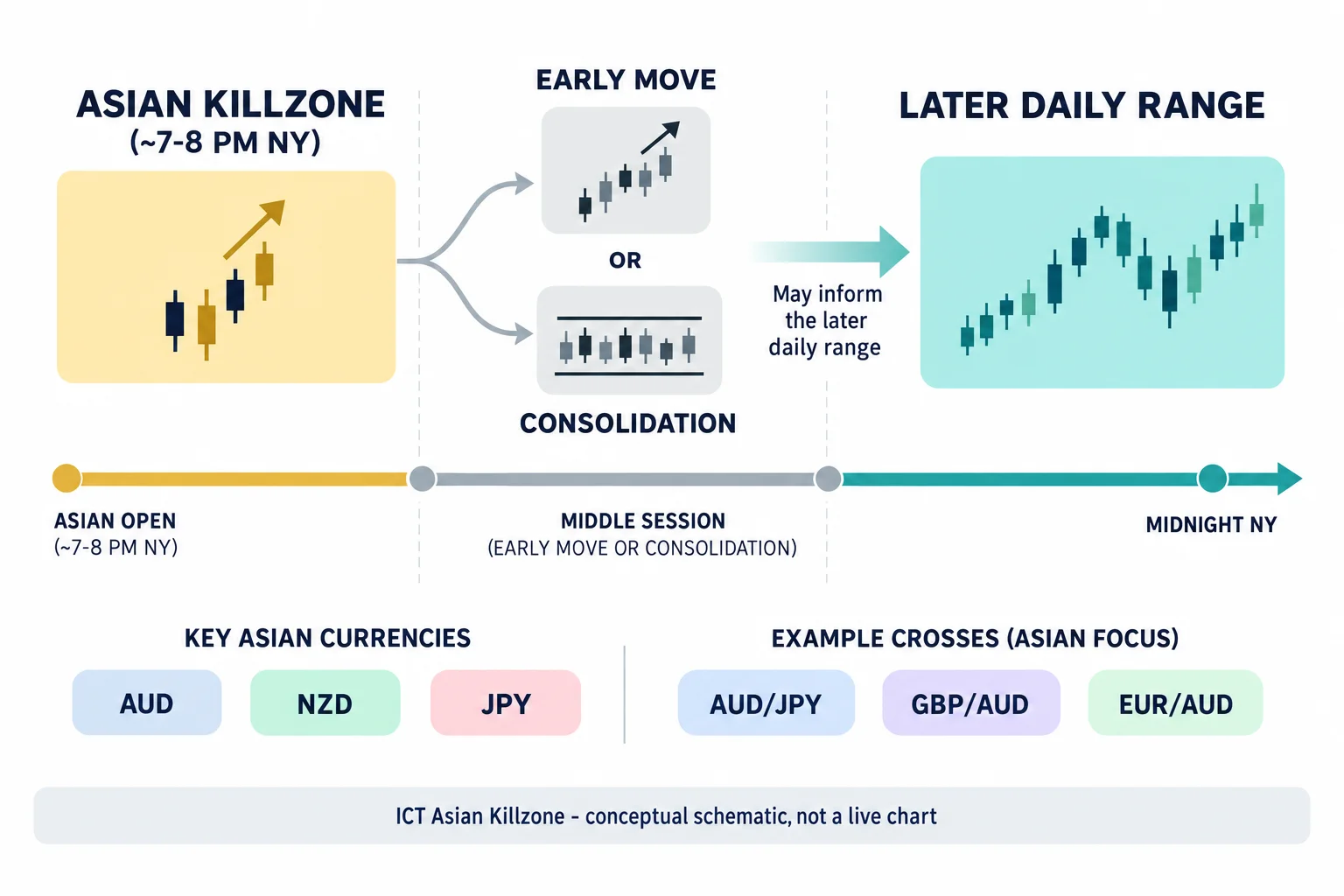
The presentation describes two broad possibilities. First, a market may move soon after the Asian open and form what ICT calls an “optimal trade entry,” a retracement pattern from his wider methodology. Second, it may remain in consolidation.
In the chart examples discussed around 1:58, ICT says the Asian open can sometimes produce a short scalp opportunity. He also says a higher-time-frame directional bias can be helpful. These are ICT’s interpretations of selected historical charts; the transcript does not provide enough information to reproduce the setup rules or evaluate their performance.
If no such movement develops, ICT treats the pre-midnight range as informative. At 5:57, he says consolidation may provide clues about how the later daily range develops. This video does not fully explain how those clues should be applied, noting that later lessons cover them in more detail.
Why ICT Forex Favors Currency Crosses
Beginning at 7:18, ICT argues that non-USD crosses can be more active during this period because the US dollar often consolidates before midnight New York time. Examples named in the lesson include AUD/JPY, GBP/AUD, EUR/AUD and GBP/CHF.
His general selection idea is to compare a relatively strong currency with a relatively weak one while favoring currencies whose home markets are active. At 12:48, he combines that relative-strength concept with his optimal-trade-entry pattern.
ICT also makes clear that this session does not suit his own schedule or preferences. He presents it as a possible niche for someone whose availability is limited to North American evening hours, rather than suggesting every trader should participate.
Asian Session Timing at Midnight New York Time
Near 11:48, ICT identifies midnight New York time as a key reference point in his model. Consequently, the practical study period taught here is the interval between the Asian open and midnight, with the first few hours receiving the greatest attention.
A useful educational interpretation is to separate three elements when reviewing this lesson: the clock window, the currencies active in that window and whether price expands or consolidates. That structure can help a viewer annotate charts consistently, but it does not validate ICT’s setup terminology or establish a trading edge.
ICT Forex Asian Killzone Takeaways
- “Asian Killzone” is ICT’s name for a focused observation and setup window around the Asian open.
- ICT uses New York time and allows for daylight-saving shifts instead of relying on one fixed hour year-round.
- AUD, NZD and JPY pairs receive attention because their associated markets are active.
- ICT expects either an early move fitting his methodology or a consolidation that may inform later analysis.
- He considers non-USD crosses especially relevant before midnight New York time.
- The video supplies illustrative chart commentary, not a complete, independently tested trading system.
Related resources
- ICT Forex – The ICT Asian Killzone (primary video)
- Forex market hours (Wikipedia)
- BabyPips forex market hours guide
- CFTC Learn & Protect: Advisories & Fraud Awareness (regulatory)
This summary is educational and is not investment advice. The primary video was uploaded on December 9, 2017.