Key takeaways
2022 ICT Mentorship Episode 32 explains a late-session consolidation framework that defines the active daily range and midpoint, then waits from 3 p.m.
Read the full summary
2022 ICT Mentorship Episode 32 explains a late-session consolidation framework that defines the active daily range and midpoint, then waits from 3 p.m. to 4 p.m. New York time for price to run above relative equal highs into buy-side liquidity, break lower, form a fair value gap, retrace into that gap, and move toward the daily midpoint. ICT describes the prior session as an outside day with a down close, meaning its high exceeded the previous high and its low fell below the previous low, but says the following morning remained choppy and offered no sufficiently clear short setup. At 4 minutes 37 seconds he notes that trading near the center of the range weakens directional clarity, at 6 minutes 12 seconds he introduces the timing and midpoint framework, at 8 minutes 40 seconds he reports a short entry and partial exit, at 11 minutes 15 seconds he labels the session a consolidation day, and at 17 minutes 2 seconds he revisits the midpoint target. The main lesson is to separate broader directional bias from a valid entry, avoid forcing trades during two-way movement, and require timing, price location, and confirmation to align. His execution, price levels, remaining-position outcome, Twitter commentary, and claims about his son's live-account results are not independently substantiated and do not prove repeatable profitability.
How we researched this article
BestProps used document-based research from primary firm sources, checked September 19, 2026. The complete source list, scope, limitations, and commercial-state record appear near the end of this article.
In 2022 ICT Mentorship Episode 32, ICT reviews a trading session he had discussed through real-time Twitter posts. The central lesson is how he interprets a choppy consolidation day: rather than forcing trades inside an indecisive range, he waits for a time-specific move above short-term highs and then watches for price to return toward the midpoint of the day’s range.
This episode is primarily retrospective commentary on ICT’s own framework and reported execution. It should not be read as independent proof that the framework predicts markets or produces repeatable profits.
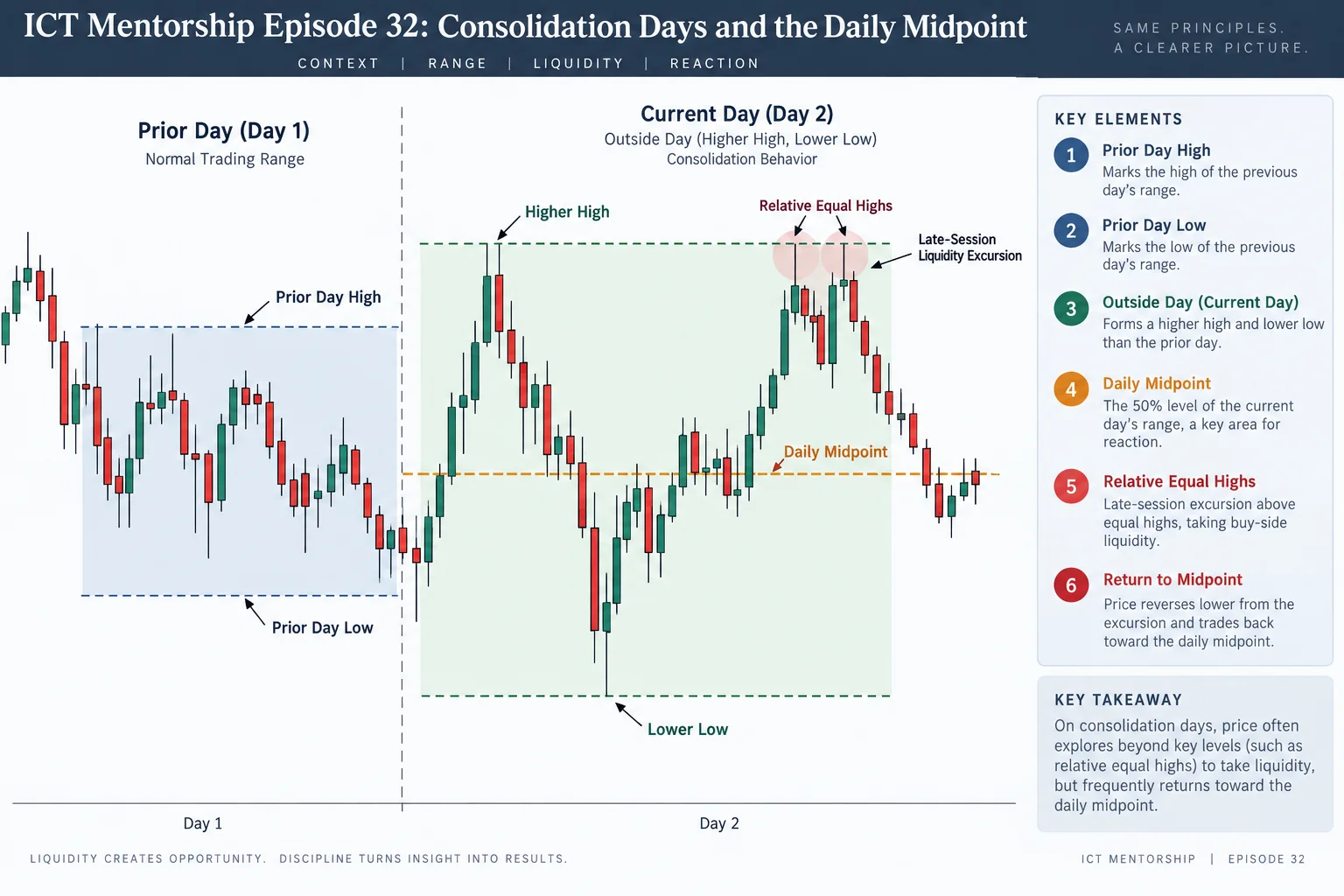
2022 ICT Outside Day Context
ICT begins by identifying the preceding session as an outside day with a down close. He defines an outside day as one whose high exceeds the prior day’s high while its low also falls below the prior day’s low.
Within his interpretation, an old low beneath the market remained a possible draw. However, he says that when price stops short of such a low, the following action can become choppy. That distinction matters because a broader directional expectation does not automatically provide a clear entry within the current intraday range.
Why ICT Found the Episode 32 Morning Difficult
Moving from the hourly view to a five-minute chart, ICT describes price trading back and forth through a relatively confined area. He points to what he calls fair value gaps, short-term lows and relative equal highs, but says the early action did not produce a sufficiently clear short setup.
At 4:37, he characterizes the market near the middle of its range as having roughly balanced directional possibilities. His practical point is not that every market is mathematically 50-50 at its midpoint. Rather, within his model, returning to the center of a dealing range weakens the clarity of a directional thesis.
He therefore separates two ideas:
- A longer-term preference for price eventually reaching sell-side liquidity below an old low.
- The immediate need to assess each potential trade within the range then controlling price.
This is one of the episode’s more broadly useful educational observations: a directional bias and a valid trade setup are not the same thing. ICT repeatedly labels the morning action as unattractive because short-term highs and lows were being crossed without sustained movement.
ICT Episode 32 Daily Midpoint Framework
The episode’s main setup begins at 6:12. ICT says he had directed his Twitter audience to mark the period from 3:00 to 4:00 p.m. New York time and to study the midpoint of that day’s range.
His narrative was that price could first rise above relative equal highs. In ICT terminology, those highs represented “buy-side liquidity”: potential buy orders associated with breakout entries and stop orders protecting short positions. He then expected a reversal back into the established range rather than continued upside expansion.
On the one-minute chart, ICT identifies the sequence he was seeking:
- Price moves above short-term highs.
- The move reaches the area ICT labels buy-side liquidity.
- Price breaks lower and forms a fair value gap in his terminology.
- A retracement enters that gap.
- Price moves back toward the midpoint of the day’s range.
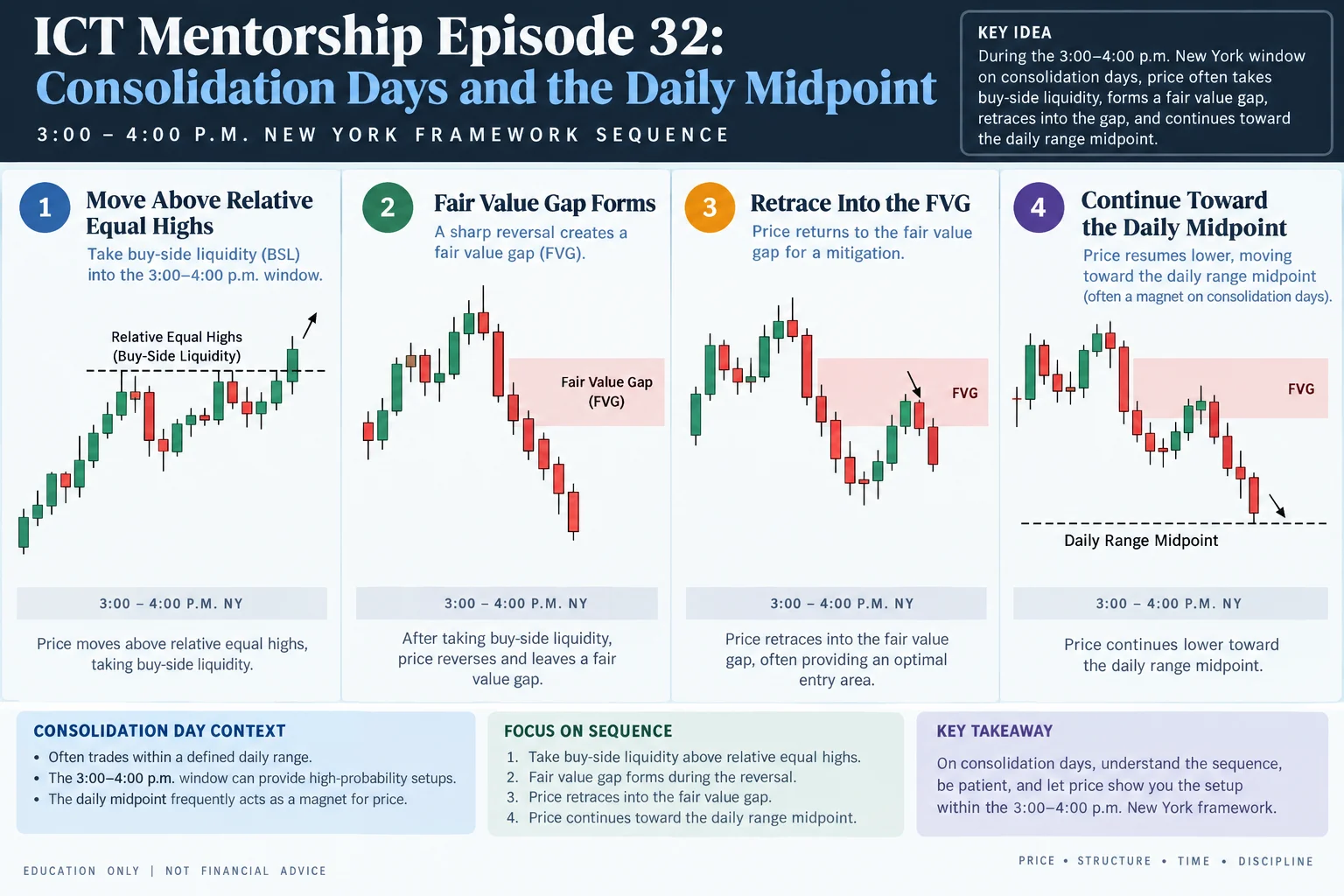
At 8:40, he walks through this sequence and then reports his own short entry and partial exit. The transcript contains quoted price levels, but those figures cannot be independently confirmed without inspecting the chart and execution records shown in the recording. Nor does the transcript establish the final outcome of the remaining position.
ICT Episode 32 Consolidation Day Definition
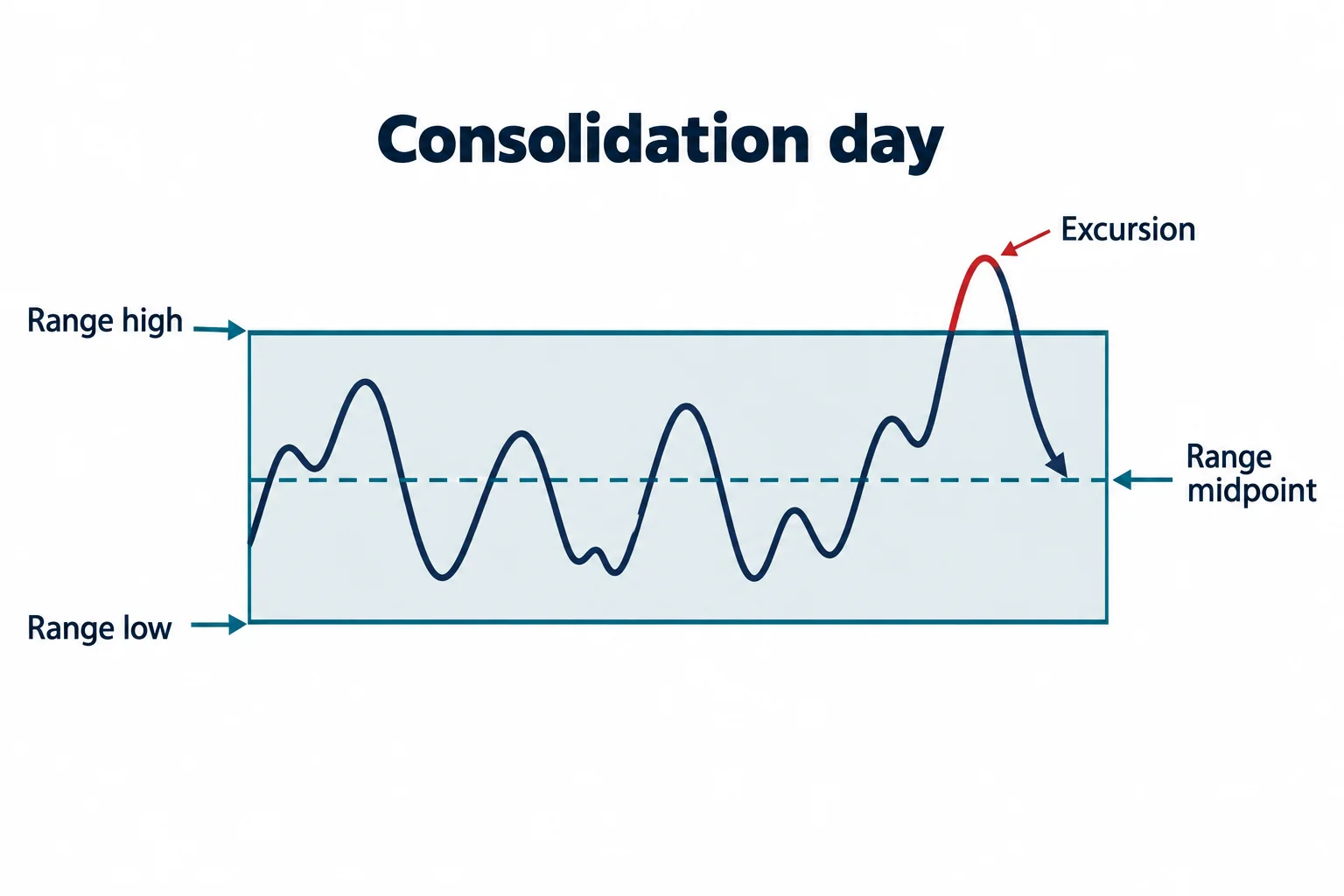
At 11:15, ICT calls the session a consolidation day. He describes this as a day when an initial range forms and price remains largely confined within it until later in the afternoon.
In his account, the pre-3:00 p.m. rise could encourage breakout buyers while also triggering stops above earlier highs. He interprets that concentration of buy orders as liquidity against which larger participants could sell. This is ICT’s market interpretation, not a directly observable identification of who took the opposite side of each transaction.
He returns to the range midpoint at 17:02. For the session discussed, his expectation was that an excursion outside the intraday range could reverse and gravitate toward its center. His educational recommendation is to avoid repeatedly trading unclear movement and instead wait for the specific time and price conditions required by the model.
2022 ICT Mentorship Trading Takeaways
Separate from ICT’s proprietary terminology, the episode illustrates a disciplined analytical process:
- Define the active intraday range and its midpoint.
- Distinguish broader bias from a concrete entry condition.
- Recognize when two-way price action offers little clarity.
- Require price location, timing and a confirming sequence to align.
- Avoid treating every apparent imbalance or crossed swing point as a trade.
ICT also discusses his Twitter commentary, personal execution and his son’s reported live-account results. Those anecdotes are claims made by the speaker and are not independently substantiated by the transcript. They should not be treated as typical results or evidence of expected performance.
Watch 2022 ICT Mentorship Episode 32
2022 ICT Mentorship Episode 32
ICT reviews a consolidation day and his late-session framework targeting the daily range midpoint.
Watch on YouTubeThis summary is educational commentary, not investment advice or a recommendation to trade.