Key takeaways
ICT 2022 Mentorship Episode 31 reviews a reported intraday bearish setup in the June 2022 S&P 500 futures contract, using the May 16, 2022 low as a potential sell-side liquidity objective before refining execution with a 15-minute bearish order block, a five-minute fair value gap, a swing high, and a stop above the nearby candle…
Read the full summary
ICT 2022 Mentorship Episode 31 reviews a reported intraday bearish setup in the June 2022 S&P 500 futures contract, using the May 16, 2022 low as a potential sell-side liquidity objective before refining execution with a 15-minute bearish order block, a five-minute fair value gap, a swing high, and a stop above the nearby candle high. ICT says greater volatility led him to focus on stock indices rather than forex, while arguing that his price-action concepts can transfer across asset classes. At four minutes 44 seconds, he explains that missing the market opening does not end the analysis because a later retracement into a three-candle fair value gap may frame continuation. He reports entering four contracts, tightening his stop when price fell aggressively, taking a partial exit, and holding remaining exposure toward the prior low. The core lesson is to separate destination from execution because the old low provides a directional target, not a complete signal, while lower-timeframe structure supplies confirmation and invalidation. The trade, executions, chart annotations, fills, and subsequent market path are ICT's retrospective account and are not independently verified.
How we researched this article
BestProps used document-based research from primary firm sources, checked September 19, 2026. The complete source list, scope, limitations, and commercial-state record appear near the end of this article.
In 2022 ICT Mentorship Episode 31, ICT reviews an intraday bearish setup in the June 2022 S&P 500 futures contract. The lesson focuses on identifying a likely liquidity objective first and then using lower-timeframe structures (particularly a bearish order block, a fair value gap, and a swing high) to frame an entry.
This is a retrospective explanation of ICT’s own market interpretation, not an independently verified trading result. The transcript can report what he says he entered or managed, but it cannot confirm executions, chart annotations, fills, or the market’s later path.
Why ICT Episode 31 Studies Stock Index Futures
After warning viewers about impersonators and social-media scams, ICT explains why the episode covers an equity index rather than foreign exchange. At 1:00, he says he was concentrating on stock indices because that was where he perceived greater volatility at the time. His broader teaching point is that the price-action concepts he uses are intended to transfer between asset classes.
That does not establish that identical methods perform equally in every market. Contract specifications, trading hours, liquidity, volatility, and execution conditions differ. The supported point is narrower: ICT tells students to study the active market rather than insisting on one asset class when it is comparatively quiet.
Targeting Liquidity in the 2022 ICT Mentorship
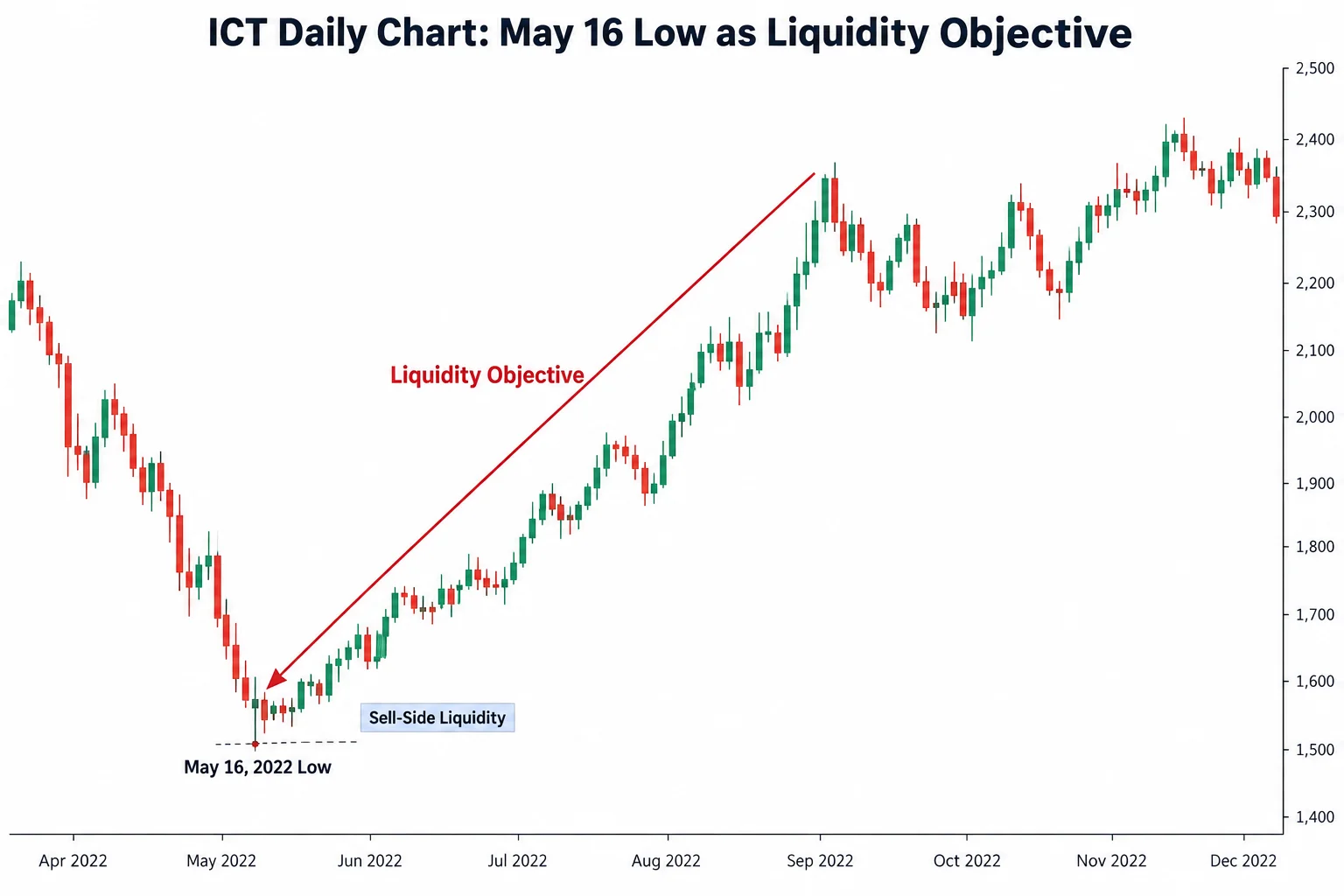
The central reference was the low from May 16, 2022. Around 3:07, ICT explains that when price is above an earlier low and he directs attention toward that low, he is treating it as a potential downside liquidity objective.
He describes his role as pointing students toward a possible destination rather than issuing a complete trade signal. He explicitly says that he is not providing everyone with a synchronized entry, stop, and target. In his presentation, students must still analyze the lower timeframe and decide whether a suitable setup develops.
The sequence taught in this episode can be summarized as:
- Identify an earlier low that ICT interprets as containing sell-side liquidity.
- Form a directional expectation that price may trade toward or through that low.
- Move to lower timeframes to look for bearish confirmation and an entry model.
- Define invalidation around nearby price structure rather than relying on the target alone.
- Manage exposure as price moves toward the proposed objective.
Using Fair Value Gaps to Target Liquidity
At 4:44, ICT addresses students who focus only on finding a setup at the market opening. His point is that a missed opening does not necessarily end the analysis: a later retracement into a fair value gap may offer another framework for studying continuation toward the same objective.
In ICT terminology, a fair value gap is a three-candle imbalance used to mark an area where price moved rapidly. Traders following this framework watch how price responds if it revisits that area. The transcript’s automated recognition occasionally renders the phrase incorrectly, but the surrounding discussion clearly concerns a fair value gap.
Refining the ICT Bearish Liquidity Setup
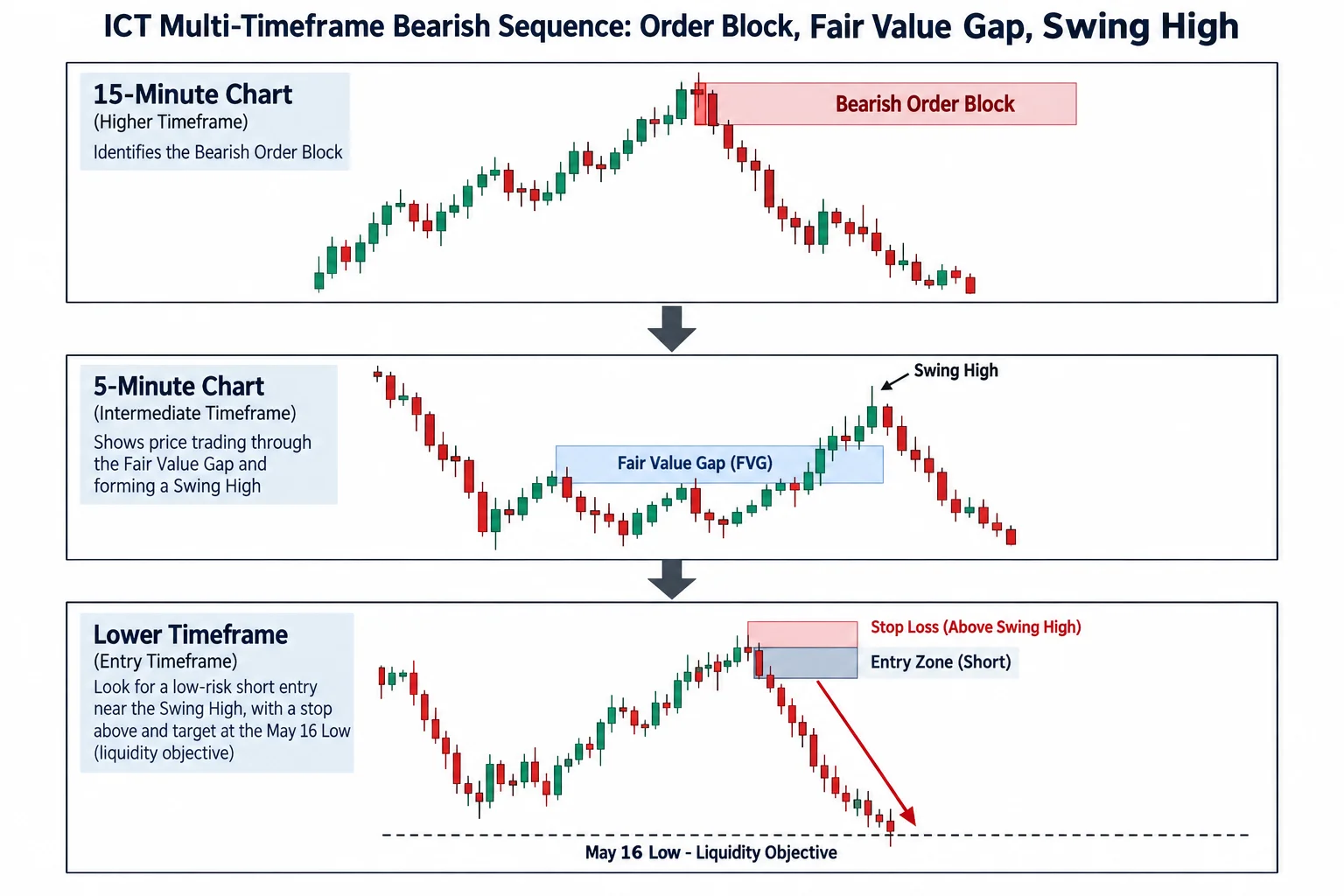
ICT then moves from a 15-minute chart to a five-minute view. At 5:52, he labels an up-close candle preceding a decline as a bearish order block. He says price returned to that area before moving lower.
On the lower timeframe, he describes price trading through a fair value gap and then forming a swing high. At 7:01, he combines those observations with his bearish expectation and the May 16 low as the objective. He says the nearby candle high could serve as the structural reference above which a stop would be placed.
ICT also reports entering four contracts and displays what he identifies as his executions. Because the source available here is an audio transcript without chart verification, those contract details should be understood as his account of the trade rather than independently authenticated fills.
Managing ICT Liquidity Trades Intraday
At 7:41, ICT says he adjusted his stop after price began moving lower aggressively. He attributes that decision to elevated volatility and characterizes it as risk management. He subsequently describes taking a partial exit and holding remaining exposure as the market continued toward the earlier low.
The later chart review highlights a recurring rhythm: decline, consolidation, a short move toward nearby stops, and another decline. Around 8:19, he identifies sideways action near the start of the New York lunch period and then points to additional imbalances and liquidity runs during the continuation.
Interpreting the 2022 ICT Mentorship Lesson
The most useful general lesson is the separation of destination from execution. A prior low supplied ICT’s directional objective, but it was not itself the entry signal. The proposed execution depended on lower-timeframe bearish structure, a fair value gap, a swing high, and a defined invalidation point.
This distinction can help organize chart review: first document the hypothesized liquidity target, then record the exact evidence that would support or invalidate a setup. It also prevents hindsight from turning every move toward an old high or low into an apparently obvious trade. The episode presents ICT’s discretionary interpretation, not a tested guarantee that price must seek a particular liquidity level.
More 2022 ICT Mentorship Resources
- Primary source: ICT 2022 Mentorship Episode 31 (YouTube)
- Fair value gap concept overview (Babypips) Unofficial third-party explanation; not tested or endorsed by BestProps.
- Order block definition (Investopedia) General reference; not specific to ICT's framework.
- E-mini S&P 500 futures contract specifications (CME Group) Official exchange reference for the instrument discussed.