Key takeaways
ICT 2022 Mentorship Episode 26 teaches real-time price interpretation using liquidity, fair value gaps, bullish order blocks, market structure and price delivery through a hypothetical S&P 500 futures long that runs against the stated daily bias.
Read the full summary
ICT 2022 Mentorship Episode 26 teaches real-time price interpretation using liquidity, fair value gaps, bullish order blocks, market structure and price delivery through a hypothetical S&P 500 futures long that runs against the stated daily bias. At 2 minutes 2 seconds, relative equal lows are breached to take sell-side liquidity after price enters a fair value gap, then price returns inside the range and shifts the expected draw toward buy-side liquidity above a short-term high rather than requiring a move to the day’s high. ICT adds near a bullish order block, places the stop beneath a recent low and states at 4 minutes 52 seconds that a return below it invalidates the premise. The management plan closes four of six contracts above the short-term high and reserves two for the more ambitious target. At 8 minutes 40 seconds, the higher of two down-close candles becomes another order-block reference, while larger candles and faster upward delivery are preferred to a slow drift. The nearer target is reached around 12 minutes 35 seconds, four contracts are removed, and the final two are stopped out after the stop is raised. The core practice is to define the expected destination, nearer and extended objectives, invalidation level and acceptable price paths before subsequent candles form, then review price behavior without focusing on fluctuating profit and loss. The example is hypothetical, caption transcripts do not verify executions or performance, and the lesson does not establish a repeatable trading edge or provide investment advice.
How we researched this article
BestProps used document-based research from primary firm sources, checked September 25, 2026. The complete source list, scope, limitations, and commercial-state record appear near the end of this article.
What ICT Teaches in Episode 26
In 2022 ICT Mentorship Episode 26 – Example Of Tape Reading Practice, ICT narrates a hypothetical long trade while marking his reasoning on a live chart. The lesson is less about reading a traditional transaction tape and more about practicing real‑time price interpretation through ICT concepts such as liquidity, fair value gaps, order blocks, market structure and price delivery.
The central exercise is to form a specific expectation before price reaches the intended target, identify what would invalidate that expectation and then observe how price behaves. ICT says the setup runs against his stated daily bias, making intraday evidence and risk management especially important.
2022 ICT Tape Reading Trade Premise
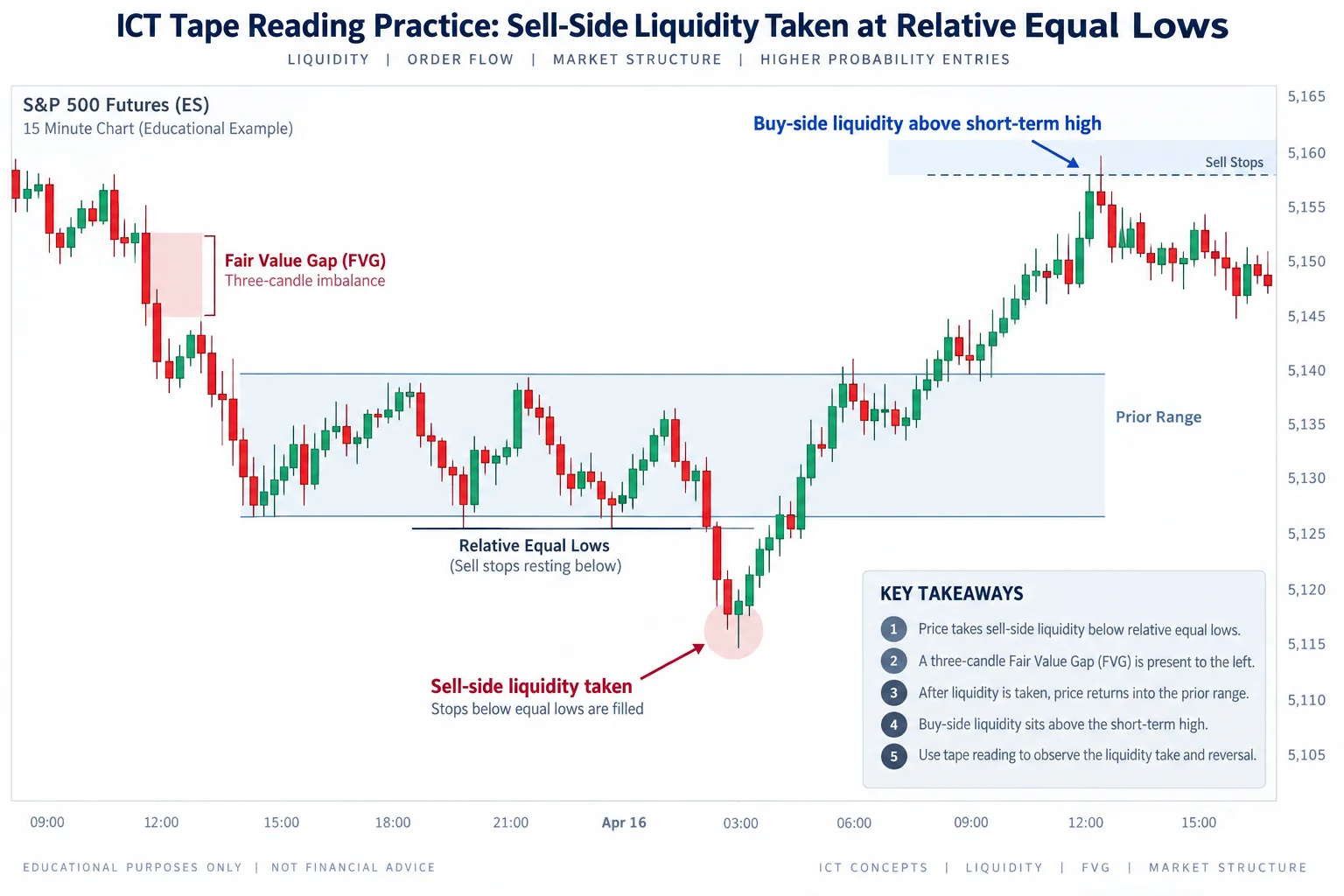
At 2:02, ICT identifies relative equal lows as a pool of sell‑side liquidity. He interprets the move below those lows as having taken the sell stops resting there. Price had also traded into what he labels a fair value gap before returning to the prior range.
From that sequence, ICT anticipates expansion upward toward a nearby pool of buy‑side liquidity. He distinguishes this practical objective from a more ambitious scenario involving the high of the day. His key point is that a trade does not need to reach the furthest conceivable target to satisfy the original premise.
ICT asks viewers to ignore the fluctuating profit‑and‑loss display and concentrate on price at 3:15. In his interpretation, the relevant sequence is:
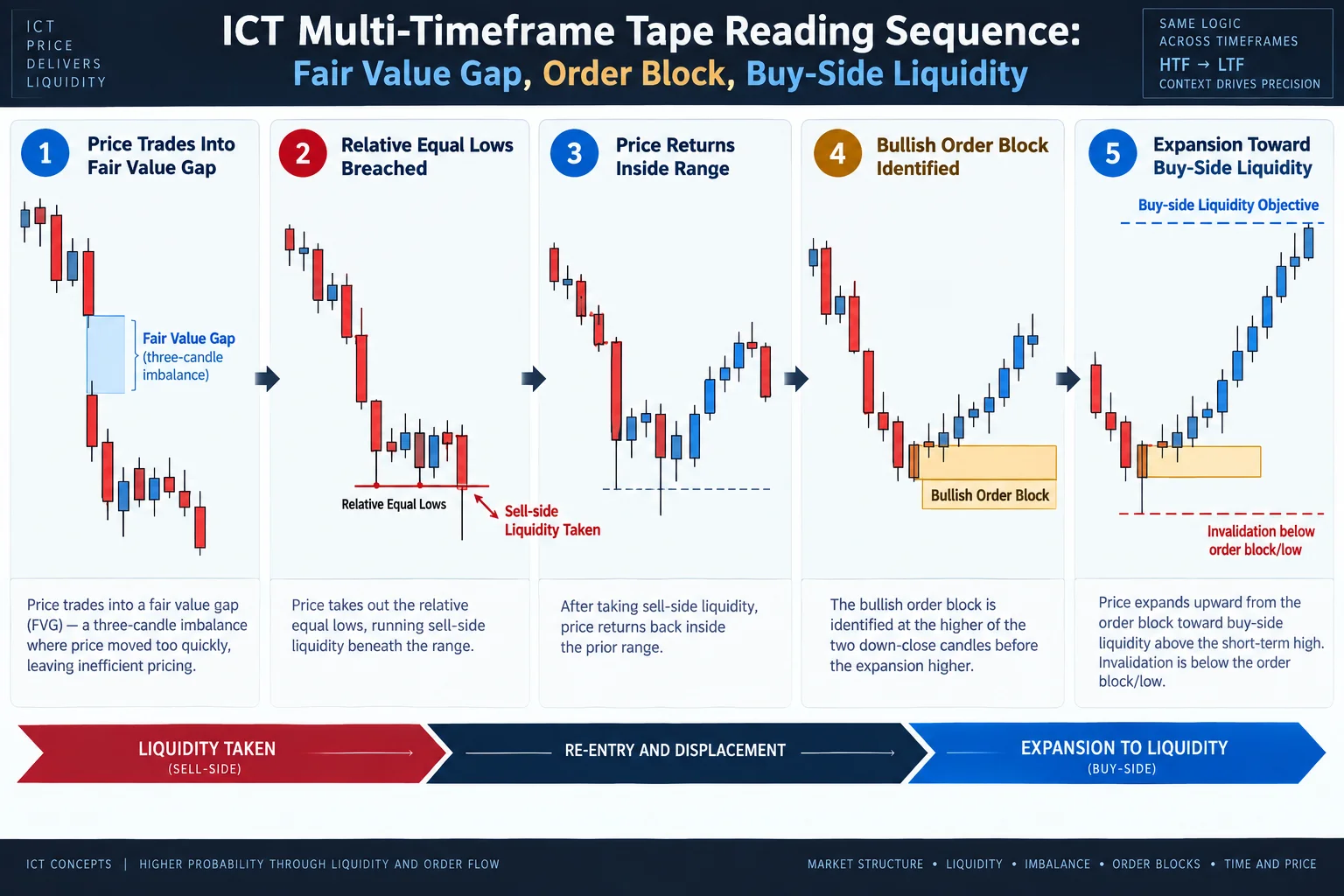
- Price trades into a fair value gap.
- Relative equal lows are breached, taking the identified sell‑side liquidity.
- Price returns inside the range rather than continuing decisively lower.
- Buy‑side liquidity above a short‑term high becomes his next draw.
ICT Tape Reading Position and Invalidation
Around 4:14, ICT explains why the lack of continued downside matters to him. He notes repeated intraday declines and a move below the previous day’s low, followed by limited follow‑through. He then adds to the hypothetical long position as price trades near a level he identifies as a bullish order block.
His stop is moved beneath a recent low. At 4:52, he states that price should not return below that area if his reading is correct. This provides a clear invalidation condition rather than leaving the idea open‑ended. He also connects the stop area to the lower portion of the fair value gap and an earlier short‑term high, which he treats as structural support for the premise.
For position management, ICT plans to remove four of six contracts after price runs above the marked short‑term high. The remaining portion is reserved for the more ambitious objective, if price continues. These quantities belong to the video’s hypothetical example and should not be treated as sizing guidance.
ICT Tape Reading Order Block Annotation
ICT draws and adjusts order‑block levels while the chart develops. At 7:51, he explains that a viewer can practice this kind of tape reading without placing even a demo trade. The educational task is to state an expectation clearly, mark the relevant levels and watch whether price confirms or invalidates the scenario.
At 8:40, he selects the higher of two down‑close candles as another order‑block reference. He allows for several possibilities: price could retrace into the candle, touch only its upper wick or turn higher without reaching it. This is presented as preparation for multiple short‑term paths, while the higher liquidity objective remains unchanged.
ICT says he wants to see decisive upward delivery (larger candles and speed) rather than a slow, uncertain drift. He interprets the down‑close candles as supporting price when an upward expansion follows at 11:02.
ICT Tape Reading Exit and Outcome
After price approaches the marked buy‑side objective, ICT raises his stop and reiterates his plan to close four contracts above the short‑term high. The transcript indicates that this target is reached around 12:35. He then leaves the remaining portion subject to the market rather than requiring price to reach the day’s high.
In the recap at 13:37, ICT describes the sequence as an initial entry around the fair value gap and sell‑stop run, an additional entry around the order block, a four‑contract reduction above the liquidity objective and a stop‑out on the final two contracts after the stop had been raised. He calls the displayed result hypothetical. Because the source is a caption transcript, it does not independently verify executions, fills or account performance.
ICT Tape Reading Practice Takeaways
The transferable practice is structured observation rather than prediction certainty. Before watching the next candles, a student can mark a liquidity event, state the expected destination, identify a nearer and a more ambitious objective, define invalidation and record what price actually does. Reviewing those observations separately from profit‑and‑loss fluctuations can help assess whether the original reasoning remained internally consistent.
This video documents ICT’s terminology and interpretation of one chart example. It does not establish that these concepts provide a repeatable trading edge, and it is not investment advice.
More 2022 ICT Mentorship Resources
- Primary source (ICT 2022 Mentorship Episode 26 (YouTube))
- Fair value gap concept overview (Babypips) Unofficial third‑party explanation; not tested or endorsed by BestProps.
- Order block definition (Investopedia) General reference; not specific to ICT's framework.
- E‑mini S&P 500 futures contract specifications (CME Group) Official exchange reference for the instrument discussed.