Key takeaways
ICT’s 2022 Mentorship Episode 24 uses the May 5, 2022 session and June 2022 E-mini Nasdaq 100 futures to teach that reaching relative equal highs, sweeping an old low, or touching a fair value gap does not create a valid setup without structural confirmation and displacement.
Read the full summary
ICT’s 2022 Mentorship Episode 24 uses the May 5, 2022 session and June 2022 E-mini Nasdaq 100 futures to teach that reaching relative equal highs, sweeping an old low, or touching a fair value gap does not create a valid setup without structural confirmation and displacement. For a bearish setup, price must trade above an old high or relative equal highs, then break a nearby short-term low energetically, form a fair value gap in that displacement leg, and later retrace into the gap for potential short-side entry logic. A second bearish approach begins when price enters a pre-existing fair value gap, after which the same structural shift, displacement through a nearby low, and new fair value gap are required. The long-side model is the inverse. In the session discussed, price swept liquidity below an older low near the nine thirty equities open but failed to displace back above it, instead consolidating and weakening on the five-minute view, so ICT concluded that the model never activated and no model-based entry existed. He tells students to study historical Nasdaq and S&P 500 charts, backtest, and paper trade rather than treat market observations as buy or sell instructions, emphasizing that missing a move is preferable to forcing an unconfirmed trade and that the transcript does not establish profitability, independently verify the chart, or document an executed trade.
How we researched this article
BestProps used document-based research from primary firm sources, checked September 25, 2026. The complete source list, scope, limitations, and commercial-state record appear near the end of this article.
In 2022 ICT Mentorship Episode 24, ICT combines a risk-and-responsibility discussion with a technical lesson on deciding whether a price-action setup has actually formed. The central message is that reaching an area of interest is not enough. Under the model ICT describes, price must also produce a particular sequence of confirmation (including displacement through a relevant short-term level) before there is a setup to study.
The episode uses a market scenario from May 5, 2022, but the captions alone do not show every chart detail or establish any trade execution. ICT ultimately says the conditions he wanted did not develop, making this primarily a lesson about filtering, patience, and accepting a missed move.
2022 ICT Mentorship Study Before You Trade
ICT begins by asking viewers to approach the mentorship as a structured learning process. At 1:59, he characterizes this stage as one of discovery: students should search historical charts for the pattern rather than immediately trade it, even in simulation. He also says that merely seeing several examples does not establish understanding.
This distinction becomes important because ICT had posted a community prompt directing viewers to watch Nasdaq and S&P 500 charts. He explains at 7:09 that the words “studying” and “watching” were not instructions to buy or sell. His stated purpose was to focus attention on a possible scenario that still required confirmation.
ICT repeatedly attributes responsibility for any executed trade to the person placing it. He frames his teaching as chart study, backtesting, paper trading, and market opinion, not individualized trade instructions. Whatever one thinks of his broader market claims, this episode clearly tells viewers not to convert an observation into an automatic entry.
ICT Setup Validation When Displacement Fails
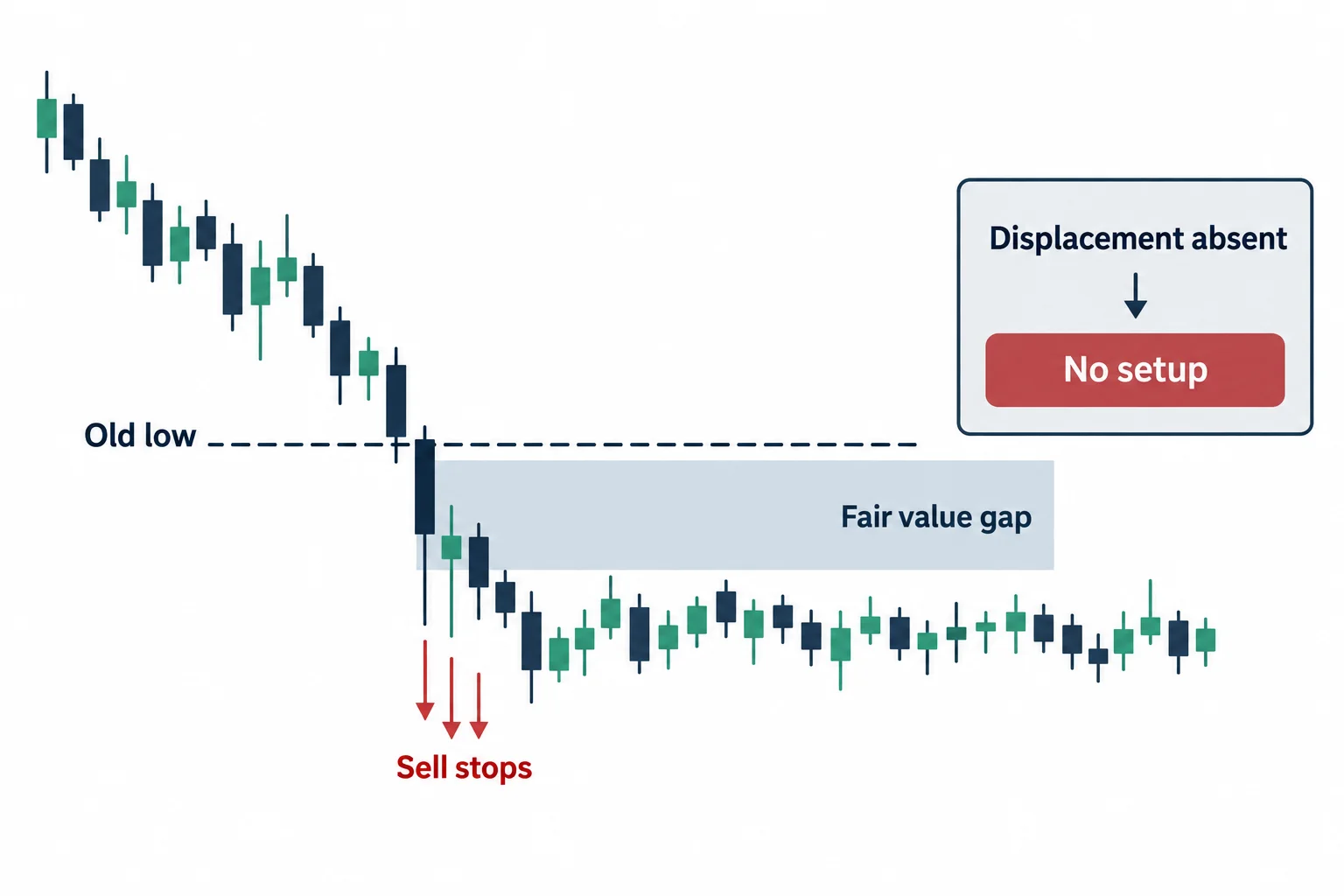
Beginning around 16:44, ICT discusses the June 2022 E-mini Nasdaq 100 futures contract. He says he had considered the possibility of price moving above relative equal highs and then turning lower. He presents this as a conditional expectation, not as something that necessarily occurred.
He also describes an earlier potential long-side sequence around the 9:30 equities open. Price was expected to move into an area he identified as a fair value gap, take liquidity beneath an older low, and then show an energetic move back above that low. In ICT’s terminology, that energetic repricing is “displacement.”
The first condition occurred: according to his narration, price moved below the prior low, where he expected sell stops to be resting. The required confirmation did not. At 22:35, he explains that price failed to displace back above the old low. A five-minute view likewise showed consolidation and continued weakness rather than an energetic reversal.
For ICT, that absence mattered more than the fact that price had entered the anticipated area. His interpretation was that the model never activated, so there was no model-based entry. The transcript does not independently verify the chart or test the model’s performance; it records ICT’s explanation of how he applied his own rules to that session.
Where ICT Bearish Trade Setups Form
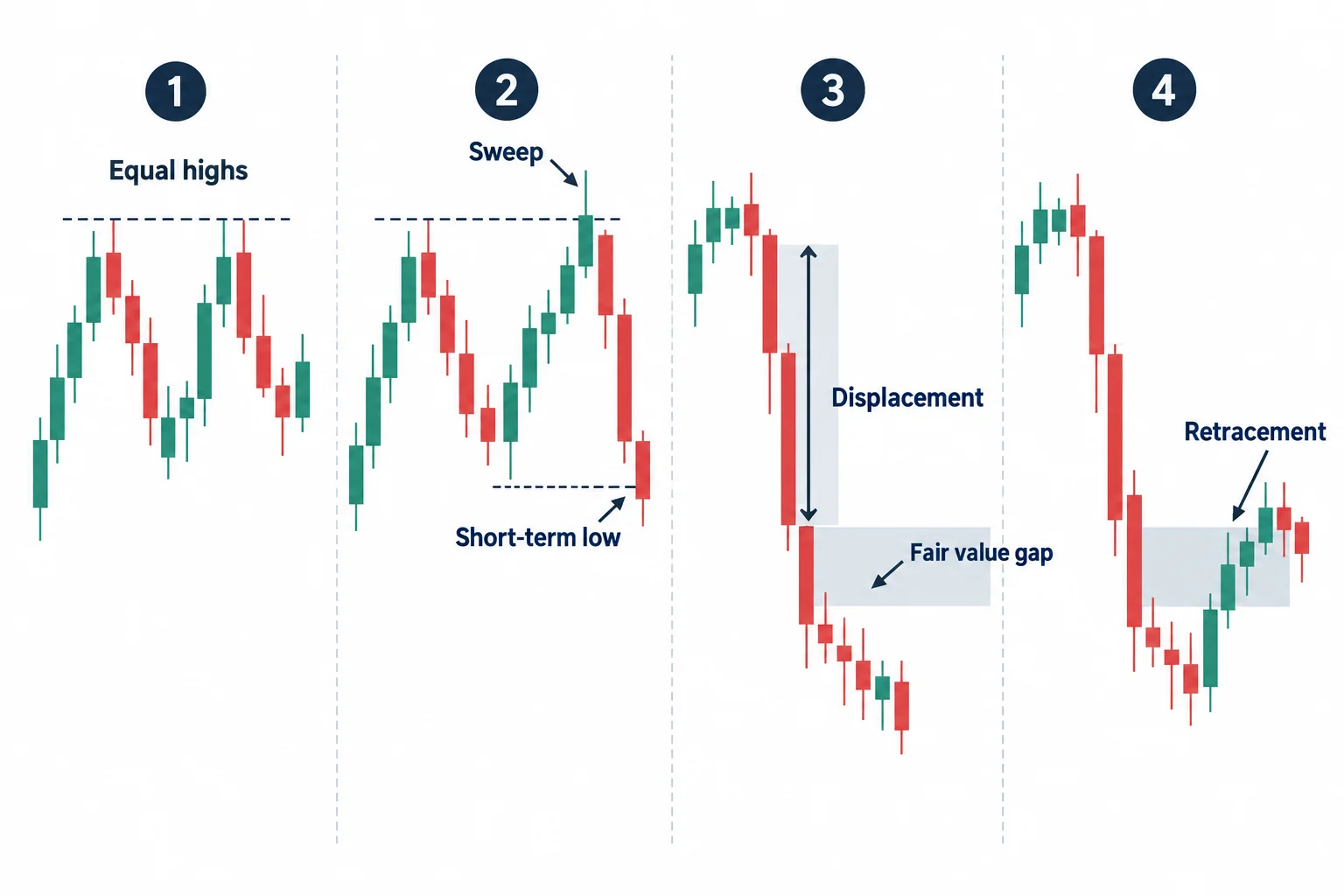
The more formal model lesson begins at 31:46. For a bearish example, ICT outlines this sequence:
- Price approaches and trades above an old high or a group of relative equal highs.
- The analyst identifies a nearby short-term low formed during the advance.
- Price must break that short-term low with displacement rather than merely drift below it.
- The displacement leg is then examined for a fair value gap.
- A later return into that gap becomes the location considered for the model’s short-side entry logic.
The key filter appears at 33:30: moving above relative equal highs is not sufficient by itself. ICT says there is no setup until price subsequently takes out the relevant short-term low with an energetic move.
ICT Fair Value Gaps as the Initial Reference
ICT then gives a variation in which price rallies into an older fair value gap while the analyst has a bearish outlook. He says the gap need not be completely filled. After price enters it, the analyst again looks for a structural shift and displacement through a nearby low. Only after that shift does the newer displacement leg become the area searched for another fair value gap.
At 37:01, ICT summarizes these as two entry approaches within the model: one beginning around relative equal highs and another beginning when price trades into a pre-existing fair value gap. The long-side version is described as the inverse, although the transcript does not provide the same level of step-by-step detail for it.
2022 ICT Mentorship Educational Takeaways
Separate from ICT’s specific terminology, the episode illustrates a broadly useful analytical principle: define both the location and the event that confirms a hypothesis. An area of interest answers where something might happen; a trigger defines what must happen before the idea qualifies under the rules. If the trigger never appears, the disciplined conclusion is “no setup,” not a retrofitted explanation after price moves.
The episode also emphasizes process over participation. ICT treats missing a move as preferable to forcing a trade that does not satisfy the stated model. Near 38:48, he reiterates that his prompts mean to study and observe recurring characteristics, not to interpret them as coded trade calls.
That does not prove the model has predictive value or profitability. A transcript cannot substitute for defined testing, complete chart data, costs, or independently verified results. The supported takeaway from Episode 24 is narrower: ICT says a liquidity move or fair value gap touch must be followed by displacement and structural confirmation, and the session discussed did not provide that sequence. This summary is educational commentary, not investment advice.