Key takeaways
Inner Circle Trader on the ICT YouTube channel presents a high-risk intraday equity-index long around the nine thirty open, combining a bullish daily bias, a swing-high break, a bullish fair value gap, a sweep of sell stops below a short-term low, and a return into the gap rather than treating the gap as a standalone…
Read the full summary
Inner Circle Trader on the ICT YouTube channel presents a high-risk intraday equity-index long around the nine thirty open, combining a bullish daily bias, a swing-high break, a bullish fair value gap, a sweep of sell stops below a short-term low, and a return into the gap rather than treating the gap as a standalone signal. ICT expects immediate upward displacement after entry, views a later small gap as potential support, prefers stop-loss orders but describes using a manual exit in this trade, considers moving the stop to breakeven, and says he would stop trading for the day if stopped out. A target limit order reportedly fills at about 8 minutes 41 seconds, and ICT claims two trades generated $1,255 before roughly $15 in commissions while discussing an illustrative goal of about 20% monthly returns. The instrument, exact levels, fills, balance, drawdown, and profitability are not independently verifiable from the captions, and the episode provides no mechanical exit rule or evidence that the setup is repeatable.
How we researched this article
BestProps used document-based research from primary firm sources, checked September 25, 2026. The complete source list, scope, limitations, and commercial-state record appear near the end of this article.
In 2022 ICT Mentorship Episode 15, ICT narrates a short intraday equity-index trade around the 9:30 opening. The lesson focuses on his interpretation of bullish market structure, a fair value gap, nearby sell-side liquidity and the volatility risks associated with the opening bell.
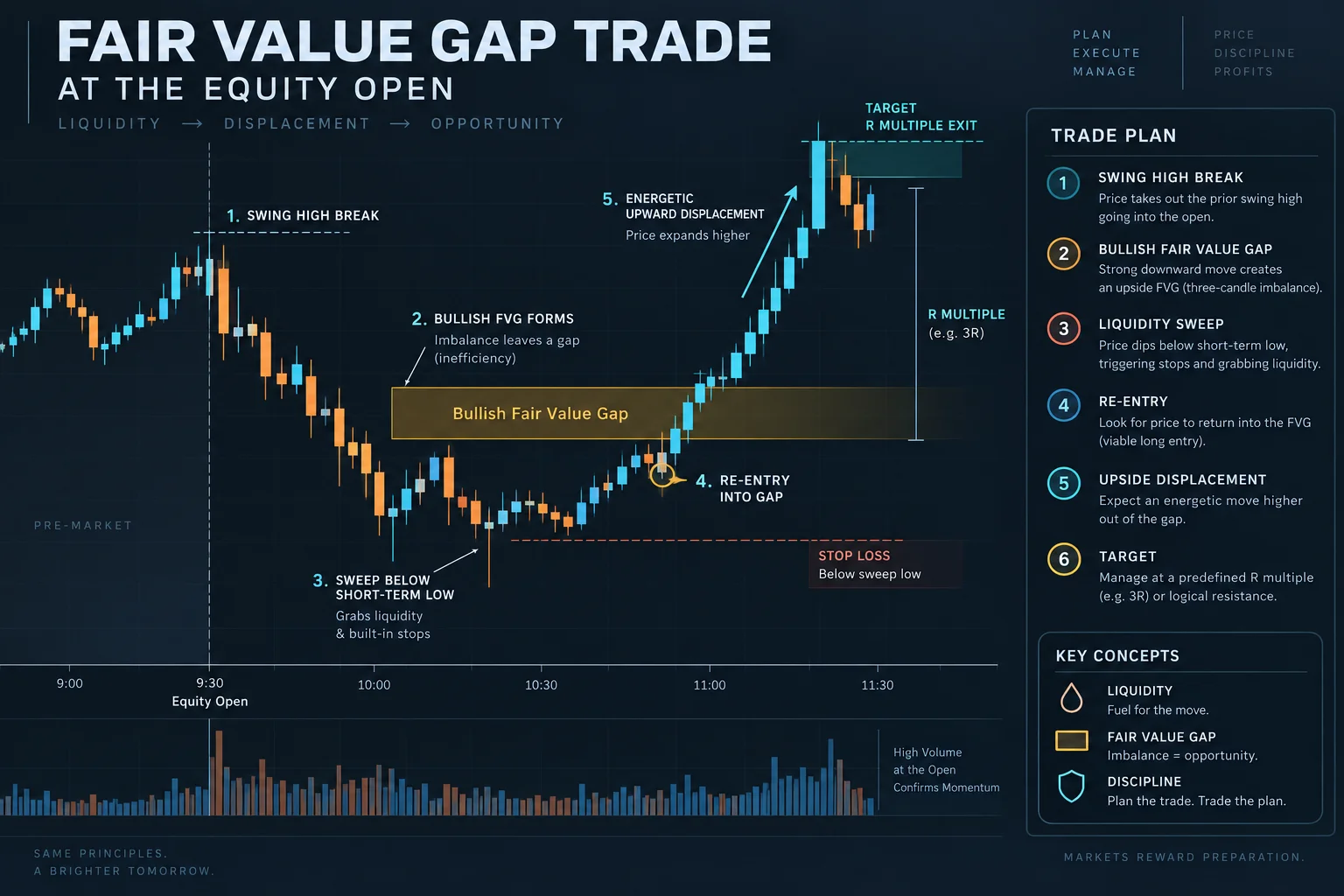
This is primarily a trade walkthrough rather than a complete introduction to the terminology. The captions also do not identify the instrument clearly, and the video’s unseen chart is necessary to verify its precise levels and order activity. Accordingly, the discussion below explains ICT’s stated reasoning without treating the setup as a demonstrated or repeatable trading edge.
ICT Fair Value Gap Trade Direction
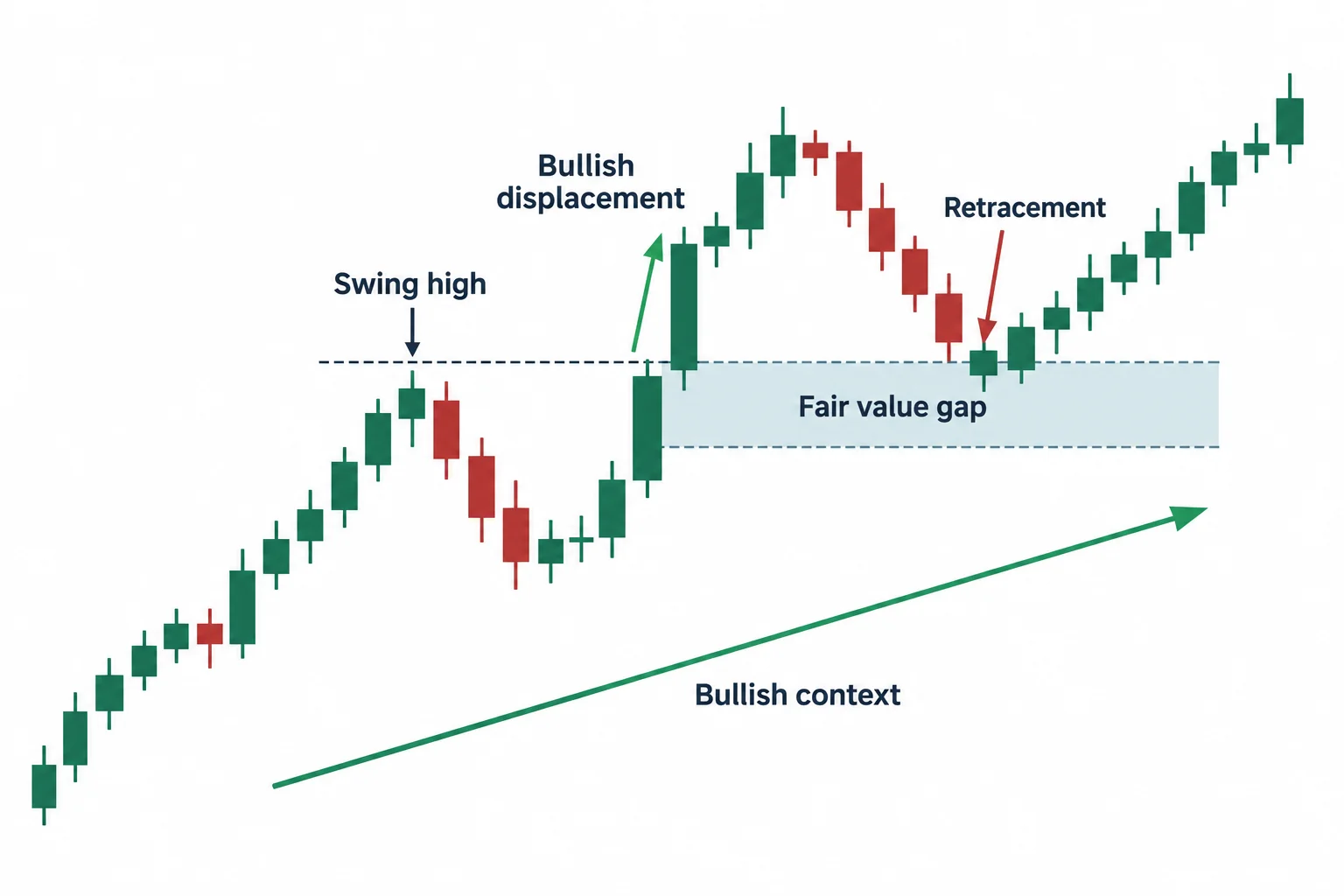
ICT begins by saying that he is watching for a swing high to break and for a potential fair value gap to form (0:28). After the break, he characterizes the intraday market structure as bullish and marks what he considers an imbalance on the chart (1:23).
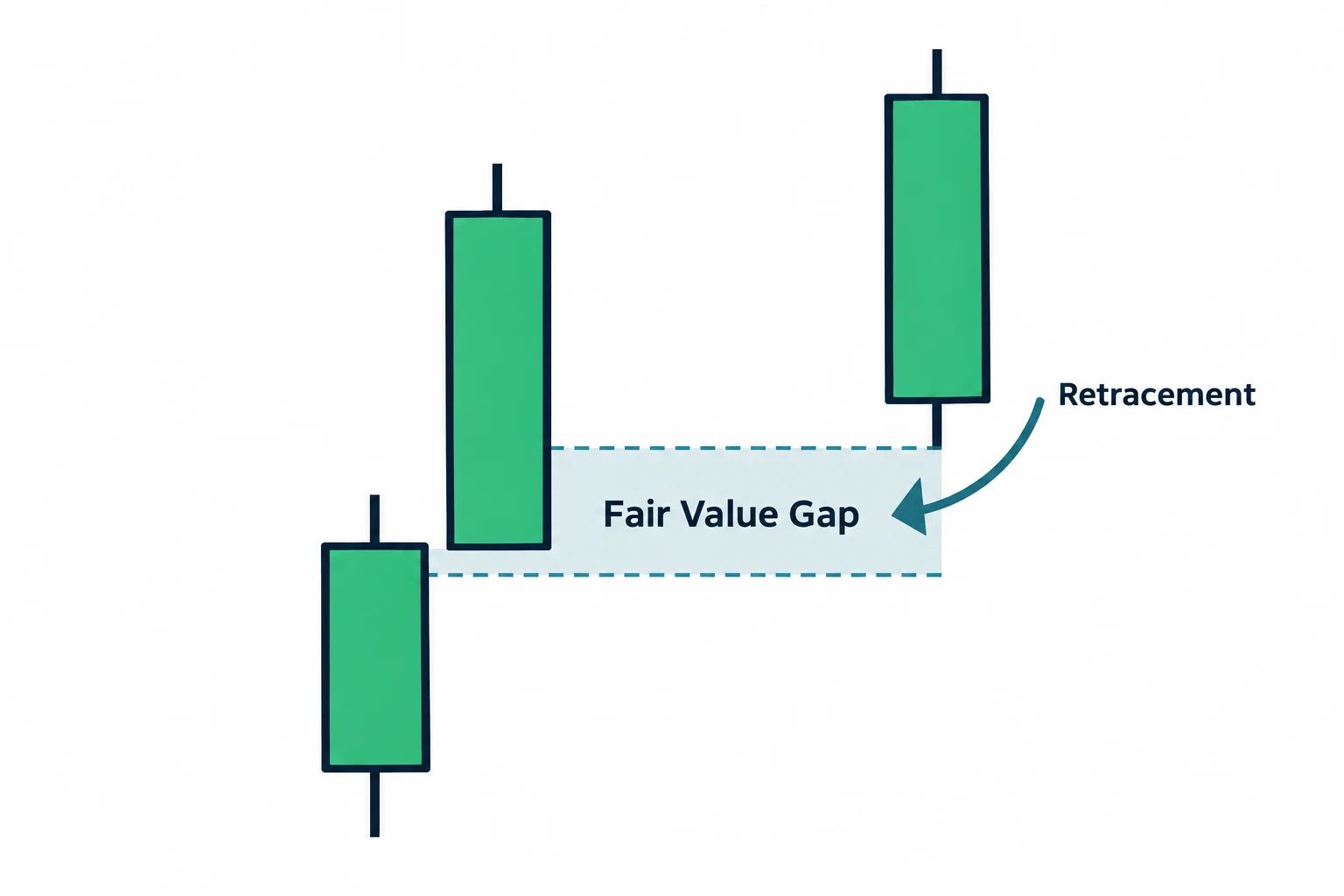
In ICT’s framework, a bullish fair value gap refers to an area created during a rapid upward movement where the surrounding three-candle structure shows limited overlap. He watches for price to return to that area after the bullish displacement. This is terminology from ICT’s own market model; the transcript does not provide an independent test of its predictive value.
He also states that his daily bias is bullish and that he is therefore looking for higher prices (4:01). This higher-time-frame expectation supplies the narrative behind the lower-time-frame setup. In other words, he is not treating the gap alone as an automatic entry signal.
ICT Trade Liquidity at the Equity Open
As price approaches the marked area, ICT considers whether it might first move beneath a recently formed short-term low. He reasons that traders buying early may place protective sell stops below that low. At 3:00, he cautions that the equity open can whip below such a level and leave an early long entry “painfully wrong.”
He then describes price as taking the sell stops below the low before returning to the fair value gap (3:40). Within his interpretation, that sequence supports a long entry because it combines:
- a bullish daily bias;
- a break of the nearby swing high;
- a newly identified bullish fair value gap;
- a move beneath a short-term low where he expects stops to rest; and
- a return into the gap after that liquidity event.
ICT explicitly calls the entry high risk. The key educational point is therefore not that any sweep below a low should be bought, but that he uses several contextual elements to construct the trade idea.
ICT Trade Expectations After the Fair Value Gap Entry
After entering, ICT says he wants to see immediate upward expansion rather than hesitant movement (4:32). He later identifies another small fair value gap in the upward candles and says that, if revisited, he would expect it to act as support (6:09).
This provides a practical invalidation concept: a setup expected to produce energetic displacement should be reassessed if price fails to behave accordingly. However, the transcript does not define a universally applicable time limit, price distance or mechanical exit rule.
ICT Trade Risk at the Equity Open
The most important caution in the episode concerns stop handling. ICT says he normally prefers a stop-loss order but, during this trade, is prepared to close manually if price moves below his chosen level. He also directly says that he is not encouraging viewers to trade without a stop (4:46).
From a general educational perspective, manual risk control creates execution risk: a trader can hesitate, lose connectivity or receive a worse exit than expected during fast movement. The episode documents ICT’s discretionary choice in that moment; it does not establish manual exits as safer than resting protective orders.
Later, ICT says he could move the stop to his entry and would stop trading for the day if taken out (6:42). He also mentions an economic-calendar event that the generated captions render ambiguously as “F1 see” and “FC.” It likely refers to an event associated with later volatility, but the exact term is not reliable enough to identify. His supported point is simply that equity traders should check the economic calendar and, in his view, finish early when significant volatility is expected later in the session.
ICT Trade Exit and Account Commentary
ICT places a limit order at his target and reports that it fills at approximately 8:41. He then states that two trades produced $1,255 before roughly $15 in commissions and says he will not trade again during the remainder of March. These are the speaker’s own contemporaneous account statements; the transcript alone cannot independently verify the fill, account balance, drawdown or net result.
Earlier, he describes the account as an attempt to illustrate an average return of about 20% per month. That is a personal performance-related claim, not a reasonable expectation established by this video. A single narrated session cannot demonstrate sustainable profitability, and no viewer should infer a performance promise from it.
2022 ICT Mentorship Episode 15 Trade Lesson
The episode shows how ICT links higher-time-frame bias with lower-time-frame structure instead of using a fair value gap in isolation. His sequence is: establish a bullish narrative, wait for a swing-high break and imbalance, observe a possible sweep beneath a short-term low, enter on the return into the gap, and then demand prompt displacement toward a predefined target.
2022 ICT Mentorship Episode 15 Resources
- Inner Circle Trader (ICT) YouTube channel Original source of the mentorship series.
- Smart Money Concepts overview (BabyPips) Independent educational summary of related market-structure ideas.
- Fair value definition (Investopedia) General finance reference for fair value, distinct from ICT's fair value gap usage.
- Economic Calendar (TradingView) Public resource for scheduled events, distinct from the specific “F1 see/FC” event referenced in the transcript.
This summary is for education only and is not investment advice. Futures trading involves substantial uncertainty, and expected displacement, targets and risk-handling choices in this transcript are examples from a single session, not predictions or guarantees.