How we researched this article
BestProps used document-based research from primary firm sources, checked September 24, 2026. The complete source list, scope, limitations, and commercial-state record appear near the end of this article.
In ICT 2026 Smart Money Concepts In Action \ January 06, 2026, ICT narrates a premarket paper-trading session and explains what he wants to see around the opening bell. His commentary centers on nearby liquidity, settlement references, an opening gap, and whether price can move through an overhead area without meaningful resistance.
The recording is best treated as a real-time illustration of ICT’s own market framework, not proof that the concepts provide a repeatable trading edge. The source transcript was generated by automated speech recognition and the chart was not available for independent inspection here, so some specialized labels remain uncertain.
Initial bullish idea and liquidity objectives
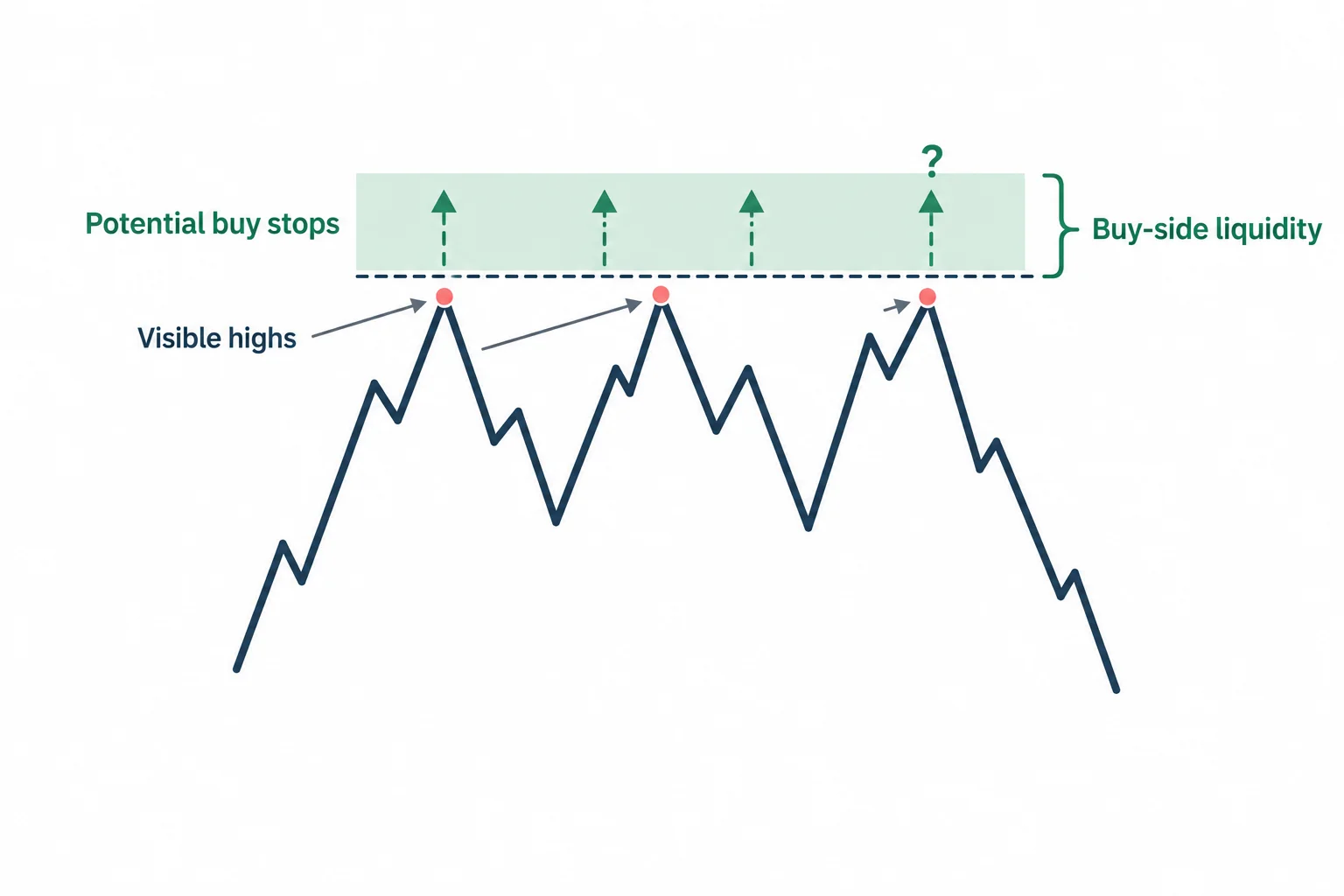
After explaining that the start of his recording was missed, ICT describes entering long on the candle following an earlier wick. At 3:13, he says he is interested in buy-side liquidity above the premarket highs and another set of relatively equal overnight highs. In ICT terminology, “buy-side liquidity” generally refers to an area above visible highs where buy stops may be resting.
He also points to an orange region above price and compares electronic-trading-hours information with the previous regular-session settlement. The automated transcript does not identify the orange region reliably, so its exact label is left to the video rather than inferred from recognition output.
At 4:40, ICT says he is watching whether a nearby area supports price or whether price trades through it. He does not consider a decline to the lower reference necessary before a move higher. This is a conditional scenario: continued strength would support his immediate bullish expectation, while a deeper move would weaken that particular path.
Settlement, the gap, and competing draws
ICT characterizes the morning as unusually difficult and says he is relying heavily on experience. Beginning around 5:08, he discusses the previous day’s regular-hours settlement beneath the market. He reasons that the opening configuration could create a gap that might attract price downward.
His preferred bullish behavior is for price to reject that lower objective. If the market does not return to the orange-shaded area, he interprets the overhead levels as the more relevant draws. In this context, a “draw” is ICT’s directional objective for where he believes price may seek liquidity or rebalance an inefficiency. It is an interpretive forecast, not a guarantee that price must visit the level.
He also notes that it is the first full trading week of the year and a nonfarm-payroll week, using those conditions to explain his caution. ICT says he generally waits until the second week of February before putting anything into the market. During this discussion, at 6:24, someone in the room corrects him after he says 2016 instead of 2026 — a reminder that the session was recorded live with other people present.
What ICT wants to see before the opening bell
Around 6:52, ICT describes behavior that would make a potential bull flag appear valid to him. He wants to see price take out a minor short-term high on a closing basis before he rolls his stop higher. The transcript renders one nearby liquidity term unclearly, but the surrounding commentary indicates that he is monitoring that minor high as an upside objective.
At 9:58, he turns attention to a green-shaded daily-chart area. The automated captions render its name as “suspension block,” which is quoted here as transcribed rather than translated into a definition. What is clear is the expected behavior: ICT wants price to pass through the zone with little resistance and then accelerate above the nearby minor high.
His emphasis is therefore not merely on price touching an objective. He wants displacement and follow-through — an assertive move through the marked region rather than a brief test followed by rejection. At 12:24, he observes a reaction and says price is running higher, while continuing to call for a forceful move through the green zone. He also says he would prefer the move to leave only a small portion of the prior candle open rather than fully overlap it.
Opening-bell management and paper-trading limitations
Immediately before the opening bell, ICT explains why he is not tightening the stop as aggressively as he might later in the session. At 13:09, he contrasts the volatile opening with a trade that has already spent 15 or 20 minutes establishing an opening range. He says that if the position is stopped, he will wait until 10:00 before trading again.
After price reaches the minor buy-side objective, ICT asks for follow-through rather than a simple touch. At 14:21, he identifies the tag; shortly afterward he says he is selling half of the position and rolling the stop.
The platform response becomes part of the lesson. ICT identifies the account as a TradingView demo or paper-trading account and complains that the partial exit is not displayed promptly; the transcript shows him waiting for the display before the half position is reflected. The account is simulated, so nothing here is a real-money fill, and the recording does not provide enough independently verifiable information to reconstruct the entry, exit, prices, position size or profit and loss. He adds a separate anecdote about an earlier occasion when stop and limit orders disappeared during a trade; that story is his recollection about the platform rather than evidence about this session’s outcome.
The session ends with ICT saying he will step away and return to watch the 10:00 hour.
General educational takeaway
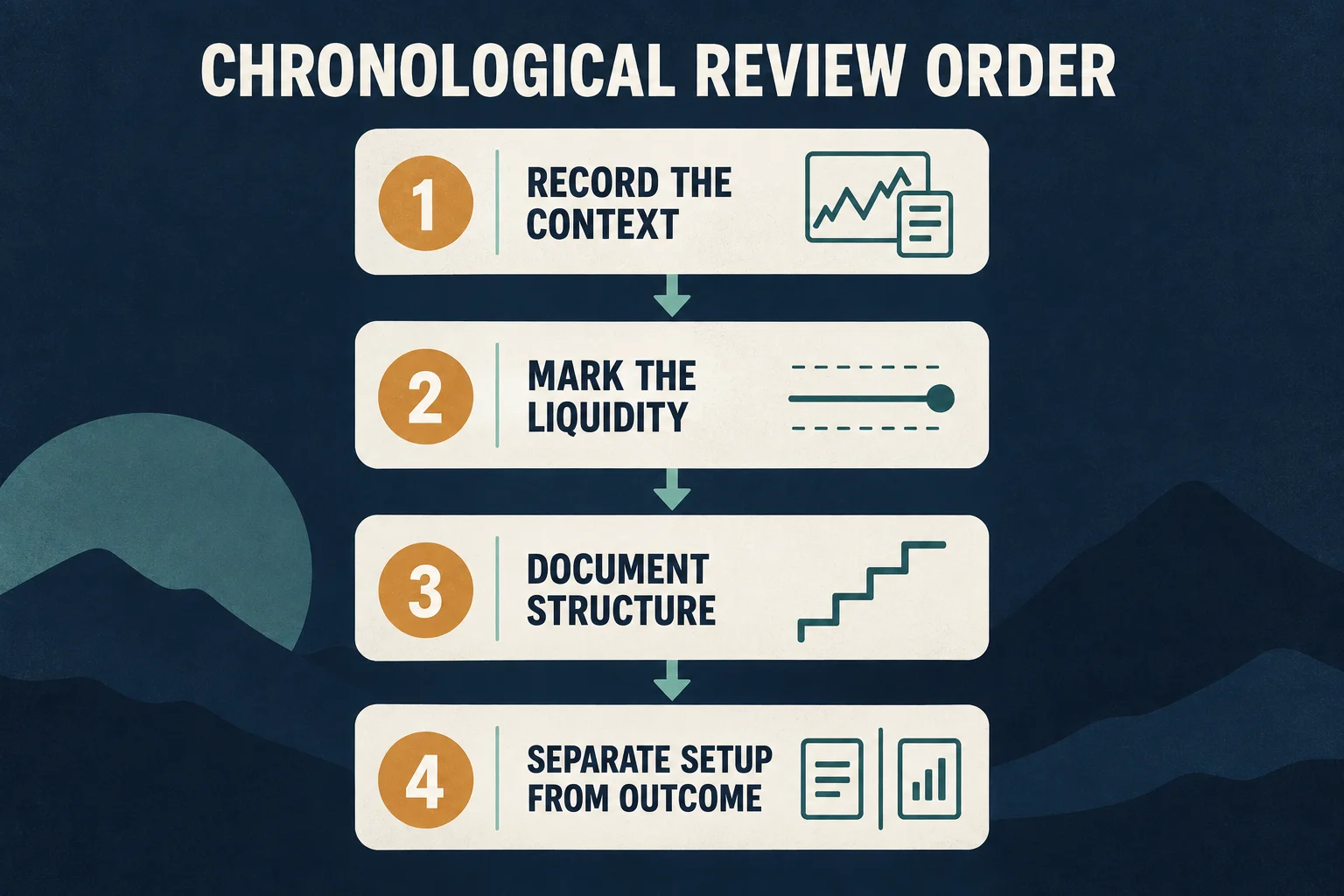
- Define competing reference points before the open, including settlement, gaps, session highs and overhead liquidity.
- Frame expectations conditionally: identify both the behavior that supports a scenario and the behavior that negates it.
- Distinguish a liquidity touch from sustained follow-through or displacement.
- Account for opening-bell volatility when considering stop placement.
- Do not assume a simulated order filled as intended merely because it was submitted; platform feedback and execution records matter.
These points summarize ICT’s interpretation of this specific session. They are educational observations rather than investment advice, and the recording does not establish the profitability or general reliability of the framework.
Date, transcript and source notes
The title carries January 6, 2026, while the upload’s own page, read on 2026-09-13, lists a publish and upload time of 2026-01-07 at 06:01:33 in the UTC−08:00 offset, a runtime of 1,006 seconds, 131,155 views and a category of Education, with the page public and not unlisted. The two dates describe the session and the publication: the recording is a premarket session that runs up to and just past the 9:30 a.m. Eastern opening bell, and inside it ICT explains that the microphone had not been on and that he had to restart the audio, which is consistent with a session published the following morning rather than a title that contradicts its upload.
The recording is also a live domestic setting rather than a studio lesson: children and dogs are audible and several lines are addressed to them, and the automatic transcript contains a handful of short filler phrases that carry no trading content. None of those passages is used here, and no chart value, marker, order or result is taken from the visuals, which were not viewed for this article.
Timestamps above come from automatic speech recognition of the recording’s complete audio (whisper-large-v3-turbo) rather than from uploader captions, so recognized words were checked against context. Two labels are deliberately left as transcribed rather than interpreted: the green daily-chart area rendered “suspension block” at 9:58, and the orange overhead region, which the captions describe only in damaged form at 3:38 and 13:34 (“first presence of everybody got from Friday”, “Friday’s first percent of everybody got low”) while the clean phrase “first presented fair value gap” appears at 0:10. What that orange zone actually is on the chart is left to the video. ICT does not state contract prices or exact levels aloud in the recording, so this article attributes none, and the paper-trade discussion is reported as his account of a simulated order rather than as an execution record.
Watch the original session on YouTube
This video cannot be played inside another website: the embedded player itself reports “Playback on other websites has been disabled by the video owner.” That response was read from the player on 2026-09-13 and again on 2026-09-14, so no player is reserved here and no embed is left blank. The recording is available directly on YouTube.
Watch ICT 2026 Smart Money Concepts In Action \ January 06, 2026 on YouTube ↗
Sources
Three references support this article: the mapped recording, the platform documentation behind the watch card, and the platform’s own explanation of how automatic captions are produced.
- [1] The mapped recording. ICT 2026 Smart Money Concepts In Action \ January 06, 2026, The Inner Circle Trader on YouTube. Watch-page metadata read 2026-09-13: public, not unlisted, publish and upload 2026-01-07, runtime 1,006 seconds, 131,155 views. Embedding is disabled by the video owner; re-tested from this site’s origin on 2026-09-14.
- [2] YouTube Help: Restrict embedding. The platform’s own documentation of per-video embedding controls, including blocking on all domains. It is the owner-side setting behind the message quoted in the watch card above. Google controls that page and can change it.
- [3] YouTube Help: Automatic captions. The platform’s explanation that automatic captions are generated by machine learning, that creators are encouraged to add their own, and that automatic captions may contain errors. This page’s timestamps come from local automatic transcription of the audio rather than from the uploader, and the same caution applies.
BestProps is not affiliated with The Inner Circle Trader, YouTube, Google or TradingView, and no source listed here endorses this article, this site or any setup. ICT terms used on this page — buy-side liquidity, draw on liquidity, fair value gap, suspension block and opening range — are quoted as the presenter’s descriptive language for third-party educational concepts and are not official definitions. The session described was a simulated account, and nothing here is investment advice or a claim about present market conditions.