How we researched this article
BestProps used document-based research from primary firm sources, checked September 14, 2026. The complete source list, scope, limitations, and commercial-state record appear near the end of this article.
Source note: this page is grounded in the timestamped transcript of the recording below — automated speech recognition of its full audio (local Whisper large-v3-turbo), not YouTube captions. The recording is a screen-recorded chart review; no chart imagery was available to the reviewer, so timestamp links point to what the speaker says, not to verified levels. Entries, fills and account results are not verified anywhere on this page.
What the recording is
Post US Holiday Monday Followup was published by The Inner Circle Trader on Monday, July 6, 2026, with a runtime of 22:45 and roughly 33,000 views when its watch page was read on 2026-09-14. It is a same-day follow-up, not a lesson: at 0:17 the narrator, publicly known as ICT, refers back to a lecture he recorded that morning with his son, and at 7:25 he says he will look at NQ only.

Two things make this recording worth reading closely. First, he states a specific participation rule for post-holiday Mondays and then admits he broke his own rule and lost on the day. Second, he spends the second half of the video refusing to give a forecast, framing everything as an if-then observation instead.
The rule he states, and admits breaking
His holiday argument starts at 1:19: when a US holiday is being observed, he expects money to stay on the sidelines for another day, and he says normal participation may not return until Tuesday or Wednesday. The concrete rule follows at 4:54: if a holiday that would close the banks falls on a Saturday or Sunday, he treats the following Monday as a “no-touch” day. At 11:53 he gives the operational version: read the tape, do not even demo trade it, and stay out, adding at 12:08 that a trader should give themselves permission to miss a move, because regret over a missed move is one of the worst habits a trader can develop (12:17).
Then he turns the rule on himself. At 5:39 he says he had laid out on X that these were days not to participate, and that he forced himself into the session anyway to see what he could do; at 5:34 he states plainly that he got it wrong and that this is acceptable. At 4:06 he notes that viewers watched an attempt that did not pan out and that he then mitigated it, and at 4:11 he says that had it become a second loss there would have been nothing to discuss — the correct response would have been to stop rather than force a larger mess. He also addresses viewers who reported losses that day at 6:17, framing the session as a lesson about when not to participate.
Why he says he had no strong bias
The chart half of the recording opens on the 15-minute timeframe. At 0:23 he says price did gravitate up into an inefficiency and breached its consequent encroachment slightly before returning to a fair value gap; at 0:42 he marks the reaction as a quadrant level and at 0:58 notes that price failed to reach the octant above the lowest quadrant.
The reason for his hesitation is positional. At 14:34 he measures the dealing-range high and low and demonstrates that the session opened almost exactly at the 50% level — equilibrium — which in his words means nobody can know with enough certainty to justify putting real money at risk (14:51). He had already conceded at 3:58 that he went in without a bias and forced himself to participate, and at 3:41 that being in the middle of a range makes strong conviction hard at the start of a week.
What he says he was actually watching
He is unusually explicit about how few references he used, in part to answer a criticism. At 15:44 he responds to a viewer who complained about “a lot of gray boxes” on the chart by counting them: a dealing-range high, a dealing-range low, a minor buy-side pool and a minor sell-side pool — nothing more. At 16:16 he points to the relative equal lows left behind and treats that minor sell-side area as still relevant, and at 17:01 he describes giving the full dealing range plus two internal inefficiencies, the lowest and the highest within the range.
His plan for the next sessions is stated as conditions rather than a prediction. At 16:36 he says that if price rolls over, takes out the lows and accelerates on a sustained run rather than dipping and recovering, he would want to see an attempt toward the lower inefficiency; at 17:59 he calls this explicitly an if-then statement, and at 17:47 he says that if price instead manages to reclaim the upper area he will treat that as the draw on liquidity. At 18:45 he adds that he could be entirely wrong and price could simply continue higher, in which case he would turn his attention to the upper side.
He also reviews what he did during the session: at 9:48 he explains that when price failed to close below the level he had favored, he switched gears and aimed for a run up into a 15-minute inefficiency instead, and at 10:27 that he wanted to see the area act as a sensitive price level using his event horizon. The afternoon sequence he narrates runs from a rally into a small pool of liquidity, a touch of the inefficiency’s low, a failure to reach consequent encroachment, and then a break lower into an old low (11:10).
Checking the holiday framing against published calendars
This is the part of the recording that can be tested. Under the Federal Reserve’s own Holidays Observed release, “for holidays falling on Saturday, Federal Reserve Banks and Branches will be open the preceding Friday” while the Board of Governors is closed, and “for holidays falling on Sunday, all Federal Reserve offices will be closed the following Monday”.[2] The New York Stock Exchange, for its part, observed Independence Day 2026 on Friday, July 3, and lists a normal trading day for Monday, July 6.[1] July 4, 2026 fell on a Saturday, which matches the recording’s own context at 5:01.
Two clarifications follow. First, describing the preceding Friday as a broad “bank holiday” is loose: under the Fed’s published rule the Reserve Banks stayed open that Friday while the Board of Governors closed, whereas the equity market did close. Second, and more important for a reader, “no-touch Monday” in this recording is a participation judgement about thin post-holiday conditions, not a statement that the market was closed — the Monday session existed and traded. Treating his rule as a calendar fact rather than a discretionary filter would misuse it.
Restraint as the actual lesson
The closing third of the recording is about behaviour rather than charts. At 6:44 he says traders need to recognise when probabilities have shifted against them and dial participation back; at 7:03 he suggests that anyone who cannot control that impulse should physically step away from the charts. At 13:50 he describes the period as the summer doldrums and advises looking for the rare session where everything aligns rather than participating daily.
At 20:52 his prescription for an opening in the middle of a range is to “submit to time” and let the market supply more information, even if that means taking a demo trade purely to stay in touch with the market, and at 21:16 he reduces the response to two options: change the opinion, or remove yourself. He acknowledges at 21:25 that doing nothing feels counter-intuitive for someone who wants to trade every day, and at 21:45 argues that a trader should want the model to speak clearly before acting, with the market itself providing the correction if they do not (22:11).
What the recording does not establish
The transcript documents commentary, not execution. It does not show the order ticket, the position size, the fills or the result of the attempt he says he mitigated, and no account statement appears. It cannot confirm that the levels he marks existed as described, because the charts themselves were not inspected for this page, and the automated transcript renders at least one recurring label inconsistently — a phrase repeatedly transcribed as a “first presented fair value gap” whose exact wording and meaning are uncertain, so no precise technical definition is asserted here from it.
Two categories of claim in the recording are his interpretation rather than established fact, and are labelled as such on this page. The first is market mechanics: his account of dealers “miscalled as market makers” who do not create the day’s high or low (2:54) and of price delivery as a scripted response to low-participation days (2:17) is his framework, not a demonstrated mechanism. The second is macro commentary, where at 19:38 he characterises the economy, market manipulation and geopolitical risk and calls those characterisations facts rather than opinions; they are assertions, and this page does not treat them as findings.
What is usable regardless of the terminology
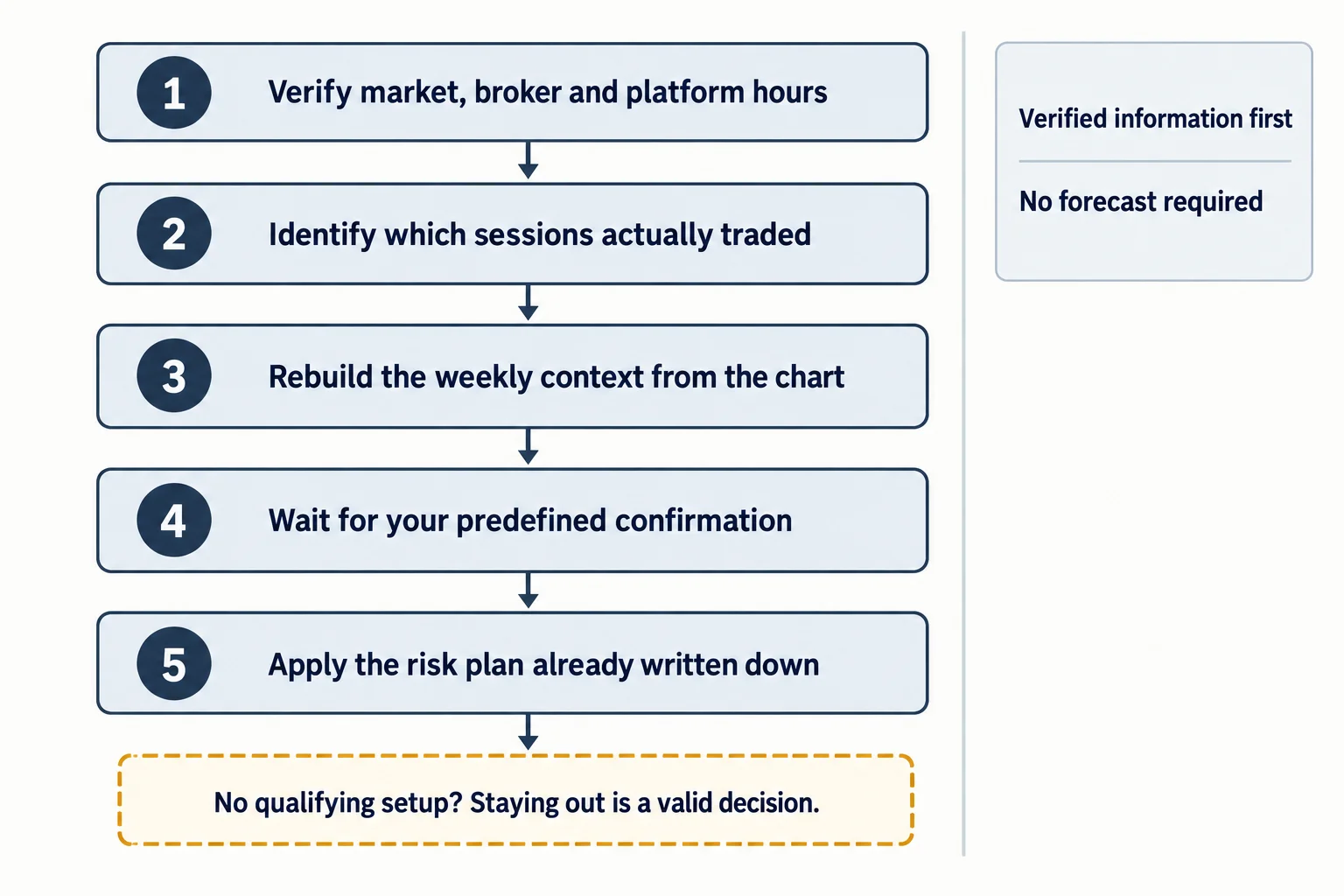
- Test the calendar claim before trusting the rule. Whether a given Monday is thin is checkable: the exchange calendar, the Fed’s holiday release and your own venue’s notices do not always agree, and the recording’s own reference point (a Saturday July 4, an observed Friday holiday, a normal Monday session) is a good example of a case where the schedule and the narrative differ.
- Write conditional plans, not forecasts. The if-then structure he uses here — sustained break versus reclaim, with a stated response for each — is a repeatable way to plan without committing to a direction.
- Note where the open sits in the range. An opening print at the midpoint is a specific, checkable condition, and his own conclusion that it reduced conviction is a useful data point rather than a rule.
- Cap attempts after a loss. His stated response to a second loss — stop rather than force a larger mess — is a pre-commitment that can be written into a plan before the session.
- Quote your own account limits. This site’s drawdown reference states that “a static drawdown floor is fixed from the starting balance” while “a trailing drawdown floor moves up after profits and usually never moves back down”, and warns that the comparison “is not a universal ranking” because rules vary by firm, program and account size.[3]
Related recording on YouTube
Watch the original video on YouTube
Playback on other websites has been disabled by the video owner, so the player cannot be embedded in this article. The same message appears when the player is tested directly from a BestProps page origin, so no player area is reserved here and no blank embed is left behind.
Sources for holiday schedules, this recording and funded-account limits
Three references were read directly on 2026-09-14 for this revision: the exchange calendar that governs holiday observance for listed markets, the Federal Reserve’s own holidays release, and this site’s drawdown reference. None of them reports an outcome for the session discussed, and none endorses this page.
- [1] NYSE: Holidays & Trading Hours (2026 list shows Independence Day observed Friday, July 3, and a normal session on Monday, July 6; read 2026-09-14)
- [2] Federal Reserve Board: Holidays Observed (K.8) — Saturday holidays keep Reserve Banks open the preceding Friday with the Board closed, and Sunday holidays close offices the following Monday (read 2026-09-14)
- [3] BestProps: Prop Firm Drawdown Rules by Calculation Method (static versus trailing floors; read 2026-09-14, page states its sources were checked August 1, 2026)
- [4] The Inner Circle Trader: Post US Holiday Monday Followup (published 2026-07-06, runtime 22:45; transcribed locally from its own audio for this page)
BestProps is not affiliated with The Inner Circle Trader, the Federal Reserve System or the New York Stock Exchange, and no source listed here endorses this article, this site or any setup. Terms such as fair value gap, inversion fair value gap, consequent encroachment, event horizon, dealing range and lay of the land are used on this page only as descriptive labels taken from the recording. The recording was transcribed from its own audio and reviewed against that transcript; nothing here demonstrates a tested, repeatable or profitable result, and no trade described in it has been verified. This article is educational commentary and is not investment advice.