Key takeaways
In Futures Commentary & Motivational Lecture — June 24, 2026, ICT reviews higher-time-frame markets and then moves into a long talk about process, study habits and risk.
Read the full summary
In Futures Commentary & Motivational Lecture — June 24, 2026, ICT reviews higher-time-frame markets and then moves into a long talk about process, study habits and risk. On the charts he describes the dollar index as bullish while revisiting analysis he says he published on June 7, links that to weakness in EUR/USD and GBP/USD, and works through crude oil, gold and silver and the NQ. He explains his “event horizon” reference as a midpoint measurement used for partial profit and decision-making rather than a prediction, argues that daily charts give context while lower time frames give repetition, and closes with the argument that a developing trader should be satisfied with a defined process: cut losses without revenge, limit video consumption, log lessons and questions, and put an hour a day into tape reading. Everything below paraphrases an automatically generated speech-recognition transcript of a 1 hour 43 minute recording. The charts were not available for verification, and nothing here is a recommendation to trade futures.
How we researched this article
BestProps used document-based research from primary firm sources, checked September 14, 2026. The complete source list, scope, limitations, and commercial-state record appear near the end of this article.
The market explanations and terminology below represent ICT’s own framework and interpretations. The transcript does not independently establish the accuracy, profitability or general effectiveness of that framework, and the charts shown in the recording cannot be verified from it.
Higher-time-frame market review
ICT opens with the US Dollar Index, describing it as bullish and returning to analysis he says he published on June 7 (2:13). In his account, he had expected a pullback into an inversion fair value gap and then a run up to take smaller buy-side liquidity and reach for roughly 101.977. Those are ICT-specific chart readings and a stated objective, not an independently verified forecast.
He connects a stronger dollar with potential weakness in EUR/USD and GBP/USD. For EUR/USD he discusses a prior low, a wick and the wick’s midpoint. The automatic transcript renders his term as “consequent encouragement”; in context the intended phrase is likely consequent encroachment, and the procedure he describes is to measure a wick from its open to its extreme and use the halfway point as a reference. He says a close below that midpoint would increase his confidence in lower objectives.
The GBP/USD review begins at 5:01, where he describes price having reacted to an inversion fair value gap and repeats that traders should not demand perfect exits: reducing exposure near an anticipated low or midpoint is presented as an alternative to insisting that price reach the most distant objective.
What ICT calls an “event horizon”
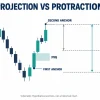
At 6:10 he answers questions about his “event horizon” concept. In this lecture it is built by anchoring a Fibonacci tool between two chosen price levels and keeping only the 50% mark, which he treats as a candidate reaction area and a place to make management decisions rather than a prediction.
- The level can be used as a predetermined partial-profit reference.
- A reaction there may indicate a pause, although he says he does not know in advance how price will behave on arrival.
- Within his framework, a close through the level can increase confidence in a farther target.
- When two midpoint measurements sit close together he treats the result as a zone rather than one exact price.
He returns to the idea during the NQ discussion at 27:02, anchoring between an older high and another reference to locate a halfway point. His stated lesson is that reaching that area should trigger a decision — reassess the stop, consider a partial, avoid an all-or-nothing exit that depends on the final target.
Crude oil, metals and the NQ
In the crude-oil segment at 9:39 he says he has lost interest in tracking the market but still wants to make an observation: price is considerably lower than when he said he would look for it to fall on June 7. He discusses volume imbalances, old lows and inefficiencies as longer-range objectives, and shows a chart setting that he says changes where a volume imbalance appears. He also states that the tool is not a one-click trading solution and that a trader still needs a directional thesis and an interpretation of price.
Gold and silver follow at 13:14. He reviews downside objectives he had previously discussed and argues that a trader holding a profitable bearish idea should consider realising gains rather than waiting for the furthest objective. The transcript refers to specific chart levels, but it cannot confirm what was visible on the charts, whether any order was filled, or what happened afterwards.
The NQ section begins at 17:51. He works across daily, 15-minute and one-minute charts and refers to relative equal highs and lows, imbalances, an opening range and what the transcript renders as a “suspension block”. He also narrates short and long management decisions. Because the transcript cannot separate every practice-mode action from a live brokerage execution, these remarks are treated here as a description of his lesson rather than as verified trade records.
Higher time frames give context, lower time frames give repetition
At 34:44 he explains why he studies both daily and intraday charts: daily charts establish directional context, but their setups unfold too slowly to provide frequent practice, while lower time frames supply more observations and repetitions even though they can feel psychologically faster because more candles print.

Later he applies a midpoint idea to the previous day’s range and to individual wicks, saying that in a bearish context a shallow retracement remaining in the lower half of the prior range can support a continuation thesis. He presents this as his interpretive model, not as a statistically tested rule.
The motivational section: process before payout
From 53:18 the lecture turns to behaviour. He argues that a beginner does not have to hold every idea to its final target, and that closing a trade between the entry and the objective is not a failure when discomfort or experience says otherwise.
His main points in this part of the recording:
- Trading ideas concern probabilities, not certainties.
- A losing transaction should be accepted without retaliation and without abandoning risk controls.
- When performance deteriorates, return to the basic question of where price may reasonably be drawn next.
- Focus on executing a defined process instead of rushing toward income goals.
- Keep leverage and expectations controlled rather than seeking rapid account growth.
- Do not let approval on social media dictate decisions or encourage extra risk.
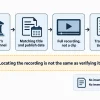
At 1:39:53 he gives a concrete routine: no more than two videos a day, log what was learned and the questions the video raised, and subscribe to at least an hour a day of tape reading (1:40:39). Where live observation is impossible he suggests recording the screen and watching it later without first checking the outcome, precisely so the review is not shaped by knowing what happened. That exercise reduces hindsight bias; it still cannot reproduce the pressure of live execution.
Educational takeaway
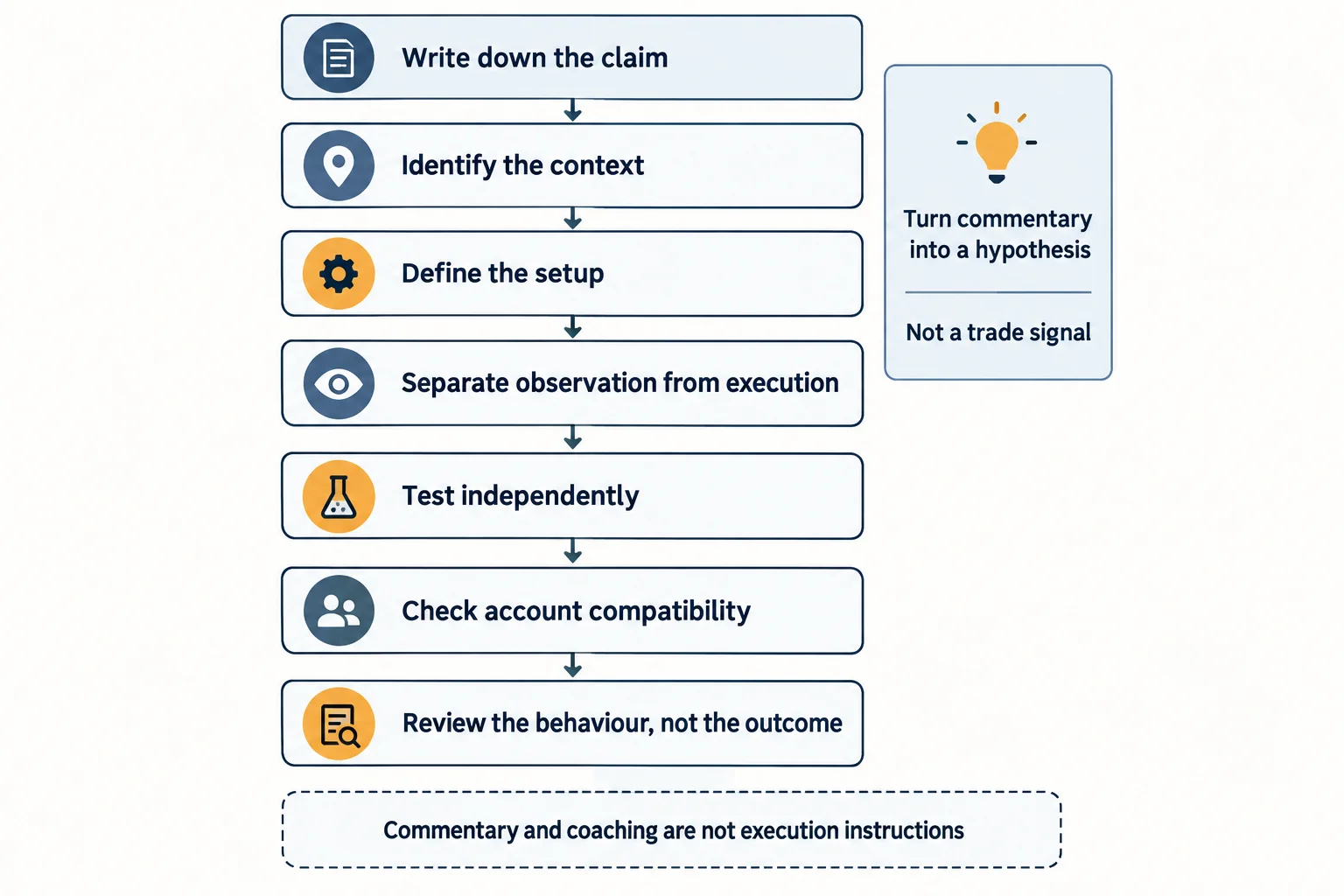
The transferable content of the recording is not any single projected price. It is the separation of analysis, management and psychology: directional context and candidate objectives first, midpoint levels as decision zones second, and an explicit acceptance that uncertainty remains. A useful exercise with material like this is to write the thesis down beforehand, define what would weaken it, and assess the process afterwards instead of treating one favourable chart sequence as proof of a durable edge.
This page paraphrases an automatic speech-recognition transcript of the recording. Specialised terms and numbers may contain recognition errors, no visual chart verification was performed, and the recording’s claims about forecast accuracy, market influence or student outcomes are not adopted or repeated here as facts. Neither are the political, historical and financial allegations that appear in parts of the lecture; they are outside the market-teaching content and would need independent sourcing.
Related source video: Futures Commentary & Motivational Lecture — June 24, 2026
The recording discussed above is Futures Commentary & Motivational Lecture — June 24, 2026 on the channel The Inner Circle Trader, with a stated runtime of about 1 hour 43 minutes. Every attributed statement and timestamp on this page comes from its automatic transcript. The upload date is a separate fact from the date of any chart example shown inside the recording, which the transcript does not establish.
Watch the original recording on YouTube
This recording cannot be played inside another website. A playback test of the embed markup used on this page, run on 2026-09-14, returned the player’s own surface “Video player configuration error” with error code 153 and a prompt to watch the video on YouTube, so no player area is reserved here and no blank embed is left behind. The recording remains available directly on YouTube.
Official sources for reviewing trading commentary
Two sources are cited, both published by the U.S. regulator that oversees commodity futures: how the CFTC expects the public to treat tips and social-media material, and where its current consumer guidance is indexed. Neither reports anything about this recording, states a market level, or endorses this page.
CFTC: understand the products before reacting to internet hype
The CFTC’s customer advisory on reacting to internet hype advises the public to research and understand how commodity futures, physical and securities markets differ, along with the risks of speculative trading, before acting on tips or other information communicated through social media.[1]
The same advisory describes how large numbers of individual speculators entered commodity products after posts on message boards and social platforms, producing brief but dramatic price swings, and notes that there are many more posts about individuals losing some or all of their money than posts about gains.[1] That is why commentary like the lecture summarised above is treated on this page as a claim to examine rather than as a verified result.
CFTC: the current advisories index
The CFTC’s Learning Resources and advisories index gathers its consumer publications in one place, including Futures Market Basics, so current official guidance can be read at the source rather than through a summary.[2] Both links were re-checked on 2026-09-14.
Two third-party links that the previous version of this page carried — a lecture-archive blog post and a social-media thread — were removed rather than left unverified. Neither was read first-hand for this article, neither is a primary source for the recording, and nothing on this page depends on them.
On third-party ICT and SMC indicators: any indicator, script or tool marketed under names such as “ICT” or “Smart Money Concepts” is an independent third-party product, is not official Inner Circle Trader material, is not endorsed by the video creator, and has not been tested or recommended by BestProps. No such product is named or linked here, no result is reported for one, and no claim is made that any of them would have improved any decision described above.
BestProps is not affiliated with The Inner Circle Trader, and no source listed here endorses this article, this site or any setup. ICT, inversion fair value gap, consequent encroachment, event horizon, volume imbalance, relative equal highs and lows and suspension block are used on this page only as descriptive study terms for what the speaker says. Nothing here claims that any level predicts price, that any of the described techniques was verified on a live or funded account, or that any approach produces a reliable result, and nothing here is individualised investment advice.
Sources
- [1] CFTC: Customer Advisory – Understand Risks and Markets before Reacting to Internet Hype (read 2026-09-13; link re-checked 2026-09-14)
- [2] CFTC: Advisories & Articles / Learning Resources index (read 2026-09-13; link re-checked 2026-09-14)
- [3] YouTube: Futures Commentary & Motivational Lecture — June 24, 2026 – The Inner Circle Trader (source recording; automatic transcript used, player tested 2026-09-14)