Key takeaways
ICT’s March 31, 2022 First Year Trading Expectations lesson emphasizes survival, risk control and rule compliance over returns.
Read the full summary
ICT’s March 31, 2022 First Year Trading Expectations lesson emphasizes survival, risk control and rule compliance over returns. He advises using one model, one contract and preferably one satisfactory setup before stopping, with a personal ceiling of about two trades per session or four per day. ICT claims his live‑account exercise doubled over three months despite two drawdown periods, while March was intentionally lighter and aimed at roughly a 20 % objective, but these results are not independently verified. He frames breakeven as a respectable first‑year outcome and warns against over‑leveraging, excessive trades, commissions, revenge trading and increasing activity after a win. Traders should predefine entry, invalidation, risk, exits, monthly objectives, losing‑day limits and trade‑count limits, monitor progress over a meaningful series, preserve mental capital when real money creates emotional attachment, and study live price movement, bias, liquidity, order blocks and fair value gaps rather than copying ICT’s trades without context.
How we researched this article
BestProps used document-based research from primary firm sources, checked September 25, 2026. The complete source list, scope, limitations, and commercial-state record appear near the end of this article.
In Real Money Real Results – First Year Trading Expectations Part 3 of 3, uploaded March 31, 2022, ICT reviews what he describes as the third month of a live-account exercise. Although he discusses account statements and on-screen trading records, the central lesson is not a particular setup. It is that a new trader’s first challenge is controlling risk, trade frequency, expectations and emotional reactions.
The figures and results in the presentation are ICT’s own claims. The captions alone cannot independently authenticate the account, statement PDF, executions or later performance. More importantly, ICT repeatedly frames the exercise as his opinion about what may be possible at the high end, not as a typical or promised first-year outcome.
First Year Trading Review and Discipline
ICT begins with a disclaimer that his expectations are personal opinions rather than a “Lamborghini lifestyle” promise. He says March was intentionally lighter because he was taking a break and planned to stop after reaching an objective of roughly 20%. He then scrolls through what he presents as a statement and its PDF version so viewers can compare the files (00:01).
As he reviews the month, his recurring instruction is to follow one model, select trades carefully and finish once the planned opportunity is complete. At 04:24, he summarizes the desired routine as finding a setup, entering, exiting and being done. He contrasts that restrained process with the excitement-seeking behavior that can turn trading into repeated, casino-like activity.
ICT argues that excessive transactions create two problems at once: more opportunities to make execution mistakes and a growing commission burden. He suggests a personal maximum of two trades in one session or four across the day, while emphasizing that this is his opinion rather than a universal rule (06:18). His preferred discipline exercise for a beginner is to stop after one satisfactory setup instead of immediately looking for another trade.
Why Money Discipline Comes Before Trading Setups
After presenting his calculation of March’s result, ICT says the account had experienced two drawdown periods during the three-month exercise. He claims that it nevertheless doubled over the period, but he also acknowledges that a limited run cannot prove a durable edge or rule out luck. The transcript does not provide enough information to reconstruct or independently audit those results.
The more transferable section begins at 10:28. ICT says the precise logic behind every setup is secondary to the first live-trading hurdle: respecting account equity. He defines drawdown in practical terms as a decline caused by accumulating losses and distinguishes a sudden drop from gradual erosion. Both can be emotionally difficult, particularly for someone who has only practiced in simulation.
His broader point is that trade size and frequency should leave room for mistakes. He says he used one contract in the exercise and criticizes overleveraging as a fast route to account failure. Later, he characterizes his displayed result as the upper end of what he would expect, not a baseline that students should assume they will reproduce (39:45).
Why Breakeven Is a Strong First Year Result
One of the video’s more measured observations is that an early breakeven period need not be treated as failure. ICT describes a trader whose equity rises modestly, returns toward its starting point and repeats that pattern without suffering a catastrophic loss. In his interpretation, that pattern may show that some self-control already exists, even if execution and consistency still need work (40:04).
He also connects trading style to temperament. A person’s patience, decision speed and emotional reactivity can affect whether a rapid intraday approach or a slower position-based approach is manageable. This is presented as ICT’s mentoring opinion, not a validated personality test. The useful educational takeaway is narrower: a method must be operationally compatible with the person expected to follow it.
How Real Money Changes Trading Decisions
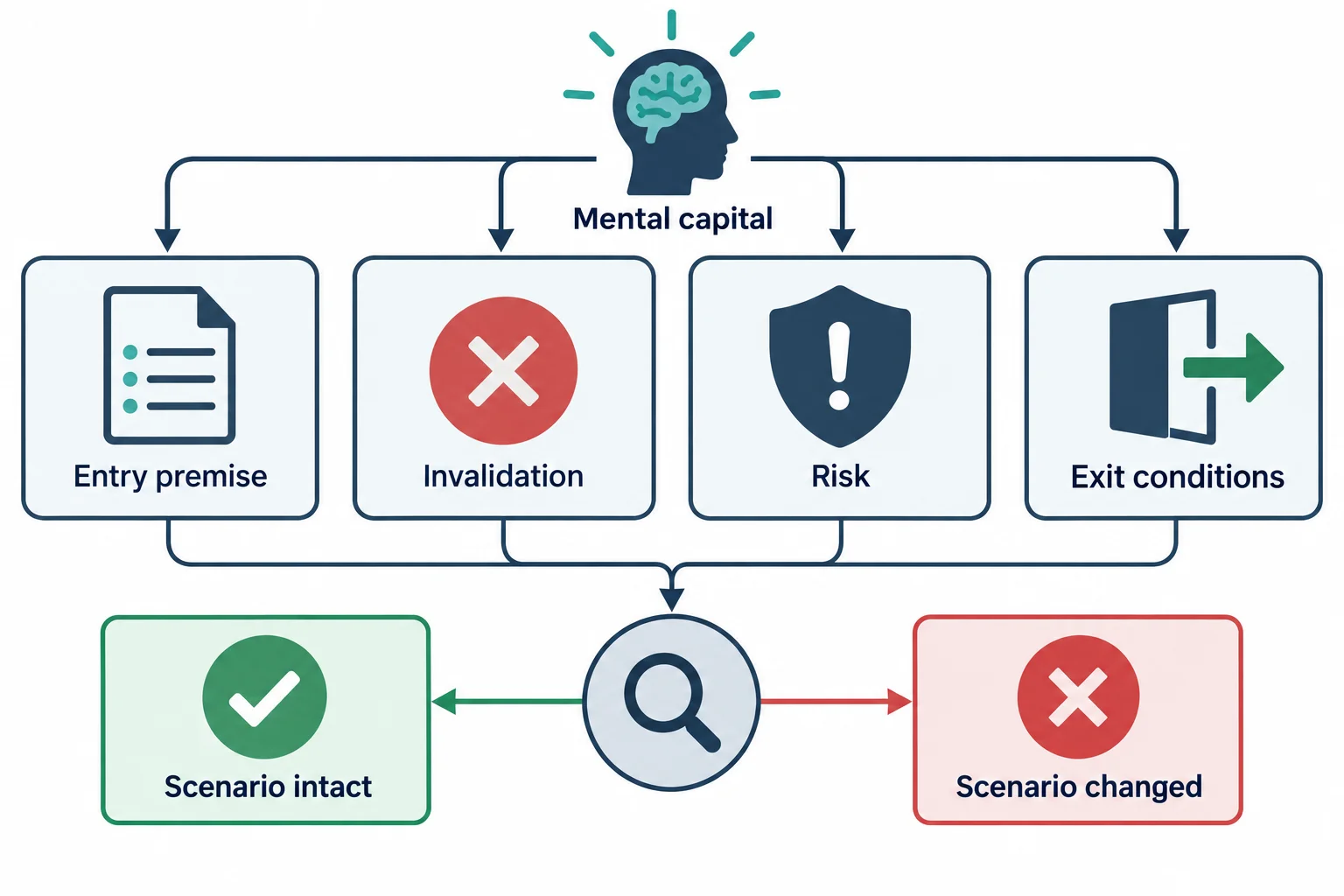
ICT warns against assuming that success in a demo account will transfer seamlessly to a funded account. Once gains and losses carry dollar values, a trader may hold a losing position because they do not want their first trade to fail, or remain in a position after the original premise has weakened. He calls the attention consumed by hope and emotional attachment “mental capital” (44:01).
His proposed response is to focus on whether the original scenario remains intact rather than on whether the trade is currently profitable. This portion should not be read as a universal instruction to exit whenever discomfort appears; anxiety can arise even when a predefined plan remains valid. A safer educational interpretation is that entry, invalidation, risk and exit conditions should be decided before emotional pressure makes them harder to apply.
Why Trading Discipline Matters After Winning
ICT’s strongest recurring theme is that limits are needed during both losses and winning streaks. At 47:43, he says traders should set realistic monthly objectives and stop when those objectives are reached. He rejects the idea that an unusually easy run is automatically a reason to increase activity. In his account, pushing harder after success can lead to an initial loss, emotional retaliation and a chain of poorly justified trades.
- Set a maximum number of trades before the session.
- Track commissions and other friction rather than looking only at gross results.
- Define limits for losing days and profitable periods.
- Evaluate progress over a meaningful series, not by demanding profit every day.
- Treat drawdown behavior and rule compliance as core first-year measurements.
These are general educational interpretations of the discussion, not individualized financial advice or evidence that ICT’s claimed results can be replicated.
Study Price Before Copying ICT Trades
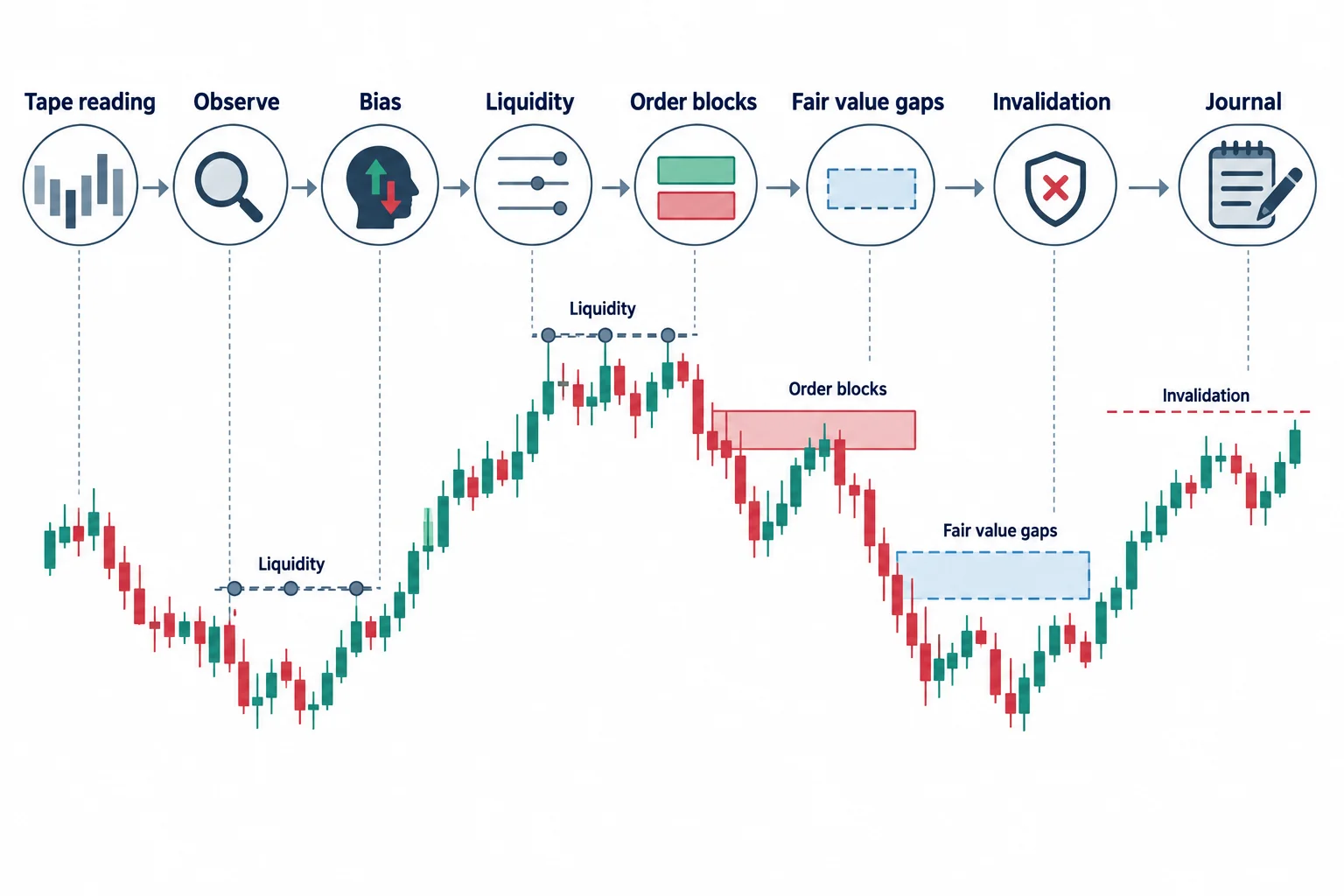
ICT explicitly discourages viewers from copying his future live commentary. He says doing so creates dependency because viewers cannot know the purpose, risk or context of an example (30:10). Instead, he advocates observing live price movement without immediately placing trades, forming a directional expectation and identifying what would invalidate it.
He calls this “tape reading,” although in this video he uses the term broadly for reading chart-based price action rather than providing a formal order-flow definition. The captions mention concepts such as bias, liquidity, order blocks and fair value gaps, but this session does not establish or test their predictive validity. Its supported lesson is that recognizing a pattern in a static example is different from interpreting changing conditions in real time.
Realistic First Year Trading Expectations
Near the conclusion, ICT says the first three months should reveal weaknesses in execution, patience, organization and rule-following. His displayed performance is described as an aspirational ceiling, while breakeven is presented as a respectable starting point. That distinction matters more than the headline return: the video’s defensible educational message is to survive the learning period, limit exposure, document behavior and avoid turning an ambitious example into a personal requirement.