Key takeaways
ICT’s Real Money Real Results First Year Trading Expectations Part 2 reviews purported February 1–28, 2022 account activity to emphasize live-trading behavior rather than teach strategy or establish representative returns.
Read the full summary
ICT’s Real Money Real Results First Year Trading Expectations Part 2 reviews purported February 1–28, 2022 account activity to emphasize live-trading behavior rather than teach strategy or establish representative returns. ICT generates and scrolls through a PDF statement while comparing broker and laptop times, but the transcript cannot authenticate balances, fills, transactions, document origin, or the ambiguously captioned final return calculation. Key guidance includes accepting individual losses without abandoning risk limits, practicing cautious execution after a chosen fair value gap, order block, optimal trade entry, or breaker setup, exiting quickly to study hesitation, and avoiding slippage, costs, prolonged trades, and uncontrolled repetition. After substantial February 14 drawdown, ICT recommends returning to the rules, taking one preferred setup, then moving aside. To counter revenge trading after a missed move, he suggests limiting the next day to 1 or 2 trades, warns that more than 3 trades invites trouble in this example rather than as a universal rule, and advises stopping entirely for observation or tape reading when discipline deteriorates. The supported takeaway is to identify a model, execute cautiously, review behavior, reduce frequency after rule violations, and protect the account, not to treat one displayed month as proof of typical first-year profitability or future performance.
How we researched this article
BestProps used document-based research from primary firm sources, checked September 25, 2026. The complete source list, scope, limitations, and commercial-state record appear near the end of this article.
In Real Money Real Results – First Year Trading Expectations Part 2 of 3, ICT reviews what he identifies as February 2022 account activity. The presentation is less a strategy lesson than a discussion of the behavioral problems a developing trader may encounter when moving from simulated practice to live execution.
ICT begins with an important qualification: the results represent his opinion about what a student might eventually accomplish by applying his teaching, and he explicitly says that not everyone will obtain the same results. The transcript alone cannot authenticate the account, reveal the statement’s figures, or establish that the experience is representative.
Why ICT Displays Real Money Trading Results
During the opening minutes, ICT selects a February 1–28 date range, creates a PDF and compares the time shown by the broker interface with the time on his laptop. He then scrolls through the resulting document. He says that this uninterrupted process is intended to answer viewers who doubt the material and that a downloadable statement was linked in the original video description.
This portion is visible in the video beginning around 0:23. However, captions only record what ICT says while displaying the material. They do not independently verify balances, transactions, fills or the document’s origin.
How First Year Trading Losses Shape Expectations
At approximately 4:12, ICT argues that traders should become comfortable seeing losing transactions. His point is not that losses should be ignored. Instead, he describes them as events that require attention without being interpreted automatically as proof of personal failure or the end of a trading career.
That distinction matters. Accepting that individual trades can lose is different from accepting unlimited losses, abandoning risk limits or assuming that recovery is inevitable. ICT later emphasizes the need to avoid destroying the account, although the transcript does not provide a complete risk-management framework.
Balancing Trade Execution and Overtrading in the First Year
The central lesson begins near 6:18. ICT says a newer trader may struggle to find a personal rhythm and may hesitate even after recognizing a setup. In his interpretation, direct execution experience is necessary because live trading creates psychological pressures that are absent or reduced in demo trading.
ICT describes a specific exercise for someone who is afraid to place a live order: enter after the chosen setup appears, exit quickly once the transaction is recorded, accept the associated cost and then study what happened afterward. He presents repetition as a way to reduce execution anxiety. He also refers to several possible setup labels (fair value gap, order block, optimal trade entry and breaker) without teaching those concepts in detail here.
This suggestion should not be separated from his repeated warnings. At 9:54, ICT says the trader must be careful not to blow the account or remain in trades too long. Earlier, he calls some of the high-frequency activity overtrading and says such days are undesirable.
Separating Trade Execution Practice From Overtrading
- Execution practice: A deliberately defined exercise intended to observe hesitation and order-entry behavior.
- Overtrading: Repeated activity without adequate control, including attempts to force a result after feeling that a move was missed.
- Rule-based participation: Waiting for a selected setup, limiting activity and accepting that some sessions may produce no trade.
These categories are an educational interpretation of the discussion, not evidence that frequent live orders are necessary or appropriate for every learner. Transaction costs, slippage and losses can accumulate, and the transcript supplies no tested protocol for sizing such exercises.
Managing First Year Trading Drawdown With Smarter Execution
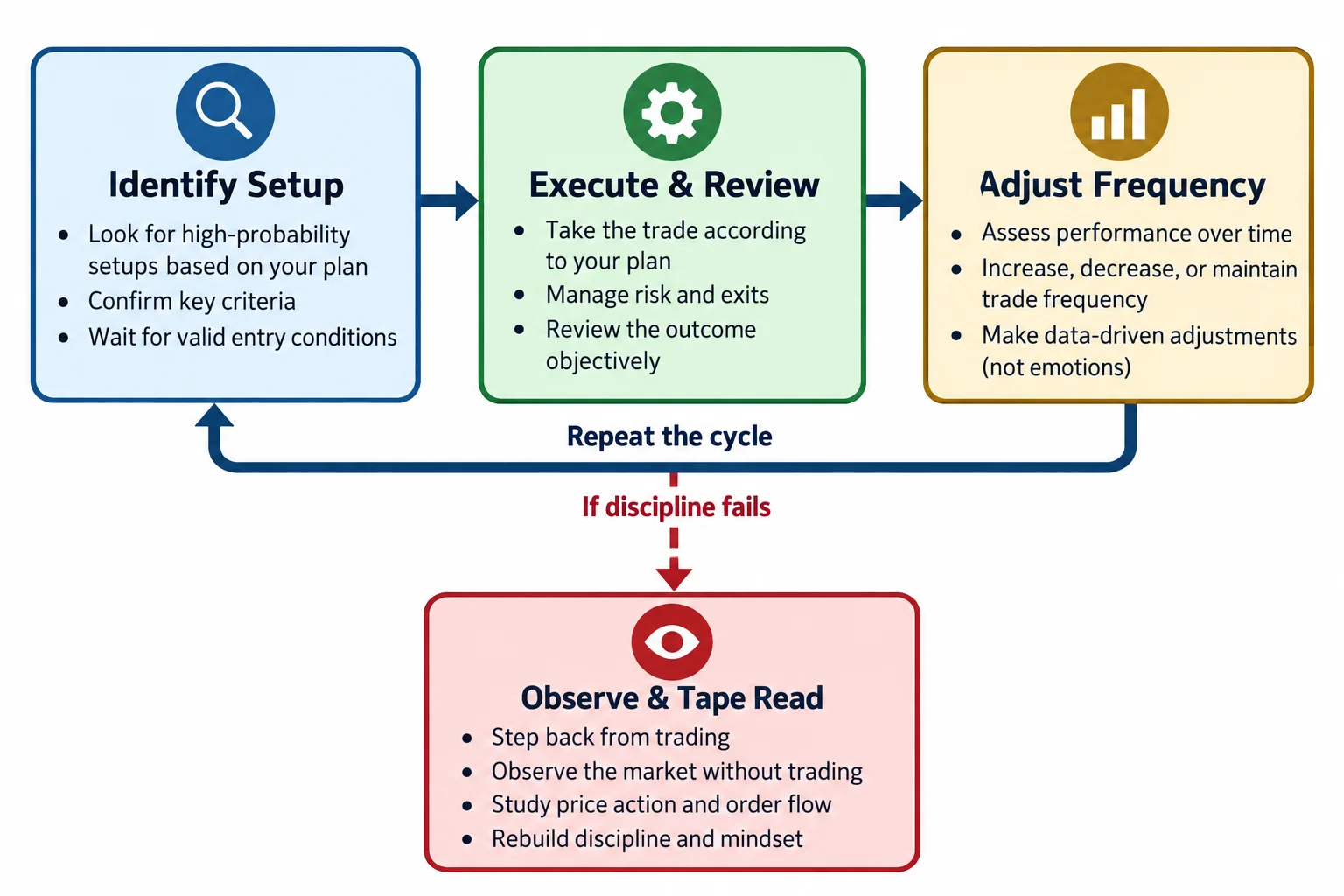
Around 10:30, ICT points to substantial drawdown on February 14 and says the appropriate response is to change gears. He describes returning to the rules, taking one preferred setup and then moving to the sidelines.
He subsequently discusses a day that began with a losing trade but, according to his narration, ended with a small net gain. No exact figures are available in the captions, so neither the transaction sequence nor the outcome can be independently reconstructed from the transcript.
How First Year Traders Stop Revenge Trading
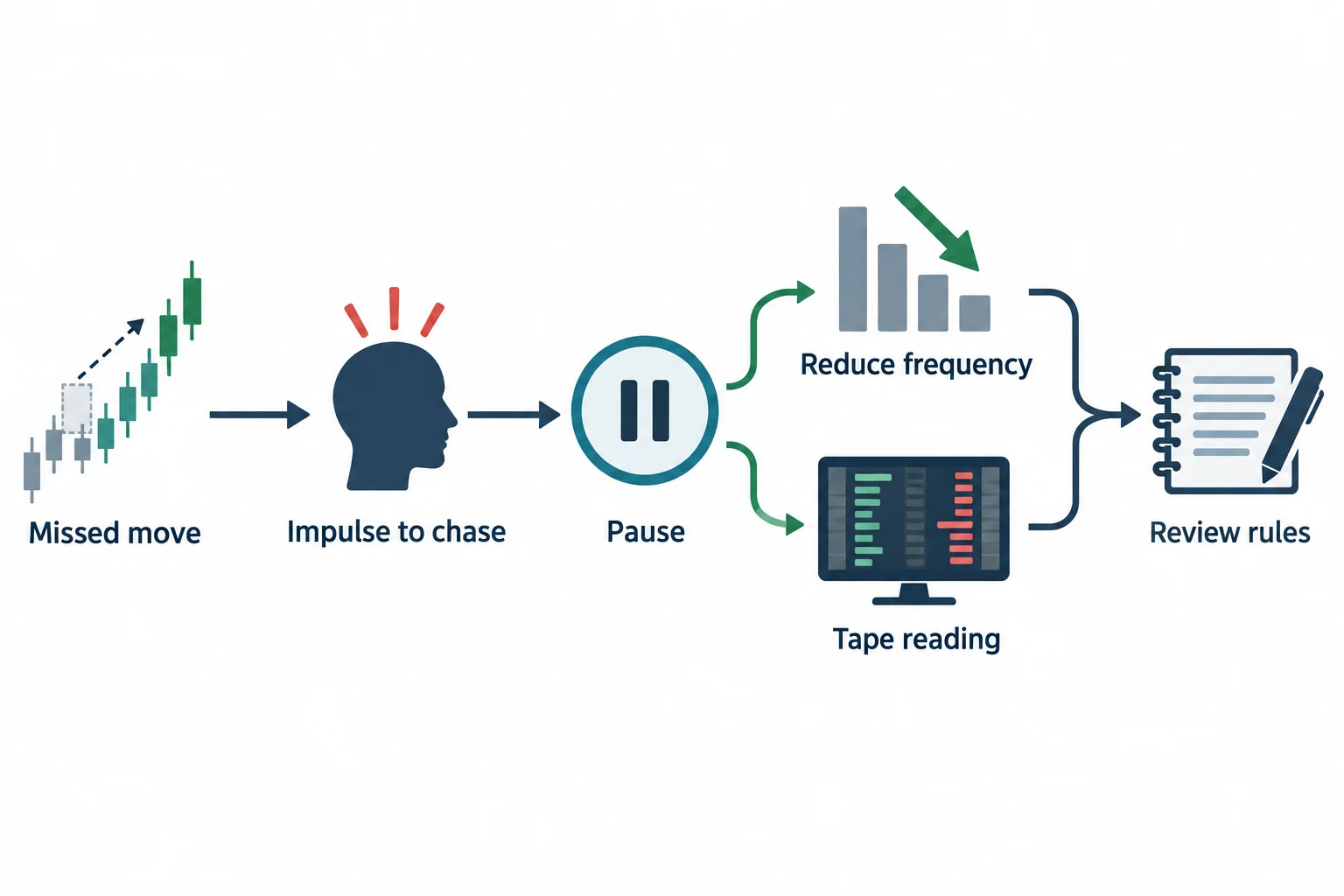
Near 12:12, ICT describes another behavioral trap: feeling that a market move was missed and then trading aggressively in an attempt to obtain the desired result. His proposed correction is to reduce frequency and impose a boundary of one or two trades on the following day. He characterizes activity beyond three trades as inviting trouble in this example, rather than presenting that number as a universal rule.
ICT also discusses the opposite response: taking no trades when confidence and discipline have deteriorated. At 12:55, he suggests stepping back and returning to observation or “tape reading.” He says that he had publicly stated he would stop trading for the remainder of February and presents the later inactivity as consistent with that statement.
ICT First Year Trading Expectations From Part 2
The most supported takeaway is behavioral rather than financial. ICT portrays early live trading as a process of learning to execute without allowing repetition to become uncontrolled activity. His suggested cycle is to identify a model, observe hesitation, practice execution cautiously, review what followed and reduce or stop activity when behavior departs from the rules.
At the end, ICT compares what he calls January’s ending balance with February’s ending balance and describes dividing the difference by the January balance to calculate a positive rate of return. The generated captions render his final figure ambiguously, so it should not be treated as a verified percentage. More broadly, a displayed month cannot establish typical first-year performance, future profitability or the effectiveness of a trading method.
Watch the Source Lecture
Watch: Real Money Real Results – First Year Trading Expectations Part 2 of 3 — a 14-minute transcript-grounded lecture by The Inner Circle Trader. The displayed account activity is ICT’s own February 2022 statement, presented unedited with broker and laptop times matched.
Related Resources
- The Inner Circle Trader YouTube channel — ICT’s complete free mentorship curriculum, including the 2022 Mentorship from which this video is drawn.
- February 2022 account statement PDF — the downloadable document ICT displays and scrolls through in the recording (linked in the original video description).
- Inner Circle Trader (ICT) methodology overview — a third-party summary of ICT concepts including order blocks, fair value gaps, and kill zones; not authored by ICT and not verified against his teaching.
This commentary summarizes ICT’s stated interpretations for educational purposes. It is not investment advice or a performance expectation.