Key takeaways
ICT Part 3 presents a deliberate-practice workflow for demo trading and historical backtesting using realistic position sizes, one repeatable setup, complete win and loss records, and emotionally neutral review rather than treating demo funds as monopoly money or over-trading.
Read the full summary
ICT Part 3 presents a deliberate-practice workflow for demo trading and historical backtesting using realistic position sizes, one repeatable setup, complete win and loss records, and emotionally neutral review rather than treating demo funds as monopoly money or over-trading. Using EUR/USD daily, 15-minute, and five-minute charts, ICT removes indicators, studies open, high, low, and close, and applies the optimal trade entry model by anchoring Fibonacci from a swing low to higher highs and consistently entering at the 62% retracement plus spread. The bullish example focuses on the 8 thirty to 11 a.m. New York window, a stop below the setup low, and targets at the previous day’s high plus standard-deviation extensions. ICT reports an actual high of 114.52 plus one pipette versus a 114.46 target, but this is not a verified fill or performance result. Every test should record pips risked and gained, drawdown, entry logic, time to target, immediate versus delayed reaction, movement available, and objective notes, including losing setups and profitable trades closed before target. A setup that fails to react promptly may justify killing the trade. Broker demos, Forex Tester, and TradingView are acceptable environments, while the resulting backlog builds hindsight-derived experience. Part 4 will address moving from demo practice to live funds, and none of the examples constitutes investment advice or a tested, reproducible trading system.
How we researched this article
BestProps used document-based research from primary firm sources, checked September 25, 2026. The complete source list, scope, limitations, and commercial-state record appear near the end of this article.
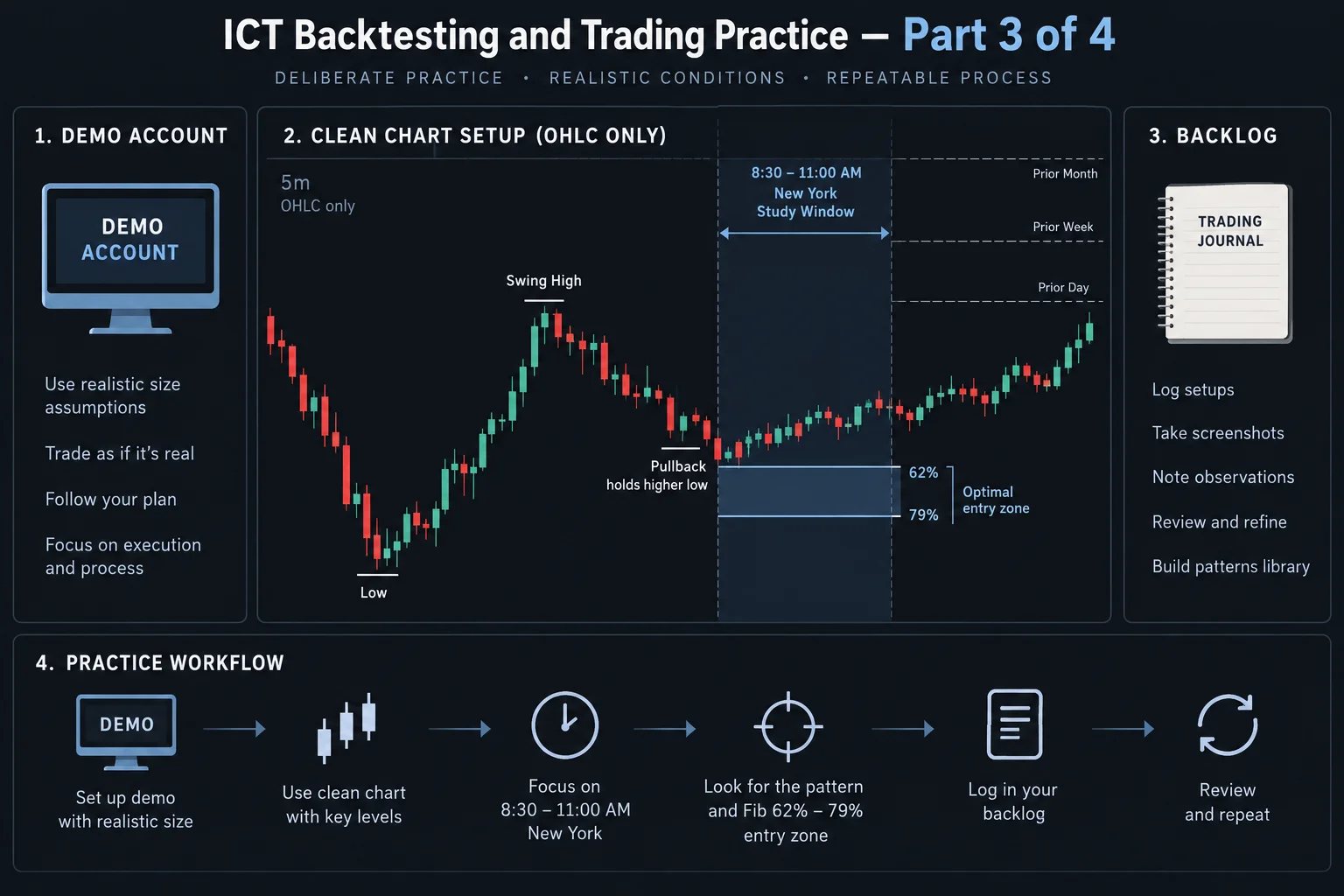
In Part 3 of ICT’s “If I Could Go Back & Tell Myself What I Know Now” series, ICT reviews how he would structure demo practice and historical backtesting if he could restart his trading education. The lesson centers on deliberate practice: realistic assumptions, one defined setup studied repeatedly, complete records of wins and losses, and emotionally neutral journaling.
The chart discussion uses EUR/USD and ICT’s “optimal trade entry” framework as examples. These are ICT’s own market interpretations, not independent findings about indicators or markets generally. Nothing in this article is investment advice, and captions alone cannot establish real-money fills, performance, or why markets moved.
ICT Backtesting with Realistic Trade Constraints
At 0:44, ICT asks how a developing trader should practice and backtest daily setups. He opens with broker demo platforms: most brokers offer a trial version, and Forex demo accounts at some brokers never expire. The key caution is not to treat the demo account like "monopoly money." Sit down with a sober hypothetical position size and build habits that remove the opportunity to over-trade.
ICT explicitly warns against taking repeated trades just because an earlier correct decision felt profitable. Over-trading is the early trap: you “lose a lot of money trying to do that,” he says. Third-party tools like Forex Tester and TradingView are legitimate backtesting environments, but ICT’s emphasis is on the practice discipline, not the platform.
ICT Backtesting with a Simple Trade Model
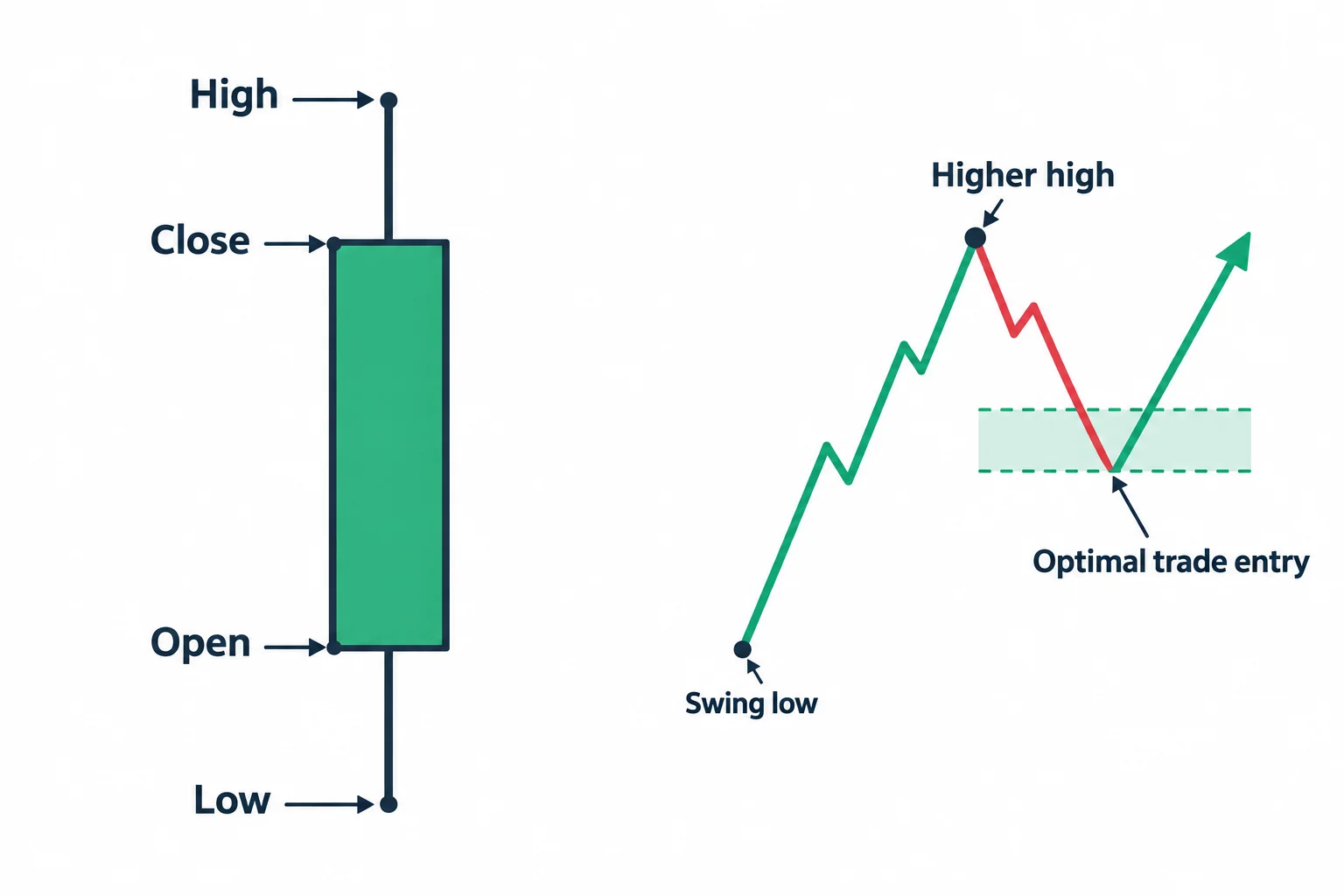
Beginning around 3:38, ICT recommends stripping indicators from the chart and focusing on the four price levels: open, high, low, and close. He demonstrates on a EUR/USD daily chart with a 15-minute time frame side by side, anchored to the optimal trade entry pattern from his public YouTube series.
At 5:54 he anchors a Fibonacci tool from a swing low to a higher high, overlaying it on successive higher highs so every retracement falls inside a visible range. The 62% retracement level is his preferred entry; he advises deferring the "insatiable desire for you to find the perfect entry" and using the 62% level consistently. He reports that the actual high came in at 114.52 plus one pipette against a standard-deviation target of 114.46, a good idea as a target but not a verified fill, since the transcript alone cannot confirm execution.
ICT Backtesting Across Time Frames and Trade Windows
ICT’s example assumes a bullish daily narrative aimed toward an earlier high. Around 7:27 he narrows the intraday study to 8:30-11:00 a.m. New York time, scrubbing forward to see daily dividers and marking each day’s New York window with a line segment or rectangle.
He describes the framework: every daily candle goes higher, and each day stages accumulation, manipulation, and distribution. Accumulation sits near the low; the New York session 8:30-11:00 is where the retracement lower appears, and inside that consolidation he looks for a five-minute optimal trade entry at the 62% retracement with a stop below the setup low. He enters long at 62% plus spread and targets the previous day’s high plus standard-deviation extensions.
ICT Backtesting Records Winning and Losing Trades
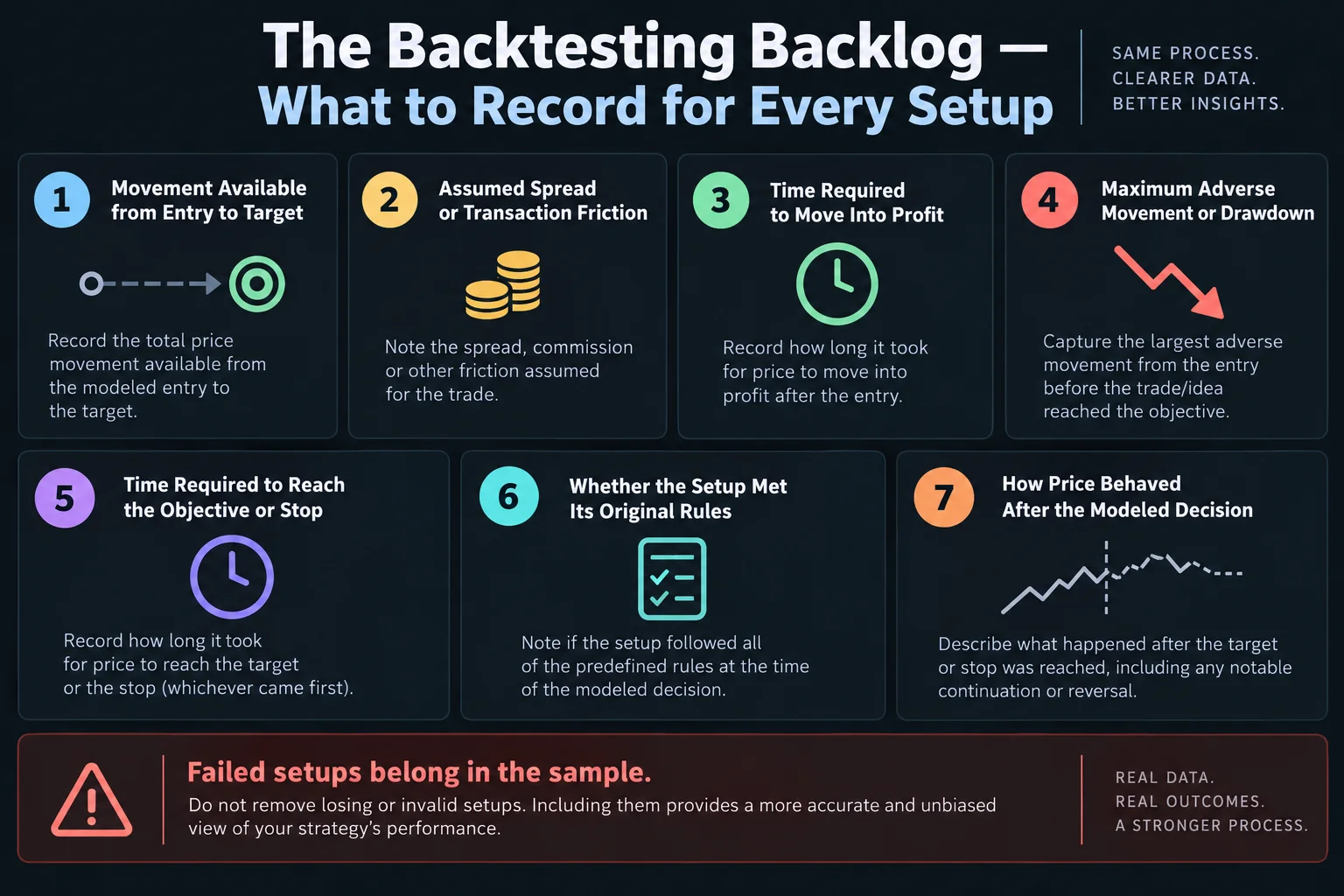
At 9:08 ICT quantifies each backtested trade: pips risked, pips gained, time from entry to target, and drawdown incurred. He uses the 62% retracement level each day, records whether it delivered, and tracks how often the setup reacted immediately versus needing patience. The resulting collection is a backlog providing “hindsight-derived experience.” He explicitly includes losing setups, not just winners.
At 10:41 ICT notes that not every trade starts and turns right at the 62% level (you may incur drawdown) and that being offside is often signaled by the setup not reacting right away, which is "probably better for you to kill the trade altogether." He demonstrates on the 15-minute chart: next day 8:30-11:00, price rallies then pulls back, creating an optimal trade entry at 62% with a target at the previous day's high.
ICT Backtesting Reviews Trade Mistakes Objectively
A second major theme is journal quality. Around 14:14 ICT advises against filling the journal with toxic thinking ("I was stupid" or "I should have seen it"). He frames annotations so there is "no emotions whatsoever" while still pulling out salient lessons: what led to being wrong, and why it happened. Until you study objectively, you keep falling victim to the same pattern.
At 16:00 he reviews additional days showing the anticipated setup not delivering, with scaled profits taken off. The key question: how long did you stay in the trade while it dropped? Even a profitable trade can end before the target. On Friday the setup delivered the previous day's high, but the weekend interrupted the sequence. He still records the timing and pip movement.
ICT Backtesting and Deliberate Trade Takeaways
This installment is less about finding more setups than about improving the practice process: use realistic assumptions, define one repeating framework, record every outcome honestly, and review with neutral annotations. ICT closes the series here and previews Part 4: transitioning from demo practice into live funds.
Watch the original ICT lesson on YouTube
The video cannot be played inside another website: when its embedded player was opened and clicked on 21 September 2026, the player itself reported “Playback on other websites has been disabled by the video owner.” and settled on a “Watch on YouTube” prompt, with no duration and no playback progress reported. That message is the reason no embed is reserved here; the recording is available directly on YouTube.
ICT Backtesting Sources and Further Trade Reading
- The original Inner Circle Trader lesson, Part 3: use the timestamp links in this article to compare the explanation with its source.
- YouTube’s embedding documentation: platform guidance relevant to the external watch link above.
- 17 CFR 4.41: disclosures concerning hypothetical performance: a regulatory reference, not a statement that a particular recording or this article meets every legal requirement.
This is independent educational commentary. It is not official ICT material, a tested trading system, or a claim that the reported results can be reproduced.