Key takeaways
ICT frames the lesson as a hypothetical conversation with his younger self.
Read the full summary
ICT frames the lesson as a hypothetical conversation with his younger self. He argues that a developing trader should establish at least six months of consistent demo trading before risking live capital, keep risk below a stated 3% maximum, and prove the ability to endure consecutive losses without reacting emotionally. His analytical sequence moves from seasonal tendencies through quarterly shifts and a monthly bias down to daily templates and time-of-day behavior, including his “Power of Three” concept of accumulation, manipulation and distribution. He warns against compounding urgency, forced entries, oversized positions and unnaturally tight stops, and recommends measuring progress monthly, defining invalidation before entry, reducing leverage after losses and restoring size gradually. He strongly endorses scaling out of winning positions and sticking with one method through normal losing streaks. The video provides no verified trade logs, charts or independently confirmed performance, so these seasonal, session and velocity claims remain ICT’s personal interpretations rather than proven results.
How we researched this article
BestProps used document-based research from primary firm sources, checked September 25, 2026. The complete source list, scope, limitations, and commercial-state record appear near the end of this article.
In “If I Could Go Back & Tell Myself What I Know Now… Part 4 of 4”, uploaded August 4, 2020, ICT frames the lesson as a hypothetical conversation with his younger self. Rather than presenting a chart walkthrough, he reflects on preparation, risk, losses, impatience and the habits he believes would have spared him avoidable pain.
The central message is restraint. ICT argues that a developing trader should establish consistency in simulation, control exposure and accept being wrong before considering live funds. His specific market framework and performance-related statements are his own interpretations and recollections, not independently verified results.
ICT Advice on When to Leave Demo Trading
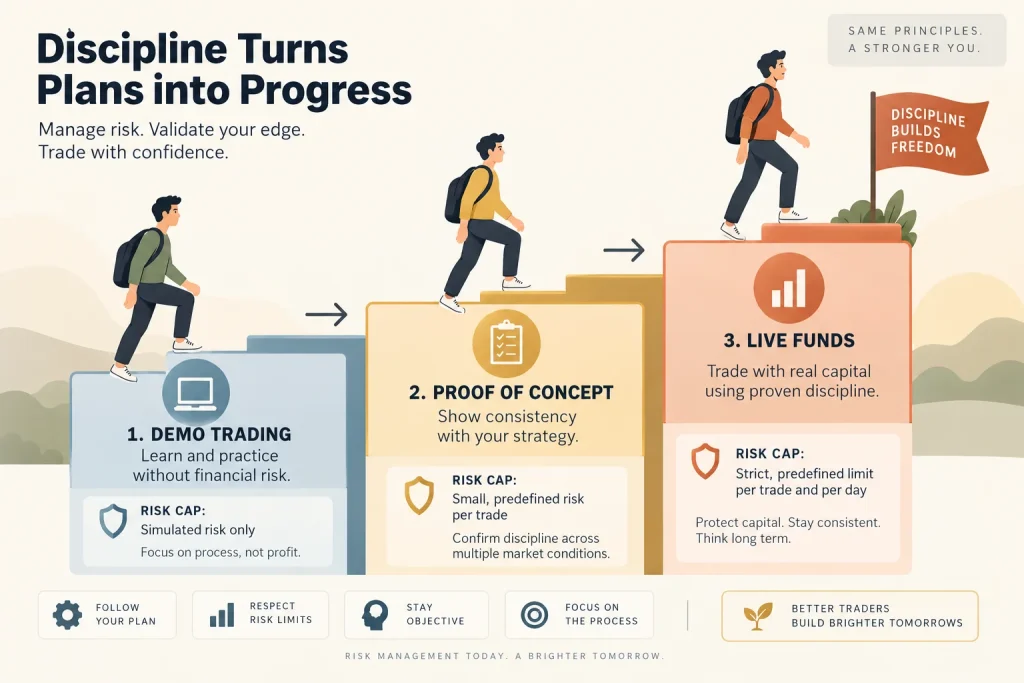
At 0:22, ICT asks when someone should move from demo (or what he knew as paper trading) to live capital. His answer begins with “proof of concept.” He proposes at least six months of consistency, risk kept below a stated maximum of 3%, and the ability to endure consecutive losses without reacting emotionally.
He also reflects on the reading he did early in his career, saying he accumulated over 2,000 books and found fewer than a dozen worth the time. This is best understood as ICT’s personal readiness checklist, not a universal threshold. Six consistent months cannot establish that a method will continue working, while a percentage cap does not by itself make a position suitable. Account size, instrument volatility, leverage and the definition of risk all matter.
ICT Advice From Market View to Trade Execution
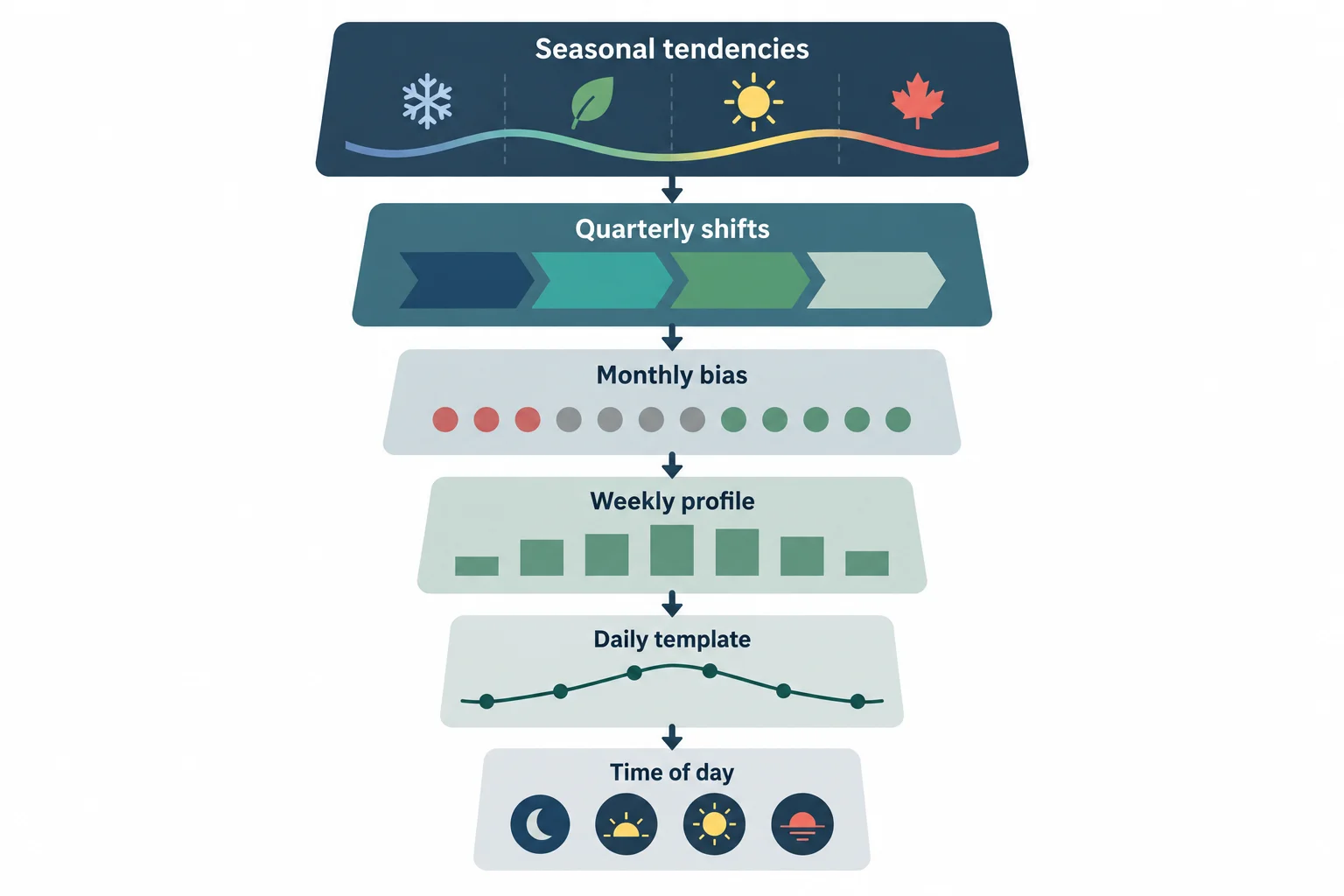
ICT’s analytical sequence begins at 1:41. He prioritizes three elements:
- seasonal tendencies;
- quarterly shifts or moves developing over roughly three to four months;
- a directional monthly bias.
He then moves down through a weekly profile, a daily template and time-of-day behavior. In his framework, these layers should generally align rather than produce a trade taken against the presumed higher-time-frame direction.
At 5:19, he discusses whether a large daily range might be followed by contraction and describes his “Power of Three” concept as accumulation, manipulation and distribution within the daily open-high-low-close structure. At 5:59, he adds claimed tendencies associated with the London open, New York session and London close.
These session observations are presented as ICT’s market interpretations. The transcript supplies no visible charts, sample selection, test results or exact prices with which to evaluate them.
ICT Advice to Avoid Rushing Profits and Perfect Trades
Beginning around 7:24, ICT warns against trying to accelerate account growth through compounding, excessive frequency or larger positions. He recalls days of repeatedly switching direction and taking many entries. His broader point is that urgency can replace a planned process with reactive decision-making.
He recommends evaluating progress over a month rather than demanding a gain every day or week. The return figures mentioned in this discussion are illustrative claims from ICT, not expected results or a benchmark readers should pursue.
He also tells his younger self not to chase perfection: being right 100% of the time is unrealistic and chasing the “perfect” setup wastes time. This is an acceptance of fallibility rather than a tested trading rule.
ICT Advice on Defining Invalidation and Preserving Capital
At 11:31, the focus shifts to accepting fallibility. Before entry, he says, a trader should identify what would invalidate the idea. If those conditions appear, closing the position or remaining on the sidelines can preserve both financial and “mental capital,” his term for the amount of loss a person can actually tolerate without abandoning the plan.
ICT Advice to Reduce Trade Exposure After Losses
One of the video’s clearest risk lessons starts at 15:45. ICT recalls responding to losses by increasing contract size in an effort to recover quickly. He associates that behavior with some of his largest drawdowns and longest losing streaks.
His proposed response is the opposite: reduce leverage after a loss and restore size only gradually after recovery. He also advises being patient with drawdown recovery, noting there is no deadline to make the money back. The contract sequence he gives is an example from his own framework, not a generally appropriate sizing formula. The transferable educational principle is that loss-driven escalation can compound both exposure and emotional pressure.
ICT Advice on Risk Limits and Forced Setups
ICT returns to his suggested maximum risk at 20:44, warning against calculations based on risking 8%, 10% or 12% per trade. He says beginners should not assume an indicator or simplified rule will produce consistent outcomes.
He later describes “velocity” as repeatedly trading a recurring lower-time-frame pattern rather than waiting only for very large reward-to-risk multiples. This is an especially important claim to treat cautiously. The transcript provides no verified trade log or testing, and higher frequency can increase costs, mistakes and aggregate exposure. It should not be read as evidence that frequent trading has a proven advantage.
At 25:41, ICT addresses forced entries. He describes entering before a planned level is reached because of fear that the move will leave without him. In his account, this combines an early entry, excessive leverage and an unnaturally tight stop. His preferred response is to accept a missed trade rather than rewrite the setup.
ICT Advice on Taking Partial Trade Profits
At 28:23, ICT strongly endorses scaling out of winning positions. He says taking partial profits can lower open exposure and make it psychologically easier to hold the remainder according to the plan.
This approach has trade-offs: scaling out may reduce gains if price continues directly to the final target. The video emphasizes its psychological and risk-reduction benefits but does not compare alternative exit methods with data.
ICT Advice for Following Your Trade Process Through Losses
The final section begins at 34:05. ICT says consecutive losses are normal and do not automatically prove that a method is broken. He warns that repeatedly abandoning one system for another can prevent meaningful evaluation.
His simplifying advice is to focus on one market, one key level, a higher-time-frame bias and one side of the market until evidence invalidates the idea. He closes by discouraging comparison with other traders and by emphasizing personal development over borrowed status.
ICT Trade Advice to Know Now
The most broadly applicable lesson is not a specific seasonal, session or intraday setup. It is a behavioral framework: practice before risking money, define invalidation in advance, avoid revenge sizing, allow recovery to take time and do not force a trade because of fear of missing out. None of these principles eliminates losses, and the video does not establish future profitability. This summary is educational commentary, not investment advice.
Related Resources
ICT’s advice is one trader’s personal framework. The following general educational references cover the underlying concepts and are not endorsements of any specific method.
- What Is Risk Management? [4] — an overview of risk management principles, including position sizing and risk limits.
- Paper Trading: How It Works, Benefits, and Limitations [5] — a look at simulation trading as a practice environment before using live capital.
- How to Build a Trading Plan [6] — guidance on defining rules, invalidation criteria and consistency in advance.