Key takeaways
ICT Weekly Scalping Setup Review presents a top-down EUR/USD and GBP/USD framework that sets directional bias from a broken daily swing, identifies an older hourly high, low, or previous session extreme as the liquidity objective, then seeks a clear impulse and Fibonacci retracement on 15-minute or five-minute charts during the New York session.
Read the full summary
ICT Weekly Scalping Setup Review presents a top-down EUR/USD and GBP/USD framework that sets directional bias from a broken daily swing, identifies an older hourly high, low, or previous session extreme as the liquidity objective, then seeks a clear impulse and Fibonacci retracement on 15-minute or five-minute charts during the New York session. The bullish sequence is a break above a daily swing high followed by formation of a swing low, while the bearish sequence reverses those conditions. EUR/USD setups are preferred after 7 a.m. New York time, with the optimal trade entry spanning approximately the 62% to 79% retracement zone, invalidation near the swing low, smaller size for entries farther from that low, and prior highs or Fibonacci extensions as profit references. GBP/USD follows the same logic, including a New York open retracement and a later continuation entry while price remains below the reference high with room to the objective. ICT stresses obvious liquidity levels, displacement rather than sideways action, completion once the target is reached, reviewing multiple major pairs and crosses, accepting days with no valid trade, and practicing on demo for several months. The examples are retrospective market interpretations, and the speaker’s return and compounding claims are not supported by performance records or controlled testing.
How we researched this article
BestProps used document-based research from primary firm sources, checked September 25, 2026. The complete source list, scope, limitations, and commercial-state record appear near the end of this article.
ICT Weekly Scalping Setup Review Overview
In ICT Weekly Scalping Setup Review – 11/25/17, ICT reviews EUR/USD and GBP/USD price action to illustrate a top-down framework for finding short-term setups. The lesson moves from directional bias on the daily chart to liquidity objectives on the hourly chart and possible entries on 15-minute or five-minute charts.
The central message is selectivity rather than constant activity. ICT argues that traders should wait for a repeatable set of conditions, accept that some days offer no suitable setup, and focus on one manageable segment of price movement. These are ICT’s market interpretations and teaching conventions, not independently established rules or evidence of a trading edge.
▶ Watch the source recording: ICT Weekly Scalping Setup Review – 11/25/17 on YouTube
ICT Weekly Setup Daily Directional Bias
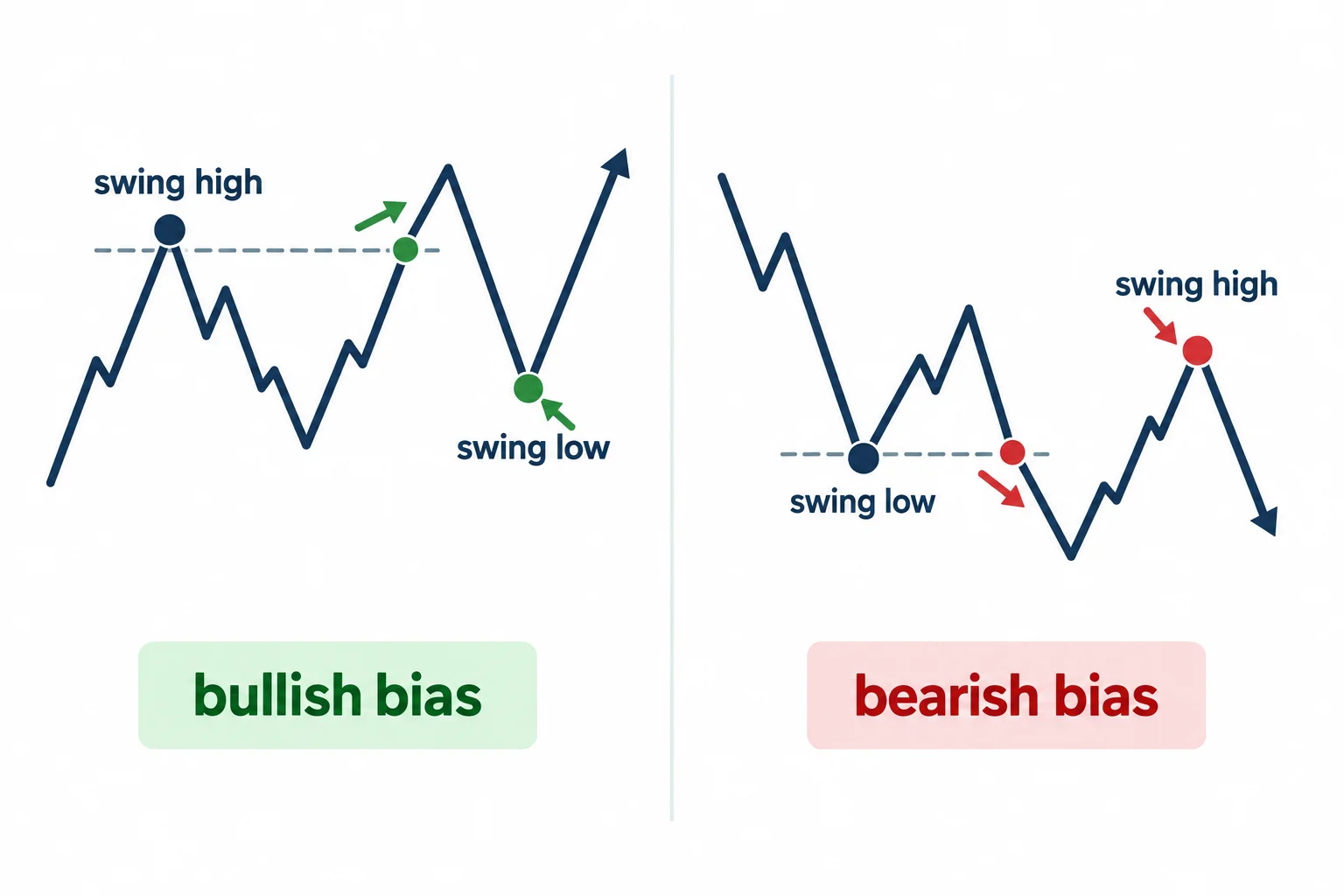
ICT begins the substantive lesson at 1:12 with EUR/USD, often called “fiber.” His proposed bullish sequence is straightforward:
- Identify a daily swing high.
- Wait for price to trade through that high.
- Then wait for a subsequent swing low to form.
- Use that sequence as the basis for looking for long setups.
He later presents the inverse case: after a swing low is broken, wait for a swing high to form before developing a bearish bias. In ICT’s framework, this provides a consistent definition of direction without relying on moving averages or diagonal trend lines.
At 2:21, ICT encourages viewers to test the concept for themselves. That distinction matters: the recording supplies retrospective examples and commentary, but it does not provide a controlled test of how often the method succeeds.
ICT Scalping Setup Hourly Liquidity Targets
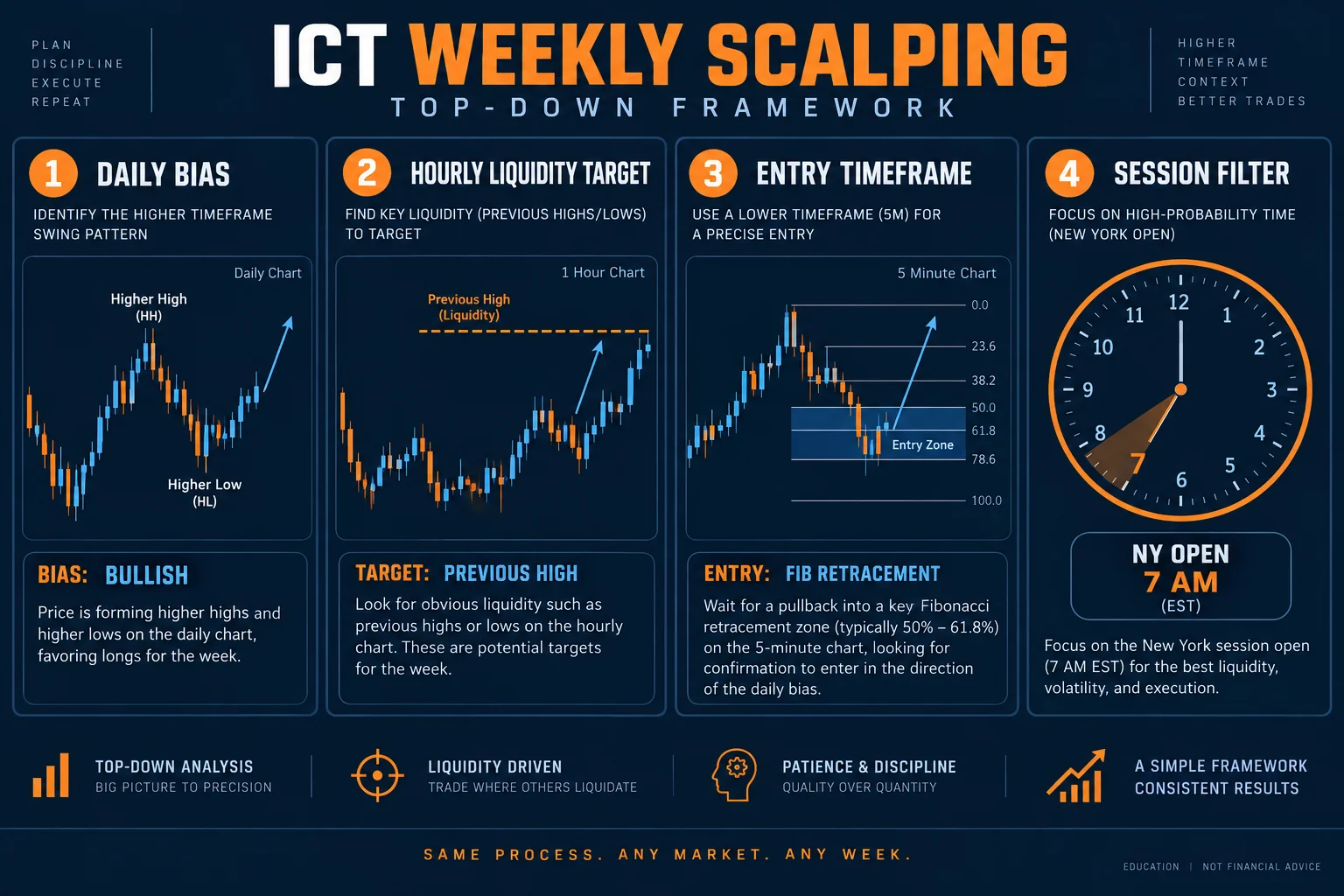
After defining the daily bias, ICT moves down to the hourly chart to find what he calls the draw on price (the nearby pool of liquidity the market is, in his framework, likely to seek). For the bullish EUR/USD example, the relevant reference is an older swing high sitting above current price.
He discusses this hourly liquidity reference at 4:57, explaining that the target should be obvious rather than subtle: if a retail trader could be expected to see a level, it qualifies as a candidate reference point.
Importantly, ICT treats reaching the objective as a decision point, not an invitation to extend risk. Once price trades through the referenced high, the setup has, in his telling, completed its purpose.
ICT Scalping Setup Lower Time Frame Entries
With the daily bias and hourly draw established, ICT drops to intraday charts in search of a specific pattern: a forceful directional move (an “impulse leg” in his vocabulary) followed by a retracement into a Fibonacci-derived zone during the New York session.
For EUR/USD, he notes that the preferred setup should occur after 7:00 a.m. New York time.
Because the 15-minute chart does not show a sufficiently clear impulse leg, he moves to the five-minute chart at 8:46. He anchors a Fibonacci measurement to a forceful rally from a swing low and identifies what he calls an “optimal trade entry” retracement. Later, he describes that zone as approximately the 62%–79% retracement area.
ICT emphasizes that an entry did not need to occur at one exact price. In his reading, a broader zone remained usable before the relevant high was taken. The initial high and older hourly high then served as possible profit references, with extensions above those highs discussed as secondary objectives.
At 10:45, ICT reconnects the intraday idea to the daily bullish bias. He also discusses placing invalidation near the swing low and reducing position size when entering farther from that low. This is a description of his risk-framing logic, not individualized investment guidance.
ICT Weekly Scalping Setup GBP/USD Examples
The GBP/USD, or “cable,” review starts at 14:09. ICT again identifies a daily swing high that was traded through, waits for a swing low, and interprets the resulting short-term condition as bullish. An older high becomes the proposed liquidity objective.
On the lower time frame, ICT highlights a New York open retracement into his optimal-entry zone at 16:16. He then reviews a continuation example from Friday. Although the earliest retracement began before his preferred session window, he argues that a later entry could still fit the idea while price remained below the reference high and sufficient room remained toward the objective.
At 20:39, he describes price reaching a Fibonacci-derived target near the anticipated area above a prior high. He explicitly says the rationale is not that Fibonacci is “magic”; in his model, the measurement is a way to organize an expected extension around liquidity.
ICT Scalping Setup Trading Takeaways
- Start with structure: Define directional bias on a higher time frame before examining entries.
- Name the objective: Identify the old high, old low or previous session extreme that serves as the proposed draw on price.
- Require displacement and retracement: Sideways action without a clear impulse leg may not qualify.
- Respect the method’s timing filter: These examples focus primarily on the New York open window.
- Avoid forcing daily trades: ICT concludes that the conditions will not necessarily appear every day or in a preferred currency pair.
Near 23:17, ICT recommends reviewing multiple major pairs and crosses and practicing with a demo account for several months. He also makes specific return and compounding claims. Those claims are the speaker’s projections and are not substantiated by performance records or testing in the transcript. Demo execution also cannot reproduce every feature of live trading.
Overall, the video presents a compact checklist: establish bias from a broken daily swing, wait for the opposite swing to form, identify a nearby liquidity reference, and search for an intraday impulse and retracement during the designated session. It is an educational account of ICT’s framework, not investment advice or a promise of profitability.
ICT Weekly Scalping Setup Resources
- ICT Weekly Scalping Setup Review – 11/25/17 (source video) This is the full 25-minute session this article summarizes, with chapter-relevant timestamps linked throughout.
- ICT Forex – Market Maker Primer Course (YouTube playlist) This is the broader ICT instructional series introducing the market-structure and liquidity vocabulary used in this review.
- Market structure basics (BabyPips School of Pipsology) This is an independent, beginner-friendly explainer on swing highs, swing lows and trend definition that parallels Step 1 of the framework above.
- Fibonacci retracements (BabyPips) This is a neutral reference covering how Fibonacci retracement zones are drawn and used, matching the optimal-entry discussion in this review.