Key takeaways
ICT’s Smart Money Concepts and Chaos lesson uses a hypothetical June 2022 E-mini S&P 500 futures paper trade to explain liquidity, premium pricing, fair value gaps, directional bias, and selective execution while rejecting tribal hostility around trading methods.
Read the full summary
ICT’s Smart Money Concepts and Chaos lesson uses a hypothetical June 2022 E-mini S&P 500 futures paper trade to explain liquidity, premium pricing, fair value gaps, directional bias, and selective execution while rejecting tribal hostility around trading methods. After roughly 17 minutes on creator disputes, ICT says traders can be profitable without order blocks, breakers, or fair value gaps and asks followers not to harass critics. The technical example starts around 17 minutes 12 seconds with a bearish five-minute-chart narrative built around relative equal highs, buy-side liquidity, the midnight and 8 30 opening prices, consolidation, and a dealing-range premium. ICT reports paper-selling three contracts at 4223.75, refining the entry on a one-minute fair value gap with a referenced candle low of 4222, observing a swing high at 4225.25 on 15-second and five-second charts, and taking partial exits into an imbalance and below relative equal lows toward sell-side liquidity. His process is to set bias, wait for a premium move above prior highs, interpret it as a liquidity sweep, refine entry on a lower timeframe, target old lows, and stop after the expected session move. ICT distinguishes the price-delivery algorithm from smart-money participants but provides no order-book evidence, algorithm documentation, or independent testing for his broader market-control claims. The most defensible lessons are to separate paper trades from live results, accept that ideal setups can lose, trade selectively, avoid forcing additional positions, and treat terminology as a framework rather than proof of superiority or profitability.
How we researched this article
BestProps used document-based research from primary firm sources, checked September 25, 2026. The complete source list, scope, limitations, and commercial-state record appear near the end of this article.
In Smart Money Concepts & Chaos (YouTube upload date April 27, 2022), ICT combines two related lessons. First, he criticizes the combative online culture surrounding “smart money concepts.” Second, he walks through a hypothetical E-mini S&P 500 futures paper trade to explain his interpretation of liquidity, premium pricing, fair value gaps, and market narrative.
The result is not simply a chart-pattern tutorial. ICT argues that terminology such as “order block” or “fair value gap” should not become a badge of superiority. He also presents a specific theory of price delivery involving algorithms and an elite class of traders. Those market-mechanism claims are ICT’s interpretations; the transcript does not independently establish them.
Why ICT Smart Money Culture Creates Chaos
For roughly the first 17 minutes, ICT addresses disputes among trading creators. He acknowledges that his earlier public persona encouraged a confrontational, “gladiator” style and says that drama can attract attention. His present message is more restrained: traders should not attack people merely because they use a different method.
At 6:32, ICT agrees that the culture built around smart money concepts can generate negative tribal behavior. He explicitly says traders can pursue profitability without using an order block, breaker, or fair value gap. In other words, even while defending his framework, he rejects the proposition that it is the only possible trading discipline.
That theme returns near 14:46: a trader can appreciate another person’s skill without adopting the same logic. ICT asks his audience not to harass critics or flood their comment sections. Whether another creator accepts smart money concepts, he says, does not determine an individual trader’s outcome.
How ICT Smart Money Uses Liquidity Before Bearish Trades
The technical portion starts at approximately 17:12. ICT identifies the chart as the June 2022 E-mini S&P 500 futures contract. He says he reviewed it on a phone while waiting at a car dealership and chose to demonstrate a paper trade rather than place a live order over an uncertain mobile connection.
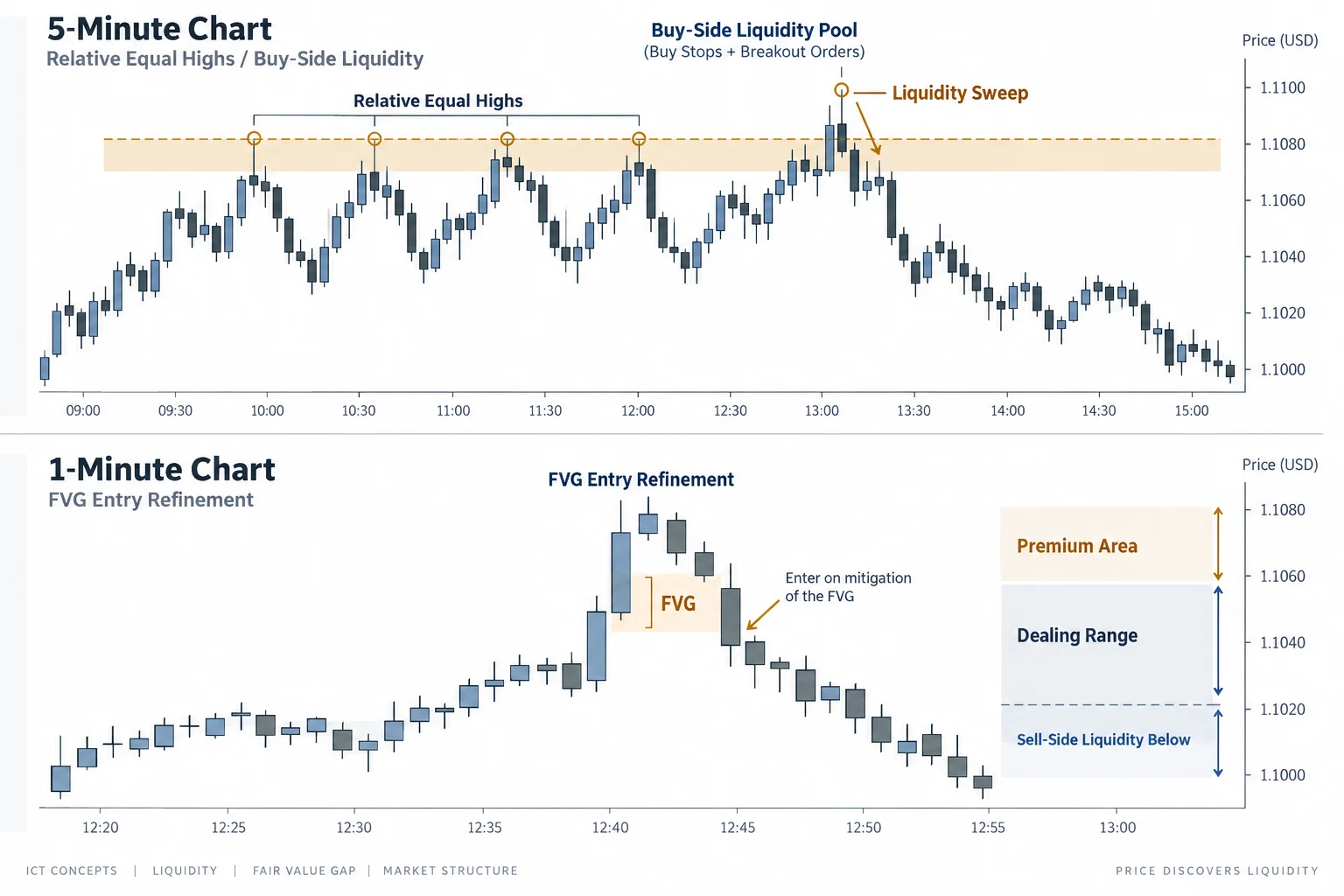
His initial framework is bearish. On the five-minute chart, he identifies relative equal highs and interprets the area above them as “buy-side liquidity.” In ICT’s model, this potential order pool can include:
- Buy stops protecting existing short positions.
- Buy orders from traders attempting to enter after an upside breakout.
- Market orders activated when price trades through the prior highs.
At 21:40, he adds intraday context: the midnight opening price, the 8:30 opening price, an earlier consolidation, and the dealing range. Because price had moved above relevant opening levels and the relative equal highs, he characterizes it as trading at a premium. Within his bearish narrative, this is where he looks for a possible short rather than selling merely because he expects lower prices.
ICT Algorithms and the Smart Money Distinction
ICT separates two ideas that are often blended together. He calls the price-delivery mechanism the “market maker” or algorithm. He then describes “smart money” as traders or entities waiting to transact when the algorithm delivers price to a useful liquidity area.
Beginning around 23:58, he argues that a move above the highs supplies willing buyers against whom larger traders could sell. He then looks below prior lows for sell-side liquidity that could provide counterparties when short positions are covered.
ICT makes much broader claims here, including that markets are algorithmically controlled and that ordinary buying and selling pressure does not explain price movement. These are forcefully stated personal views in the video, not conclusions verified by the transcript. No order-book data, algorithm documentation, or independent test is supplied in the spoken material.
How ICT Smart Money Executes a Hypothetical Trade
At 36:03, ICT restores the paper-trade markers. He reports a hypothetical short entry of three contracts at 4223.75 and describes taking partial exits as price moved into an imbalance and below relative equal lows. Because this was explicitly a paper trade, it should not be treated as evidence of a live fill or account performance.
He then drops to a one-minute chart and identifies a fair value gap whose referenced candle low was 4222. ICT says he watched price trade into that area and submitted the hypothetical market sell. Later, he uses 15-second and five-second views to discuss timing, reporting that the relevant swing high was 4225.25. These figures are spoken in the transcript, but the underlying chart cannot be independently inspected from captions alone.
The educational structure of the example is:
- Establish a directional bias.
- Wait for price to reach a premium and move above earlier highs.
- Interpret the move as a sweep of buy-side liquidity.
- Use a lower-time-frame fair value gap to refine a possible entry.
- Look toward old lows and sell-side liquidity for potential exits.
- Stop trading once the anticipated session move has occurred.
ICT Smart Money Trade Risk and Responsibility
One of the more broadly applicable lessons appears around 38:00. ICT says his analysis can be wrong and that losing trades remain possible even when conditions appear favorable. He distinguishes a “perfect” setup from a guaranteed result: in his usage, perfect conditions only mean conditions in which he is comfortable participating.
He also stresses selectivity. After the opening-session idea had played out, he says he took no additional trades because he was less confident about the rest of the day. This restraint is more important educationally than the apparent precision of one retrospective example. A transcript cannot establish repeatability, profitability, or what would have happened under live execution conditions.
Key ICT Smart Money Concepts and Takeaways
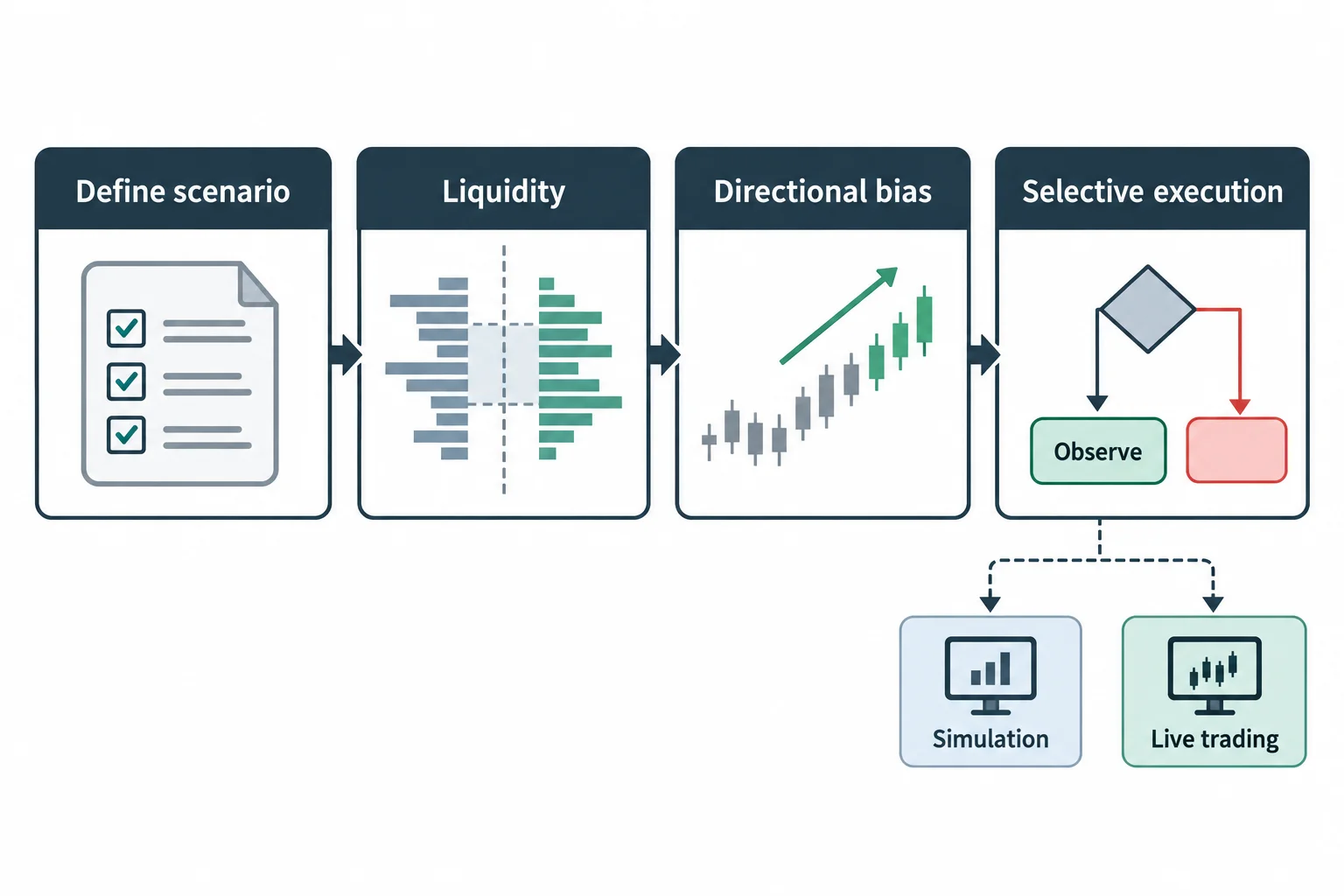
The video uses “chaos” in two senses: social conflict around branded trading concepts and the apparent disorder of short-term price movement. ICT’s answer to the first is humility and tolerance. His answer to the second is a narrative built from time, price, liquidity, directional bias, and selective execution.
Viewers can study that framework without accepting every causal claim ICT makes about algorithms or hidden market participants. The most supportable lesson from the recording is procedural: define the scenario in advance, distinguish simulation from live trading, expect losses, avoid forcing trades, and do not treat a preferred vocabulary as proof of superiority. This is educational commentary, not investment advice or a promise of trading performance.
ICT Smart Money Resources for Further Study
The following original-source materials provide structured education on the ICT framework discussed in the video. All are publicly accessible and independently verifiable.
- The Inner Circle Traders (ICT Trading Education) Official structured curriculum from Michael Huddleston's team, organized in 13 clusters from Foundations through Advanced concepts, including annotated diagrams and knowledge quizzes.
- What is ICT Trading? The Inner Circle Traders Authoritative beginner's guide explaining the core methodology, liquidity model, PD Arrays, and how ICT differs from indicator-based analysis.
- ICT Trading: What Are the Main ICT Concepts? FXOpen Independent brokerage overview covering BOS, CHoCH, MSS, liquidity pools, order blocks, fair value gaps, optimal trade entries, and kill zones.
- ICT Trading Beginner's Guide (innercircletrader.net) Free tutorial site by a working ICT trader organizing Huddleston's concepts from Foundations through Advanced, including a consolidated PDF option.
Disclosure: The above resources are provided for educational reference only. BestProps does not endorse, verify trading results from, or receive compensation from any linked third-party educators or platforms. All trading involves risk; past performance does not guarantee future results.