Key takeaways
ICT’s October 2, 2020 lecture presents a personal NFP-week filter rather than a universal trading rule.
Read the full summary
ICT’s October 2, 2020 lecture presents a personal NFP-week filter rather than a universal trading rule. Using a 15-minute EUR/USD chart, he explains that he generally stopped trading after Tuesday’s New York session and avoided Wednesday through Friday before non-farm payrolls because his journals showed the first week of each month produced disproportionate errors, revenge trading and drawdowns. He recommends plans that define eligible calendar periods, excluded sessions, maximum trades per day, week or month, and conditions for reducing bias or expectations. Instead of ignoring abstained sessions, he documented Wednesday through Friday turning points, price, time, day, prior highs or lows exceeded, distance traveled, liquidity runs, market-structure breaks, optimal trade entry, order blocks, swing measurements, the NFP high and low, and London open, New York open and London close levels. Digital journals can tag month, NFP week, instrument and session for faster comparison, while handwritten records were his preference. Ahead of the November 3, 2020 US election, he expected unusually high volatility, planned to reduce commentary and participation, and warned that stop orders may fill beyond requested prices when markets gap, making restraint, lower exposure and simulation preferable to assuming larger moves create better opportunities.
How we researched this article
BestProps used document-based research from primary firm sources, checked September 25, 2026. The complete source list, scope, limitations, and commercial-state record appear near the end of this article.
In this October 2020 lecture, ICT explains why he generally stood aside after Tuesday’s New York session during non-farm payroll (NFP) weeks. He also demonstrates how he continued studying those sessions without trading them and closes with a historically situated warning about possible volatility around the 2020 US election.
The primary source is ICT Price Action Lecture: Non-Farm Payroll Trade Conditions & The Coming Volatility Storm, uploaded on October 2, 2020. The discussion reflects ICT’s personal market interpretations and risk preferences, not a demonstrated rule that NFP conditions are universally untradeable.
Why ICT Avoided Late Non-Farm Payroll Trades
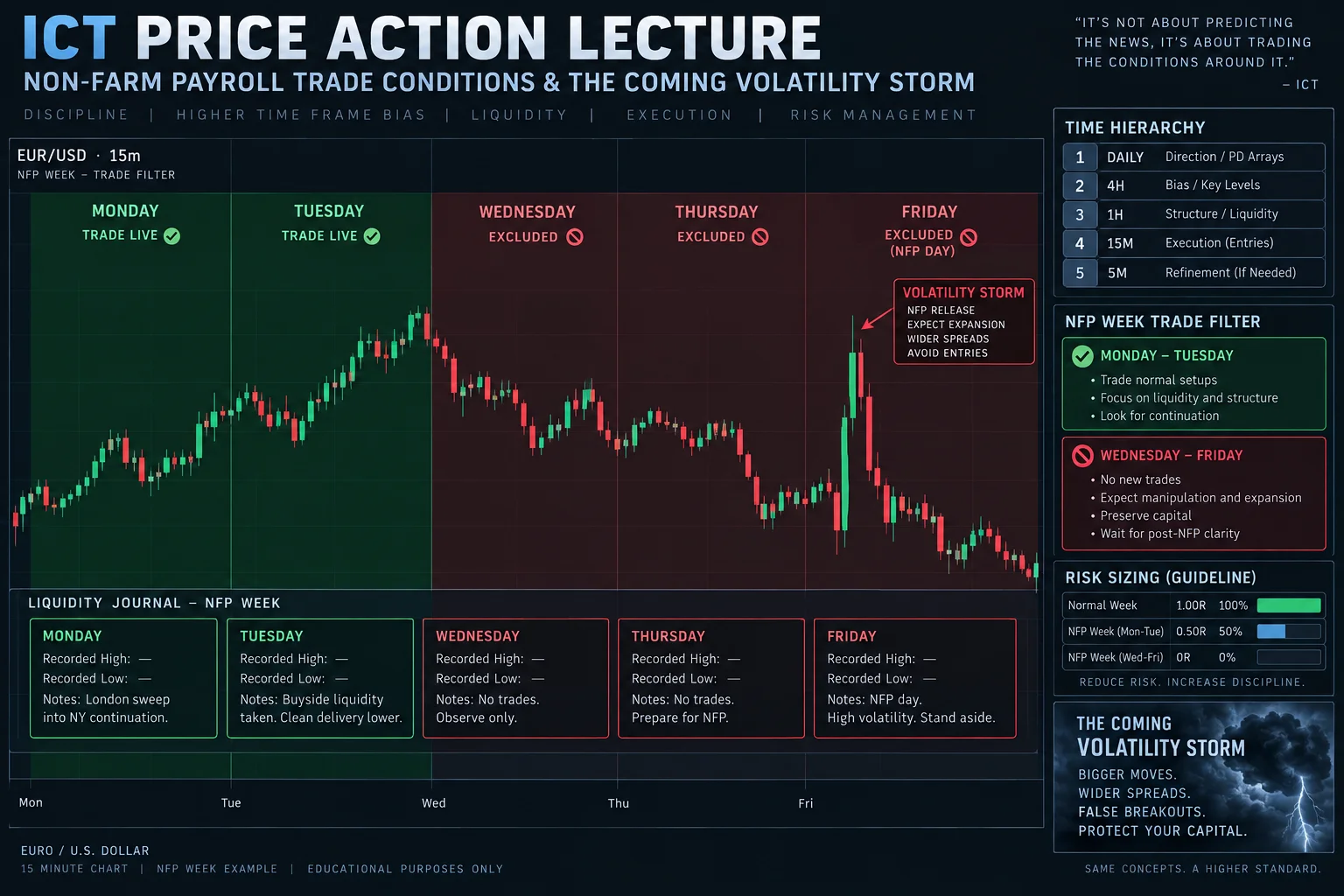
ICT introduces his NFP-week filter at 00:14. Using a 15-minute EUR/USD chart as the lesson’s visual setting, he says price delivery during the first week of a new month can appear skewed or difficult to assess as markets anticipate US employment data.
His rule was personal and specific: after Tuesday’s New York session, he generally did not participate on the Wednesday, Thursday, or Friday leading into NFP. He does not claim that prices stop moving. In fact, he acknowledges that attractive moves can occur; his point is that he did not need to pursue every available move.
At 02:39, he broadens the lesson from NFP to trading-plan design. A rules-based plan, in his view, should contain filters governing matters such as:
- which calendar periods are eligible for participation;
- which sessions or days should be excluded;
- the maximum number of trades permitted in a day, week, or month;
- when expectations and directional opinions should be reduced.
ICT attributes his NFP filter to his own journals and trading history. Beginning around 03:49, he recounts that these days produced a disproportionate number of errors for him. He also describes how an initial loss could trigger revenge trading, turning a small mistake into a larger drawdown. His account of losing two commodity trading accounts while trading the S&P is presented as personal testimony; the transcript provides no records with which to verify those results.
How ICT Used Journal Evidence for Trade Filters
One of the lecture’s most transferable ideas appears at 07:52: collecting data is of little value if a trader ignores observations that conflict with a preferred conclusion. ICT says his own review showed that the first week of each month was his weakest period, so he reduced trade frequency, lowered expectations, and remained more flexible about bias.
This is not evidence that every trader will obtain the same result. As a general educational interpretation, it illustrates a useful review process: define a calendar category, record decisions consistently, and compare that category with the trader’s own baseline. A filter should follow from documented observations rather than from a desire to justify an existing belief.
How ICT Documented Non-Farm Payroll Price Action
At 09:46, ICT explains that abstaining from execution did not mean ignoring the market. He drew a simplified line representation of Wednesday through Friday and marked meaningful turning points rather than reproducing every small fluctuation.
For short-term highs and lows, he recorded the price, time and day, whether a prior turning point was exceeded, and the distance price traveled beyond it. He treated these events as runs on liquidity within his framework. He also measured selected swings and annotated concepts he calls market-structure breaks, optimal trade entry, and order blocks. These labels belong to ICT’s analytical vocabulary; the transcript alone does not validate their predictive power.
ICT discusses paper versus digital records at 11:46. He preferred handwritten journals but acknowledged their search limitations. A digital journal can attach keywords (such as month, NFP week, instrument and session) to each entry, making comparable historical examples easier to retrieve.
Price Action Reference Points for Later Sessions
Beginning near 16:32, he says he recorded the NFP day’s high and low along with session highs and lows around the London open, New York open and London close. He then watched how price interacted with those reference points in subsequent weeks.
In ICT’s interpretation, an old high or low might later attract price, be exceeded and retested, or help frame another setup when combined with his time-and-price criteria. He explicitly asks viewers to inspect their own data rather than accept the proposition on authority. The video does not reveal what happened after the recorded session, so no later market outcome can be inferred from it.
ICT Warning About the Coming Volatility Storm
At 19:15, the lecture changes from NFP study to a warning recorded on October 2, 2020. With the November 3 US election approaching, ICT anticipated unusually high volatility and said he intended to reduce his own market commentary and participation.
His concern was that apparent opportunity could conceal risks that newer traders did not appreciate. At 24:01, he highlights gap and execution risk: a stop order may not be filled at its requested level if the next available trade occurs beyond it. He therefore emphasized restraint rather than treating expected volatility as an invitation to pursue larger moves.
The election discussion includes forceful political opinions and broad claims about market structure. Those statements should be understood as ICT’s contemporaneous views, not as verified findings. The enduring educational theme is narrower: exceptional uncertainty can justify reducing exposure, pausing forecasts, or observing in simulation rather than assuming that larger movement automatically creates better conditions.
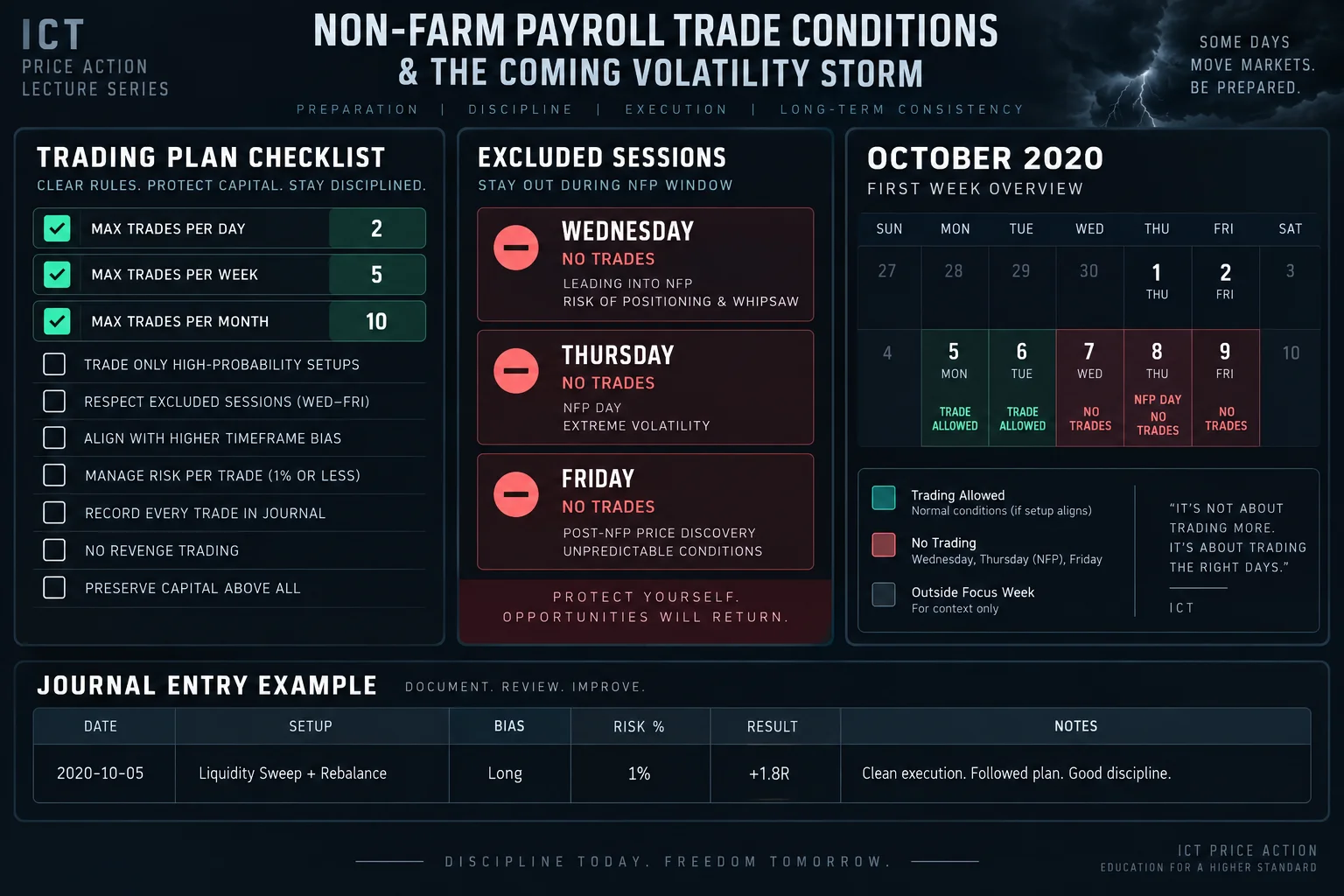
ICT Price Action Lecture Takeaways
This lecture is fundamentally about selective participation. ICT’s NFP rule was based on his account of his own errors, not on the absence of price movement. His proposed alternative was to observe, annotate liquidity events and session levels, and preserve the information for later analysis. More generally, the session argues that a trading journal should identify when a particular decision-maker performs poorly, and that choosing not to participate can itself be a deliberate rule. This summary is educational commentary, not investment advice or a promise of trading performance.
Source and transcript notes
This article was reconstructed from the video’s timestamped transcript. Claims about ICT’s personal rules, views, and past performance are attributed to the speaker and not independently verified. No financial advice is given. The video is the primary source; timestamps link to the YouTube watch page.
Primary source
Verified original-source resources
- Inner Circle Trader official website (ICT’s official site for courses and community)
- The Inner Circle Trader YouTube channel (primary-source lectures and mentorship episodes)
- CFTC: Forex Fraud FAQs (regulatory context for retail forex risk)
- CFTC Forex Fraud Advisory (official advisory on retail forex risks)