Key takeaways
ICT’s Pattern Recognition London Close OTE Short Fiber lesson reviews a EUR/USD day trade in the London close kill zone, using a higher-timeframe bearish premise, an intraday rally into an Optimal Trade Entry retracement area, a stop above the setup, and sell-side liquidity near prior lows as the objective.
Read the full summary
ICT’s Pattern Recognition London Close OTE Short Fiber lesson reviews a EUR/USD day trade in the London close kill zone, using a higher-timeframe bearish premise, an intraday rally into an Optimal Trade Entry retracement area, a stop above the setup, and sell-side liquidity near prior lows as the objective. At 56 seconds, ICT emphasizes recognizing a short even when the retracement looks locally bullish, prioritizing directional bias and liquidity over a mechanical OTE buy interpretation. He planned to scale out near an initial target and retain a smaller portion, but the setup formed late in the session, fatigue caused him to fall asleep, and he missed his preferred reduction sequence. Price reportedly reached the anticipated area around 4 minutes 2 seconds, including a reference to 10 pips below an institutional price level, before the remaining portion returned to his stop around 4 minutes 50 seconds. The transcript’s target rendered as 117.25 and other exact chart levels cannot be verified, while fills, account records, OTE measurements, and profitability are not independently documented. The main lessons are to evaluate entries within a defined directional thesis, preplan multiple exits without assuming perfect execution, and avoid trading while fatigue impairs monitoring and decision-making.
How we researched this article
BestProps used document-based research from primary firm sources, checked September 25, 2026. The complete source list, scope, limitations, and commercial-state record appear near the end of this article.
In Pattern Recognition – London Close OTE Short – Fiber, ICT reviews a short-term EUR/USD setup framed around the London close period, an Optimal Trade Entry (OTE) retracement and a lower liquidity objective. The lesson is less about a perfectly managed trade than about recognizing a bearish setup when the immediate price action appears bullish.
ICT London Close OTE Short Setup
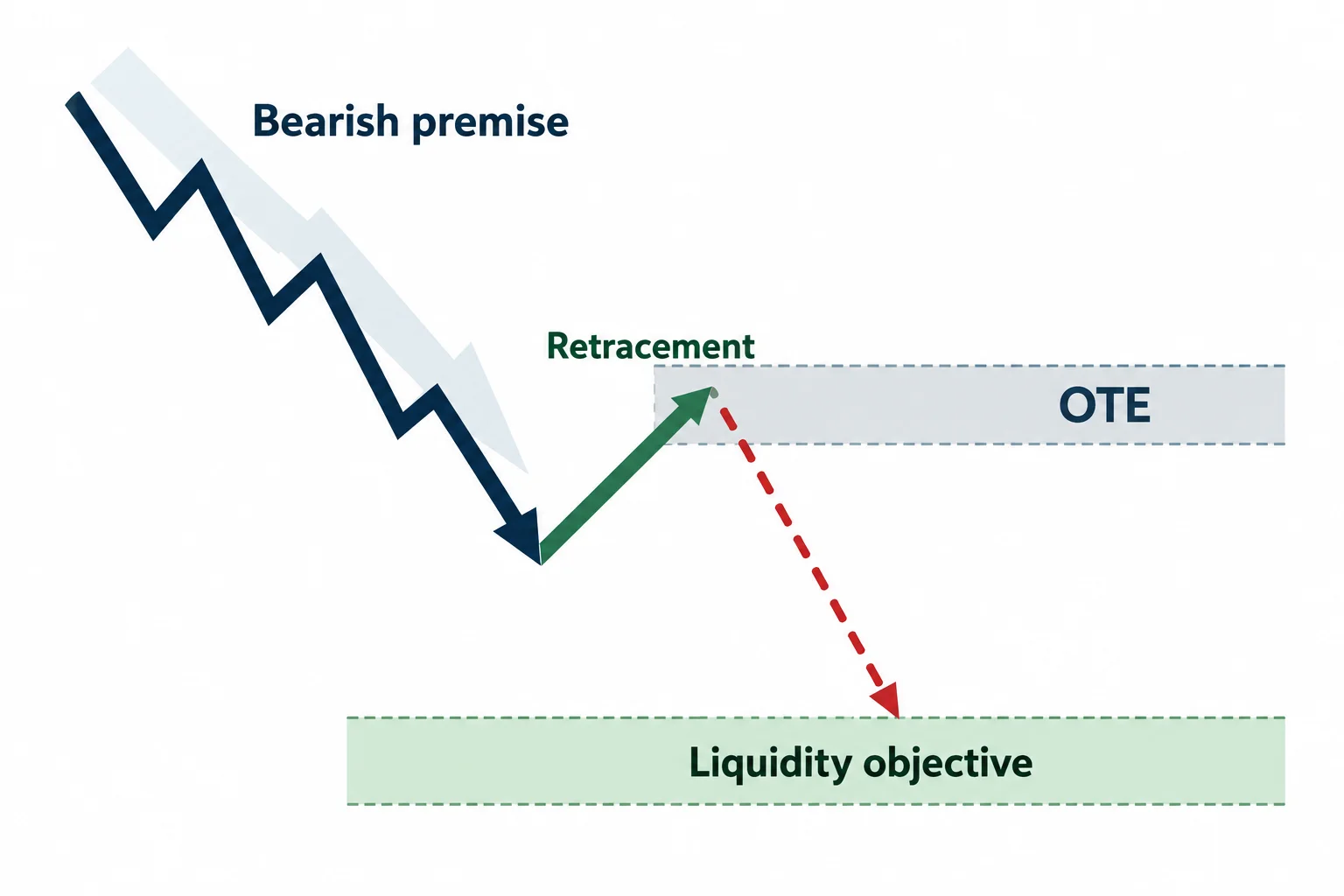
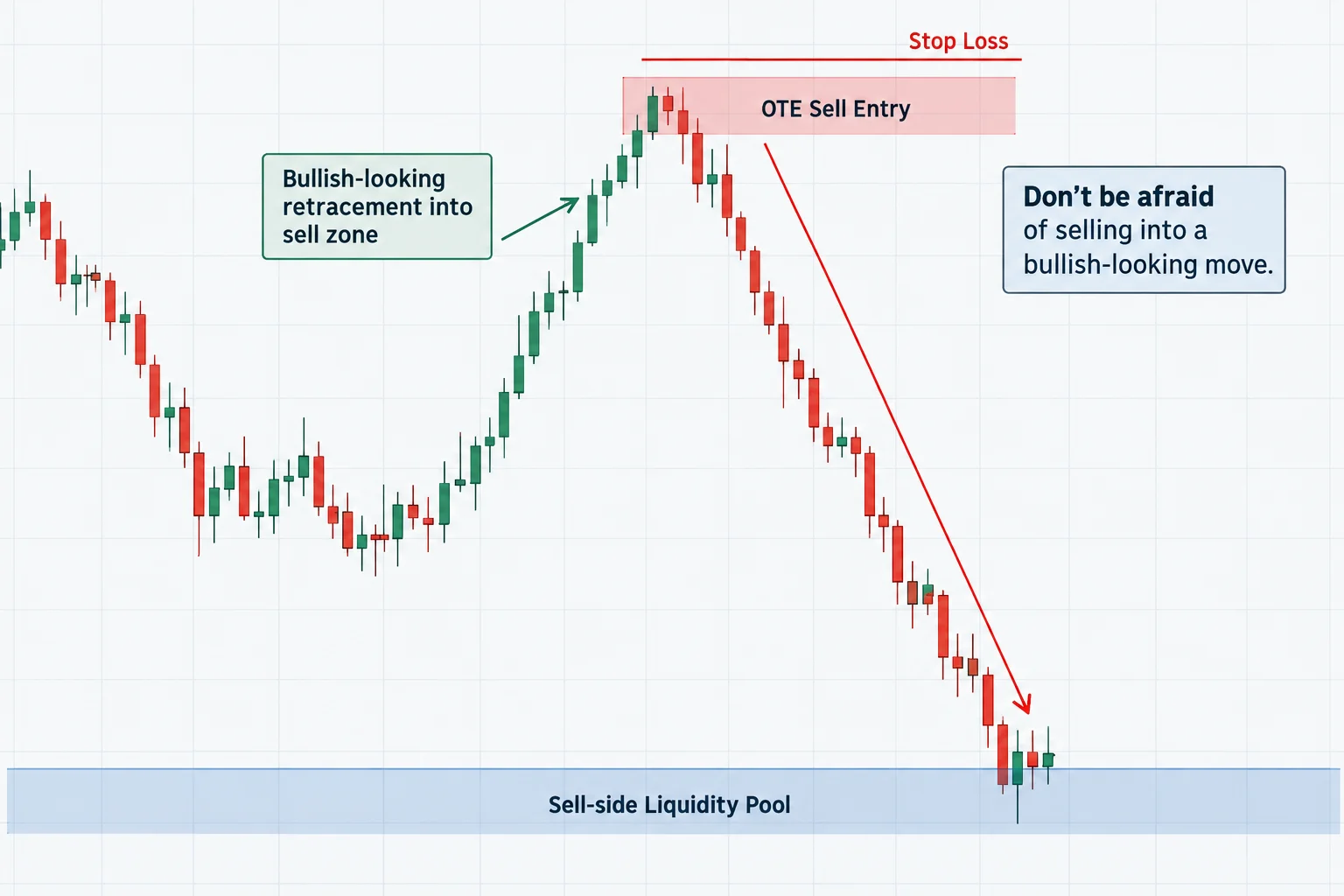
At 0:02, ICT identifies the example as a EUR/USD day trade in what he calls the London close “kill zone.” He marks an OTE area inside a retracement range, places a stop above the setup and discusses an initial target. The automated transcript renders that target as “117.25,” but this likely represents a decimal-form EUR/USD quotation that cannot be confirmed without inspecting the chart.
The central pattern-recognition point begins around 0:56. ICT asks viewers to study the appearance of the retracement and become comfortable evaluating a short even though the move looks bullish in the moment. He notes that someone applying OTE mechanically might interpret the same action as a potential buy. In his framework, however, the broader directional premise and intended liquidity objective take priority over the appearance of the immediate upswing.
London Close Direction and EUR/USD Liquidity
ICT explains at 1:23 that he expects price to reprice toward a larger liquidity pool. He then connects the intraday retracement to what he interprets as bearish implications from the daily chart. His stated objective is an area of sell-side stops near prior lows, highlighted from 1:54.
This is ICT’s market interpretation, not proof that an algorithm must behave in the described way. The transcript also does not provide enough chart detail to independently assess the higher-timeframe structure, the exact OTE measurements or the marked liquidity levels.
ICT OTE Short Sequence
- A higher-timeframe bearish premise supplies the directional bias.
- An intraday rally enters the area ICT identifies as an OTE retracement.
- The rally looks bullish locally, which makes the proposed short psychologically uncomfortable.
- ICT expects price to move toward sell-side liquidity around the lows.
- He plans to reduce the position near an initial objective and retain a smaller portion for a further move.
ICT OTE Short Execution and Fatigue
The review also contains an unusually direct risk-management lesson. At 2:15, ICT says the setup formed late in the relevant session window. He then acknowledges that he was extremely tired while monitoring it. Around 2:45, he describes repeatedly closing his eyes and eventually nodding off.
After returning his attention to the chart, ICT says price had already moved through the area where he wanted to manage the position. He reports scaling out one portion but missing the better opportunity to reduce more. He subsequently adjusted his management rather than obtaining the exit sequence he initially wanted.
Near 4:02, ICT says price reached the area he had anticipated. The transcript records references to “10 pips below” an institutional price level and to intraday symmetry, although the precise quoted number is ambiguous in the automated captions. He also says the remaining portion later returned to his stop at 4:50.
Reading the ICT London Close Pattern
Separate from ICT’s specific market model, the example illustrates three broader study points. First, an entry pattern should be considered within a clearly defined directional thesis rather than treated as an isolated signal. Second, planning multiple exit points does not ensure they will be executed as intended. Third, fatigue can materially impair monitoring and decision-making. The speaker’s own account makes that operational issue more concrete than the chart pattern itself.
The closing reflection is also notable: ICT distinguishes the trade idea from the quality of its management. He says the move developed broadly as expected and that he took something from it, while accepting that the final portion was stopped. Because the transcript does not show independently verifiable fills, account records or the full chart context, this should be read as a summary of his narrated example, not as evidence of profitability or a repeatable trading edge.
Watch the ICT London Close Lesson
This article draws on the timestamped automatic transcription of Pattern Recognition – London Close OTE Short – Fiber. The transcript is a source for the speaker’s words, not independent proof of the reported trading performance. The recording’s chart detail remains important when following the annotations.
Watch the original lesson on YouTube
The video cannot be played inside another website: when its embedded player was opened and clicked on 22 September 2026, the player reported “Video player configuration error” (Error 153) and settled on a “Watch video on YouTube” prompt. That message is why no embed is reserved or left blank here; the recording itself is available directly on YouTube.
Watch Pattern Recognition – London Close OTE Short – Fiber on YouTube ↗
ICT Pattern Recognition Sources and Further Reading
- The original Inner Circle Trader lesson: use the timestamp links in this article to compare the explanation with its source.
- YouTube’s embedding documentation: platform guidance relevant to the external watch link above.
- 17 CFR 4.41: disclosures concerning hypothetical performance: a regulatory reference, not a statement that a particular recording or this article meets every legal requirement.
This is independent educational commentary. It is not official ICT material, a tested trading system, or a claim that the reported results can be reproduced.