How we researched this article
BestProps used document-based research from primary firm sources, checked September 25, 2026. The complete source list, scope, limitations, and commercial-state record appear near the end of this article.
In this long-form forex lesson, ICT reviews a September 22, 2020 EUR/USD short setup built from a bullish US Dollar Index thesis, daily-low targets, an hourly optimal trade entry retracement, and nested 15-minute parent and subordinate swings. ICT argues that traders who miss an entry should avoid chasing, confirm the higher-time-frame premise, and wait for a predefined retracement. He describes a prior low as a mitigation block, seeks a sell-limit fill near a prior candle body, and adjusts the stop from roughly 15 pips to slightly under 11 pips, targeting a lower chart level. The transcript cannot verify the order, fill, management, or result. ICT says completed MT4 screenshots are weak evidence without prospective entries, stops, targets, timestamps, and management, while distinguishing student MT4 use from educators relying solely on post-trade images. His own examples use TradingView paper trading rather than live funds, which can demonstrate process but cannot prove profitability, eliminate selection bias, or validate claims about broker manipulation. The practical standard is to require a thesis stated before the move, visible invalidation and objectives, clear demo, paper, or live labeling, losing examples, and reviewable time-stamped recordings, with ICT acknowledging that the method is not flawless and repeated trading will eventually produce losses.
In this long-form forex lesson, ICT reviews a September 22, 2020 EUR/USD setup, explains how he approached a missed entry, and gives his perspective on evaluating trading educators who publish MT4 screenshots. The recording combines a chart lesson with an extended discussion of demo trading, broker feeds and the limits of after-the-fact performance images. Watch the complete primary video on YouTube. The discussion reflects ICT’s interpretations and claims, not independently verified evidence of a trading edge.
ICT Forex Price Action on EUR USD
ICT begins with what he describes as a short-term bullish view of the US Dollar Index. From that premise, he expects weakness in foreign currencies such as the euro. He then moves from the dollar chart to EUR/USD and identifies daily lows as the downside objective for his day-trading model. This top-down framing begins at 0:15.
ICT Trade Lesson for Missed Forex Entries
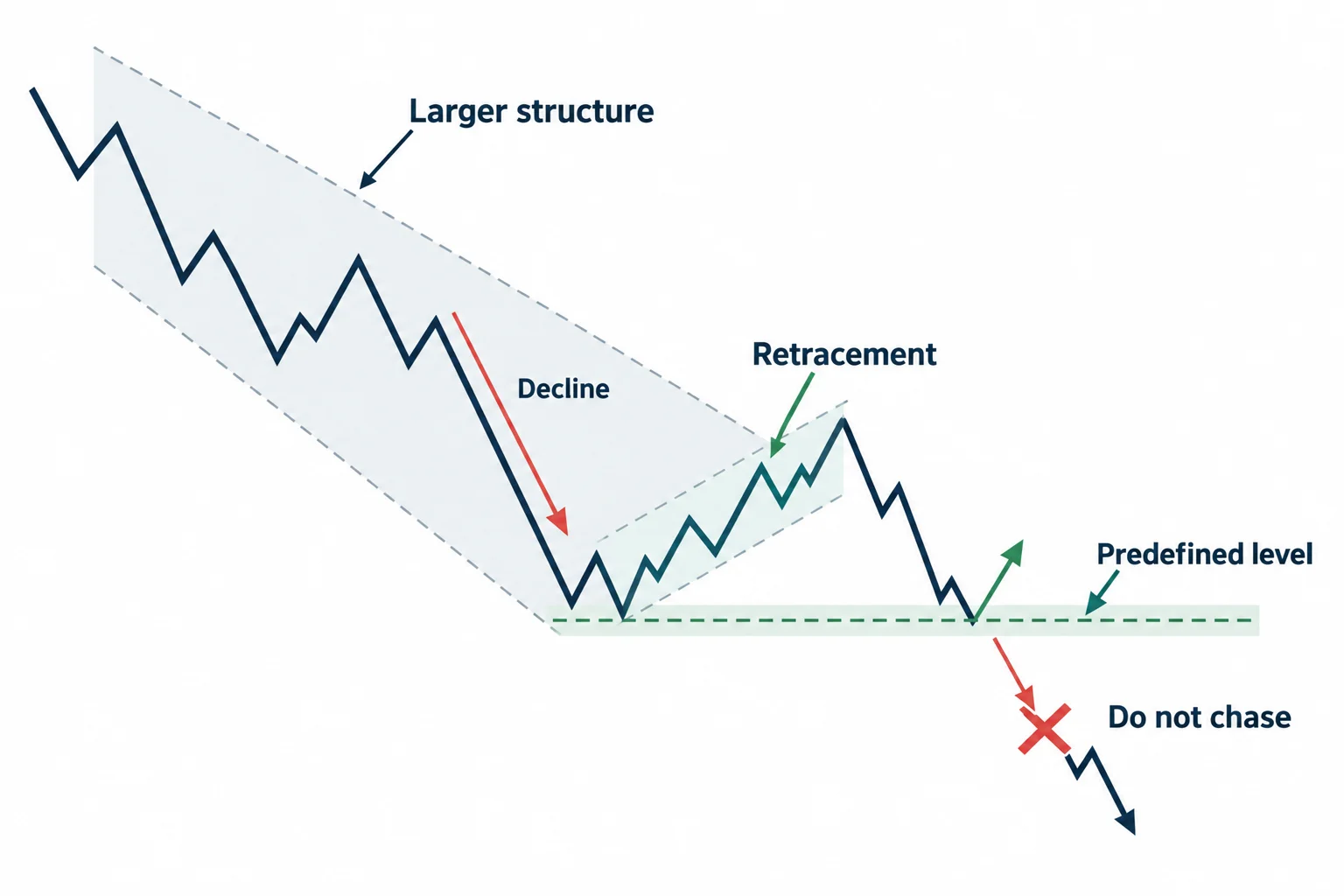
- Do not automatically sell after a sharp decline merely from fear of missing out.
- Reassess whether the larger directional premise is still intact.
- Identify a smaller swing or retracement inside the larger structure.
- Wait for price to return to a predefined level rather than pursuing it with a market order.
- Place any interpretation of support, resistance or indicators inside the broader narrative rather than treating a pattern as self-sufficient.
At 7:47, he specifically warns against chasing the decline. He later labels a prior low a “mitigation block,” distinguishing it from what he calls an ICT breaker. These are ICT-specific classifications, not universally standardized market terms.
ICT Forex Price Action and Mitigation Blocks
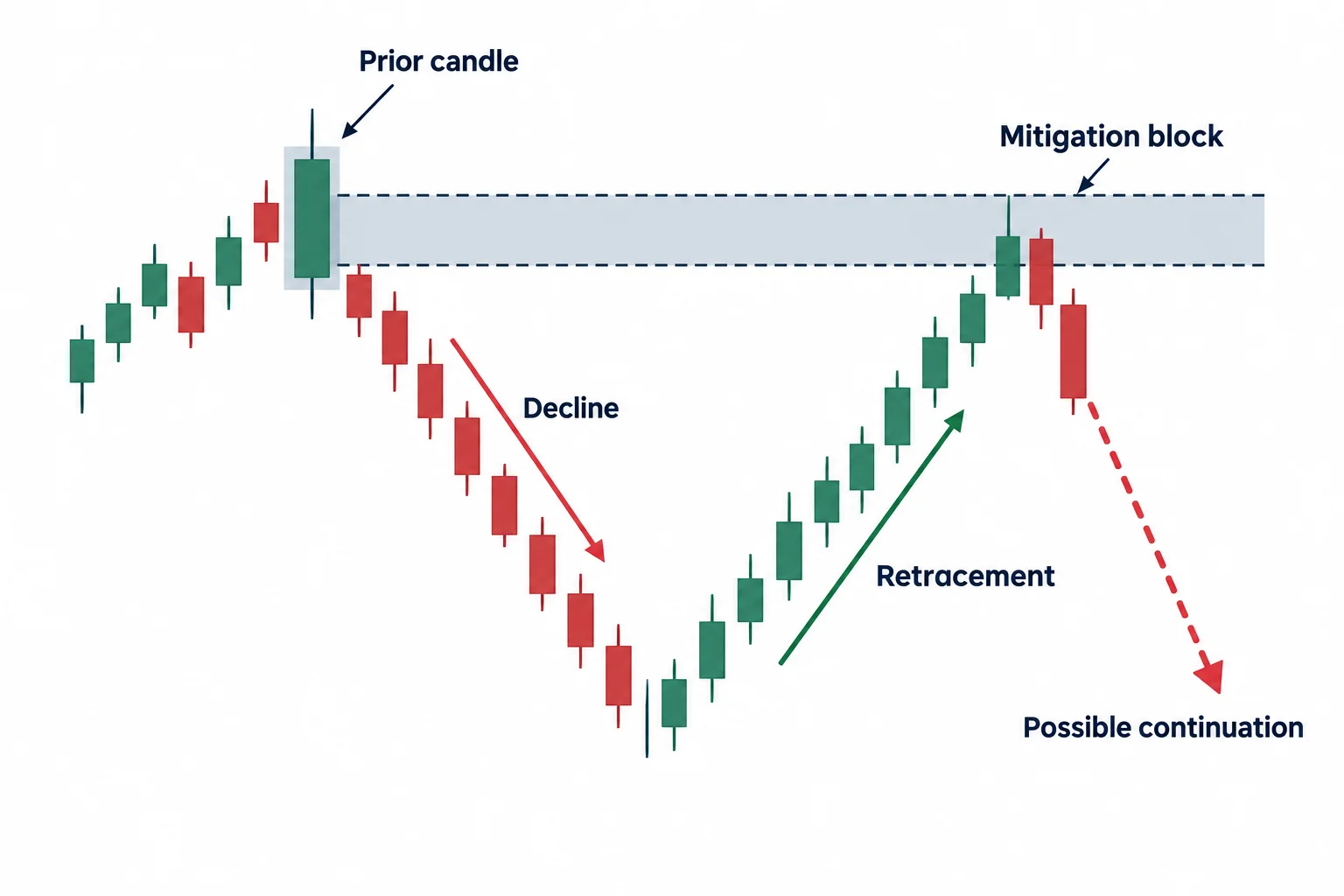
Much later, ICT returns to the chart and explains the limit-order idea in more detail. He says he was looking for price to retrace toward the body of a prior candle before continuing lower. His public-level explanation of a mitigation block is that liquidity providers may have inventory associated with facilitating earlier transactions and may use a return into that area to offset exposure. That account begins around 49:49.
This should be read as ICT’s market model, not as verified visibility into bank positions or the causes of a particular price move. The transcript does not provide order-book evidence establishing who took each side of the transactions.
ICT also discusses using a sell limit below his exact reference level to improve the chance of a fill. He mentions adjusting a stop from roughly 15 pips to slightly under 11 pips and targeting a lower chart level. Although the recording reportedly proceeds to an execution segment, the transcript cannot independently establish the visual order placement, fill, management or final outcome.
ICT Claims About Broker MT4 Trade Evidence
The second major topic starts around 13:19. ICT argues that screenshots showing completed MT4 trades are weak evidence when viewers cannot see when an order was entered, where its stop and target were placed, or how it was managed. He alleges that some parties can alter or fabricate apparent trading histories, but the transcript alone does not substantiate claims against any particular person or platform.
Importantly, ICT does not conclude that every use of MT4 is fraudulent. His more nuanced position appears later at 1:08:29: a student using MT4 is different from an educator relying solely on post-trade screenshots as proof of expertise. He says educators should demonstrate their process on another platform and show entries before the move, along with stops, targets and management.
ICT identifies his own examples as TradingView paper trading rather than live-account trading. At 31:10, he describes paper trading as a practice setting in which a learner can study execution without losing real funds. He repeatedly discloses that his examples are hypothetical, while arguing that visible decision-making is more educational than a profit screenshot.
Reviewing ICT Forex Trade Evidence
- Was the market thesis stated before the claimed move?
- Are the entry, invalidation level and objective visible in advance?
- Is the account clearly labeled as demo, paper or live?
- Does the presenter show losing and uncertain situations as well as selected successes?
- Can the original, time-stamped recording be reviewed rather than only a screenshot?
- Are platform demonstrations being confused with audited profitability?
A visible demo execution can clarify a teaching process, but it does not prove live profitability, eliminate selection bias or establish that a method will work in the future. ICT himself acknowledges near 1:18:46 that the approach does not work flawlessly and that trading every session would eventually produce a loss.
ICT Forex Price Action Lesson Takeaways
- The core chart lesson is to begin with a higher-time-frame directional thesis, map the larger swing, and wait for a retracement inside a subordinate structure instead of chasing price.
- The broader lesson is to judge trading education by transparent, prospective reasoning, not by isolated screenshots, lifestyle marketing or unsupported profit claims.
- Neither this transcript nor a paper-trading demonstration verifies profitability, and none of the material should be treated as investment advice.
Primary video: ICT Forex Price Action Lesson: Trade Review, Brokers & MT4 Scams