Key takeaways
ICT reviews an intraday EUR/USD range setup on 15-minute and five-minute charts during the eight thirty a.m.
Read the full summary
ICT reviews an intraday EUR/USD range setup on 15-minute and five-minute charts during the eight thirty a.m. to eleven a.m. New York window, recommending charts use New York time and treating order blocks as contextual zones rather than automatic signals. The 15-minute narrative tracks a London low, a rally into a bearish order block and mean threshold, a decline through equal lows and sell-side liquidity into a bullish order block, then a potential rebound toward short-term highs and buy-side liquidity. On the five-minute chart at 10 minutes 28 seconds, ICT describes selling a revisit to an up-close candle characterized as both a bearish order block and mitigation block after price failed to exceed a swing high and broke lower, targeting nearby lows rather than the entire move. During the rebound, he says he reduced most of a long above a short-term high and protected the remainder with an adjusted stop, reflecting range management rather than an expectation of sustained expansion. The narrated move exceeded 40 pips, but the transcript cannot verify exact prices, entries, exits, fills, account activity or performance. Core rules are to identify consolidation versus displacement, mark prior highs, lows and equal-level liquidity, establish the higher-timeframe narrative before moving lower, combine structure, liquidity and time of day, and align profit targets with assumed range conditions.
How we researched this article
BestProps used document-based research from primary firm sources, checked September 25, 2026. The complete source list, scope, limitations, and commercial-state record appear near the end of this article.
In ICT Forex Lesson – EurUsd NYO Lecture, ICT reviews an intraday EUR/USD setup using 15-minute and five-minute charts. The lesson focuses on reading price within a consolidation, aligning charts to New York time, identifying liquidity around prior highs and lows, and using order blocks as contextual areas rather than automatic trade signals.
This is a retrospective explanation of ICT’s interpretation, not independent proof that the concepts produce a trading edge. The transcript also cannot verify the chart’s exact prices, any account activity shown on screen, or results beyond what ICT narrates.
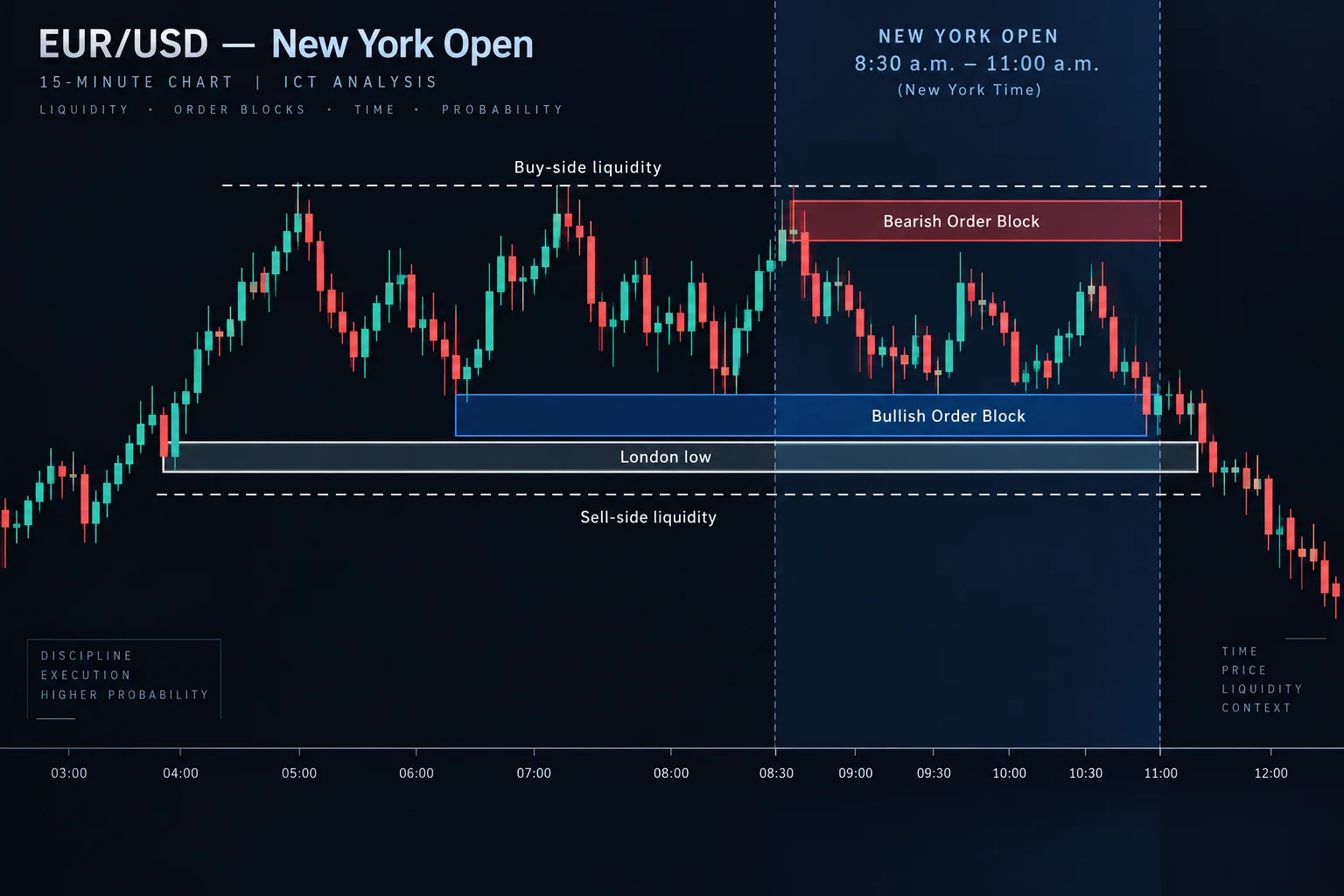
ICT Forex Range Before a Breakout
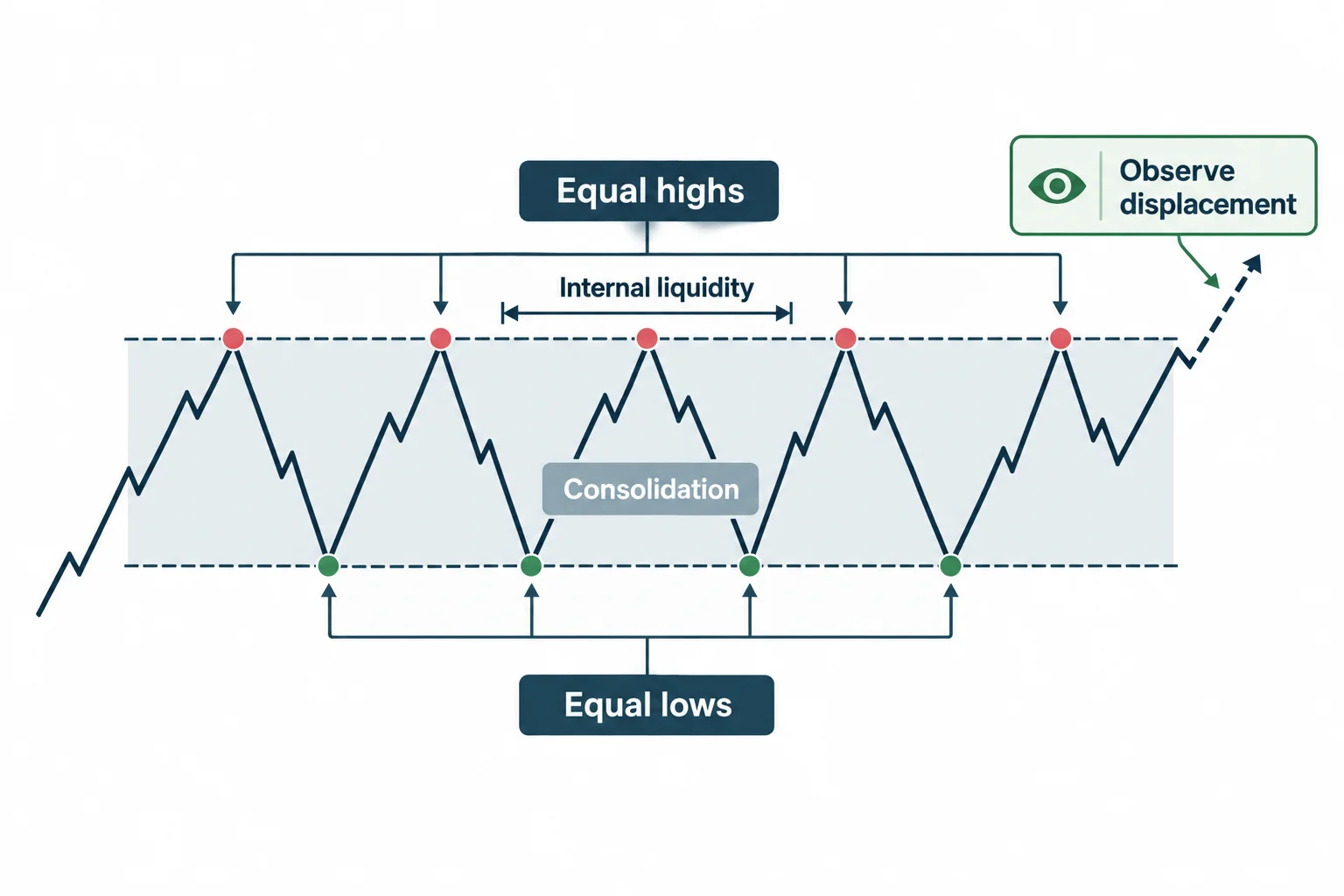
ICT begins the chart discussion by identifying a Monday high and several nearby lows. At 1:55, he notes that students familiar with his material may immediately focus on equal highs and equal lows. His broader point is that these levels need a narrative: sometimes price approaches them as an objective, while at other times a trader must wait.
For this session, ICT describes EUR/USD as being in consolidation. Consequently, his working expectation is not an immediate, sustained breakout. He instead interprets the market as trading within its established range until a more decisive displacement occurs. This range-based premise shapes the rest of the analysis, including why he discusses taking profits near internal liquidity rather than holding everything for a distant target.
Why ICT Forex Charts Use New York Time
At 3:03, ICT defines the session window under review as 8:30 a.m. to 11:00 a.m. New York time. He recommends setting chart platforms to New York time so that the session markers in his lessons align consistently, regardless of the viewer’s location.
This is primarily a chart-organization convention. In the example, ICT marks midnight in New York, discusses an earlier London-session move, and then evaluates how price behaves as the specified New York window begins. Standardizing the clock helps prevent a viewer from assigning the same candle to a different session because of platform or local-time settings.
ICT EURUSD 15-Minute Range Narrative
ICT describes price as first forming a London low and then advancing into an area he labels a bearish order block. In his terminology, the relevant zone is associated with an up-close candle near a swing high. He also mentions the candle body’s midpoint, which he calls the “mean threshold.”
Importantly, at 4:49, ICT cautions that not every up-close candle is a bearish order block and that even a valid bearish order block is not automatically a short-sale opportunity. The location only becomes meaningful to his analysis when combined with market structure, liquidity and time of day.
His narrated sequence is:
- Price establishes a low during the London portion of the day.
- It rallies toward a 15-minute area ICT interprets as a bearish order block.
- Price then declines through relative equal lows, which he describes as sell-side liquidity.
- The decline reaches a bullish order-block area during the 8:30–11:00 New York window.
- ICT then looks for a possible rebound toward short-term highs and other perceived buy-side liquidity.
At 8:23, he brings these elements together: the London low, the reaction from the bearish area, a move below nearby lows and arrival at a bullish area around the New York open. He also compares the pullback with what he calls an optimal trade entry, while stressing that his decision is based on his order-block logic rather than mechanically trading Fibonacci levels.
ICT EURUSD Five-Minute Short Setup
ICT moves to the five-minute chart at 10:28 to explain why he says he entered a short. He characterizes a group of candles as both a bearish order block and a mitigation block, adding that a mitigation block is similar to, but not the same as, a breaker in his framework.
As narrated, price revisits an up-close candle after failing to exceed a nearby swing high and breaking lower. ICT says he sold on the revisit and targeted the lows below rather than trying to capture every possible increment of the move. His reasoning was that stop orders from long positions could be resting beneath those nearby lows, creating what he calls sell-side liquidity.
The transcript reports a subsequent decline into the lower area followed by a rally. However, because the source supplied here is an automatically generated transcript without visual chart verification, the exact entry, exit, account status and fill quality cannot be confirmed from the text alone.
Managing EURUSD Forex Trades Inside the Range
During the rebound, ICT identifies a short-term high as a possible location for buy-side liquidity. At 12:21, he explains that his plan was to reduce most of a long position after price moved above that high and then protect the remainder with an adjusted stop.
ICT presents the example as range-trading management: when the market is not expected to expand strongly in either direction, he prefers realizing most of the position at an opposing liquidity area. He narrates a move of more than 40 pips between the discussed regions, but the transcript does not independently establish the precise chart coordinates or executed return.
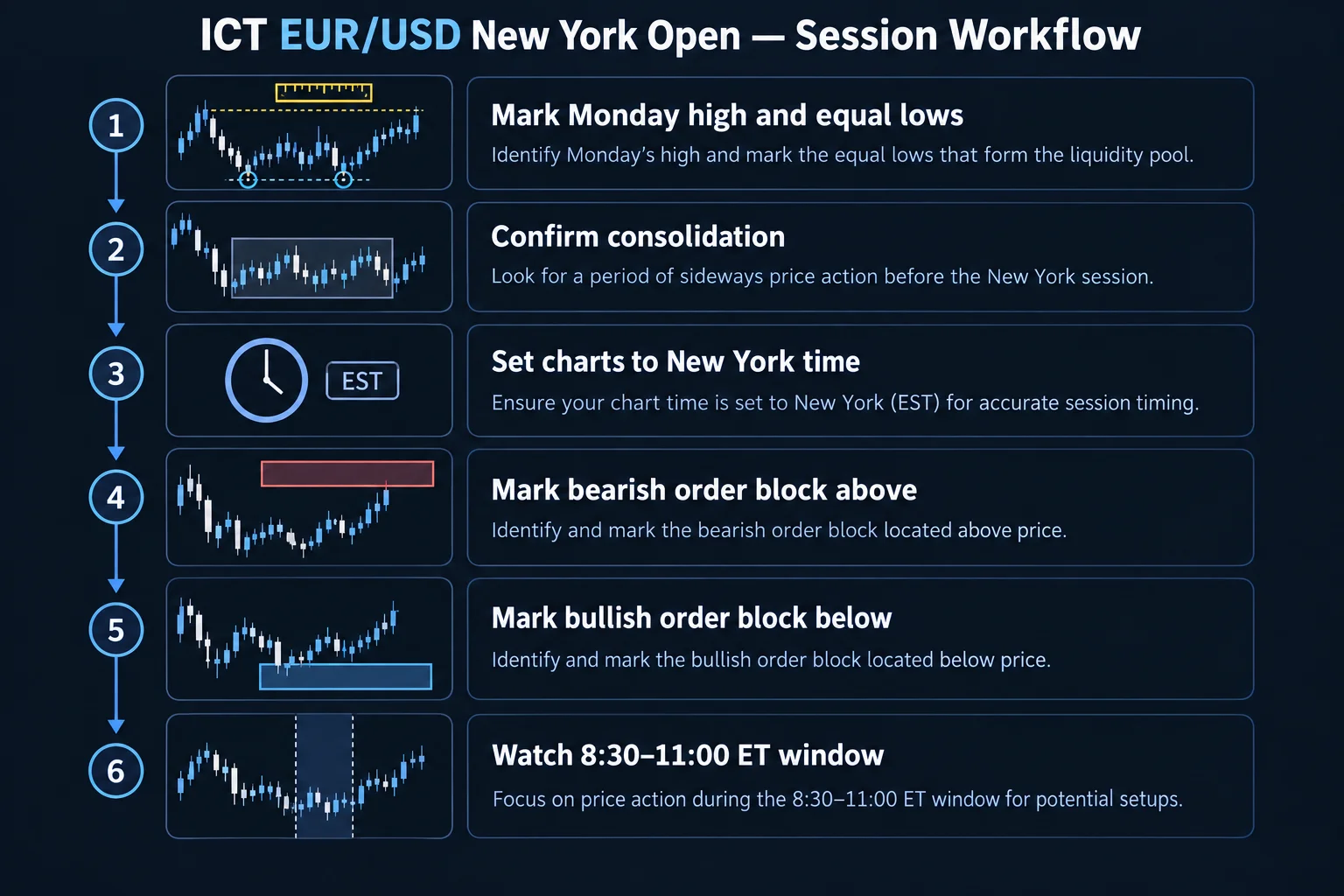
Key ICT Forex Lesson Takeaways
The useful study process is not to label every candle as an order block. Instead, the lecture demonstrates how ICT combines several layers:
- Decide whether the market appears to be consolidating or displacing.
- Use one consistent time zone when studying session behavior.
- Mark prior highs, lows and clusters of similar levels.
- Treat order blocks as contextual zones, not standalone signals.
- Move to a lower timeframe only after establishing the higher-timeframe narrative.
- Match profit-taking expectations to the range conditions being assumed.
ICT closes near 13:51 by framing his remaining upside idea as an observation for study rather than a guaranteed opportunity. That distinction is essential: the video documents one speaker’s real-time market interpretation, not a validated rule or promise of future performance.
Watch the ICT EURUSD NYO Lecture
The chart annotations, order-block discussions and live-session context are best understood in ICT’s original recording:
▶ Watch ICT EUR/USD New York Open Lecture on YouTubeThe transcript alone cannot independently verify chart annotations, prices, or trade performance.
Related ICT Forex Lesson Resources
- ICT Forex Lesson – EurUsd NYO Lecture The primary source for this article.
- Inner Circle Trader YouTube channel ICT's official channel.
- CME Group FX markets overview Neutral reference for the EUR/USD context used in the lesson.
- Forex Factory calendar Example of a public economic calendar of the type referenced for session planning (third-party; not affiliated with ICT).