Key takeaways
ICT’s Forex price action lecture defines day trading as opening and closing a position the same day, distinguishes trading the major daily move, smaller intraday swings, and scalps, and recommends choosing five-minute, hourly, daily, or weekly charts according to temperament and schedule rather than chasing every fluctuation.
Read the full summary
ICT’s Forex price action lecture defines day trading as opening and closing a position the same day, distinguishes trading the major daily move, smaller intraday swings, and scalps, and recommends choosing five-minute, hourly, daily, or weekly charts according to temperament and schedule rather than chasing every fluctuation. From 7 minutes 5 seconds, he advocates specializing in one repeatable bread-and-butter setup using concepts such as optimal trade entry, breakers, order blocks, and market structure while accepting missed moves and no-trade sessions. From 11 minutes 57 seconds, he recommends forward testing by watching or replaying sequential price data without live-trade pressure and journaling hypotheses, invalidation conditions, and outcomes. Near 16 minutes 45 seconds, a five-minute EUR/USD paper-trade walkthrough covers a London-open low, Judas swing, market-structure break, bullish breaker, and bearish order-block and optimal-trade-entry setup. At 20 minutes, ICT identifies the example as a paper trade, reduces the target from 30 pips to 20 as Friday consolidation develops, and says stops should be tightened rather than widened. His preferred Eastern Time study windows are 2 to 5 a.m. for London and 8 30 to 11 a.m. for New York, but he stresses that these windows do not guarantee setups or profits. The core lesson is to select a compatible timeframe, define and repeatedly practice one setup, revise expectations when price action changes, avoid overtrading, and delay live risk until pattern recognition feels routine, while recognizing that the transcript does not verify chart labels, fills, profitability, or broader claims about ICT’s methods.
How we researched this article
BestProps used document-based research from primary firm sources, checked September 25, 2026. The complete source list, scope, limitations, and commercial-state record appear near the end of this article.
In ICT Forex Price Action Lecture: Daytrading & Psychology, ICT combines a discussion of intraday trading styles with a longer lesson about specialization, practice, patience, and realistic expectations. He also reviews a EUR/USD paper-trade example. Because the captions do not display the chart, the precise levels and visual annotations discussed in the recording cannot be independently reconstructed from the transcript alone.
ICT Daytrading Styles Within the Daily Price Range
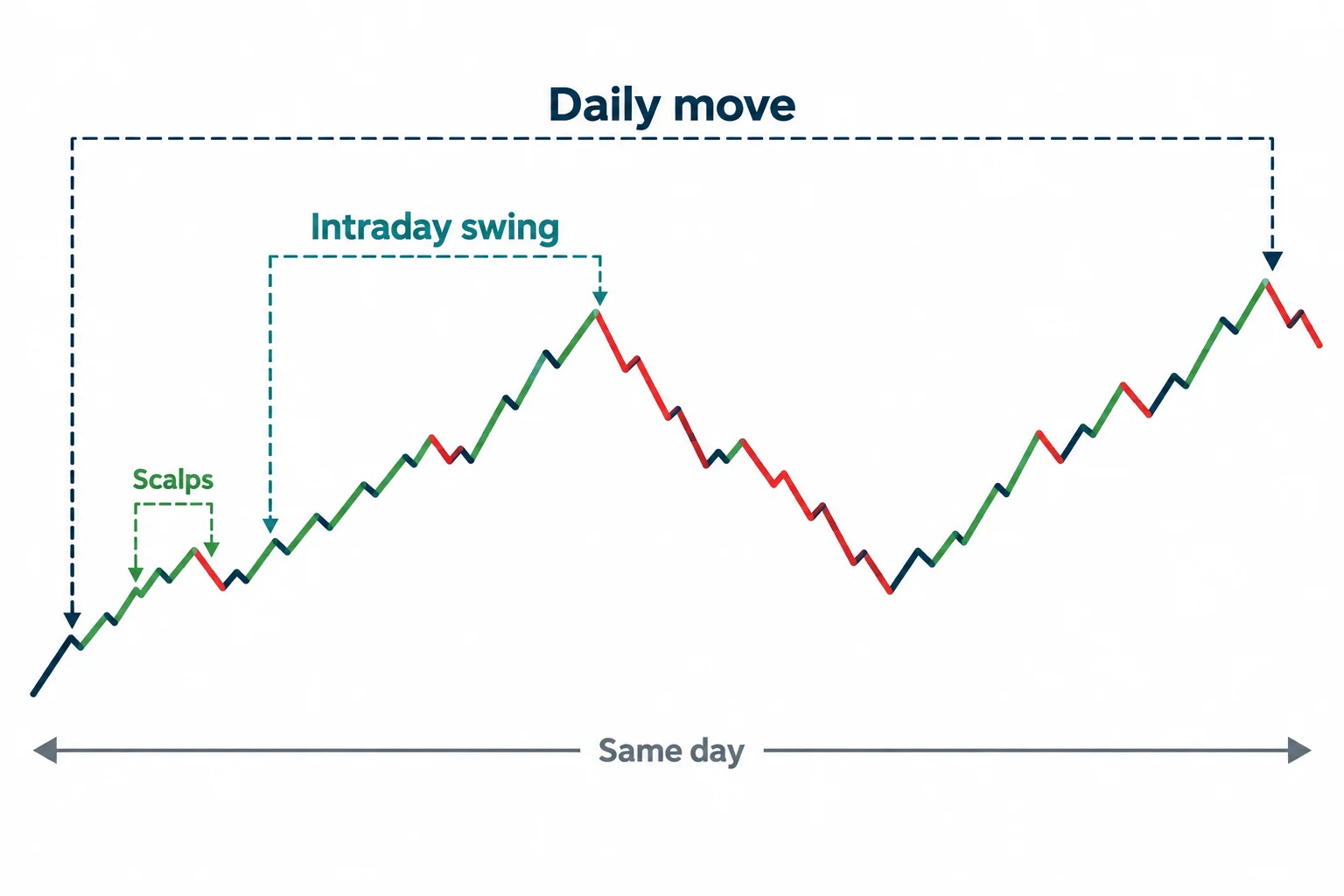
ICT begins by distinguishing three approaches that can all fall under the broad label of day trading: trading the anticipated major move of the day, trading a smaller intraday swing, and scalping short movements inside the range. His practical dividing line is whether the position is opened and closed during the same day. He separately describes positions held into another day as short-term trades and uses longer holding periods for his own definitions of swing and position trading. These are ICT’s working definitions rather than universal industry classifications. Watch from 0:54.
The larger point is that traders do not need to pursue every visible fluctuation. A person might seek one substantial daily move, one intermediate swing, or several small scalps. The appropriate choice depends on temperament, schedule, decision speed, and comfort with the timeframe.
Choose Your ICT Daytrading Timeframe and Style
At 4:25, ICT argues that similar price structures can be studied on five-minute, hourly, daily, or weekly charts. That cross-timeframe claim is his interpretation of price action, not an independently established result in this transcript. The psychologically useful part of the lesson is his insistence that a mentor cannot determine another person’s ideal trading duration.
If same-day decisions feel too fast, ICT suggests moving to a higher timeframe rather than forcing a day-trading identity. Later, he returns to this point and says personality may make someone better suited to short-term or swing trading. The lesson is therefore less about finding a universally superior chart interval and more about selecting a process that can be followed consistently.
Improve Daytrading Psychology by Missing Some Price Moves
A central psychology section begins around 7:05. ICT describes students who complete one satisfactory setup but become discouraged after seeing a larger move they did not capture. He challenges the assumption that a trader should identify every swing, noting that the same logic would require trading every opportunity across numerous currency pairs.
His alternative is specialization. The setup that repeatedly appears clear without being forced may become a trader’s “bread-and-butter” model. ICT mentions several concepts from his own teaching vocabulary (including optimal trade entry, breakers, order blocks, and market structure) but advises against combining every available concept into an unnecessarily complicated system.
- Concentrate on a limited set of instruments and conditions.
- Record the setup criteria before judging individual examples.
- Accept that valid-looking opportunities will occur without participation.
- Do not adopt a pattern merely because a teacher prefers it.
- Treat the absence of the chosen setup as a reason to do nothing.
Practice ICT Price Action Without Live Trade Pressure
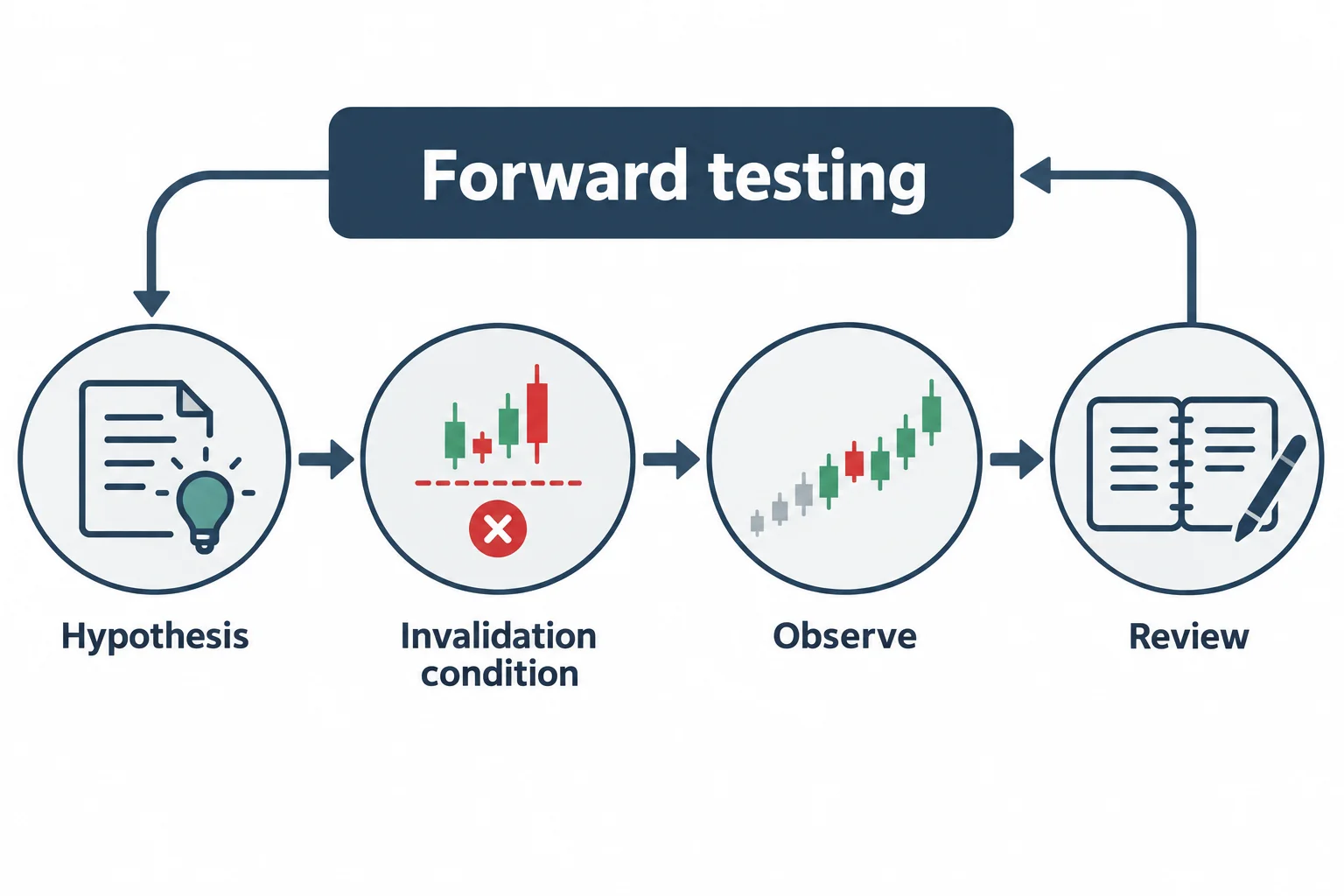
ICT’s clearest study recommendation appears at 11:57. He defines forward testing here as watching price unfold without intending to place a live trade. The student can form an expectation, observe what happens next, and review the reasoning without being distracted by profit, stops, or exits.
For those unable to watch a live session, he suggests recording the data and replaying it later. This differs from examining a fully formed static chart because bars are revealed sequentially. As a general educational exercise, a journal could capture the time, initial hypothesis, invalidation condition, and eventual observation. Such practice can help evaluate whether rules are clear and repeatable, but it does not demonstrate profitability or reproduce the emotional and execution conditions of trading real money.
ICT Forex Paper Trade Walkthrough for EUR/USD
Beginning near 16:45, ICT narrates a five-minute EUR/USD sequence using his terminology. He identifies what he calls a London-open low, a “Judas swing,” a break in market structure, a bullish breaker, and a later bearish setup combining an order block with an optimal trade entry. These labels express ICT’s reading of the chart; the transcript by itself cannot verify each visual classification.
ICT explicitly identifies the illustrated execution as a paper trade at 20:00. He says he initially sought 30 pips but reduced the target to 20 as Friday’s session progressed and price consolidated. He also says he would reduce a stop rather than widen it to accept more risk. The captions report his claimed entry, target adjustment, and paper result, but they do not independently establish a live fill or real-money outcome.
The broader takeaway is adaptability without abandoning risk limits. ICT argues that an intraday expectation should be revised when new price action or the remaining session time weakens the original scenario. That is different from moving a stop farther away merely to avoid admitting that an idea failed.
Use ICT Daytrading Windows and Avoid Forced Trades
ICT highlights broad Eastern Time study windows of 2:00–5:00 a.m. for London and 8:30–11:00 a.m. for New York. He presents them as recurring windows in his framework, not as guarantees that a setup or profitable move will occur. Watch from 1:12:58.
He repeatedly warns against confusing day trading with trading every day. Limiting observation to predefined periods, waiting for specific criteria, and accepting no-trade sessions are presented as ways to reduce overtrading. His most grounded psychological message arrives near 1:18:18: patience matters, learning takes substantial work, and pattern recognition should become routine rather than exciting before anyone considers risking live funds.
Apply the ICT Forex Price Action Lecture Carefully
The lecture’s durable educational theme is process control: select a compatible timeframe, define one setup narrowly, observe it repeatedly, document mistakes, and avoid judging progress by missed moves. ICT makes much stronger claims elsewhere in the video about his methods, market algorithms, other educators, and potential results. Those assertions are speaker commentary and are not validated by the transcript. Nothing in this summary is investment advice or a promise that the described framework will be profitable.