Key takeaways
ICT’s September 2020 forex lesson presents a three-stage pair-selection framework using a higher-time-frame Dollar Index thesis, economic-calendar differences, and EUR/GBP relative strength to choose between EUR/USD and GBP/USD.
Read the full summary
ICT’s September 2020 forex lesson presents a three-stage pair-selection framework using a higher-time-frame Dollar Index thesis, economic-calendar differences, and EUR/GBP relative strength to choose between EUR/USD and GBP/USD. With a bullish dollar premise for September 7 through 11, 2020, ICT expected both dollar pairs to weaken but viewed Thursday’s high-impact euro event and limited comparable pound news as clues that EUR/USD might consolidate while GBP/USD moved more freely. Rising EUR/GBP indicated euro strength relative to sterling, supporting GBP/USD as the preferred short candidate rather than a mechanical trade in the cross itself. Historical charts were reviewed across daily, hourly, and 15-minute views using the prior day’s range, bearish order block, imbalance, Fibonacci optimal trade entry, session timing, and liquidity below a prior daily low, with particular focus on the 8 thirty a.m. through 11 a.m. New York window after observing London activity. ICT advises tolerating consolidation, using a predefined hard stop instead of a mental stop, accepting unavoidable stop-outs, and practicing on demo while prioritizing drawdown control. The framework is educational, correlations and relative strength can reverse, calendar clues are not guarantees, and the transcript does not establish profitability or independently verify chart annotations, entries, fills, or performance.
How we researched this article
BestProps used document-based research from primary firm sources, checked September 25, 2026. The complete source list, scope, limitations, and commercial-state record appear near the end of this article.
In this September 2020 lesson, ICT presents a process for choosing between two closely related forex pairs rather than assuming every foreign currency will react equally to a directional view on the US dollar. The example compares EUR/USD and GBP/USD, uses EUR/GBP as a relative-strength gauge, and adds the week’s economic calendar as a possible clue about which market may consolidate and which may move more freely.
Primary source: ICT Forex Price Action Lesson: Cross Currency Relationships & HTF Institutional Order Flow. The discussion is educational and reflects ICT’s interpretation of market behavior, not a demonstrated trading edge or a promise of similar results.
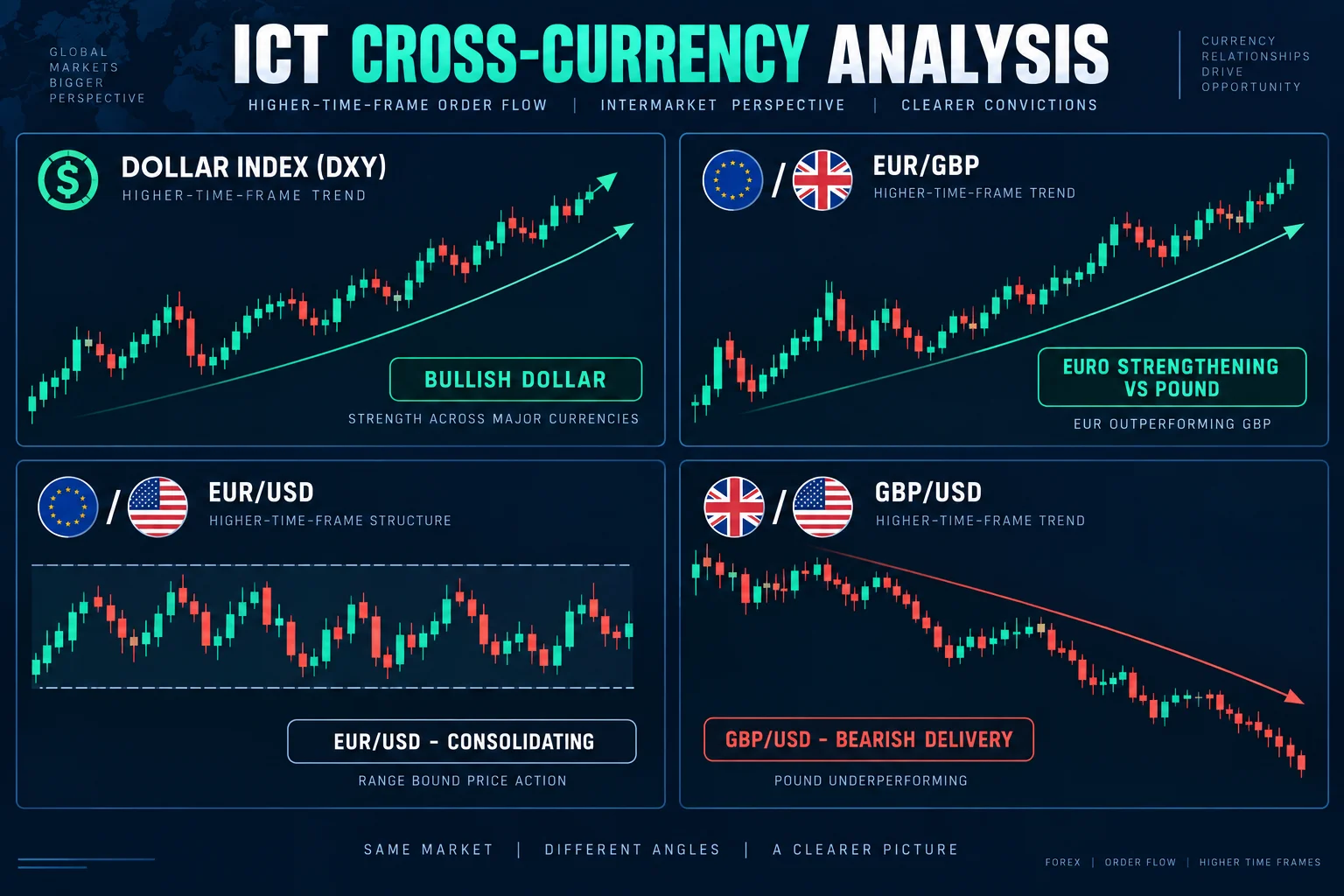
ICT Forex Price Action Lesson Goals
ICT introduces the topic as one component of a broader analytical framework, explicitly warning that it is not a standalone answer to every market question. At 00:42, he outlines four goals: identifying which related pair may lead, identifying which may stall, using that distinction in order flow, and finding explosive price swings as a result.
The starting point is a directional assumption about the Dollar Index. In the historical example, ICT says he was bullish on the dollar. A stronger dollar would ordinarily support a bearish expectation for both EUR/USD and GBP/USD, but he argues that this is not enough to select a trade. The intermediate step is to compare the euro and pound directly and decide which appears weaker.
Forex Price Action and the Economic Calendar
At 01:09, ICT reviews the calendar for September 7–11, 2020. He identifies a high-impact euro-related event on Thursday while describing the week as having little comparable UK-pound news. From this, he forms a working hypothesis: EUR/USD may remain relatively constrained ahead of the euro event, while GBP/USD may have more freedom to express the broader dollar direction.
This is presented as a probability-based clue, not a rule. ICT specifically says the calendar does not guarantee an explosive move. In his framework, it helps organize attention by suggesting which currency might wait for a scheduled catalyst.
Applying the Forex Calendar Step
- Begin with a higher-time-frame directional view on the Dollar Index.
- Check whether scheduled events differ materially between the two foreign currencies being compared.
- Treat the calendar as context for a consolidation hypothesis, not as proof of what price must do.
- Use the cross pair to evaluate relative strength before selecting a dollar pair.
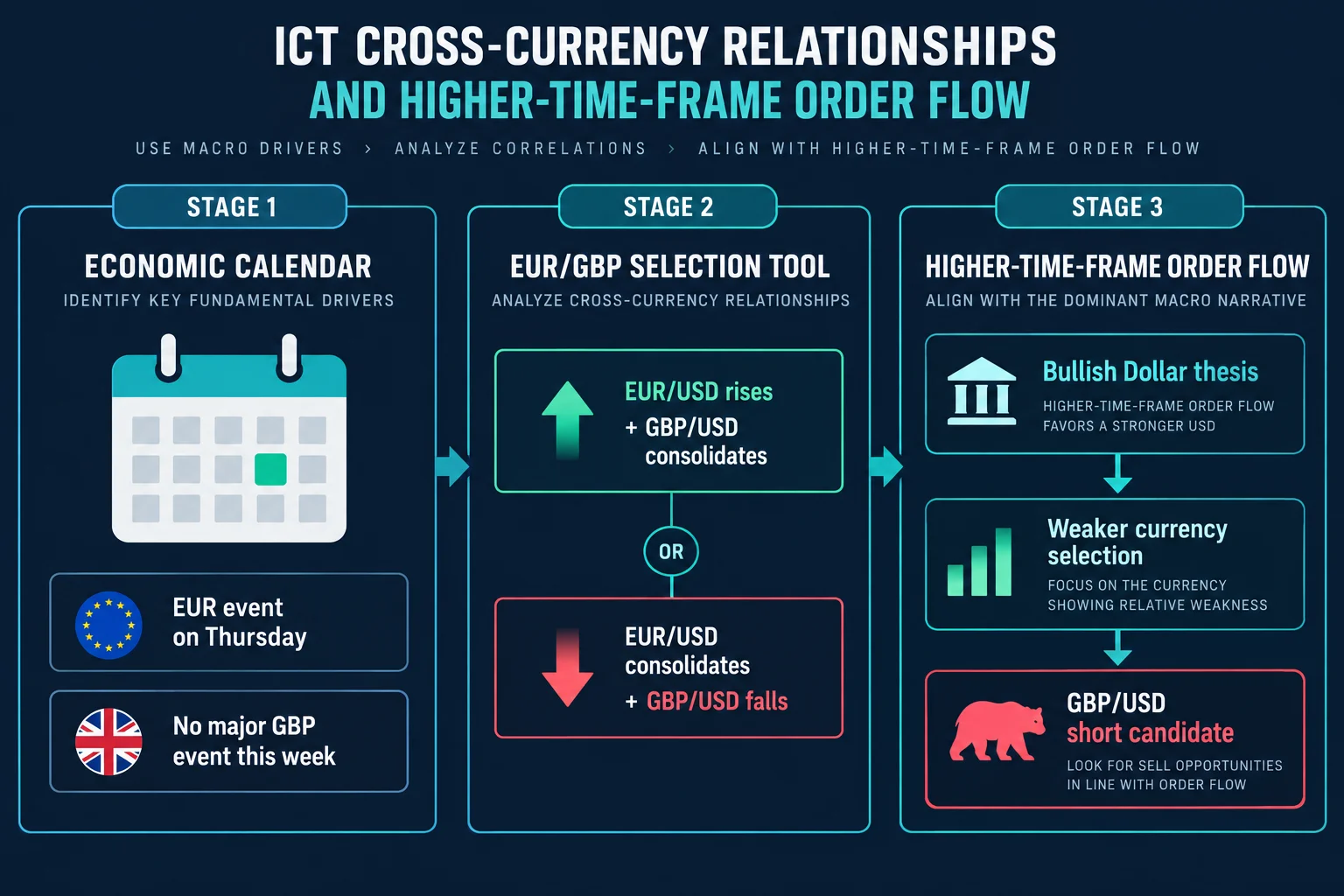
Cross Currency Relationships With EUR/GBP
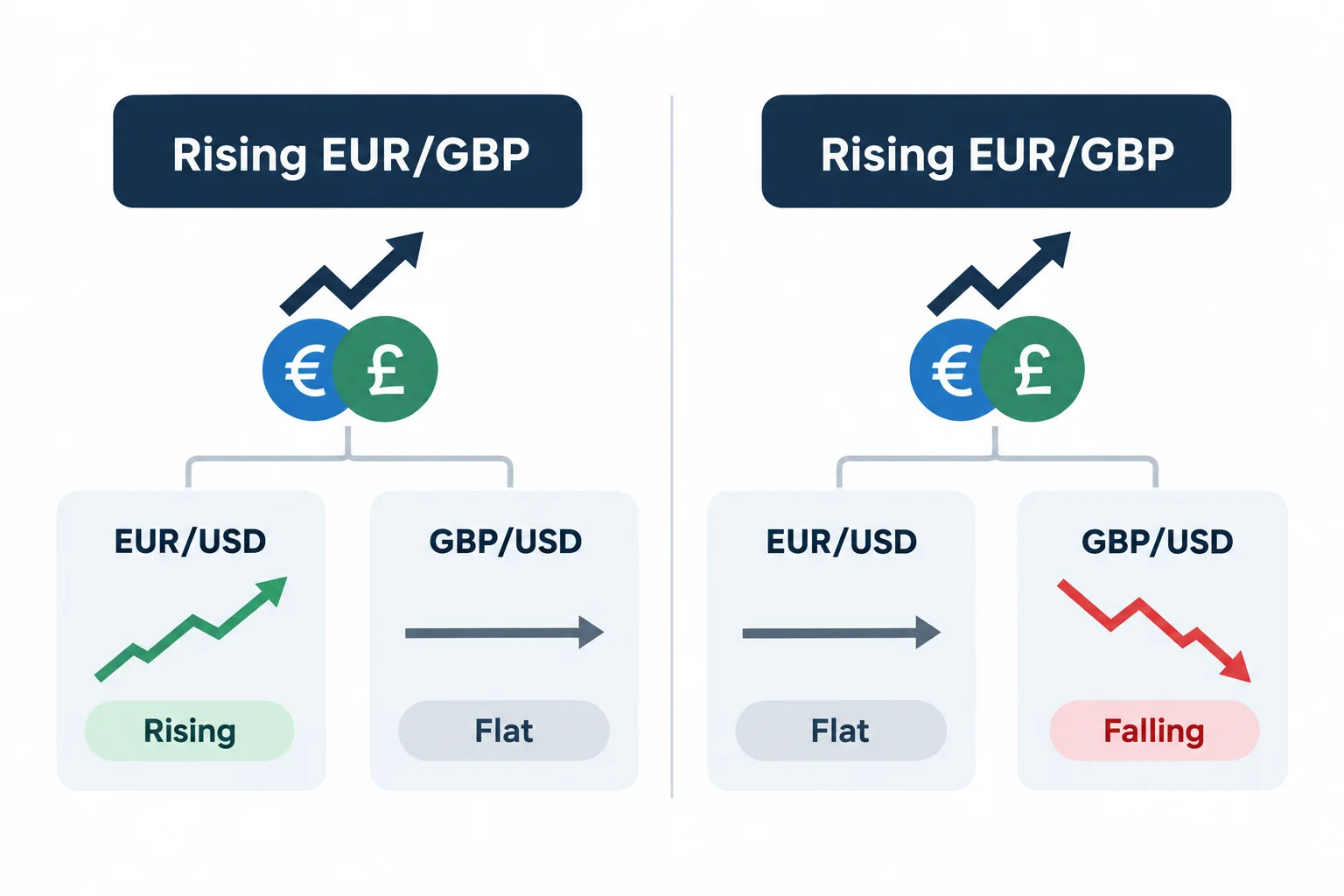
ICT explains at 05:23 that he prefers to analyze EUR/USD and GBP/USD while using EUR/GBP as a selection tool rather than necessarily trading the cross itself.
A rising EUR/GBP indicates that the euro is strengthening relative to the pound. ICT describes two broad ways this can occur: EUR/USD may rise while GBP/USD consolidates, or EUR/USD may consolidate while GBP/USD falls. Given his bullish-dollar premise and his calendar-based expectation that the euro could remain constrained, he favors the second scenario. That leads him to identify GBP/USD as the more likely short candidate in the example.
The key relationship is explained around 10:48. The cross is not treated as a mechanical signal. Instead, it is used to distinguish relative weakness inside a pair of markets that often move in the same broad direction against the dollar.
ICT Price Action on Historical Forex Charts
In the chart discussion, ICT characterizes EUR/USD as consolidated and lacking substantial downside expansion. By contrast, he describes GBP/USD as showing clearer bearish delivery and greater downside momentum. This is his visual confirmation of the earlier hypothesis: both pairs could be consistent with dollar strength, but the pound was weaker relative to the euro.
Beginning near 14:43, he narrows the GBP/USD example through daily, hourly and 15-minute views. Concepts mentioned include the prior day’s range, a bearish order block, an imbalance, a Fibonacci retracement or “optimal trade entry,” session timing, and liquidity resting beneath a prior daily low.
He focuses particularly on the 8:30 a.m.–11:00 a.m. New York window at 16:54. His rationale is that a New York participant can evaluate what occurred during London before looking for a continuation setup. The transcript alone, however, cannot independently verify the chart annotations, quoted prices, hypothetical entries, fills, or subsequent trade performance.
Forex Price Action Patience Stops and Consolidation
The final portion moves from pair selection to trade management. At 20:53, ICT uses a period of sideways movement to explain why he says he does not rush to tighten a stop. In his interpretation, price can remain inside a dealing range longer than a trader expects before leaving it.
He also acknowledges that setups fail and that stop-outs are unavoidable. He recommends practicing with a demo account, initially emphasizing control of drawdown rather than trying to maximize simulated profits. He favors a predefined hard stop over an informal “mental stop.” These are the speaker’s risk-management views; they do not remove market risk or establish that the setup is profitable.
Watch the Original ICT Lesson
The chart annotations, timing, and discussion are best understood in the original 2020 recording:
▶ Watch ICT Cross-Currency Relationships on YouTubeThe transcript alone cannot independently verify chart annotations or trade performance.
ICT Forex Order Flow Takeaways
The broader lesson is a top-down comparison process:
- Form a higher-time-frame dollar thesis.
- Compare scheduled catalysts affecting the currencies under review.
- Study their cross rate for relative strength or weakness.
- Select the dollar pair that most clearly aligns with the thesis.
- Use price structure and session timing to refine observation rather than treating correlation as permanent.
This framework is best understood as ICT’s method for organizing evidence. Correlations can change, calendar interpretations can be wrong, and the stronger or weaker currency can reverse. The video itself acknowledges that the analysis will not always be correct. Nothing in the transcript establishes profitability, and the material should not be treated as investment advice.