Key takeaways
ICT’s Breaking Bad Habits Webinar and Intraday Scalp Example, uploaded September 19, 2017 and available directly on YouTube, teaches traders to predefine setups, risk, invalidation, exits, and failure responses rather than chase guaranteed outcomes.
Read the full summary
ICT’s Breaking Bad Habits Webinar and Intraday Scalp Example, uploaded September 19, 2017 and available directly on YouTube, teaches traders to predefine setups, risk, invalidation, exits, and failure responses rather than chase guaranteed outcomes. At 7 minutes 27 seconds ICT identifies impatience and rushing as core problems linked to overconfidence, excessive leverage, overtrading, and plan abandonment. At 9 minutes 49 seconds he recommends reviewing losses without taking them personally, and at 28 minutes 7 seconds advises inexperienced traders who are stopped out to step away and track follow-up scenarios on paper instead of immediately risking more money. Around 33 minutes 27 seconds he defines optimal trade entry as an approximately 62% to 79% retracement zone with emphasis on 70.5%. His bullish model enters during a decline into that zone, then considers partial exits before the prior high, at the prior high, and at extensions beyond it. At 47 minutes 4 seconds he summarizes the process as framing entry, objectives, and risk before acting. The euro scalp reviewed from 53 minutes 30 seconds involved a long position that rallied while he slept, missed his limit order, then reversed, prompting scaled exits and closure of the remainder for what he described as a positive account deposit despite an incorrect directional expectation. At 55 minutes 1 second he discloses that the trade used a demo account, and the unavailable chart means fills, prices, account figures, Fibonacci placement, and later price action cannot be independently verified. The webinar presents ICT’s educational framework rather than a tested system or evidence of assured profitability.
How we researched this article
BestProps used document-based research from primary firm sources, checked September 25, 2026. The complete source list, scope, limitations, and commercial-state record appear near the end of this article.
In Breaking Bad Habits Webinar & Intraday Scalp Example, uploaded September 19, 2017, ICT discusses the behavioral problems he believes undermine traders, then illustrates his preferred process for planning and managing a trade. The central lesson is not a promise that one setup will always work. It is that a trader should define a setup, risk, and exit plan before acting, and should know how to respond when the original market expectation fails.
ICT Webinar on Breaking the Impatience Habit
ICT begins the substantive discussion by warning against unrealistic expectations. Early success can encourage overconfidence, excessive leverage, increased trading frequency, and departures from a trading plan. At 7:27, he identifies rushing and impatience as the most important habits to address.
His point applies to several stages of a trade: waiting for a recognizable setup, entering only when its conditions appear, and resisting the urge to manufacture another opportunity immediately afterward. He also argues that discipline cannot be separated from patience. In his interpretation, knowing a pattern is of limited use if a trader cannot wait for it.
ICT Webinar Turns Bad Loss Habits Into Lessons
At 9:49, ICT says a loss should not be taken personally. He describes his own early tendency to study winning ideas while ignoring losing ones. Later, he came to regard an unsuccessful trade as a prompt to investigate what was overlooked or misinterpreted.
This does not mean assuming every loss resulted from faulty analysis. A planned trade can lose even when its rules were followed. The useful educational distinction is between reviewing the decision process and judging the result alone. Questions raised by the webinar include:
- Did the trade match the predefined setup?
- Was the position sized so that the planned loss was tolerable?
- Did the trader change the plan because of fear or excitement?
- Was the next trade motivated by a valid setup or by a desire to recover money?
ICT addresses that final question directly at 28:07. His rule after being stopped out is not to rush back into the market. For less-experienced traders, he suggests stepping away, reviewing the idea, and tracking any follow-up scenario on paper rather than immediately committing live funds.
ICT Webinar Replaces Bad Chart Habits With Defined Setups
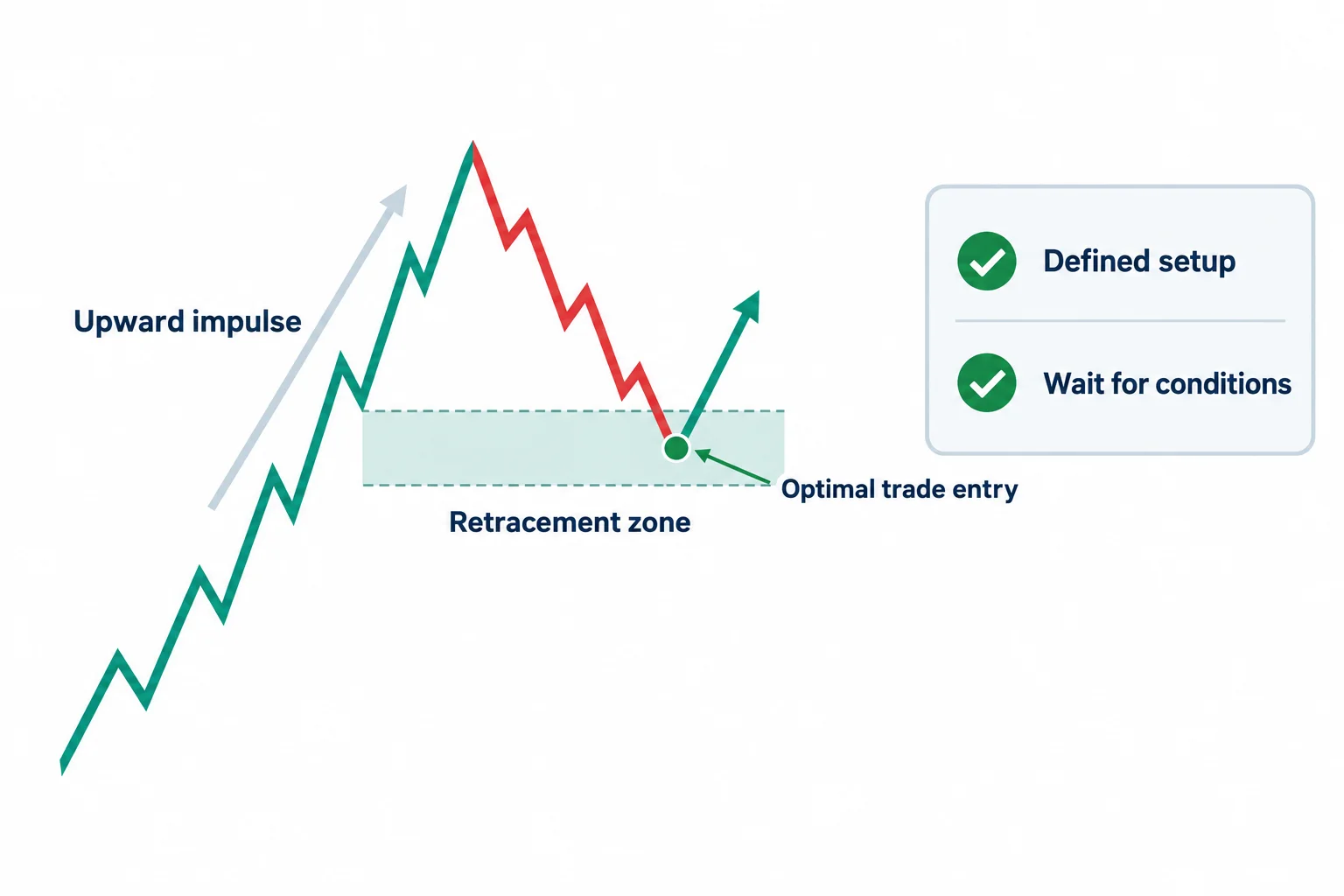
Another bad habit is staring at charts without knowing what qualifies as an opportunity. Around 33:27, ICT argues that additional screen time will not cause a desired formation to appear. A setup is either present under the trader’s rules or it is not.
He then introduces what he calls an “optimal trade entry,” described in this session as a retracement zone between approximately 62% and 79%, with particular attention given to 70.5%. In the bullish example he narrates, price first advances and then retraces. Rather than buying only after another visible rally, ICT says he looks for an entry while price is falling into the predetermined retracement area.
This is ICT’s market framework, not independently established proof of an edge. The recording’s chart is unavailable to this text-only review, so the exact candles, instrument prices, and placement of the drawn Fibonacci levels cannot be verified from the transcript.
ICT Webinar Plans Intraday Scalp Exits Before Entries
ICT calls the entry the easier part and turns to the more difficult question at 39:36: where should the position be reduced or closed? In the narrated bullish model, he identifies several possible objectives, including a level before the prior high, the prior high itself, and extension levels beyond it.
His reason for taking partial profits before the old high is uncertainty. Price might approach the expected objective and reverse without reaching it. Scaling out, in his view, can recognize that uncertainty while preserving some exposure if the move continues. This is a description of ICT’s preferred management style; it does not establish that scaling out is universally superior to another exit method.
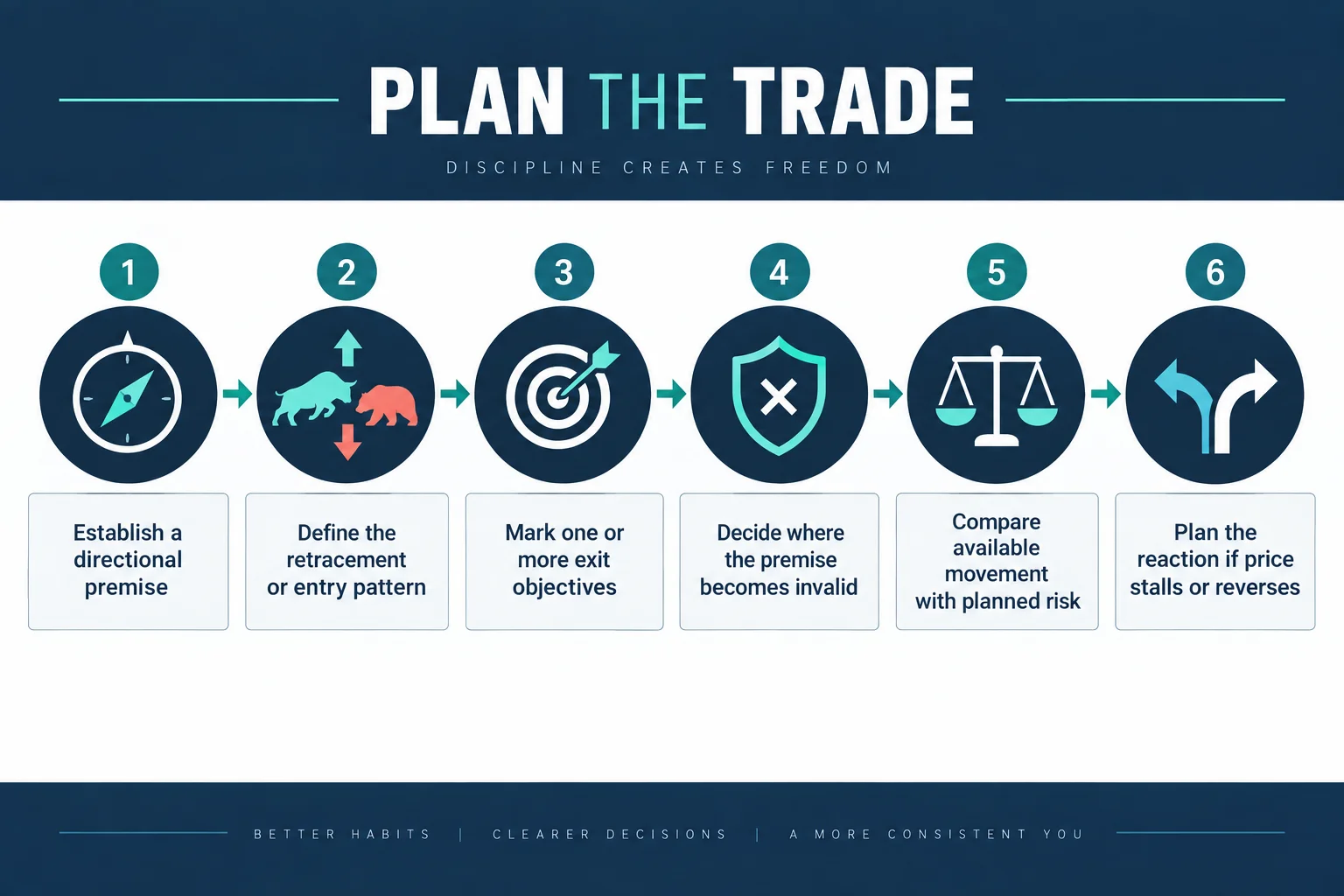
The broader planning sequence presented in the webinar is:
- Establish a directional premise.
- Define the retracement or other pattern that permits entry.
- Mark one or more exit objectives.
- Decide where the premise becomes invalid.
- Compare the available movement with the planned risk.
- Determine in advance how to react if price stalls or reverses.
At 47:04, ICT summarizes this as framing the entry, objectives, and risk before taking action.
ICT Intraday Scalp Example Uses a Demo Account
Near the end, ICT reviews a euro trade beginning at 53:30. He says he entered long and expected price to reach higher objectives. The market rallied while he slept but did not reach his limit order, then moved lower. After waking, he reports scaling out as the retracement stalled and ultimately closing the remainder.
ICT characterizes the directional expectation as wrong but the result as a positive account deposit. Crucially, at 55:01, he discloses that the example was conducted in a demo account. The transcript supports his account of the management decisions, but it does not independently verify fills, exact prices, account figures, or subsequent chart behavior.
Watch the original webinar on YouTube
The video cannot be played inside another website: when its embedded player was opened and checked on 21 September 2026, the player itself reported “Playback on other websites has been disabled by the video owner.” and settled on a “Watch on YouTube” prompt, with no duration and no playback progress reported. That message is the reason no embed is reserved or left blank here; the recording itself is available directly on YouTube.
Watch Breaking Bad Habits Webinar & Intraday Scalp Example on YouTube ↗
ICT Webinar and Intraday Scalp Sources
- The original Inner Circle Trader webinar: use the timestamp links in this article to compare the explanation with its source.
- YouTube’s embedding documentation: platform guidance relevant to the external watch link above.
- 17 CFR 4.41: disclosures concerning hypothetical performance: a regulatory reference relevant to the demo-account example ICT describes.
This is independent educational commentary. It is not official ICT material, a tested trading system, or a claim that the reported results can be reproduced.
ICT Webinar and Intraday Scalp Takeaways
The most transferable part of the session is the emphasis on process. A written setup makes it possible to distinguish planned activity from impulsive activity. A predetermined invalidation point limits the temptation to negotiate with a losing position, while predefined objectives reduce improvised decisions when a trade moves favorably.
ICT also says trading style should fit the person’s temperament and availability. That is best treated as a self-assessment prompt rather than a rule that a particular personality guarantees success in scalping, day trading, or position trading. The webinar offers ICT’s interpretation of trading psychology and trade management, not evidence of assured profitability. Trading involves substantial risk, and this summary is educational rather than investment advice.