Key takeaways
ICT’s October 5, 2017 lesson explains a bearish GBP/USD early entry taken near perceived equilibrium and the daily open before price reached the preferred Optimal Trade Entry zone at 62%, 70.5%, and 79% retracement, using smaller exposure because he expected US dollar strength and feared price would fall without filling higher sell orders.
Read the full summary
ICT’s October 5, 2017 lesson explains a bearish GBP/USD early entry taken near perceived equilibrium and the daily open before price reached the preferred Optimal Trade Entry zone at 62%, 70.5%, and 79% retracement, using smaller exposure because he expected US dollar strength and feared price would fall without filling higher sell orders. The setup used a bearish Power of Three path in which price opens, rallies near or above the open, then declines, with a projected 30-pip rise above the open defining tolerable adverse movement. ICT prioritized a four-hour sell-side liquidity target below a prior consolidation and intermediate-term low over entry precision, describing the structure as a market maker sell model, then scaled out at intermediate objectives and tightened his stop rather than seeking the exact endpoint. The lesson stresses directional bias, higher-timeframe destination, invalidation tolerance, reduced size for premature entries, and practical exits, while warning that early entry increases adverse-movement and thesis-error risk and that the transcript cannot verify the displayed prices, fills, orders, or result.
How we researched this article
BestProps used document-based research from primary firm sources, checked September 25, 2026. The complete source list, scope, limitations, and commercial-state record appear near the end of this article.
In “Anticipating OTE Patterns – Early Entries”, uploaded October 5, 2017, ICT explains why he entered a bearish GBP/USD idea before price reached his preferred Optimal Trade Entry (OTE) retracement zone. The central lesson is not that traders should routinely enter early. Rather, ICT presents a case in which his directional expectation and projected liquidity target mattered more to him than obtaining a precise retracement entry.
The recording relies heavily on charts that are not verifiable from the transcript alone. Consequently, the discussion below summarizes ICT’s stated reasoning without independently confirming the displayed prices, orders, fills, or result.
ICT Rationale Before an Early Entry
ICT begins the substantive lesson by discussing the week’s schedule and his personal preference for being more active early in a non-farm-payroll week. He emphasizes that this is his own approach rather than a universal prohibition against trading particular days. He also acknowledges that his analysis is not always correct. That qualification begins around 4:57.
His market premise was that the US dollar was likely to strengthen, which led him to expect downward pressure on “cable,” the common market nickname for GBP/USD. During the Asian session, he describes price consolidating after equal lows had been violated. He treated an older low around which price had repeatedly traded as an equilibrium area. See the explanation beginning at 7:21.
Because he was already bearish, ICT wanted exposure to a possible decline but did not want to remain awake waiting for the London session. He says he therefore entered a small short position around the perceived equilibrium rather than waiting for an OTE retracement.
ICT OTE Pattern in This Early Entry
At 9:39, ICT identifies his OTE levels as 62%, 70.5%, and 79% of a measured retracement, with reference to candle bodies. In his framework, this zone could have supplied a more favorable bearish entry if price first rallied into it.
However, he believed price might simply continue lower without retracing far enough to fill an order in that zone. His early entry was intended to avoid missing the anticipated move. Near the end of the lesson, he explicitly contrasts the two possibilities: he could have placed orders around the 62% level, but those orders might never have filled if price rolled over immediately. His summary begins at 19:58.
This distinction is important: OTE remained part of ICT’s analysis, but it was not treated as a mandatory trigger. In this example, it helped him estimate where an upward retracement might terminate and where the bearish premise would require enough room, while the actual entry occurred earlier.
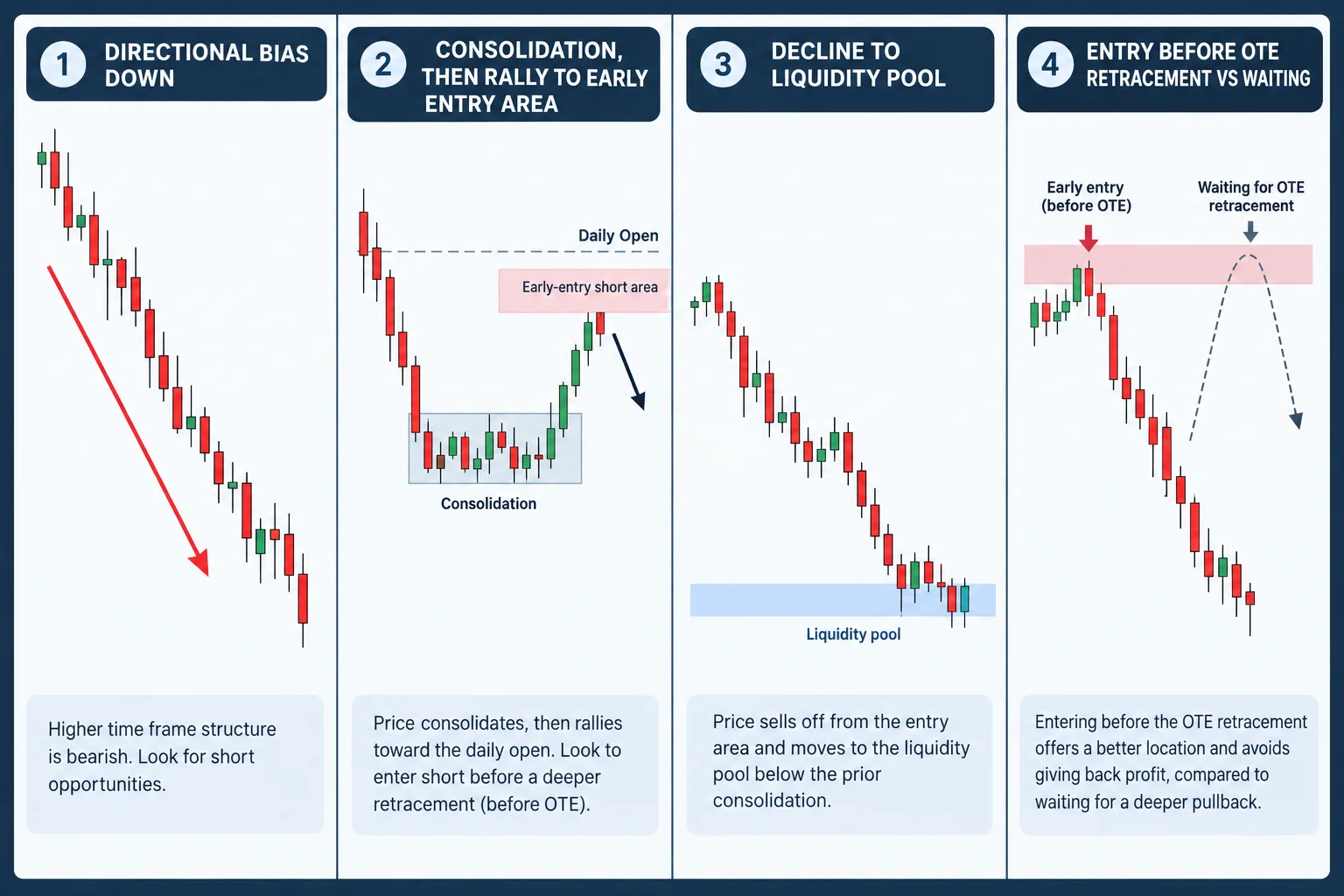
ICT Early Entry and the Projected Daily Path
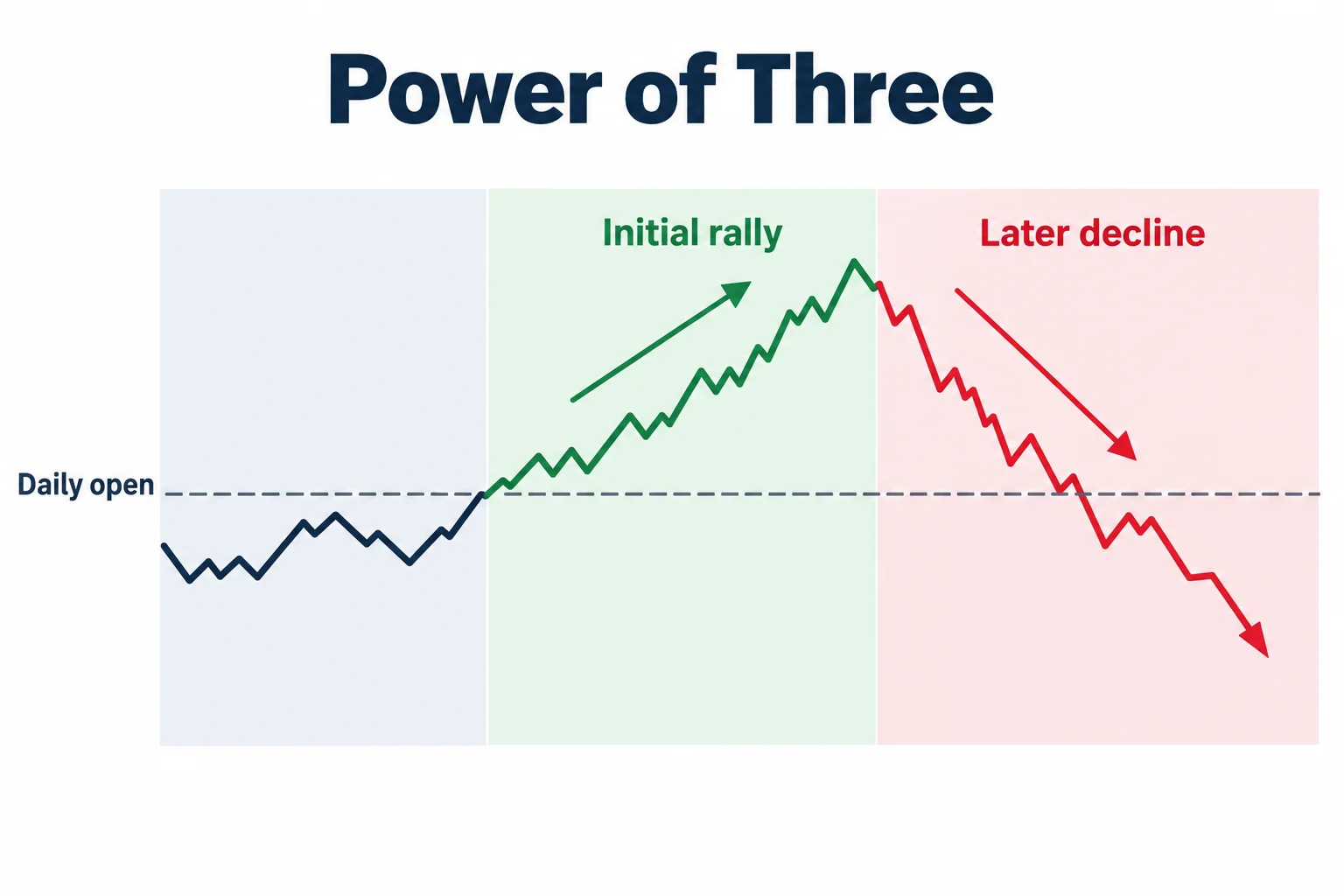
ICT then frames the setup through what he calls “Power of Three.” For a bearish day, he describes a stylized sequence:
- The day opens.
- Price rallies above or near the opening price.
- Price subsequently declines and forms the larger bearish portion of the daily range.
He says he preferred selling around the daily open or above it when expecting a bearish day, rather than insisting on the highest possible entry. He also describes targeting a substantial middle portion of the expected move instead of trying to capture the exact high and low. This section starts at 10:16.
In the chart example, ICT discusses using a projected 30-pip rise above the opening price to estimate how much adverse movement he was prepared to accommodate. Although the transcript contains approximate price references, the unseen chart and data feed cannot be checked here. Those numbers should therefore be understood only as elements of the example he presented, not as reusable parameters.
Why ICT Prioritized the Target Over Entry Precision
The main teaching appears at 14:10: ICT argues that entry is not the most important part of the setup. In his interpretation, identifying where price was likely reaching was more significant.
On a four-hour chart, he identifies a prior consolidation and an intermediate-term low. He reasons that protective sell-stop orders could be resting below that structure, creating what he calls sell-side liquidity. He labels the broader formation a “market maker sell model” and treats the liquidity below the consolidation as the downside objective.
That target supplied the rationale for accepting a less precise entry. His logic can be summarized as follows:
- Establish a directional expectation.
- Identify a plausible liquidity objective on a higher timeframe.
- Estimate the amount of movement against the position that the premise could tolerate.
- Use smaller exposure if entering before the preferred retracement develops.
- Manage exits at intermediate objectives rather than demanding the exact endpoint.
ICT later says he scaled out at what he considered logical levels and tightened his stop, preferring a favorable realized result over attempting an ideal exit. The transcript reports his description of the position, but it cannot independently establish the order history or outcome shown on screen.
How to Interpret ICT OTE Patterns and Early Entries
Separate from ICT’s specific market claims, the example illustrates a general analytical distinction between location and destination. A retracement model addresses where an entry might occur, while a directional thesis also requires a proposed target and a clear point at which the reasoning is no longer acceptable. Entering before confirmation may reduce the chance of missing a move, but it can also increase exposure to adverse movement and to an incorrect directional premise.
ICT himself cautions that he cannot promise profitability from the material. His chart interpretation, terminology, and statements about liquidity or algorithmic movement should be studied as his framework, not as proof of a repeatable trading edge. This video is educational commentary, not investment advice or a performance promise.
Watch the original lesson on YouTube
The video cannot be played inside another website: when its embedded player was opened and clicked on 22 September 2026, the player itself reported “Playback on other websites has been disabled by the video owner.” and settled on a “Watch on YouTube” prompt, with no playback progress reported. That is the reason no embed is reserved or left blank here; the recording itself is available directly on YouTube.
Watch Anticipating OTE Patterns – Early Entries on YouTube ↗
ICT OTE Pattern Source and Further Reading
- The original Inner Circle Trader lesson: use the timestamp links in this article to compare the explanation with its source.
- Optimal Trade Entry (OTE): Fibonacci Meets SMC An independent educational explainer of the OTE retracement zone and how it is commonly combined with order blocks in price-action practice.
- ICT Liquidity (Where Stops Sit & How Price Hunts Them) An independent, unofficial ICT reference explaining sell-side liquidity below prior lows and how these levels act as targets.
- YouTube’s embedding documentation: platform guidance relevant to the external watch link above.
This is independent educational commentary. It is not official ICT material, a tested trading system, or a claim that the reported results can be reproduced. The third-party explanation links above are unofficial sources and are not affiliated with or endorsed by The Inner Circle Trader.