Key takeaways
ICT 1440 is a market-education lesson on auditing the 1,440 minutes in each day rather than a trading setup.
Read the full summary
ICT 1440 is a market-education lesson on auditing the 1,440 minutes in each day rather than a trading setup. ICT recommends recording Monday through Sunday in 15-minute blocks, categorizing sleep, work, commuting, family duties, meals, recreation, and market study, then choosing one undisturbed 15-minute weekday study block, limiting beginner weekday study to about 30 minutes, allowing up to roughly two hours on a weekend day, and preserving at least one period or preferably a full day without charts, trading videos, market reading, or related social media. Students should study one narrow concept at a time, pause long lessons to reflect, stop when the scheduled block ends, and avoid trading as an emotional outlet after stressful work or family events. The framework is ICT’s personal education philosophy, and the material includes no chart prices, trade fills, backtests, performance outcomes, or evidence that this schedule improves profitability.
How we researched this article
BestProps used document-based research from primary firm sources, checked September 25, 2026. The complete source list, scope, limitations, and commercial-state record appear near the end of this article.
In “1440”, uploaded on June 25, 2018, ICT discusses time management for developing traders rather than presenting a chart setup or entry model. The title refers to the 1,440 minutes in a 24-hour day. His central message is that students should first understand where those minutes go, then reserve a small, focused block for study instead of trying to consume large amounts of material at once.
This is ICT’s personal framework and market-education philosophy, not evidence that a particular schedule produces trading profits. The recording contains no visible chart prices, trade fills, backtest results, or subsequent performance outcomes in the transcript.
How ICT 1440 Explains Daily Time
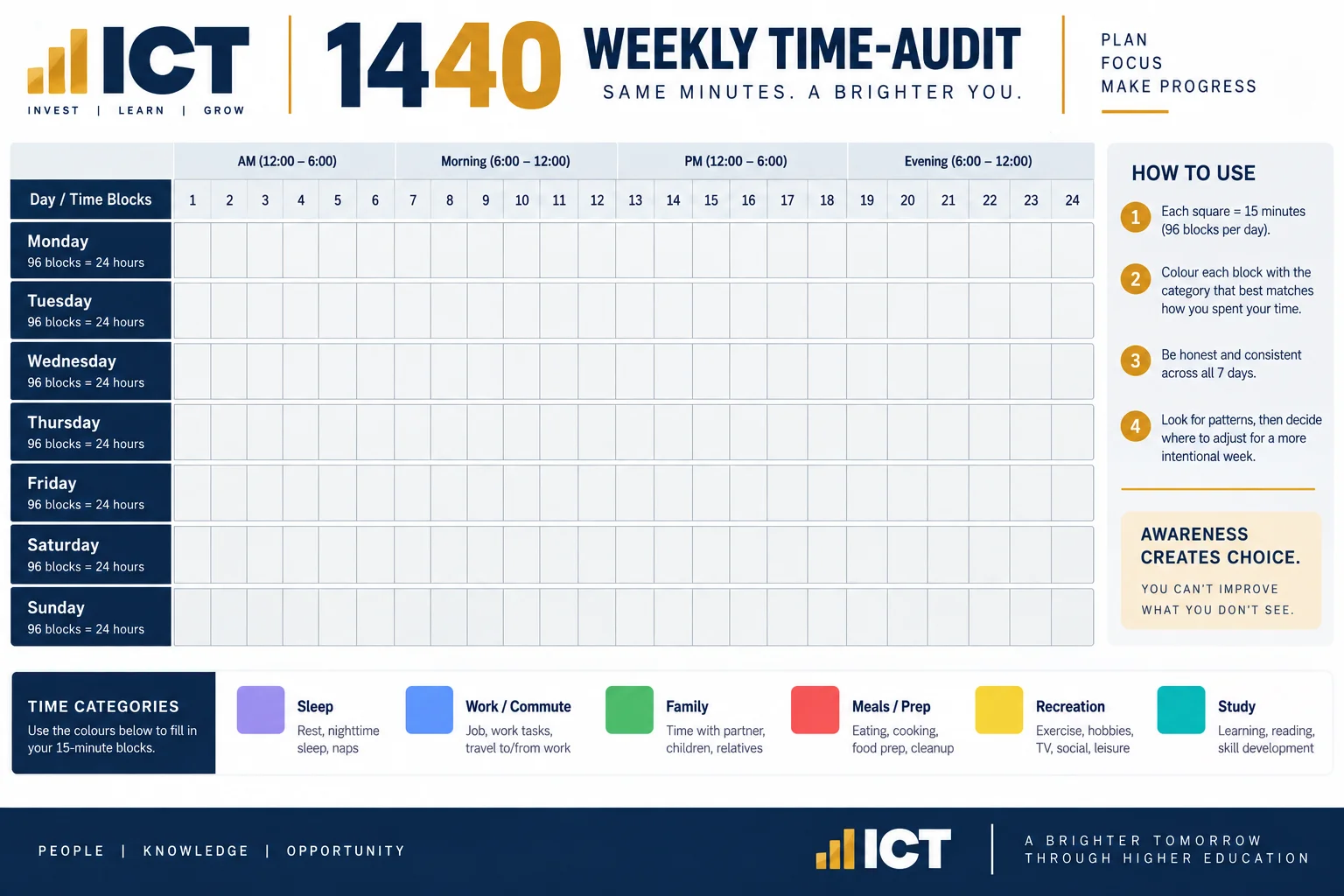
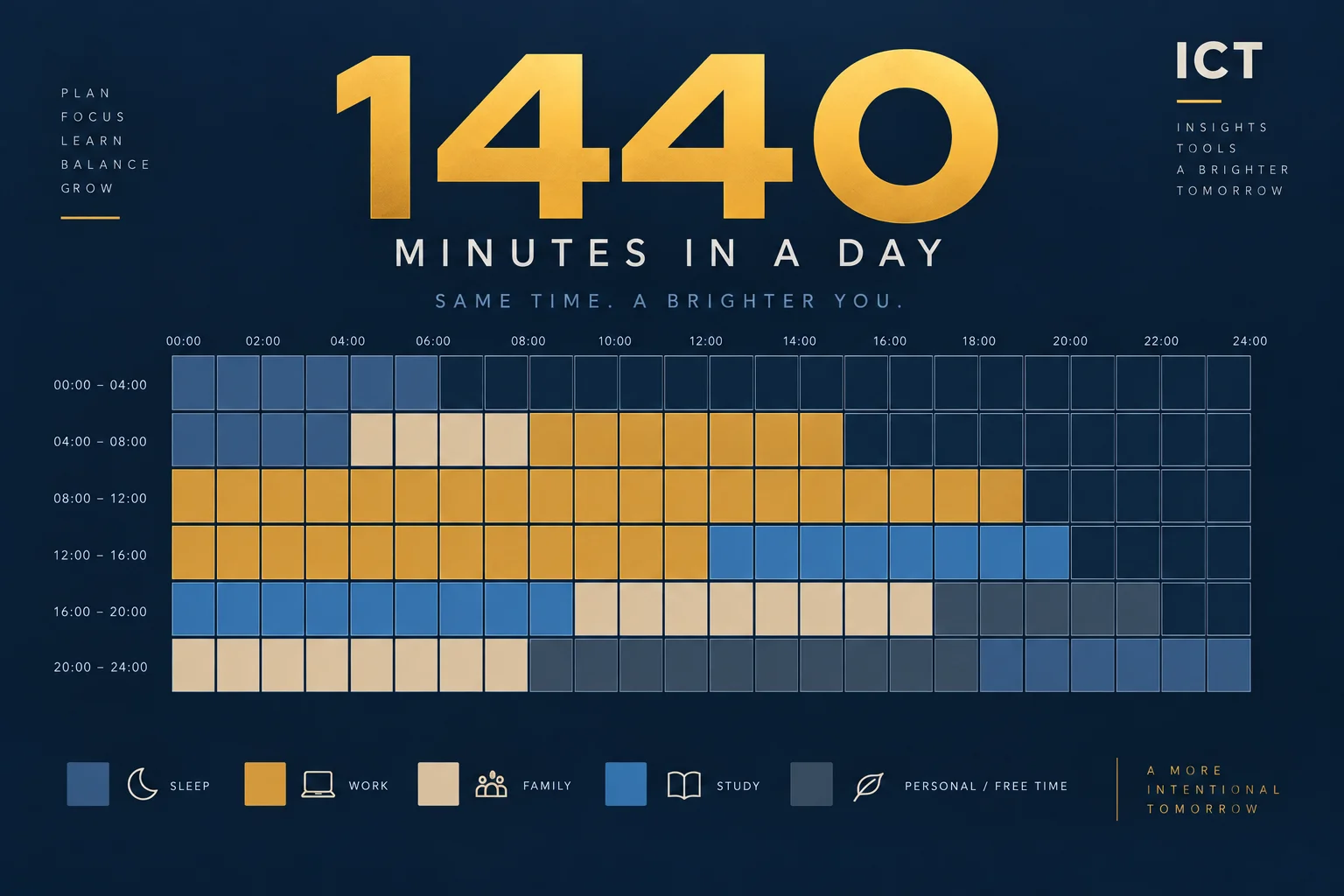
ICT introduces 1,440 as the number of minutes available in each 24-hour period. At 2:11, he asks viewers to imagine a full day divided into 15-minute blocks. Four blocks represent one hour, while the complete grid represents 24 hours.
The purpose of this grid is not to create a trading indicator. It is a time audit. ICT argues that employment, commuting, family obligations, meals, recreation, sleep, and study all compete for the same limited resource. For someone learning markets alongside a job and family, he considers managing these commitments a prerequisite to consistent study.
ICT 1440 Seven-Day Time Audit
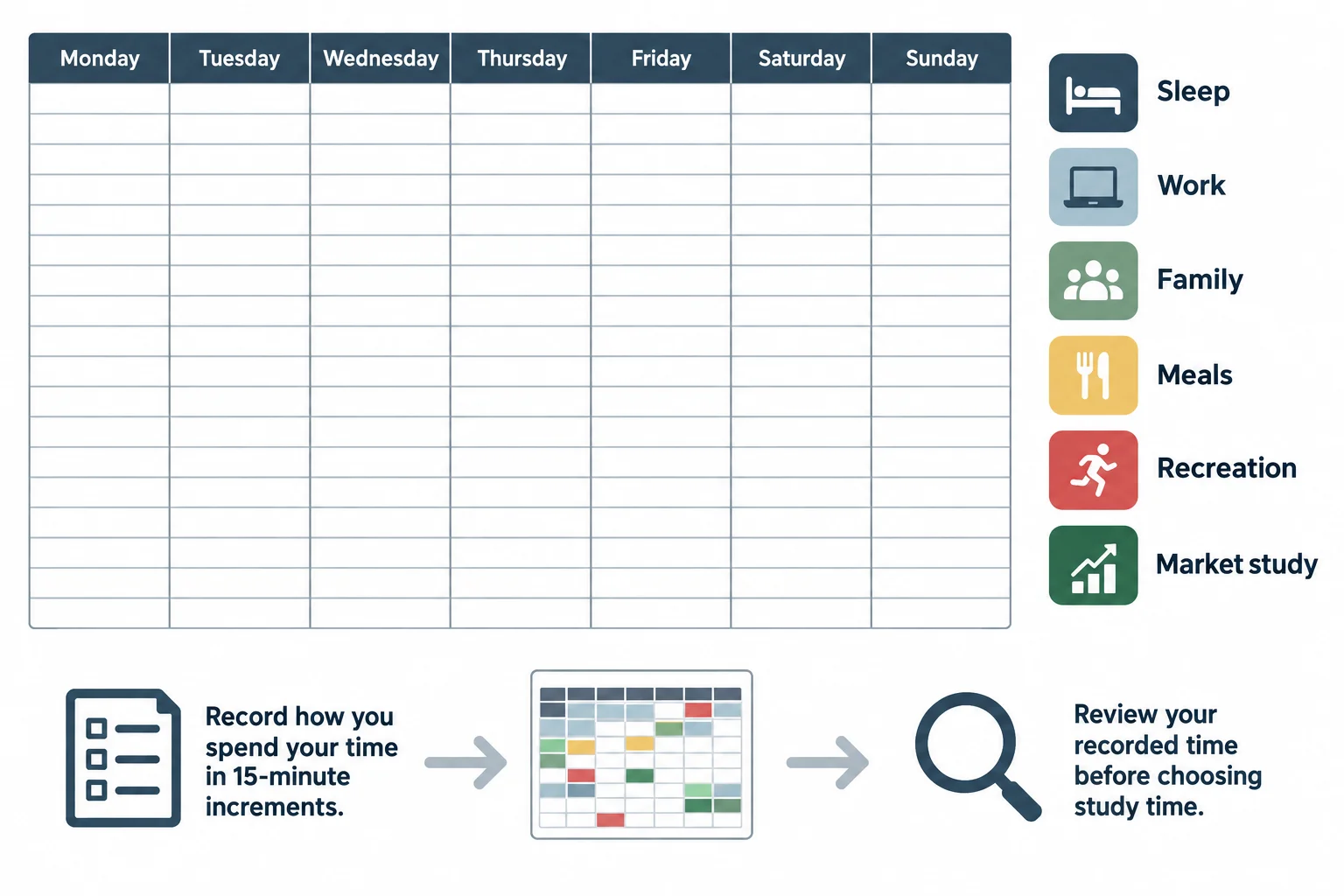
At 4:19, ICT identifies this video as the first part of a series and asks viewers to reconstruct how they spent the previous 24 hours. He suggests using broad labels such as:
- Sleep
- Work and commuting
- Family responsibilities
- Meals and personal preparation
- Recreation or entertainment
- Market study
He then describes an anonymized schedule supplied by a new student. The transcript says the example contained substantial amounts of work, sleep, and television, but it does not provide enough visual information to reproduce every block accurately. ICT uses the example to argue that a written record can expose discretionary periods that are easy to overlook.
Beginning around 11:03, he directs viewers to a blank PDF worksheet that was reportedly linked in the original video description. The assignment was to record each day from Monday through Sunday in approximate 15-minute increments. Whether that external file remains available has not been verified here.
ICT 1440 Study Time Limits
The most concrete educational recommendation appears at 9:11. ICT says a student can begin with one undisturbed 15-minute block. At 9:59, he expands that idea into a suggested maximum of roughly 30 minutes of weekday study for a beginner.
His reasoning is that watching more material does not necessarily mean retaining more. Later, at 30:28, he advises students not to treat a long lesson like passive entertainment. Instead, they can watch a portion, stop, reflect on it, and return later. He compares attempting to absorb an entire library over one weekend to cramming for an exam.
Near 45:48, ICT summarizes his preferred schedule:
- Start with 15 minutes on a weekday.
- Limit weekday study to about 30 minutes.
- Use up to approximately two hours on a weekend day for deeper study.
- Keep at least one period (or, in his preferred approach, a full day) free from charts and market content.
These figures are ICT’s personal recommendations, not experimentally established learning thresholds. Different students may have different attention spans, responsibilities, and educational needs.
ICT 1440 Time Management for Rest and Routine
Another theme is deliberate separation from the markets. At 27:16, ICT recommends scheduling a day with no chart study, market reading, ICT videos, or social media related to trading. He says his own teaching ideas sometimes emerge while he is away from charts.
ICT also connects poor scheduling with emotional decision-making. Around 39:57, he describes a person returning from a stressful day and immediately placing a demo trade as a form of release. His interpretation is that unresolved work or family stress can spill into market activity. The practical educational takeaway is to notice one’s state of mind before opening a platform, rather than treating trading as an outlet for frustration.
Applying the ICT 1440 Time Management Framework
The strongest generally applicable idea in “1440” is the distinction between deliberate study and passive content consumption. A source-grounded way to apply the exercise would be:
- Record one week in approximate 15-minute blocks without changing the normal routine.
- Group the entries into fixed obligations, discretionary time, rest, and study.
- Select one realistic study block that does not interfere with work, sleep, or family commitments.
- Give that block a narrow purpose, such as reviewing one concept or annotating one short segment of a lesson.
- Stop when the scheduled block ends and note what still needs clarification.
- Preserve time away from markets rather than filling every free period with trading content.
This interpretation does not establish that studying ICT material (or any trading curriculum) will lead to profitability. It simply turns the video’s broad time-management message into a repeatable learning exercise. The lesson concludes by asking viewers to track a full week before the proposed second installment, with the aim of identifying the minimum sustainable commitment rather than rushing through the material.
More ICT 1440 Study Resources
The following links provide additional context and are maintained independently of BestProps:
- ICT – “1440” (original video on YouTube) The source lecture for this article.
- Time management (Wikipedia) General background on scheduling and productivity principles referenced throughout the lesson.
- Exercise and weight loss: How much do you need? Context for ICT's comments on physical activity and sleep quality.
- Sleep and behavior change in chronic disease General context for ICT's discussion of sleep as a scheduled resource.