How we researched this article
BestProps used document-based research from primary firm sources, checked September 25, 2026. The complete source list, scope, limitations, and commercial-state record appear near the end of this article.
In “1440 Part 2”, uploaded July 6, 2018, ICT continues his time-management series for developing forex traders. The lesson focuses on specializing in one trading session that fits existing work, sleep, and family obligations, then building a consistent historical evidence journal through annotated charts. This is a study-process framework, not a complete trading system with verified outcomes.
Choose one session that fits your life
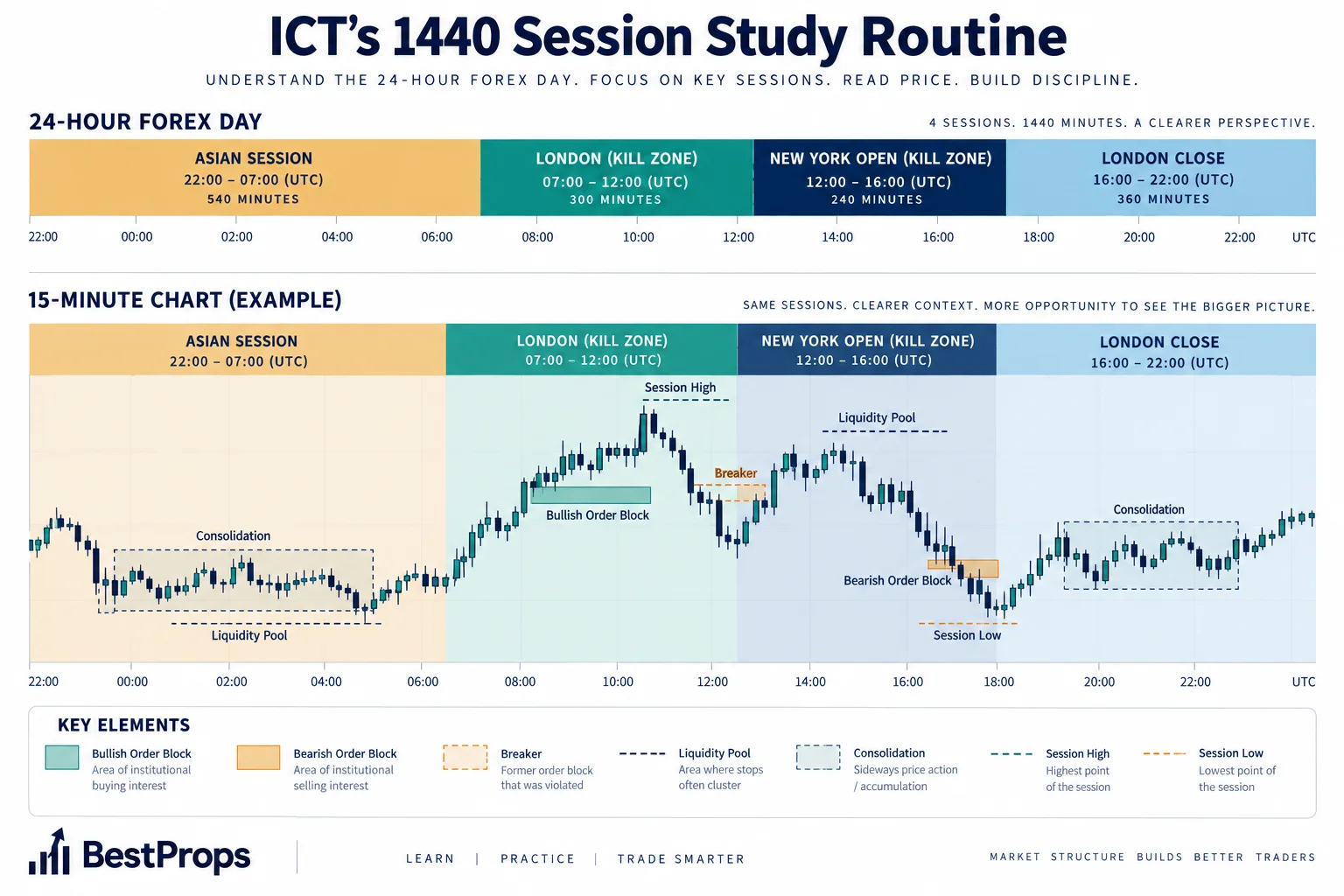
At 1:42, ICT divides the 24-hour forex day into four broad areas: the London session (including the “ICT learning up and kill zone” covering Frankfurt through London lunch), the New York open (“New York open kill zone”), the London close, and the Asian session. He argues beginners frequently overcomplicate the process by trying to follow all four.
His alternative is specialization. Around 5:14, he advises selecting the single session most compatible with the learner’s existing schedule. A session with more movement is not automatically the right choice if following it disrupts sleep, employment, or family life.
- Pick one session: Avoid treating every intraday window as an opportunity that must be monitored.
- Fit study around real obligations: Work and family time should be scheduled before chart study.
- Use defined boundaries: Set an alarm for both the beginning and end of a study block.
- Favor consistency over volume: A repeatable short routine is the priority.
Build a focused daily study routine
ICT reiterates at 9:16 that a new learner should generally limit daily study to about 30 minutes (even 15 focused minutes can be effective). He presents this boundary as a way to prevent burnout, leave time for reflection, and make each session more deliberate.
The broader lesson is attention management. ICT says learners should communicate their schedule to family members and avoid dividing attention between charts and personal commitments. In his framing, 15 or 30 undistracted minutes can be more useful than several unfocused hours spent repeatedly checking the market.
Journal past price action on one pair
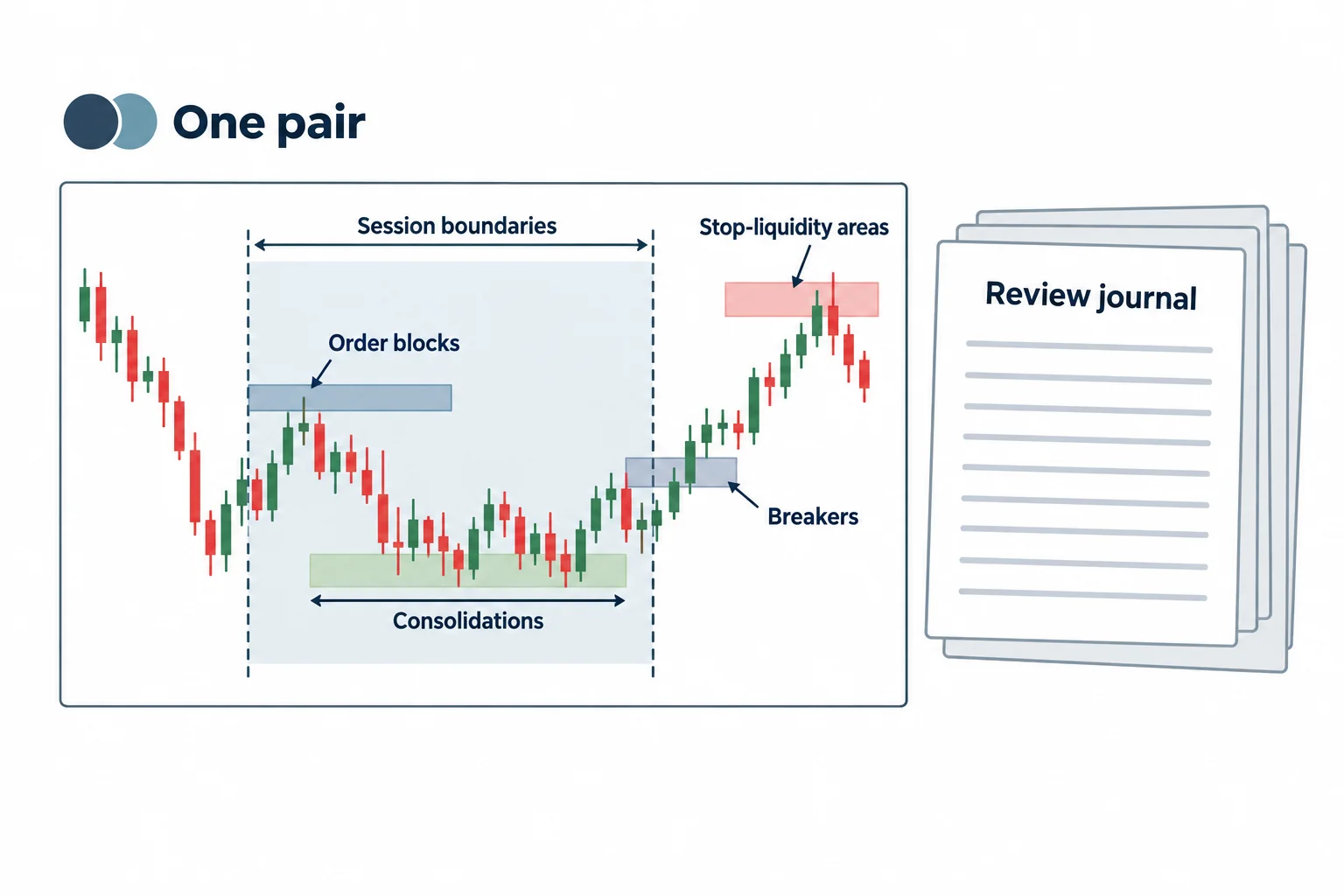
The practical exercise begins around 15:25. After choosing a session, ICT recommends reviewing past price action for one currency pair (two at most) and annotating what occurred during that same window each day.
He suggests marking the session boundaries and interpreting the chart afterward with concepts from his earlier material. In the examples described by the captions, he identifies features he calls order blocks, stop-liquidity areas, breakers, consolidations, and session-specific highs or lows. These are ICT’s retrospective chart interpretations; the transcript does not provide enough visual information to independently verify the chart levels.
At 18:22, ICT proposes maintaining this journal every weekday for at least three months. The aim is to create a personal library of examples from one pair and one time of day. He says repeated annotation helps the learner recognize characteristics associated with that session.
ICT trading session journal template
- Date, currency pair, and selected session
- A 15-minute chart with the session boundaries marked
- Important highs, lows, consolidations, and other ICT concepts the learner believes are relevant
- A hindsight explanation of how price moved through the session
- Neutral notes about what was understood or missed
- A weekend review comparing each day with the next
ICT favors the 15-minute chart for most of these notes, explaining at 27:15 that it supplies intraday detail without the degree of noise he associates with shorter intervals. He allows that an hourly view can be included when it explains the context more clearly.
Keep study separate from money
One of the clearest constraints appears at 26:10: ICT tells learners not to trade while completing this initial chart-study exercise, including on a demo account. His emphasis is on recording observations Monday through Friday and reviewing the collected material on weekends.
Later, at 31:47, he describes this as a way to focus on process without excitement about gains or fear of losses. When reviewing an eventual losing trade, he recommends documenting what happened without self-attacking language. The useful educational principle is to distinguish factual review (entry rationale, observed context, and error) from emotional judgment.
How ICT describes each trading session
ICT portrays London and New York as generally offering more movement than Asia or the London close. Near 39:19, he gives session-specific pip objectives, including approximately 20–30 pips for London, 20 for New York, and 10–15 for London close or Asia. These figures are unsupported targets stated in the lesson, not verified expectations or recommendations.
He also says Asia is commonly quieter and suggests that New York may continue London’s move or sometimes reverse it. Those are ICT’s generalized market observations. No statistical test, complete rule set, or subsequent performance record is supplied in the transcript.
Key takeaway
ICT closes at 42:29 by returning to time allocation: select one session, give it a specific place in the day, and do not monitor charts covertly while working or spending time with family. The most transferable educational idea is simple: narrow the field of study, keep a consistent evidence journal, and review observations without assuming that every apparent historical pattern will repeat.
This summary is for education only. It does not establish the effectiveness of ICT’s terminology or provide investment advice, and the video itself acknowledges that losses remain possible.
Watch the full lesson
Related resources
- ICT Breaker Block Trading — Failed Order Block Strategy (Free PDF) — explains failed order blocks and their role in liquidity sweeps.
- ICT HRLR & LRLR — Low & High Resistance Liquidity Runs — covers stop runs and liquidity hunt terminology.
- ICT Breaker Block Strategy: Turn Failed Order Blocks Into High-Probability Trades — Michael Huddleston’s framework for reversal setups.
- ICT Trading: The Complete Guide to the Inner Circle Trader Methodology — comprehensive overview of ICT’s Smart Money Concepts.