Key takeaways
ICT OTE Pattern Recognition Series Volume 9 argues that a minor breach of a previous day’s high or low does not invalidate a later New York session Optimal Trade Entry because the depth, sequence, and momentum of the liquidity run matter more than the crossing itself.
Read the full summary
ICT OTE Pattern Recognition Series Volume 9 argues that a minor breach of a previous day’s high or low does not invalidate a later New York session Optimal Trade Entry because the depth, sequence, and momentum of the liquidity run matter more than the crossing itself. Using EUR/AUD and briefly GBP/USD, ICT classifies slight breaches as shallow runs that may leave unfinished business, then looks for relative equal highs to be swept before momentum establishes a downswing and a Fibonacci retracement creates a short setup. The example retraced about 70.5 percent, while the stated OTE entry rule uses 62 percent, with the protective stop above the relevant swing high. ICT retrospectively describes seven pips of theoretical drawdown, partial-profit opportunities near 30 pips, expansion to roughly 50 pips, and a later target tied to one-half of a standard deviation of the measured dealing range, while stating that 50 to 75 pips per week would meet his personal objective. If the liquidity narrative or required conditions are unclear, traders should stay out or study another pair. The chart, swing anchors, execution, spread, fill, and results cannot be independently verified because the article relies on an automated transcript without the chart, and the framework is educational rather than evidence of predictive performance or investment advice.
How we researched this article
BestProps used document-based research from primary firm sources, checked September 25, 2026. The complete source list, scope, limitations, and commercial-state record appear near the end of this article.
In OTE Pattern Recognition Series – Vol. 09, ICT discusses whether a minor breach of the previous day’s high or low invalidates a potential Optimal Trade Entry setup later in the New York session. Using EUR/AUD as the main example, he argues that the character of the breach matters more than the mere fact that the level was crossed.
This lesson is an explanation of ICT’s own market framework, not independent evidence that the pattern is predictive. The transcript was generated through automated speech recognition, and the chart itself is not available for visual verification.
Do Earlier Liquidity Runs Invalidate an ICT OTE?
ICT introduces the lesson by noting that GBP/USD also presented what he regarded as an OTE during the New York session after running the prior day’s high. He then turns to EUR/AUD because it is a pair he says he discusses less often. See the introduction at 0:21.
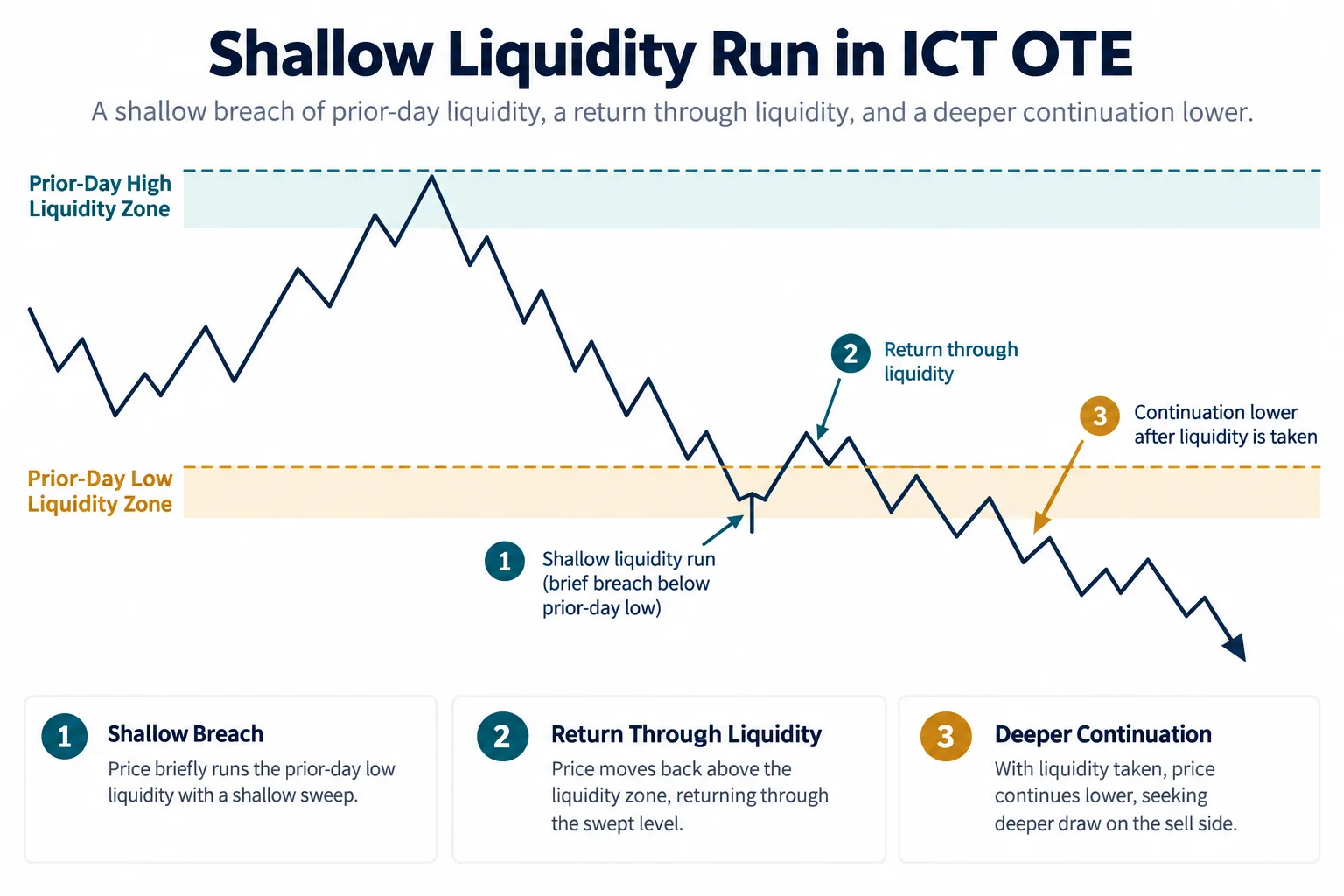
The main question appears at 0:50: if price has already moved slightly through the prior day’s low, should a trader abandon the expectation of another New York-session move through that level? ICT’s answer is no. Within his interpretation, a small breach can be a “shallow run” rather than the decisive liquidity move he is anticipating.
How ICT Defines Shallow Liquidity Runs
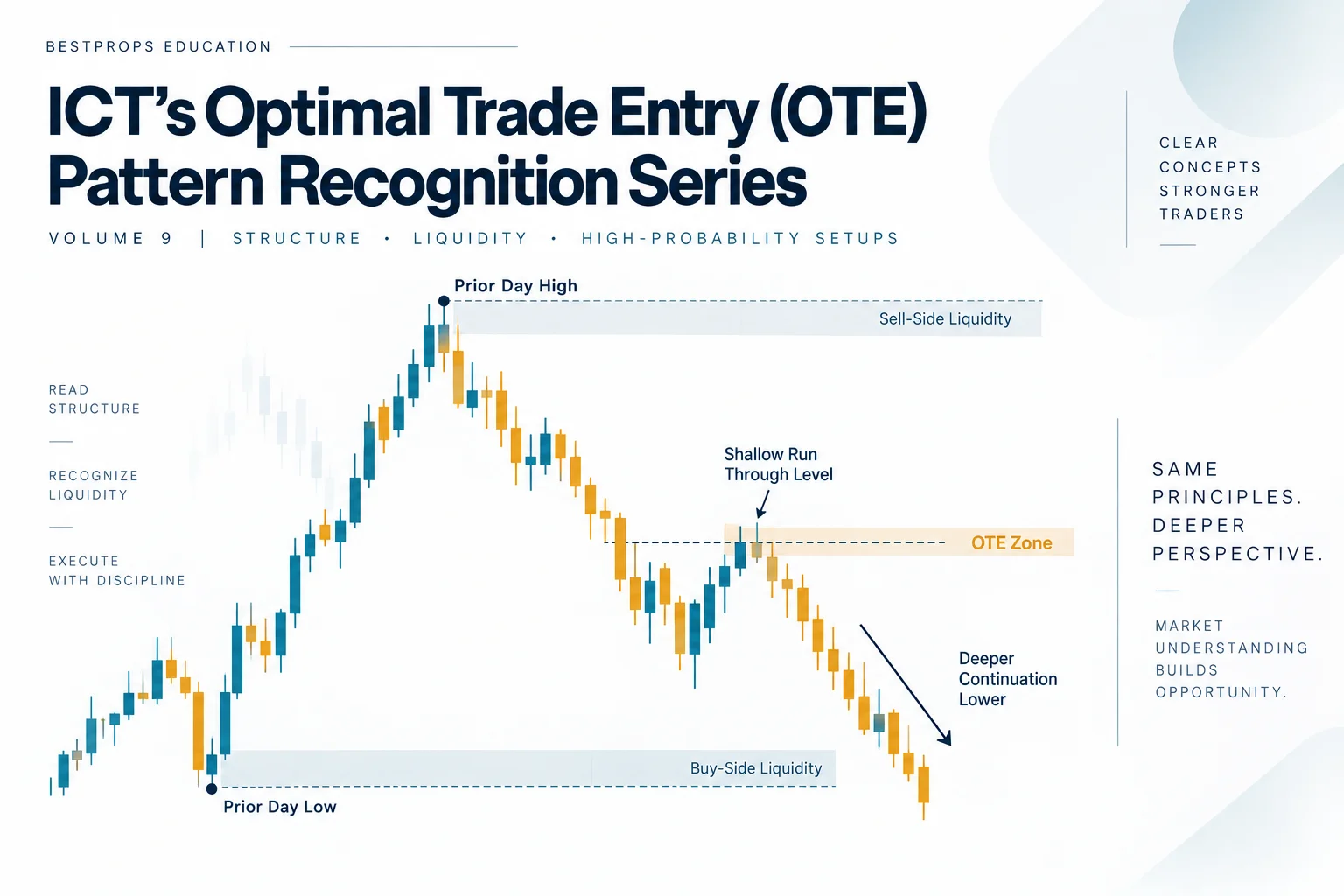
At 1:24, ICT projects Monday’s EUR/AUD low forward on the chart. He describes an initial move beneath it as shallow and says this leaves “unfinished business.” In ICT terminology, liquidity is presumed to remain around an old high or low when the first move through it is limited.
He then describes a sequence involving an old high, Monday’s low, and a later return above the high before a more substantial decline beneath the low. The educational point is not simply that price crossed both levels. ICT focuses on how far price moved beyond them, the order in which the levels were approached, and whether later price action displayed momentum.
- An old high or low is marked as a potential liquidity reference.
- A slight move beyond that reference is classified as a shallow run.
- Relative equal highs are treated as another nearby liquidity area.
- Momentum away from the highs establishes the price swing used for the retracement.
- The New York session supplies the time-of-day filter for looking for an OTE.
How ICT Frames the OTE Pattern
Beginning around 2:07, ICT says he is looking for an OTE after a run above relative equal highs. He interprets shallow runs on both sides of the observed range as evidence that price is positioned for a more meaningful move lower later in the day.
For the retracement measurement, he draws a Fibonacci range from the relevant high to the subsequent low. The transcript says price retraced to approximately the 70.5% level, while the model’s stated entry rule uses the 62% retracement level. His protective stop is placed above the swing high used in the setup.
These percentages should be understood as rules presented in ICT’s model, not as universally accepted support or resistance levels. The transcript alone does not permit verification of the swing anchors, quoted entry, spread, execution, or whether a real order was filled.
ICT OTE Targets and Trade Management
ICT states that the subsequent decline took out a short-term low and describes opportunities to take partial profits. At 2:53, he characterizes the theoretical drawdown as seven pips. He later says the move shown offered approximately 30 pips and then 50 pips as price expanded lower, with the later objective related to one-half of a standard deviation of the dealing range used for the Fibonacci measurement.
Those figures are the speaker’s retrospective description of the displayed chart. They are not independently verified trade results. ICT also says that capturing a 50-to-75-pip move in a week would satisfy his personal objective; this is an anecdotal preference, not a performance expectation or recommendation.
ICT Volume 9 Takeaways on Shallow Liquidity Runs
The closing lesson begins around 3:37. ICT advises against automatically rejecting a prior-day high or low merely because price has moved through it by a small amount. Under his framework, the trader should instead assess whether the move was shallow and where liquidity is expected to be reached during the relevant session.
He also supplies an important restraint: if the liquidity narrative is unclear, stay out or study another currency pair. In general educational terms, this amounts to requiring a setup to satisfy all defined conditions rather than forcing an interpretation after one isolated level is breached. It does not establish that the OTE framework will be profitable, and it should not be treated as investment advice.
Primary source: ICT, “OTE Pattern Recognition Series – Vol. 09”, uploaded May 20, 2020.
This article is a source-grounded explanation derived from ICT’s OTE Pattern Recognition Series Volume 9. The analysis is based on the official transcript and is not investment advice or a performance promise.