Key takeaways
ICT W.E.N.T.
Read the full summary
ICT W.E.N.T. Series Part 1 of 5, uploaded October 16, 2017, prioritizes disciplined forex practice over entries and profits, teaching three-candle swing highs and lows while providing no independently testable results, visible prices, executed trades or outcomes. ICT recommends using a realistic demo balance, matching leverage to intended live capital, practicing defined skills, focusing on one currency pair and evaluating rule adherence rather than fictional profit. The chart assignment marks seven to ten a.m. and two to four a.m. New York time for one month, although ICT inconsistently calls both three-hour windows, alongside roughly 30 minutes of purposeful daily review. A swing high has a middle candle with a higher high than both adjacent candles, while a swing low has a middle candle with a lower low than both adjacent candles. Traders should mark the highest high and lowest low across all three candles, track each open, high, low and close, extend relevant levels forward, avoid duplicating smaller internal swings contained within larger ranges and observe later reactions. The example uses an AUD/USD four-hour chart, but exact dates and prices are unavailable. ICT also argues that spot forex allows finer position sizing than some standardized contracts, warns that no method guarantees wealth or avoids losses and frames the exercise as observation requiring further definition and forward testing before it can support entries, stops, sizing or expected outcomes.
How we researched this article
BestProps used document-based research from primary firm sources, checked September 25, 2026. The complete source list, scope, limitations, and commercial-state record appear near the end of this article.
In ICT W.E.N.T. Series – Part 1 of 5, uploaded on October 16, 2017, ICT addresses what he believes new or aspiring forex traders should learn before concentrating on entries and profits. Most of the session concerns expectations, discipline and practice habits. Its principal chart lesson introduces three-candle swing highs and swing lows.
This is a summary of ICT’s teaching, not verification that his market model produces a trading edge. The transcript does not provide independently testable results, visible chart prices, executed trades or subsequent outcomes.
ICT Part 1 Foundations for Process Over Profit
ICT opens by describing forex as his preferred market while also telling viewers not to accept any mentor’s opinion unquestioningly. At 1:58, he encourages further research when a teaching does not resonate. That qualification is important because much of the presentation reflects his personal interpretation of markets and trader development.
From roughly 4:04, he argues that spot forex permits position sizing to be adjusted more finely than some standardized contracts. His larger educational point is that beginners should reduce risk and stop measuring progress solely by how much money they might make.
He repeatedly rejects the idea of immediate financial independence. At 7:17, ICT says he cannot promise wealth and emphasizes that development varies by person. Later, he warns that no method (including his own) is perfect and that losses remain possible. The session nevertheless includes ambitious return illustrations later on; those are speaker claims, not demonstrated results.
ICT Demo Discipline for Structured Trading Practice
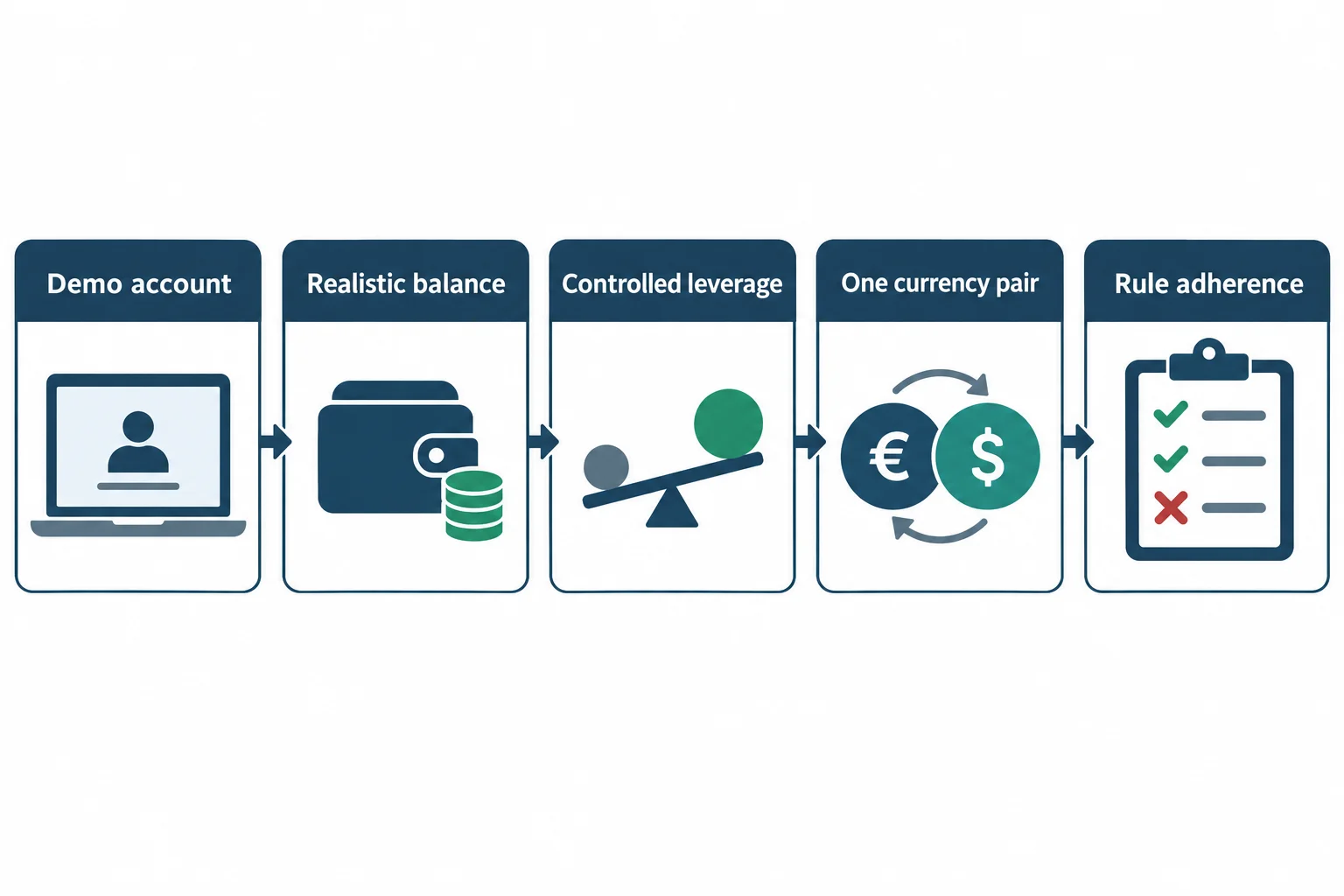
One of the clearest practical themes begins near 8:05. ICT says a demo account can reinforce poor habits if it is used for oversized, impulsive bets. He recommends treating simulated capital as if it were business equity rather than inconsequential play money.
His proposed rules include:
- Use a simulated balance (or self-imposed limit) that resembles the capital you realistically expect to fund.
- Keep leverage consistent with that intended capital rather than exploiting all available demo margin.
- Practice defined skills instead of trying to maximize fictional profits or collect screenshots.
- Use one currency pair long enough to study its behavior rather than trading many pairs without a plan.
- Evaluate decision quality and rule adherence, not the emotional excitement of a winning paper trade.
ICT revisits this at 29:29, explaining that demo results are primarily feedback for the learner. His concern is that unrealistic sizing teaches actions that would not be tolerable with live funds. As a general educational interpretation, a practice setting is most informative when its constraints match the behavior being rehearsed. It still cannot reproduce every psychological or execution feature of live trading.
ICT Part 1 Foundations for Choosing a Trading Horizon
At 26:55, ICT asks viewers to study their own decision-making. He associates rapid, reactive personalities with shorter-term trading and slower, more deliberative personalities with position trading, while suggesting even-tempered people may adapt across horizons.
These personality-to-style pairings are ICT’s opinions, not validated assessments in the source. The more broadly useful exercise is to observe how quickly you make decisions, how readily you change your mind and how you react under pressure. Those observations can help define a practice routine and identify situations in which impulsiveness or indecision becomes a problem.
ICT Part 1 Discipline for Focused Study Windows
ICT argues that learning does not require watching charts continuously. At 45:07, he assigns a chart study: mark 7:00–10:00 a.m. New York time and 2:00–4:00 a.m. New York time, then review for a month when moves began and ended. Although he subsequently describes these as “three hours twice a day,” the second stated interval is only two hours. That inconsistency should be resolved by consulting the video and chart context.
Near 1:09:24, he also recommends maintaining a life outside trading and suggests approximately 30 minutes of purposeful daily chart review rather than indiscriminate hours of screen time.
ICT Swing Point Foundations With Three Candles
The technical lesson starts at 46:42. ICT defines a swing high as a three-candle formation whose middle candle has a higher high than the candles immediately to its left and right. A swing low is the inverse: the middle candle has a lower low, with a higher low on each side.
He then maps the full high-to-low range of all three candles, not merely the middle candle’s extreme. Within that range, he treats each candle’s open, high, low and close as potentially sensitive price levels. The transcript describes an AUD/USD four-hour chart, but because the chart itself is unavailable here, its exact dates and prices cannot be established.
ICT’s exercise can be summarized as follows:
- Choose a chart and identify obvious three-candle swing highs and lows.
- For each formation, mark the highest high and lowest low across all three candles.
- Observe the opens and closes inside that range.
- Extend relevant levels forward and record how later price behaves around them.
- Avoid duplicating nearby levels when a smaller swing is contained within an already marked range.
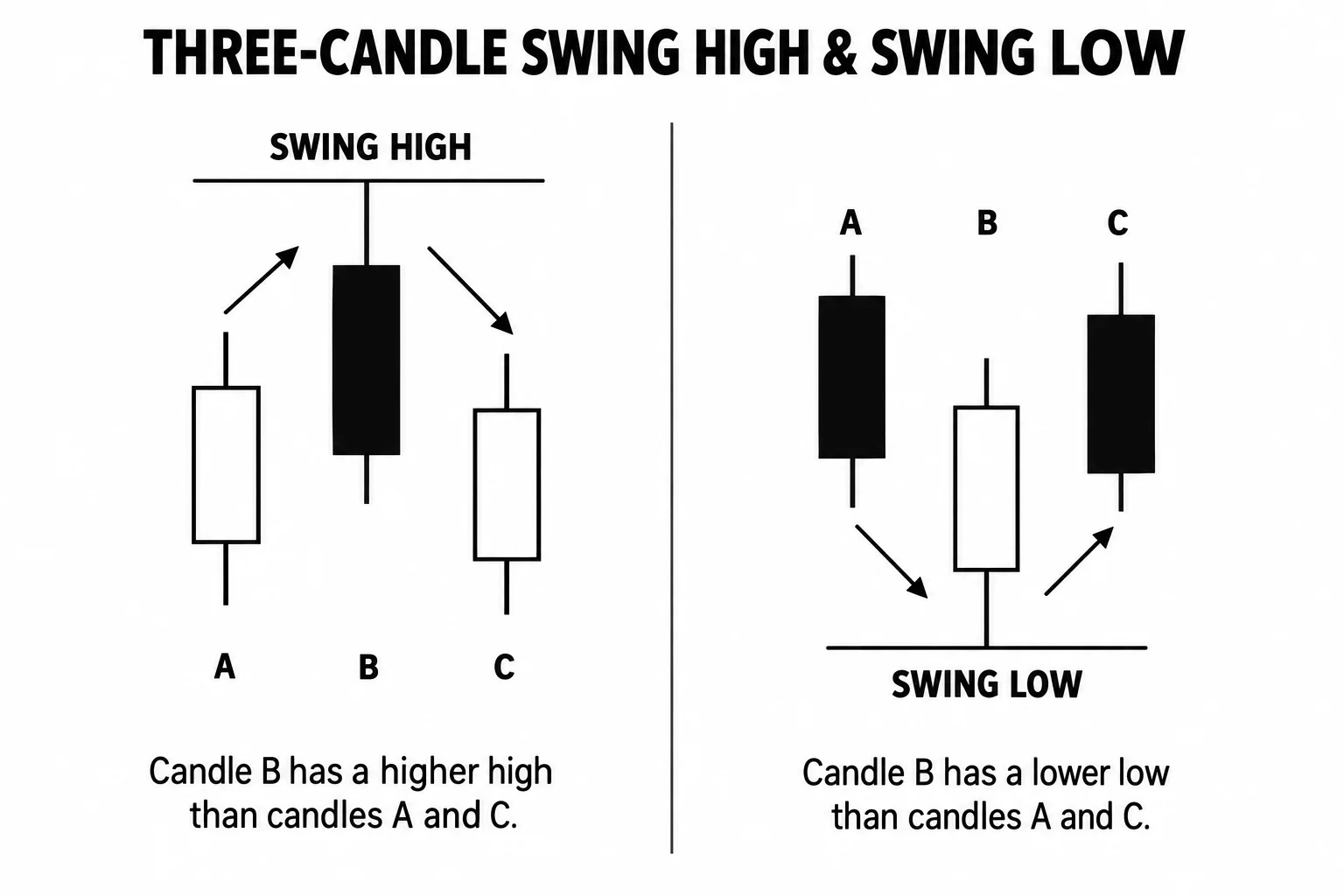
At 56:17, ICT describes an internal swing as subordinate when it falls within a more prominent swing range. He says clearer, larger structures may carry more analytical significance than every minor fluctuation. Around 1:06:45, he extends the exercise to studying later reactions at the three candles’ opens, highs, lows and closes.
What ICT Part 1 Foundations Establish
Part 1 is primarily an orientation session. ICT asks viewers to abandon get-rich-quick expectations, control leverage, use demo trading deliberately, study their own temperament and learn to recognize basic swing structure. The actionable assignment is observational rather than predictive: annotate swing ranges and selected time windows, then document what occurs.
That distinction matters. A historical reaction at a prior candle level does not by itself prove that another reaction will occur, nor does identifying a swing formation specify an entry, stop, position size or expected outcome. Any such rules would require additional definition and forward testing beyond what this transcript demonstrates.
Watch the original ICT lesson
This article draws on the timestamped English captions of ICT W.E.N.T. Series – Part 1 of 5. Captions are a source for the speaker’s words, not independent proof of a trading edge. The recording’s chart detail remains important when following the study assignment.
Watch the original lesson on YouTube
The video cannot be played inside another website: when its embedded player was opened and clicked, the player itself reported “Video player configuration error (Error 153)”. That message is the reason no embed is reserved or left blank here; the recording itself is available directly on YouTube.
Primary source and further reading
- The original Inner Circle Trader lesson: use the timestamp links in this article to compare the explanation with its source.
- Swing-point definition in the source (46:42): the section where ICT introduces the three-candle swing high and swing low.
- YouTube’s embedding documentation: platform guidance relevant to the external watch link above.
- 17 CFR 4.41: disclosures concerning hypothetical performance: a regulatory reference, not a statement that a particular recording or this article meets every legal requirement.
This is independent educational commentary. It is not official ICT material, a tested trading system, or a claim that the described methods produce reliable results.