Key takeaways
ICT presents a trading plan as a written, reviewable decision framework built around capital preservation rather than entry signals, using monthly, weekly, daily, four-hour, and hourly charts to define context, location, and triggers before trading.
Read the full summary
ICT presents a trading plan as a written, reviewable decision framework built around capital preservation rather than entry signals, using monthly, weekly, daily, four-hour, and hourly charts to define context, location, and triggers before trading. The plan should specify permitted markets, setup and invalidation conditions, maximum exposure, exits, scaling, prohibited actions, and journaling, with ICT using 2% or less risk per trade as an instructional example while urging traders to expect losing streaks, reduce exposure during drawdowns, and avoid turning position trades into unrelated short-term trades. At 21 minutes 58 seconds he recommends predetermining the first profit, scaling out, and reducing remaining risk, though break-even stops still face gaps, slippage, fees, and execution risk. Macro analysis centers on interest rates, yields, Treasury futures, positioning, seasonality, stocks, commodities, gold, oil, and the US dollar, while scheduled releases such as rate decisions, inflation, employment, GDP, retail sales, and business surveys should be treated as volatility events rather than guessed outcomes. The five-stage process is anticipatory analysis at 1 hour 4 minutes 51 seconds, execution at 1 hour 5 minutes 29 seconds, management at 1 hour 6 minutes 3 seconds, reaction and invalidation at 1 hour 6 minutes 49 seconds, and documentation at 1 hour 7 minutes 23 seconds. Weekly pip targets, fixed monthly returns, and compounding spreadsheets are hypothetical arithmetic illustrations, not verified performance or realistic forecasts, and goals should never become quotas that override setup or risk rules.
How we researched this article
BestProps used document-based research from primary firm sources, checked September 25, 2026. The complete source list, scope, limitations, and commercial-state record appear near the end of this article.
In ICT – Trading Plan Development 1, ICT presents a trading plan as a written decision framework rather than a collection of entry signals. The lesson covers time-frame selection, macro and intermarket analysis, risk limits, trade management, and journaling. It also includes hypothetical compounding examples that should be treated as illustrations, not verified results or realistic performance forecasts.
Why Your ICT Trade Plan Matters
At 2:01, ICT says traders without a clear plan tend to react emotionally because they have not decided in advance what to analyze or how to respond. His proposed alternative is a concise plan that is written, reviewed, and sufficiently familiar to guide decisions under pressure.
The practical educational point is that a plan should convert broad intentions into rules. “Be disciplined” is not operational. A usable plan would instead identify the permitted markets, analytical time frames, setup conditions, maximum exposure, exit rules, and circumstances that prohibit or terminate a trade.
Build Your ICT Trade Plan Around Market Context
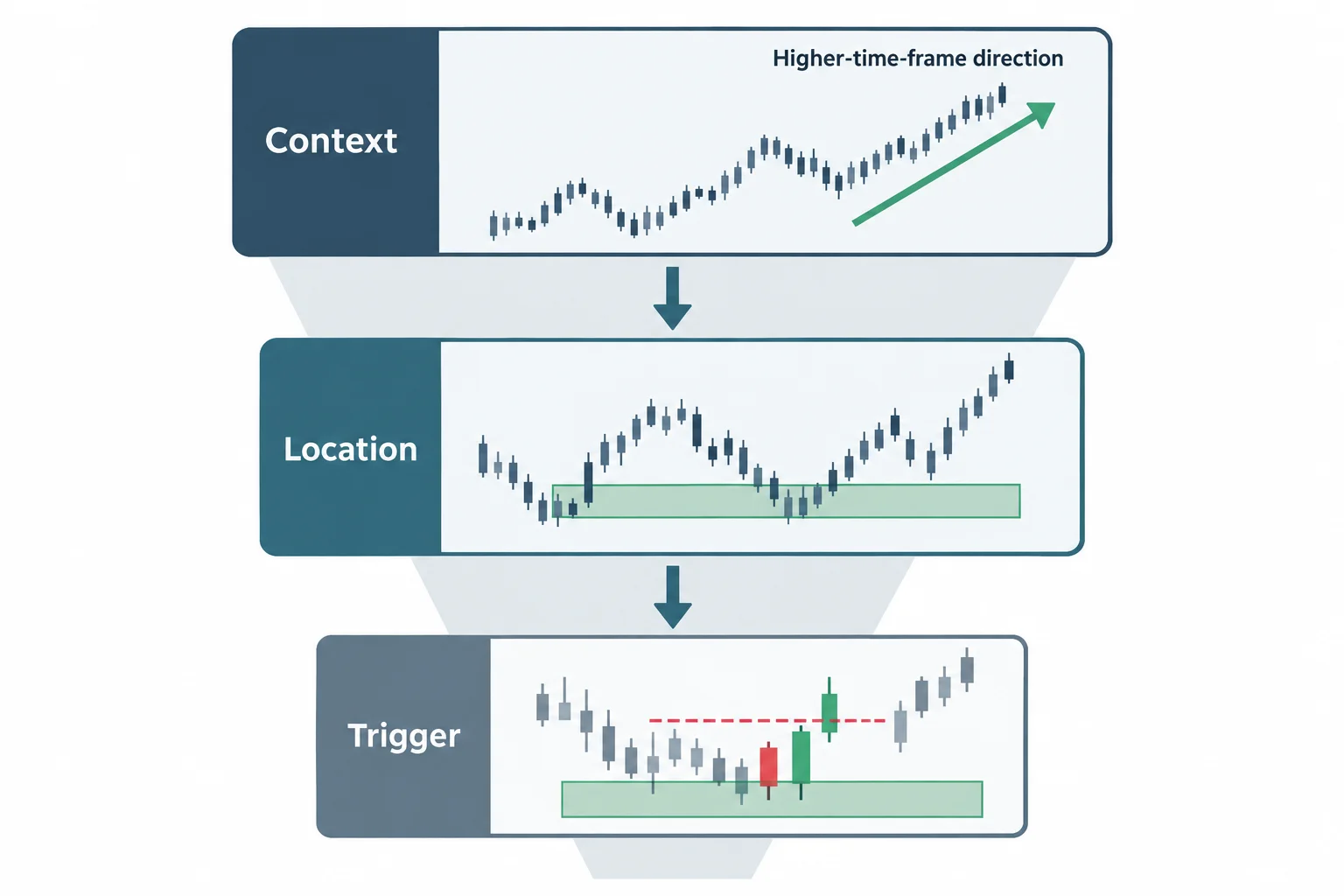
ICT distinguishes productive analysis from simply watching charts. Beginning at 3:15, he argues that chart time without a defined objective can be counterproductive. He favors a top-down process centered on monthly, weekly, daily, four-hour, and hourly charts rather than beginning with very short-term charts.
At 6:28, he goes further and calls entry signals the least important part of the process when they are detached from macro context and higher-time-frame direction. That is ICT’s market interpretation, not proof that a particular time frame or analytical method creates an edge.
A general way to translate this section into a plan is to separate three questions:
- Context: What broad market condition or directional hypothesis is being considered?
- Location: At which preidentified higher-time-frame area may action be justified?
- Trigger: What specific, observable condition permits an entry?
This ordering prevents a short-term signal from becoming the entire rationale for a trade.
Core ICT Trade Plan Components
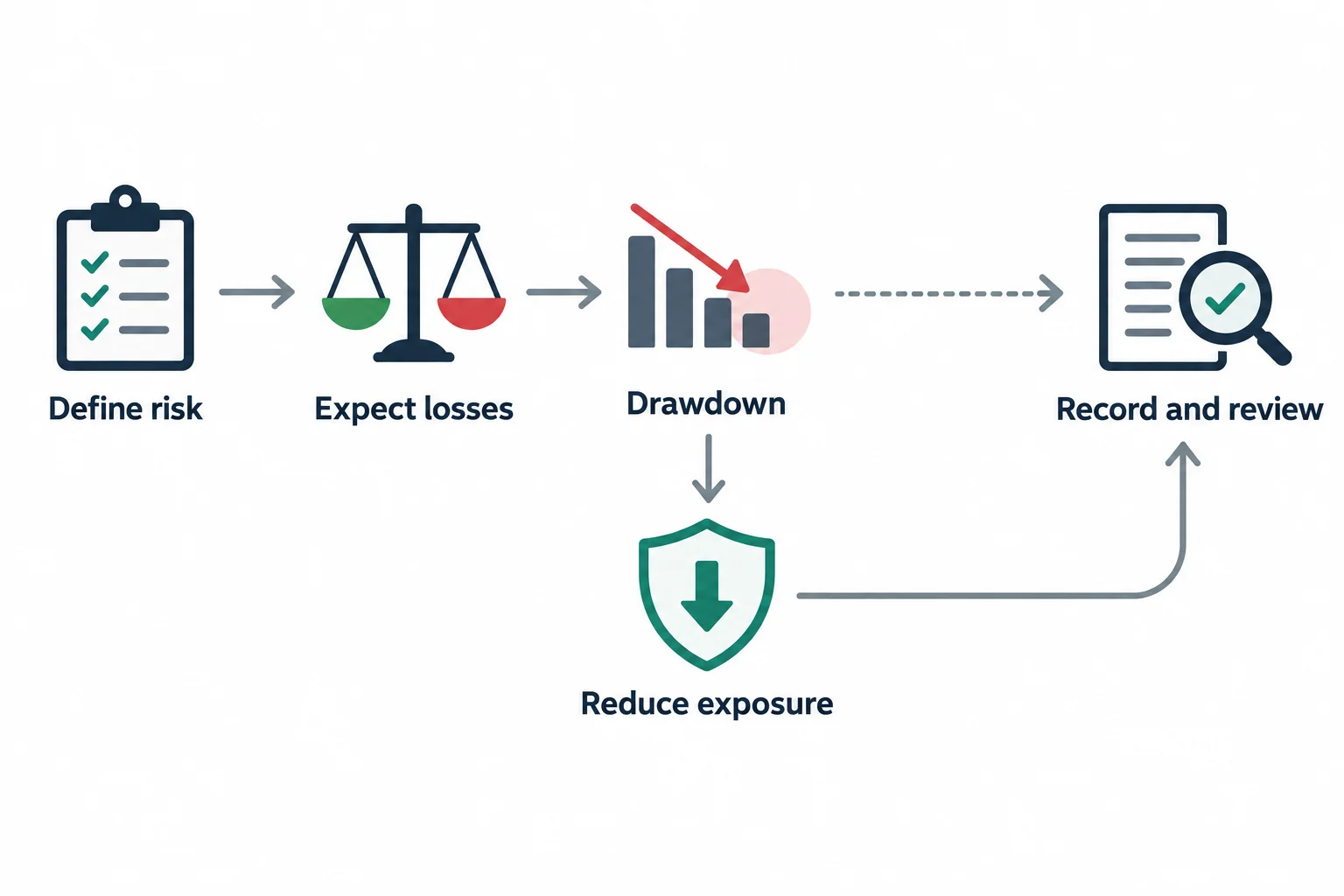
In the overview at 8:00, ICT combines risk control, equity management, fundamental information, intermarket analysis, and technical tools. He emphasizes using a limited set of tools for defined purposes rather than changing indicators whenever a recent decision fails.
Risk is the organizing principle of this section. ICT says a trader should expect losses and missed opportunities, avoid rushing into the market, and respond quickly when capital preservation is required. Around 10:40, he also warns that confidence can become overconfidence and that every plan will eventually encounter losing periods.
Set Risk Rules for Every Trade
- Define maximum risk before entering.
- Expect individual losses and sequences of losses.
- Reduce exposure rather than increase it impulsively during a drawdown.
- Do not convert a position trade into an unrelated short-term trade after entry.
- Record both favorable and unfavorable outcomes.
ICT repeatedly discusses risking 2% or less per trade. That figure is his instructional example, not a universally appropriate allocation. The transcript does not account for an individual’s finances, leverage, liquidity, slippage, correlated positions, or ability to absorb losses.
Set ICT Plan Goals Without Ignoring Risk
From 12:28, ICT advocates small risk and consistency rather than seeking a large gain from every trade. He later presents spreadsheets based on weekly pip targets and fixed monthly returns. These calculations assume repeated achievement of the stated targets and therefore demonstrate compounding arithmetic, not observed performance.
The strongest planning lesson appears later at 19:52: goals should not compel a trader to force activity. ICT acknowledges that a weekly target may be missed and that results can vary across a month, quarter, or year. Educationally, this suggests that a target can be used for review, but should not become a quota that overrides setup and risk rules.
Plan Trade Exits Before Entry
At 21:58, ICT discusses taking a predetermined first profit, scaling out, and then reducing or removing remaining risk. The exact technique is strategy-dependent, but the broader principle is useful: entry, initial objective, stop treatment, and scaling rules should be specified before exposure is opened.
The transcript does not show actual fills or establish that the illustrated scaling method produced the stated returns. Moving a stop to break-even also does not make a position economically risk-free because gaps, slippage, fees, and execution conditions may still matter.
Use the ICT Trade Plan for Macro Context
Beginning at 26:47, ICT places interest rates and yields at the center of his macro framework. He discusses comparing countries’ rates, monitoring Treasury futures and yields, considering seasonal tendencies, reviewing positioning, and checking stocks, commodities, gold, oil, and the US dollar.
These relationships are presented by ICT as tools for forming directional bias. They should not be simplified into fixed laws: relationships among yields, currencies, commodities, and equity markets can change with policy expectations, inflation, growth, positioning, and market stress.
ICT also treats scheduled news as a potential injection of volatility rather than something whose result can be known in advance. At 34:51, he discourages guessing releases and instead describes waiting to observe the reaction. His examples include rate decisions, inflation data, employment reports, GDP, retail sales, and business surveys.
Follow the Five-Stage ICT Plan Process
The clearest template arrives near the end of the presentation:
- Anticipatory analysis: At 1:04:51, form a hypothesis from higher-time-frame structure, rates, positioning, seasonality, key levels, and related markets.
- Execution: At 1:05:29, seek only setups that fit the earlier hypothesis.
- Management: At 1:06:03, apply predefined rules for stops, objectives, limit orders, and scaling.
- Reaction: At 1:06:49, terminate the idea if explicit invalidation conditions appear.
- Documentation: At 1:07:23, record the rationale, tools, screenshots, emotions, result, adherence, and lessons.
Together, these stages turn the video’s broad message into a reviewable process: prepare, execute, manage, invalidate when necessary, and document. The framework is educational and does not establish that ICT’s analytical claims or any particular trading plan will be profitable.