Key takeaways
ICT Forex Trade Psychology and Effective Journaling teaches traders to define a setup with explicit time and price criteria, manage exposure, document decisions and judge progress from their own records rather than memory or social comparison, while making no claim that the setup or journaling is profitable.
Read the full summary
ICT Forex Trade Psychology and Effective Journaling teaches traders to define a setup with explicit time and price criteria, manage exposure, document decisions and judge progress from their own records rather than memory or social comparison, while making no claim that the setup or journaling is profitable. ICT links fear of missing out at 50 seconds to unclear setups, fear of loss at 4 minutes 2 seconds to overleveraging, overtrading or lacking a tested plan, impatience at 6 minutes 20 seconds to entering early or forcing trades, social comparison at 10 minutes 8 seconds to unreliable online claims, and strategy hopping at 15 minutes 45 seconds to abandoning methods after losses or drawdowns. The journaling workflow begins at 20 minutes with an entry every day whether or not a trade occurs, plus a broader weekly review usually on Saturday and a limited watchlist of currency pairs. Decisions are classified through three reflective roles, the analyst who follows observations, numbers and the predefined model, the trader who evaluates opportunities and outcomes, and the gambler who acts impulsively, seeks excitement or exceeds planned leverage. Entries should record date, instrument, session, timeframe, planned setup, required conditions, expected behavior, screenshots, physical and emotional state, rule adherence, actual events and coping responses. At 25 minutes 3 seconds ICT recommends noting sleep, health, fatigue, illness, anger, grief, stress and personal conflict, while at 30 minutes 54 seconds he advises capturing and annotating charts when fear or uncertainty appears. At 33 minutes 33 seconds traders compare expectations with results without self-criticism, at 41 minutes 4 seconds they acknowledge faithful rule execution, and at 43 minutes they replace failure labels with the exact rule broken, preceding context and a response to test next time. The core principle is to evaluate setup quality, risk, emotions and rule adherence separately from profit or loss, save analysis before outcomes, add follow-up chart captures and review the full sequence weekly, recognizing that disciplined trades can lose and rule-breaking trades can profit.
How we researched this article
BestProps used document-based research from primary firm sources, checked September 25, 2026. The complete source list, scope, limitations, and commercial-state record appear near the end of this article.
In ICT Forex – Trade Psychology & Effective Journaling, ICT discusses common psychological barriers in trading and presents journaling as a way to examine decisions, emotions, rule-following, and recurring mistakes. The lesson does not establish that a particular setup is profitable. Its central message is that traders should define a process, document what they actually do, and use their own records rather than memory or social comparison to evaluate development.
ICT Forex Trade Psychology Barriers
Trade Fear of Missing a Move
At 0:50, ICT links fear of missing out to an unclear or poorly understood setup. In his view, a written plan should specify the conditions under which a setup is valid, including relevant time and price criteria. Knowing what qualifies (and what does not) can reduce the impulse to participate in every market movement.
This is a process claim, not a promise of profit. ICT explicitly notes that having a plan does not guarantee profitability. Rather, it gives the trader a basis for deciding when to act, decline a trade, or wait.
Trade Psychology Behind Fear of Loss
Beginning around 4:02, ICT argues that trading requires accepting uncertainty. He associates an intense fear of losses with overleveraging, overtrading, or the absence of a tested plan. His proposed responses are to reduce exposure, trade less frequently, and acknowledge that losing trades and drawdowns can occur.
The broader educational takeaway is that position size and activity level can influence emotional pressure. A journal can help reveal whether anxiety repeatedly appears when exposure or frequency increases, although the transcript supplies no independent performance test for ICT’s methods.
Trade Psychology and Impatience Between Setups
At 6:20, ICT describes entering early, immediately seeking another trade after a win, or accepting an opportunity that does not meet the plan. He characterizes trading as uncertain and warns against widening risk merely to get involved. His practical instruction is straightforward: wait for the specified setup and price instead of forcing activity.
Trade Psychology Risks of Strategy Hopping
ICT addresses social comparison at 10:08. He suggests that online claims can make developing traders feel inadequate and says their own documented progress should be the more relevant scorecard. Later, at 15:45, he cautions against repeatedly abandoning one method for the latest popular approach after a loss or drawdown.
ICT’s position is that a trader should investigate a clearly defined method, manage risk, and collect enough observations to evaluate it consistently. His assertions about having an edge are personal market interpretations and are not independently verified by the transcript.
Effective ICT Trade Journaling Practices
The journaling section begins at 20:00. ICT says he makes a daily entry whether or not he trades and performs a broader weekly review, usually on Saturday. He limits the number of currency pairs he follows so that detailed preparation and review remain manageable.
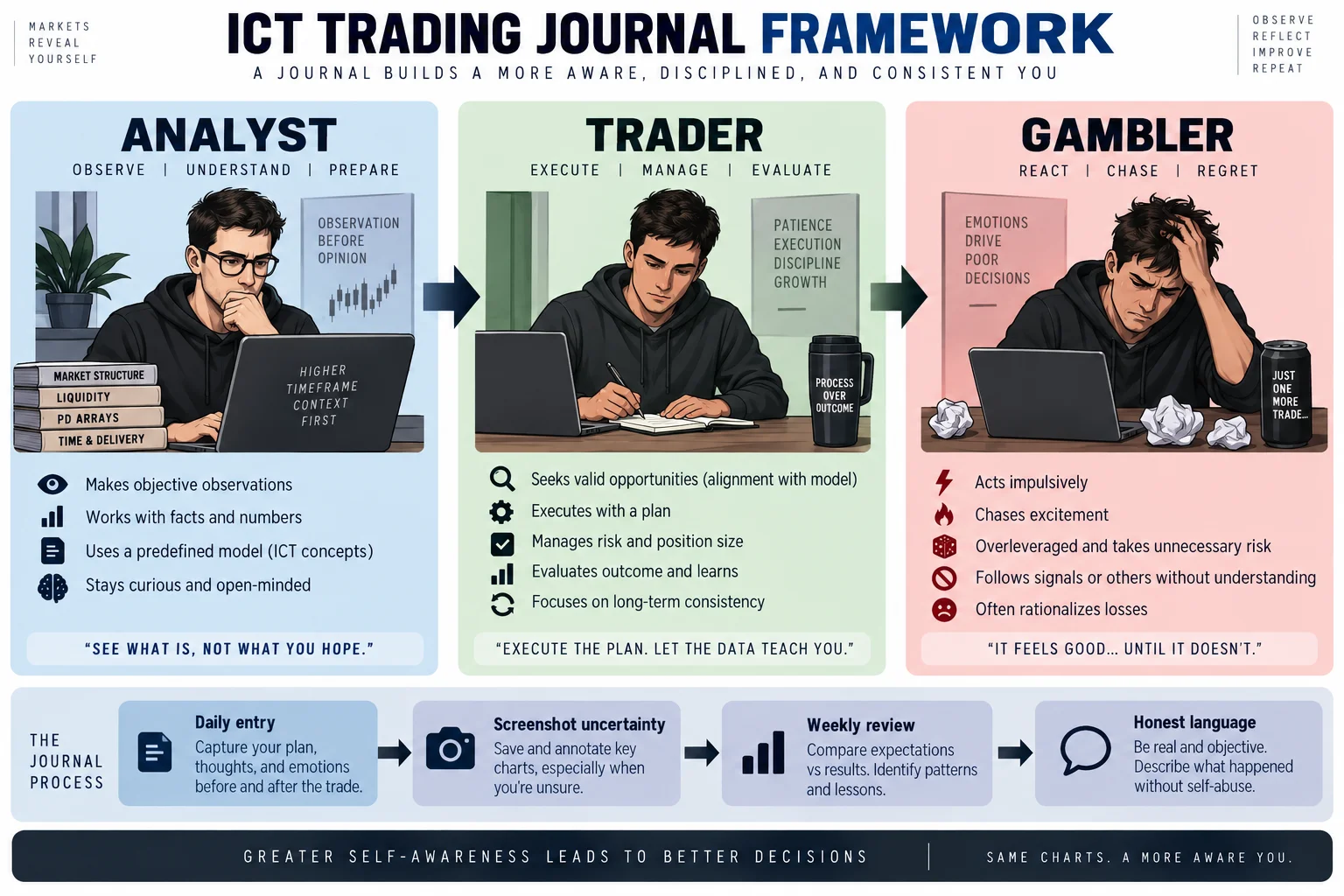
His framework separates three internal roles:
- The analyst focuses on observations, numbers, and the predefined model.
- The trader seeks an opportunity and evaluates the outcome.
- The gambler acts impulsively, pursues excitement, or uses more leverage than planned.
This is ICT’s reflective model rather than a clinical psychological classification. Its practical purpose is to label the mindset that appeared during a decision.
Journal Your Physical and Emotional Trade Context
At 25:03, ICT emphasizes recording how the trader felt before the session. He recounts trading while worried about a family medical situation and describes how anxiety created a desire to seek distraction through the market. He also mentions illness, fatigue, anger, grief, and personal conflict as conditions that may impair judgment.
A useful journal entry can therefore include sleep, health, stress, major personal events, and whether the trader felt neutral enough to follow the plan. The goal is not to diagnose a condition. It is to identify recurring circumstances associated with impulsive decisions and to recognize when stepping away may be appropriate.
Use Trade Journaling to Capture Uncertainty
From 30:54, ICT recommends taking a chart screenshot when fear or uncertainty appears, then annotating what the trader expected and felt at that moment. This preserves information that hindsight can easily distort.
A concise entry based on the lesson could contain:
- Date, instrument, session, and relevant timeframe
- The planned setup and conditions required for action
- The expected market behavior before the outcome was known
- A screenshot at the setup or moment of uncertainty
- Physical and emotional state
- Whether each rule was followed
- What actually occurred, stated without embellishment
- Any coping response used and whether it reduced impulsive behavior
Compare Trade Expectations With Results
At 33:33, ICT advises comparing the original expectation with the actual result. He discourages turning the review into self-criticism. Instead, mistakes should identify specific areas for further work.
He also distinguishes constructive language from either exaggeration or abuse. Around 41:04, he recommends acknowledging faithful execution when rules were followed. At 43:00, he warns against labeling oneself a failure after an error. A neutral alternative is to record the deviation precisely: which rule was broken, what preceded it, and what response should be tested next time.
Practical ICT Trade Psychology Lessons
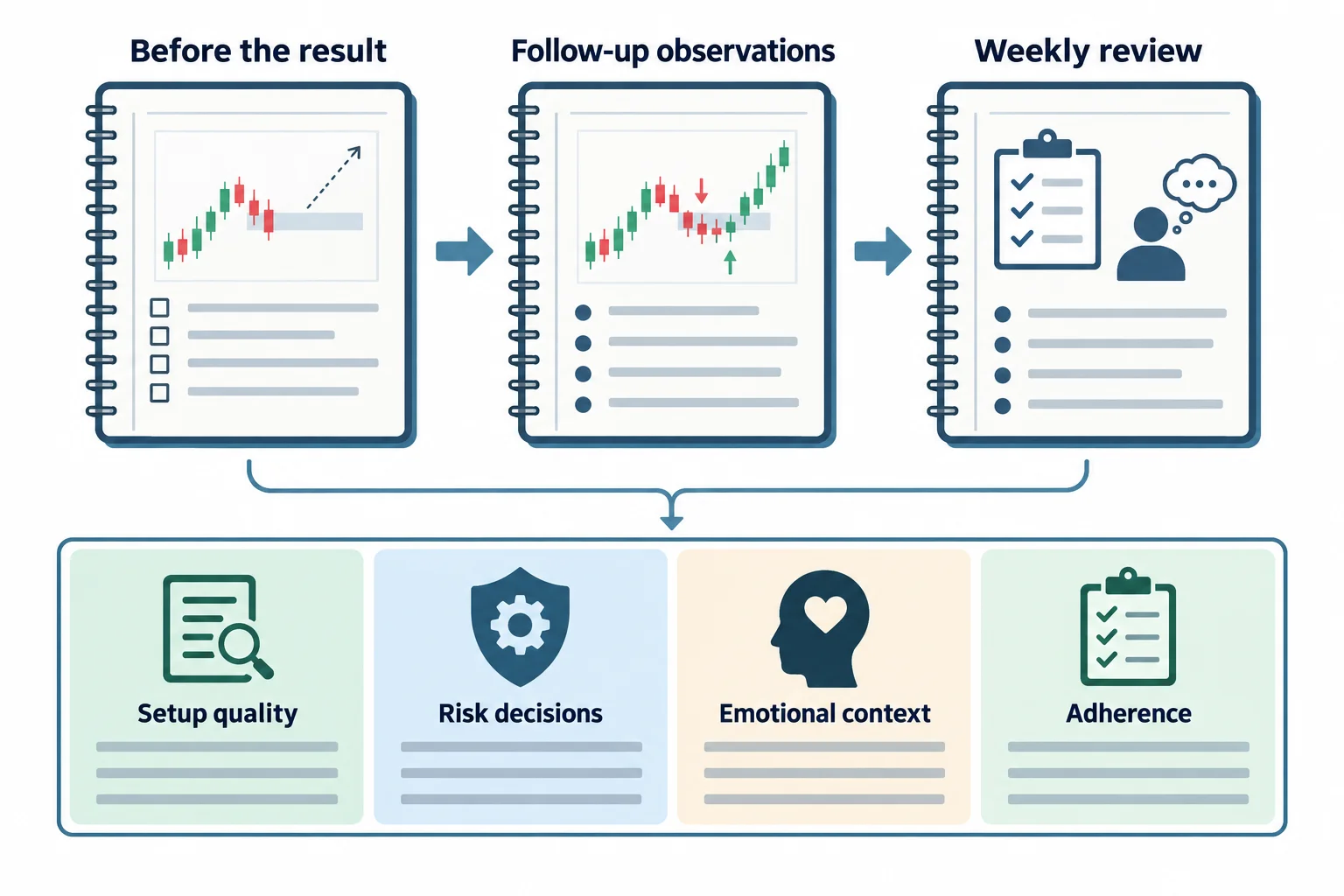
The strongest general lesson is that a journal should record the decision process, not merely profit or loss. A profitable outcome can follow a rule violation, while a loss can occur after disciplined execution. Reviewing setup quality, risk decisions, emotional context, and adherence separately makes the record more useful.
Near the end, ICT walks through a Canadian-dollar chart as an example of capturing expectations, context, and later observations. Because the transcript cannot show the charts themselves, it does not support independent verification of the displayed levels, signals, or outcome. The durable journaling principle is to save analysis before the result, add follow-up captures, and review the complete sequence at week’s end.
ICT closes by calling a trader’s own journal their most personally relevant trading book. That should be understood as his educational perspective, not evidence that journaling or any named trading concept produces profits. Markets remain uncertain, and this material is for education rather than investment advice.
ICT Forex Trade Psychology Source
ICT Forex – Trade Psychology & Effective Journaling (YouTube)
ICT Trade Journaling Resources
- The Inner Circle Trader (official website) ICT's primary educational platform.
- Inner Circle Trader on YouTube Full video archive of ICT lessons.