Key takeaways
ICT reviews GBP/USD on five-minute charts for July 26–30, 2021, using a bullish weekly liquidity target to frame Monday-through-Wednesday longs below the midnight opening price or after retracements rather than buying breakout highs.
Read the full summary
ICT reviews GBP/USD on five-minute charts for July 26–30, 2021, using a bullish weekly liquidity target to frame Monday-through-Wednesday longs below the midnight opening price or after retracements rather than buying breakout highs. Monday at 1 minute 19 seconds features a London low, an optimal trade entry retracement, and a move toward relative equal highs. Tuesday at 2 minutes 57 seconds uses a bearish Judas swing, a short-term low breach, bullish market structure break, and retracements. Wednesday at 5 minutes 5 seconds covers an FOMC seek and destroy profile with repeated high and low sweeps before a rally, while claimed fills and management near 15 minutes 1 second remain unverified. Thursday and Friday receive less emphasis on opening-price rules, and Friday at 8 minutes shows a reversal sequence after the weekly objective and Thursday high were swept, followed by a short-term low break, bearish order-block retracement, and New York decline toward opposing liquidity. At 18 minutes 53 seconds, ICT defines a generic macro as a time-dependent move between reference levels, exemplified by a bullish OTE from 7 a.m. to 10 a.m. New York time extending toward 10.30 a.m. The framework combines weekly direction, day, session window, entry pattern, and liquidity references, but the article stresses that charts, fills, results, algorithm claims, and predictive edge are not independently verified and that leveraged forex carries substantial risk.
How we researched this article
BestProps used document-based research from primary firm sources, checked September 25, 2026. The complete source list, scope, limitations, and commercial-state record appear near the end of this article.
In ICT Forex – Market Maker Series Vol. 5 of 5, ICT concludes the series by reviewing GBP/USD across the trading week of July 26–30, 2021. His central lesson is that an anticipated weekly direction can provide context for lower-timeframe setups, while the behavior of price around prior highs, prior lows, opening prices, and session windows can help organize an intraday narrative.
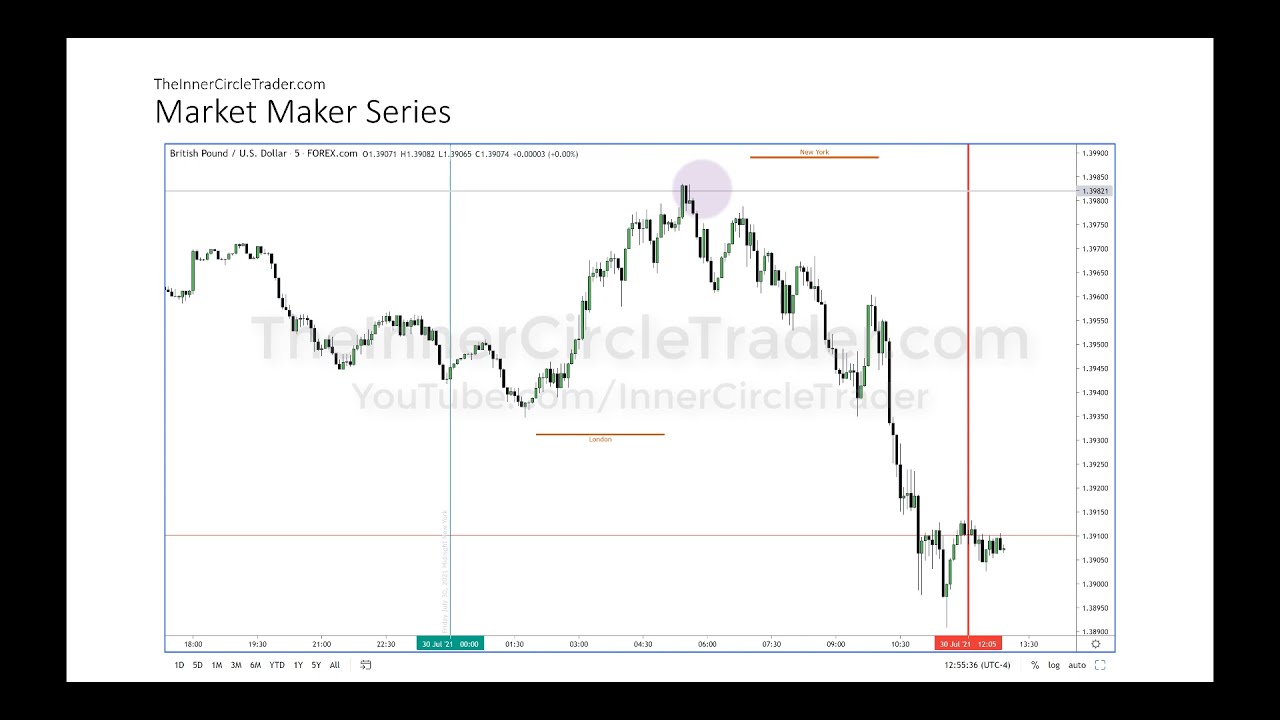
This is ICT’s interpretation of the market, not proof that markets follow a fixed algorithm or that the described patterns provide a reliable trading edge. The transcript also cannot independently verify the charts, entries, fills, or trade results shown in the recording.
ICT Forex Weekly Review Framework
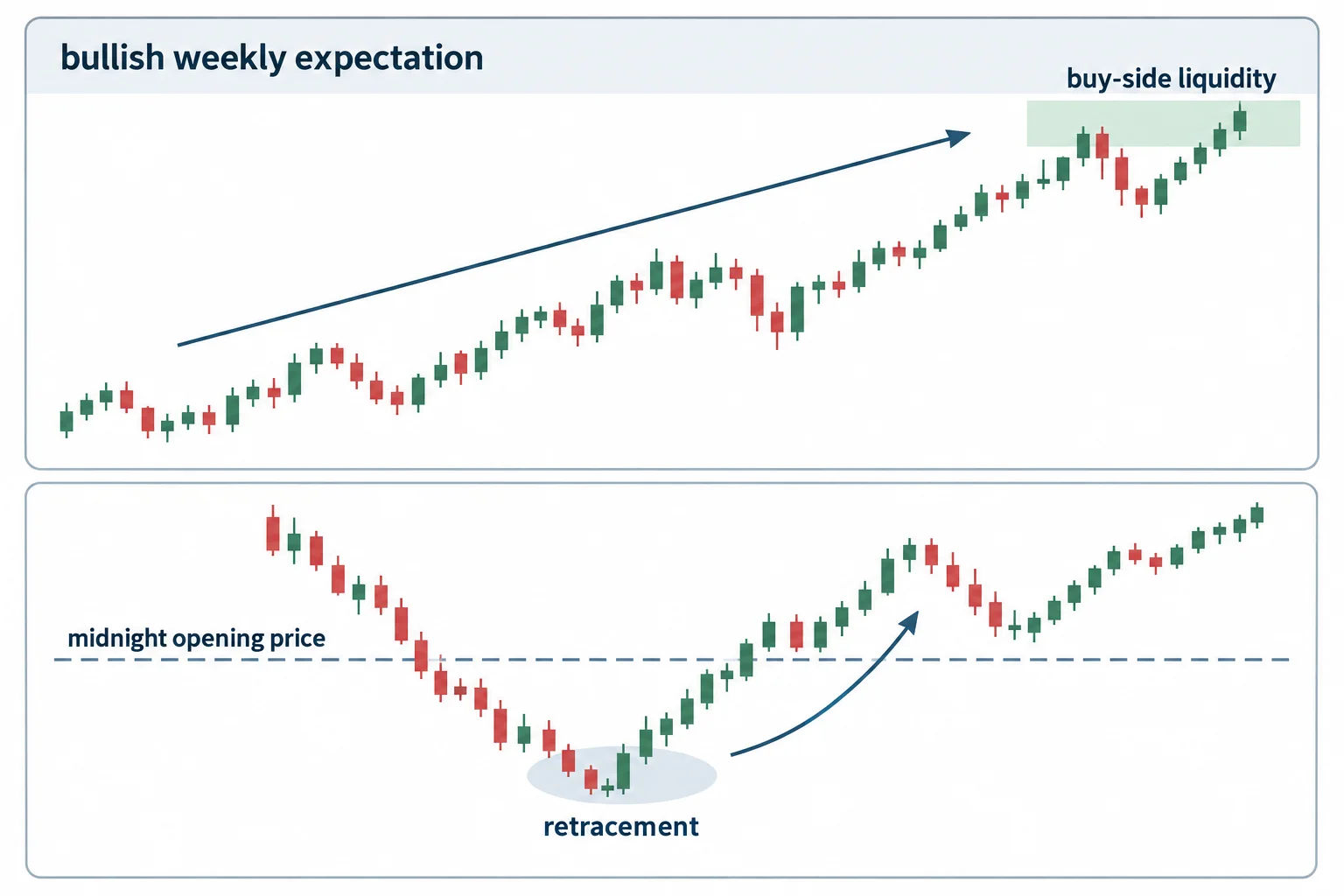
ICT begins the substantive lesson with a discussion of daily bias and what he calls generic market macros. The case study is GBP/USD, viewed on five-minute charts within what he had identified as a bullish weekly expectation. In his framework, price was expected to seek a pool of buy-side liquidity identified on the weekly chart.
That higher-timeframe premise shapes the first half of the week. Rather than treating every intraday fluctuation as an independent signal, ICT looks primarily for buying opportunities on Monday through Wednesday. He emphasizes entries below the midnight opening price or after price has moved above it and retraced, rather than buying an initial breakout at its high.
ICT Monday Trading Below the Opening Price
At 1:19, ICT reviews Monday, July 26. He describes price falling into a London-session low, rallying, and then returning below a short-term low. Within his bullish premise, he treats that sequence as a possible buying context.
He then identifies what he calls an optimal trade entry, or OTE, following a retracement. Price subsequently moves toward relative equal highs before the New York session. OTE is an ICT-specific retracement concept; the transcript refers to drawing it with a Fibonacci tool but does not clearly state the exact levels used in this example.
ICT Tuesday Judas Swing and Market Structure
The Tuesday review begins at 2:57. ICT again starts with the bullish weekly expectation but wants to see price trade lower first. He calls this initial move a “Judas swing”: a move in the opposite direction that, in his interpretation, catches traders off guard before the anticipated expansion.
After a short-term low is breached, he points to a bullish break in market structure and subsequent retracements as potential entry patterns. His practical message is not to become fixated on capturing the exact high. He considers taking a meaningful portion of the London or New York move more important than perfectly identifying the day’s turning point.
ICT Wednesday FOMC Seek and Destroy Profile
Wednesday is treated differently because it coincided with an FOMC announcement. At 5:05, ICT describes repeated runs above short-term highs and below short-term lows. He calls this a “seek and destroy” profile, a back-and-forth pattern in which positions on either side can be disrupted.
In ICT’s account, the announcement-period move took the day’s low before price rallied. He interprets the low sweep as consistent with the bullish weekly premise and later discusses a long position associated with that idea. The transcript contains specific claimed fills and position management around 15:01, but those details are personal claims presented in the video, not independently verified performance records.
Why ICT Forex Focus Changes Late in the Week
At 6:53, ICT reviews Thursday and explains that he gives less weight to the opening-price rule on Thursday and Friday. In his model, buying below the opening price during bullish weeks (or selling above it during bearish weeks) is primarily a Monday-through-Wednesday framework.
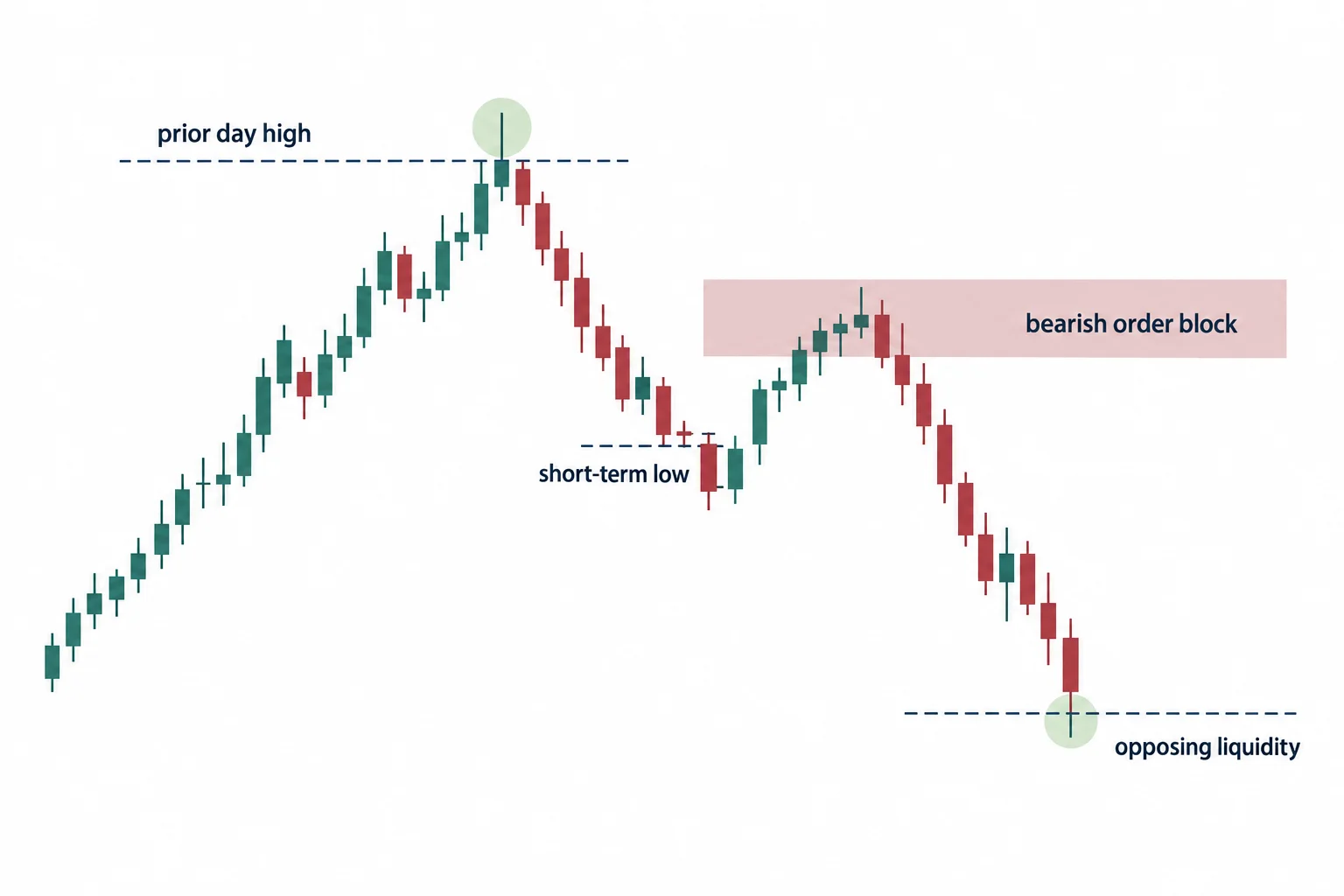
By Friday, GBP/USD had advanced each day and moved beyond the weekly objective ICT had previously identified. After price swept Thursday’s high, he no longer favored straightforward continuation. At 8:00, he outlines a reversal narrative:
- Price trades above Thursday’s high, reaching liquidity resting over the prior day.
- A short-term low preceding the final advance is then broken.
- Price retraces into what ICT labels a bearish order block.
- The New York session produces another move lower toward opposing liquidity.
The broader idea is that, once one side’s liquidity has been reached, ICT looks for evidence that price may begin seeking liquidity on the other side. He uses terms such as accumulation, reaccumulation, distribution, and “smart money reversal” to classify the week’s structure. These are interpretive labels from his methodology; the transcript does not establish the identity or activity of particular market participants.
How ICT Defines a Forex Market Macro
Later in the recording, ICT returns to the phrase “generic macro.” At 18:53, he defines a macro as a small, time-dependent price sequence within what he describes as an algorithm, for example, a move from one reference level to another during a recurring time window.
One example he gives is a bullish OTE forming between 7:00 a.m. and 10:00 a.m. New York time and extending toward 10:30 a.m. His educational priority is to combine four elements rather than search for an isolated pattern:
- the anticipated weekly direction;
- the day of the week;
- the relevant session or time window;
- the entry pattern and nearby liquidity references.
ICT Forex Study Process and Risk Caveats
The final portion broadens into study habits and trading psychology. ICT encourages viewers to create timestamped notes for topics such as order blocks, breakers, and mitigation blocks. He also acknowledges that drawdowns and losing streaks occur and says some long-term students had not yet become profitable despite sustained effort. That admission provides important context for the success stories and income claims elsewhere in the talk.
A useful educational takeaway is to document every assumption separately: higher-timeframe bias, liquidity target, session, invalidation point, and observed result. Historical chart review can illustrate terminology, but it cannot by itself establish predictive value. Trading leveraged foreign exchange involves substantial uncertainty, and this video should be studied as one educator’s market framework rather than as investment advice or a performance promise.
ICT Forex Market Maker Resources
- Inner Circle Trader YouTube channel Source of the Market Maker series and related ICT lessons.
- Investopedia: FOMC definition Background on the Federal Open Market Committee and its market impact.
- Investopedia: Liquidity and liquidity pools General explanation of the concept referenced in the lesson.
- CFTC: Forex fraud advisory Regulator guidance on risks in leveraged forex.