Key takeaways
ICT Forex Market Maker Series Volume 1 of 5 presents ICT’s historical macro framework for forming a long-term FX bias by comparing central-bank interest-rate differentials, checking currency-futures Commitment of Traders positioning, and waiting for his preferred market-structure shift before applying the bias to position, swing, short-term, day-trading, or scalping execution.
Read the full summary
ICT Forex Market Maker Series Volume 1 of 5 presents ICT’s historical macro framework for forming a long-term FX bias by comparing central-bank interest-rate differentials, checking currency-futures Commitment of Traders positioning, and waiting for his preferred market-structure shift before applying the bias to position, swing, short-term, day-trading, or scalping execution. Recorded July 26, 2021 and uploaded July 27, 2021, the lesson cites Global-Rates and Barchart as free research sources, recommends using the futures contract with the highest open interest, demonstrated with September 2021 Japanese-yen futures, and hides the small-speculators COT series. Historical examples compare the US rate of 0.25% and Canadian rate of 0.25% with Japan’s -0.10%, supporting bullish USD/JPY and CAD/JPY premises when relative commercial positioning and structure align, while noting Canada’s rate had fallen from 0.75% to 0.25% in March 2020. ICT stresses that rate differentials, the COT zero line, and nearby minor swings are not standalone trade signals, and the lesson supplies no exact entry, stop, sizing method, complete risk-management process, independent proof of market-control claims, or evidence of profitability.
How we researched this article
BestProps used document-based research from primary firm sources, checked September 25, 2026. The complete source list, scope, limitations, and commercial-state record appear near the end of this article.
In ICT Forex – Market Maker Series Vol. 1 of 5, ICT introduces a macro framework for forming a long-term directional view in foreign exchange. The lesson combines central-bank interest-rate differentials, Commitment of Traders (COT) positioning, and what ICT calls a market-structure shift.
The video was uploaded on July 27, 2021. During the recording, ICT identifies July 26, 2021 as the recording date. Consequently, the rates, futures contracts, and chart examples discussed are historical rather than current market information.
ICT Forex Series Volume 1 Purpose
At 00:30, ICT explains that this five-part presentation revisits a longer 2014 series. Volume 1 is devoted to “understanding the macro”: establishing a broad bullish or bearish premise before considering shorter-term setups.
ICT then advances a strongly stated interpretation of how the foreign-exchange market operates. Beginning at 03:23, he characterizes central banks as the true market makers and argues that currency-price delivery is controlled through central-bank systems rather than conventional retail indicators or simple supply-and-demand explanations. These are ICT’s market interpretations in the lesson, not facts demonstrated by the transcript. The recording does not provide independent evidence establishing the asserted degree of control or the institutional mechanics behind it.
ICT Forex Macro Research Before Market Charts
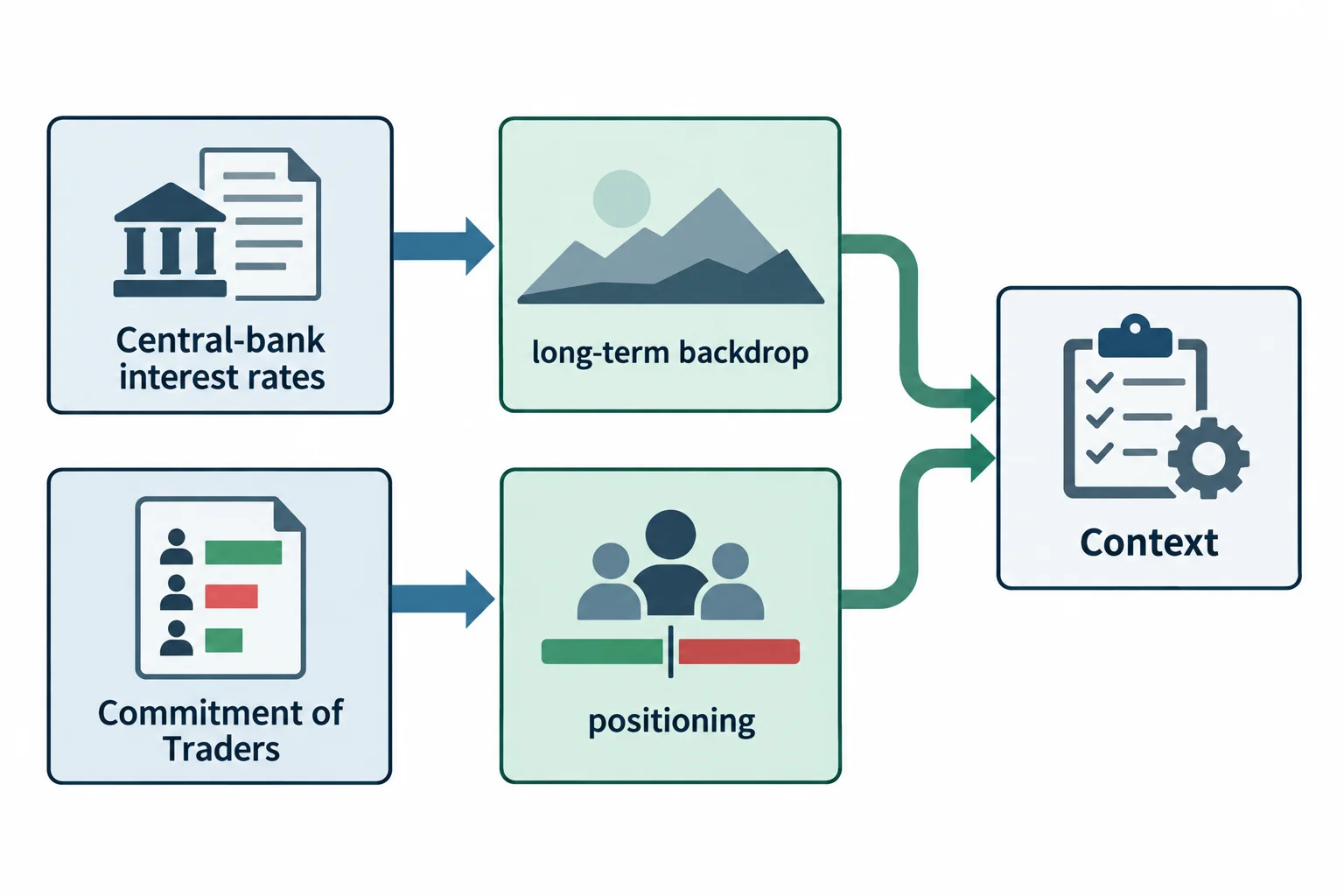
At 06:46, ICT distinguishes quantitative from qualitative analysis. In his terminology, quantitative inputs should be measurable and less dependent on a trader’s visual opinion. Asking several traders whether a chart looks bullish or bearish could produce conflicting answers; comparing published rates or reported positioning produces defined observations.
He proposes two starting inputs:
- Central-bank interest rates: used to compare the yield associated with two currencies.
- Commitment of Traders data: used in the lesson as a representation of how selected participant categories are positioned in currency futures.
ICT introduces these sources at 08:08, mentioning Global-Rates and Barchart as free research options available at that time. He treats interest rates as the long-term fundamental backdrop and COT positioning as a second input that may support or oppose that backdrop.
Selecting the Forex Futures Contract
Starting at 10:42, ICT walks through a historical Japanese-yen futures example. He says to select the contract with the highest open interest rather than the cash listing, because the COT study is being applied to a futures chart. In the recording, the September 2021 contract is the example with the highest stated open interest.
He then describes adding a Commitment of Traders study and hiding the “small specs” series. This is a platform-specific demonstration from 2021, so current menus, labels, contract months, and data presentation may differ.
Forex Market Interest Rate Differentials
At 16:43, ICT defines an interest-rate differential as the difference between the rates associated with two countries or currency areas. His framework begins by pairing a comparatively higher-rate currency with a comparatively lower-rate currency.
The historical example compares a stated US rate of 0.25% with a stated Japanese rate of -0.10%. ICT interprets that difference as a macro factor favoring the US dollar over the yen. Importantly, he later clarifies that a rate differential is only a precursor: it is not, by itself, an instruction to enter a trade whenever the chart is opened.
ICT Forex Market Rates COT and Structure
In the USD/JPY case study beginning around 19:19, ICT looks for COT positioning that aligns with the rate comparison. He interprets comparatively strong commercial positioning in the dollar and weak positioning in yen as confirmation of a bullish USD/JPY premise.
ICT cautions that simply being above or below the COT zero line is not automatically a buy or sell signal. He instead looks for relative positioning extremes and then waits for what he defines as a break or shift in market structure. At 22:01, he explains that his chosen structural reference is not necessarily the nearest small swing visible on the chart.
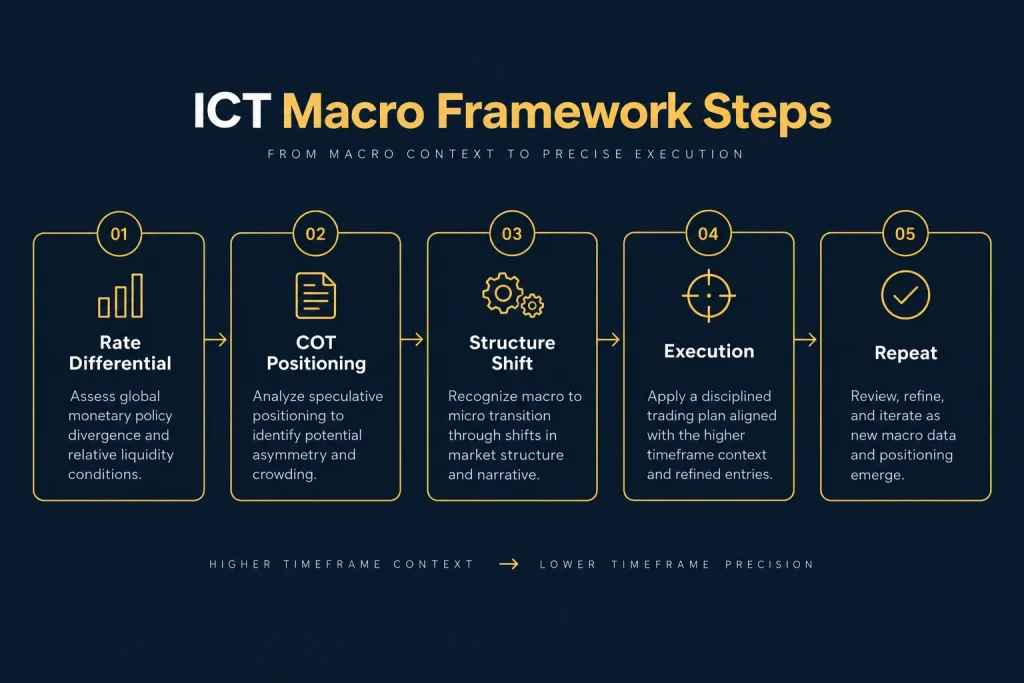
The resulting sequence in ICT’s framework is:
- Compare the two currencies’ central-bank rates.
- Review relevant currency-futures COT positioning.
- Look for positioning that supports the macro differential.
- Wait for ICT’s preferred form of market-structure confirmation.
- Use the resulting directional premise as context for the trader’s chosen timeframe.
ICT Forex Market CAD JPY Case Study
At 25:44, ICT applies the same process to CAD/JPY. He compares a historical Canadian rate of 0.25% with Japan’s stated -0.10% rate, then reviews Canadian-dollar and yen futures positioning.
ICT notes that Canada’s rate had fallen from 0.75% to 0.25% in March 2020. In his interpretation, the decrease did not invalidate the comparison because the Canadian rate remained above the Japanese rate. He presents subsequent COT changes and chart structure as supporting a bullish CAD/JPY narrative. The transcript includes his description of a substantial historical move, but it cannot independently verify chart levels, measurement conventions, entries, fills, or trading results.
ICT Forex Macro for Your Trading Horizon
The final section, beginning near 34:42, separates macro direction from holding period. ICT says that he personally favors shorter-term trading, while other traders may be better suited to position, swing, short-term, day-trading, or scalping approaches.
Related Resources
For readers who want to verify or explore the concepts discussed in this lesson, the following sources provide the underlying data and educational context:
- Global-Rates — a free central-bank interest-rate reference that ICT cites in the recording as a starting point for rate-differential research. See global-rates.com [1].
- Barchart — a free futures market data and charting platform that ICT mentions as a research option. See barchart.com [2].
- Commodity Futures Trading Commission (CFTC) — the official source of the Commitment of Traders (COT) report. See cftc.gov [3].
- ICT’s original video — the full recording this article is grounded in. See ICT Forex – Market Maker Series Vol. 1 of 5 [4].
These are the sources ICT references in the recording or that provide the underlying public data. Third-party indicator websites and charting platforms are unofficial and untested by this article; always verify data independently before acting on it.
The useful general distinction is that a long-term thesis and an execution method are separate decisions. Macro analysis can supply context without dictating an exact entry, stop, position size, or holding period. The video does not provide a complete risk-management process or establish that the framework is profitable. It should therefore be studied as ICT’s historical educational model, not as investment advice or a performance promise.