Key takeaways
ICT Mentorship 2022 is a free YouTube study series introducing a simplified single-model approach for beginners and struggling traders, focused on price action, directional bias, levels, buy-side liquidity, sell-side liquidity, optimal trade entry, drills, homework, and independent review rather than live trade signals or guaranteed profits.
Read the full summary
ICT Mentorship 2022 is a free YouTube study series introducing a simplified single-model approach for beginners and struggling traders, focused on price action, directional bias, levels, buy-side liquidity, sell-side liquidity, optimal trade entry, drills, homework, and independent review rather than live trade signals or guaranteed profits. The framework progresses through Yearning, Learning, and potentially Earning, leads with index futures using the March 2022 E-mini S&P 500 contract on a two-minute chart, mentions micro contracts as smaller-value alternatives, and suggests the concepts may also be studied in foreign exchange and other time frames. ICT planned approximately 3 to 4 months of lessons, no uploads during March 2022, an initial Friday episode followed by Tuesday and Thursday uploads, plus assignments and PDFs through YouTube’s community tab. The orientation warns against analysis paralysis, mentor dependence, overtrading, excessive leverage, and assuming marked study areas are live setups, while emphasizing that demo and live trading differ psychologically and that the transcript does not verify profitability, chart markings, fills, account results, risk management, or earning potential.
How we researched this article
BestProps used document-based research from primary firm sources, checked September 25, 2026. The complete source list, scope, limitations, and commercial-state record appear near the end of this article.
In ICT Mentorship 2022 Introduction, uploaded January 19, 2022, ICT previews a short YouTube mentorship focused on a simplified trading model. This is primarily an orientation session: it sets expectations, describes the intended audience, discusses personal responsibility, and outlines how later lessons were supposed to be delivered.
The introduction does not provide a complete trading system. It also does not independently establish that the methods are profitable. Instead, it records ICT’s own rationale for simplifying his material and his proposed process for helping students study price action.
ICT Mentorship Study Model for Developing Traders
ICT says the series was designed for people who were not yet trading successfully, including complete beginners and those who had previously struggled. At 2:37, he explains that the simplified presentation was initially conceived with his daughter in mind. His goal was to remove advanced theories and reduce the number of decisions a learner had to make.
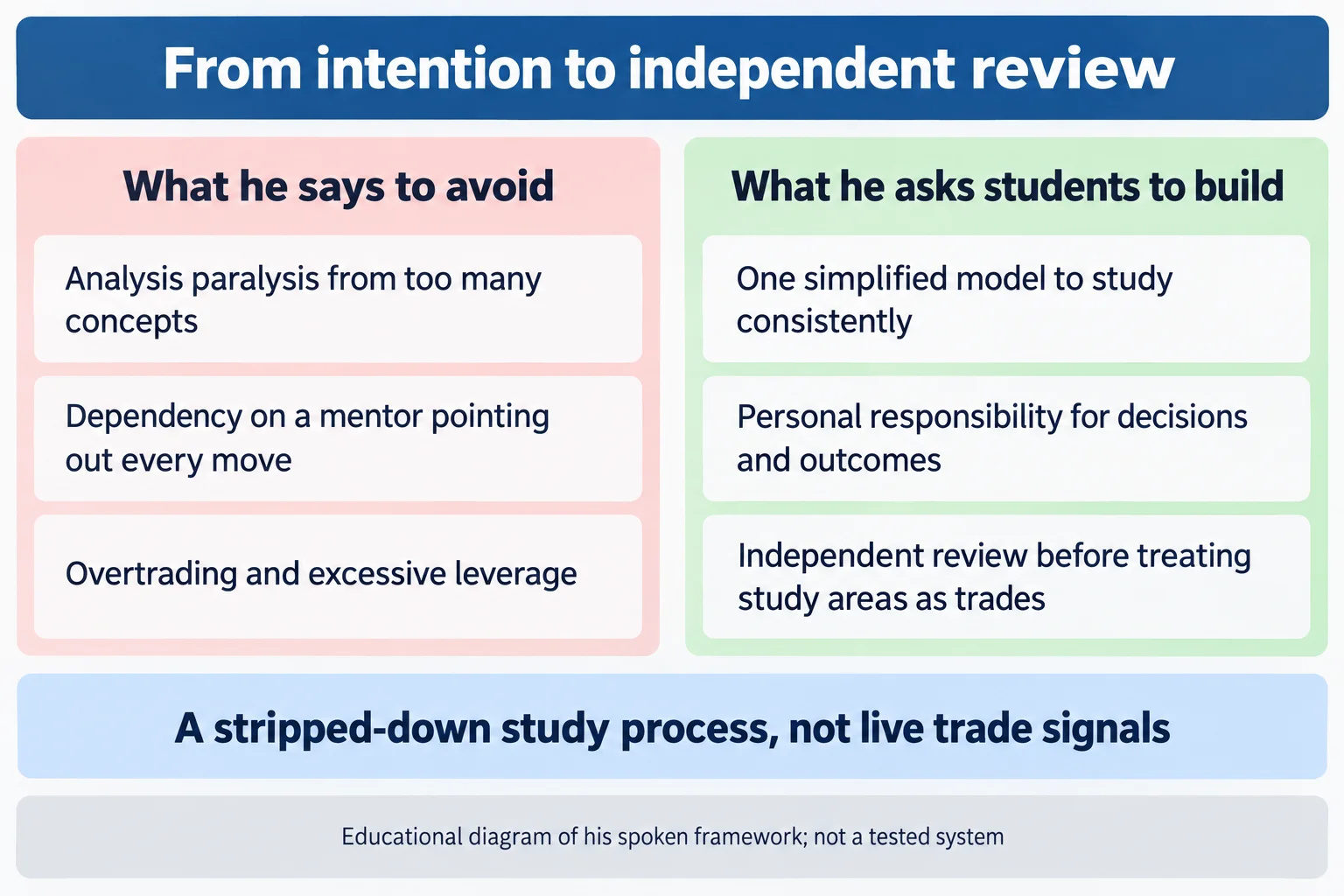
This simplification responds to what ICT calls “analysis paralysis.” Beginning around 3:30, he argues that exposure to too many concepts can leave students unsure which tool or idea to apply. The proposed mentorship would therefore stay centered on one model rather than presenting a large collection of unrelated setups.
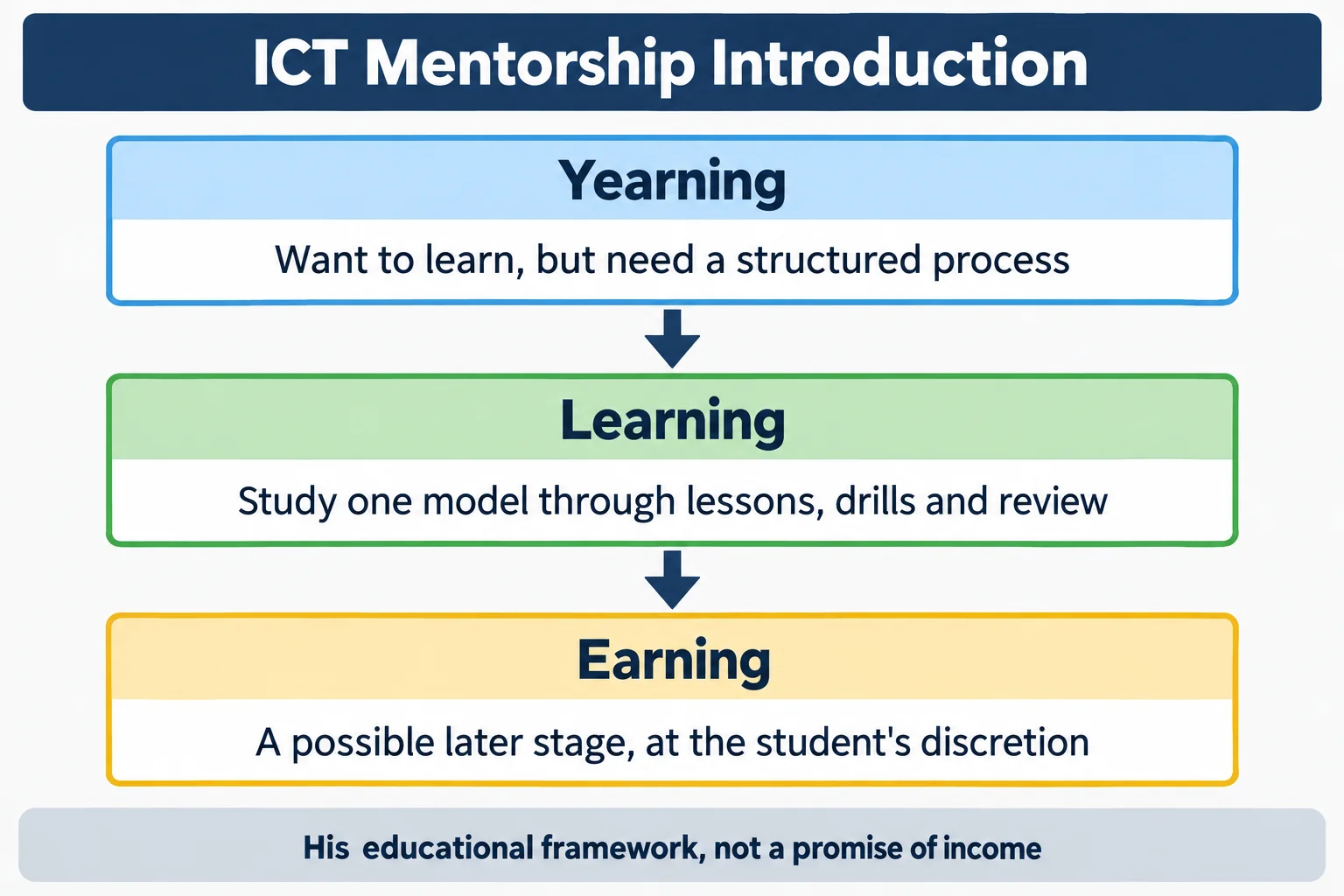
His intended progression has three broad stages:
- Yearning: wanting to learn but not yet possessing a structured process.
- Learning: completing lessons, drills, observations, and reviews.
- Earning: a possible later stage pursued according to the student’s own development and discretion.
ICT introduces this sequence at 7:06. It should be read as his educational framework, not as a promise that completing the material will produce income.
ICT Mentorship Study of Price Action and Directional Bias
At 6:16, ICT defines the main instructional objective as improving a student’s understanding of price action and directional bias. He says setups may share recognizable characteristics without appearing as exact copies of one another.
Later, while referring to charts visible in the original video, he emphasizes identifying where price may be reaching rather than demanding a perfectly precise entry. Around 24:18, he discusses a high with buy stops above it, an “optimal trade entry,” and the importance he assigns to directional bias. At 26:58, he summarizes the chart framework in terms of levels, buy-side liquidity, and sell-side liquidity.
These are ICT’s interpretations of market behavior. The transcript alone cannot validate the unseen chart markings, entry and exit locations, account information, fills, or subsequent results. It is therefore more useful to treat this section as a preview of the vocabulary and observational tasks used in the later mentorship.
ICT Mentorship Structure for Futures and Other Markets
ICT says at 4:45 that he intended to lead the instruction with index futures, although he believed the concepts could also be examined in foreign exchange markets and across other time frames. He describes his preference for short-term and intraday decisions while acknowledging that this style will not suit everyone.
In the chart discussion, he identifies the instrument as the March 2022 E-mini S&P 500 futures contract on a two-minute chart. He also explains the contract’s handle-and-tick terminology at 23:00. Later he mentions micro contracts as smaller-value alternatives to the standard E-mini contract.
Those contract details are historical context from the 2022 recording, not a recommendation to trade futures or select a particular contract size. Leverage, margin, and tick values can create substantial risk, and the transcript does not provide a complete risk-management procedure.
ICT Mentorship Process for Independent Trading
One of the clearest themes begins at 9:58. ICT warns students not to become dependent on him identifying every move in advance. He says that such dependence can impede development and that students should learn to reach and review their own conclusions.
He makes a related distinction near 7:45: areas marked for study were not intended to be interpreted automatically as live trade setups. He also repeatedly states that neither perfection nor universal success should be expected.
From a general educational standpoint, this suggests a study routine based on recording a hypothesis before an outcome is known, reviewing the result afterward, and distinguishing analysis practice from actual order placement. That interpretation is a prudent way to organize learning, but it is not evidence that the underlying market model has a verified edge.
ICT Mentorship Study Process for Trading Discipline
ICT contrasts demo practice with live trading throughout the introduction. Beginning at 16:30, he argues that real financial exposure can change a trader’s response to every price movement. He highlights drawdowns, overtrading, and excessive leverage as behavioral problems the mentorship would discuss.
He also asks students to complete drills and homework rather than search for shortcuts. At 11:36, he recognizes that jobs, school, businesses, and family commitments may prevent people from watching live data, suggesting that retrospective study may be a practical substitute even if it is not identical to live observation.
ICT Mentorship 2022 Schedule and Lesson Structure
The schedule described here is historical. ICT expected the mentorship to last approximately three or four months, with no uploads during March 2022. Near 29:54, he says the first episode would arrive that Friday, followed by Tuesday and Thursday uploads. He also anticipated assignments and PDF resources distributed through the channel’s community tab.
Overall, the video is best understood as a statement of teaching philosophy and course expectations. Its central message is to simplify the analytical process, study one model consistently, accept personal responsibility, and avoid treating mentorship commentary as a stream of trade signals. Any claims about repeatability, account results, or earning potential remain ICT’s own interpretations and expectations rather than independently demonstrated findings.
Watch the source lecture: ICT Mentorship 2022 Introduction (Jan 19, 2022) — primary transcript source, auto-generated captions.
Further Resources
- ICT Mentorship 2022 Introduction — official upload, January 19, 2022 (primary transcript source; auto-generated captions; no independent chart verification)
- Scalping — Investopedia (general educational resource on short-term trading concepts; not a source for this article’s specific claims)
- Trend Analysis — Investopedia (general resource on directional bias and trend concepts)
- Leverage — Investopedia (general resource on margin and leverage risk)