Key takeaways
2022 ICT Mentorship Episode 13, uploaded February 26, 2022 on YouTube, uses a paper-traded Nasdaq futures example to combine directional bias, buy-side liquidity, bullish order blocks, fair value gaps and the 9.30 a.m.
Read the full summary
2022 ICT Mentorship Episode 13, uploaded February 26, 2022 on YouTube, uses a paper-traded Nasdaq futures example to combine directional bias, buy-side liquidity, bullish order blocks, fair value gaps and the 9.30 a.m. New York equity open. ICT recommends documenting entry, invalidation, risk, targets, partial exits and management rules, then demonstrating consistency through roughly six months of simulation before considering live funds. His higher-probability bullish order block framework requires a down-close candle tied to upward displacement, a resulting imbalance or fair value gap and a directional narrative targeting liquidity above prior highs, with price also framed in the discount half of a range and an initial post-open decline potentially treated as a Judas swing. Stops remain beneath the candle or candle group defining the active bullish order block and move higher only after a newer supporting block forms. He pyramids three micro contracts, then two, then one rather than adding larger size later, and reports a demo balance rising from $10,000 to $12,111 across one trade with three entries, while stressing that the result is simulated, unverified and not a performance benchmark. The core lesson is to predefine the thesis, use simulation when volatility or uncertainty makes live risk undesirable, test setups through backtesting and chart review and accept that every method experiences losses and drawdowns.
How we researched this article
BestProps used document-based research from primary firm sources, checked September 25, 2026. The complete source list, scope, limitations, and commercial-state record appear near the end of this article.
2022 ICT Mentorship Episode 13, uploaded February 26, 2022, is an extra lesson applying ideas from ICT’s preceding discussion of advanced market structure. Using a paper-trading example in Nasdaq futures, ICT explains how he combined directional bias, liquidity targets, order blocks, fair value gaps and time of day. The broader lesson is not simply where he entered: it is why he chose simulated execution, how he framed the trade before entering and how he managed his thesis as price moved.
Primary source: Watch 2022 ICT Mentorship Episode 13 on YouTube.
ICT Paper Trading Builds Trade Discipline
ICT opens by distinguishing paper trading from live financial risk. He says prevailing volatility and geopolitical uncertainty made him unwilling to expose his live account after reaching his own objectives. His response was to remain engaged with the market through a demo account rather than force another live trade. This risk-avoidance rationale begins around 1:39 and is developed further at 7:43.
He also cautions students against moving to live trading too quickly. In ICT’s view, a developing trader should first document a model and trading plan, define risk and exit procedures in advance, and demonstrate consistency in simulation. He describes six months of demo practice as a threshold he would personally consider before even contemplating live funds, while emphasizing that he does not decide whether another person is ready.
At 5:00, ICT recounts entering live trading prematurely in 1992. His stated lesson is that anxiety often reflects insufficient testing and preparation. The practical takeaway is to determine entry conditions, invalidation, risk, targets and any partial exits before opening a position, not improvise them afterward.
ICT Market Narrative for Liquidity and Order Blocks
The chart discussion starts near 9:36. Although ICT says his broader equity view was bearish, he did not want to sell after price had already moved beneath a low he had been watching. Instead, he considered whether a short-term rally could reach an up-close candle, an imbalance or liquidity above nearby highs before any larger decline resumed.
He compares the Nasdaq and E-mini S&P 500, observing that the S&P contract was moving upward more energetically. His interpretation was that the relatively slower Nasdaq might be pulled higher in sympathy. This is ICT’s market reading in the lesson, not proof that correlated indices must always converge.
ICT Three-Part Order Block Framework
Around 12:43, ICT identifies relative equal highs and describes the area above them as buy-side liquidity because protective buy stops may rest there. He then watches a down-close candle left behind during a rally. Under his framework, a retracement into that candle may be treated as a bullish order block if the surrounding narrative still favors higher prices.
At 17:22, he summarizes what he considers a higher-probability bullish order block:
- A down-close candle associated with an upward displacement.
- An imbalance, which ICT also calls a fair value gap, created as price moves away.
- A directional narrative pointing toward buy-side liquidity above prior highs.
He explicitly rejects the need to classify the pattern through conventional engulfing-candle terminology. The label alone is not the setup in his presentation; location, displacement and the anticipated liquidity objective must agree.
ICT Episode Timing and Opening Trade Reversals
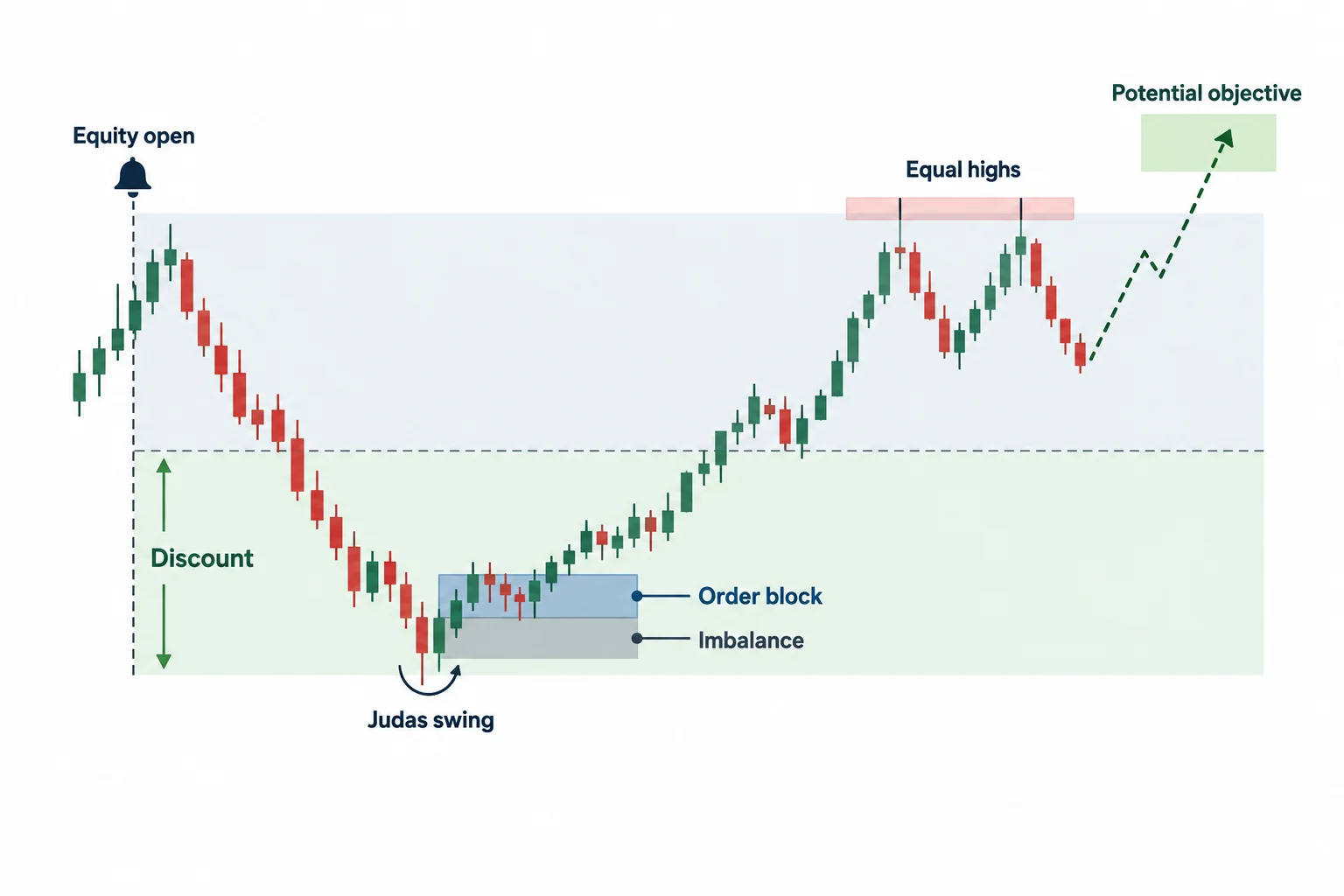
Time of day becomes important at 18:40. ICT focuses on action around the 9:30 a.m. New York equity open. He characterizes an initial move lower after the open as a possible “Judas swing” (his term for a deceptive move opposite the anticipated direction).
His bullish case combined several factors: price was in what he considered the discount half of a measured range, it had returned to a higher-time-frame order block and imbalance, and the intended objective remained liquidity above relative equal highs. He then moved from an hourly view to lower time frames to refine the hypothetical entry.
This is an important distinction: the transcript supports ICT’s explanation of the setup, but it does not independently establish that every similarly shaped opening move has the same meaning.
ICT Trade Management With Liquidity and Order Blocks
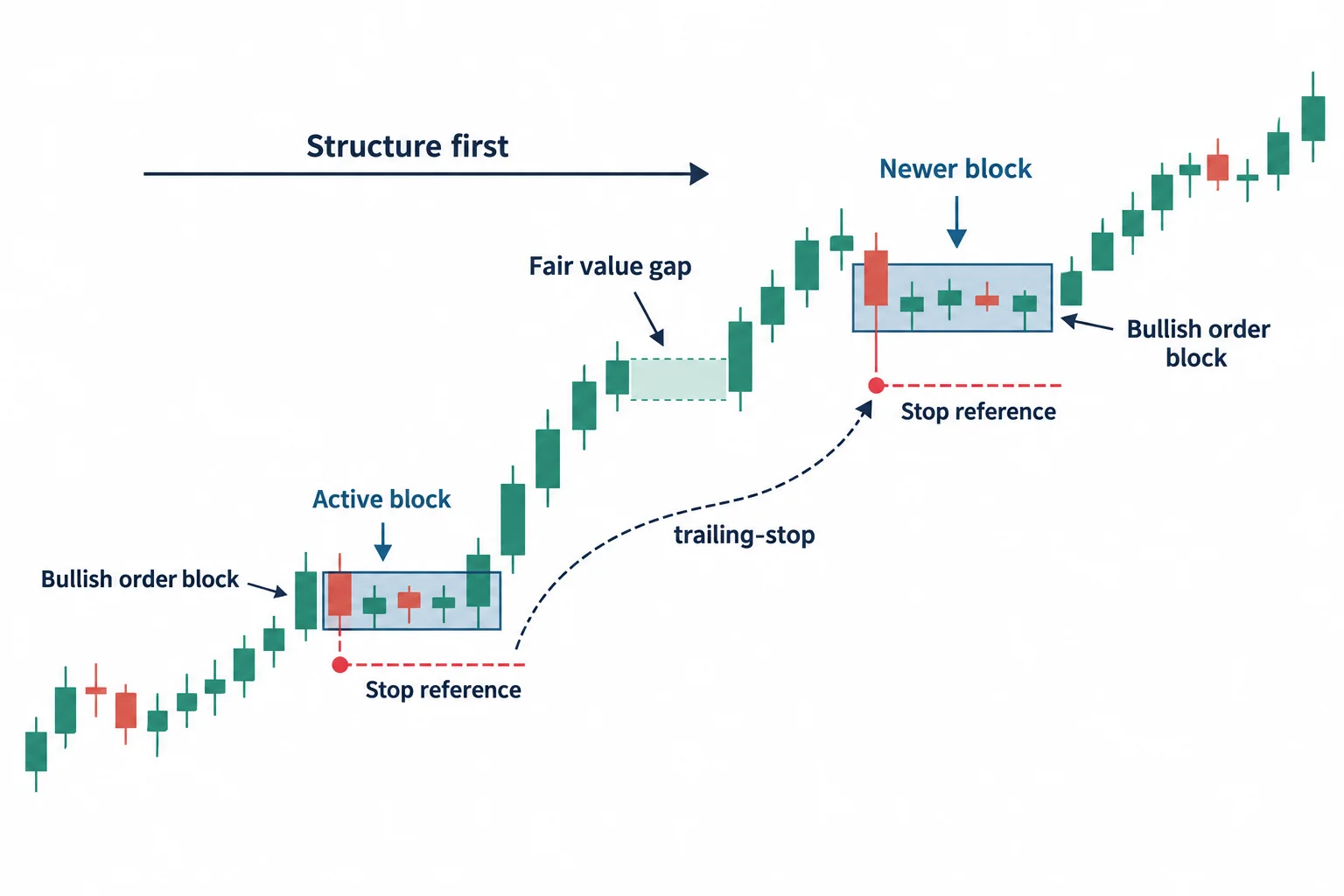
From about 21:40, ICT explains the lower-time-frame logic. He says the retracement overlapped a fair value gap while sitting within a higher-time-frame order block. Once price rallied, he monitored subsequent down-close candles as potential support.
His trailing-stop principle is discussed at 24:57. Rather than moving a stop into every minor fluctuation, he argues that it should remain below the candle or group of candles defining the active bullish order block. After another leg higher establishes a newer supporting block, the stop may be raised beneath that structure. A decisive break below it would suggest that the bullish premise might be failing.
That method does not remove loss risk. ICT acknowledges that neither he nor any trader is perfect, and the chart images needed to assess the precise placements are not contained in the caption transcript.
ICT Trade Pyramiding With Disciplined Order Size
At 32:17, ICT describes scaling into the simulated position with three micro contracts, then two, then one. He contrasts this with an “inverted pyramid” that adds increasingly larger size later in the move. His preferred structure puts the largest unit at the initial entry and reduces each addition, so earlier position equity supports the smaller later entries.
ICT reports that the paper account began at $10,000 and displayed $12,111 after the illustrated sequence, which he treats as one trade with three entries. These are self-reported demo results shown in the video, not verified live fills or evidence of expected returns. The unusually large percentage gain also implies substantial risk and should not be treated as a benchmark.
2022 ICT Mentorship Episode 13 Trading Lessons
The most transferable lesson is process rather than performance. ICT asks students to build a complete narrative before execution:
- Identify a plausible liquidity objective.
- Establish directional bias from broader structure.
- Wait for price to reach a relevant order block or imbalance.
- Account for session timing and opening volatility.
- Define invalidation and position management in advance.
- Use simulation and repeated chart review to test whether the interpretation is consistent.
Near 44:08, ICT plainly acknowledges that all trading approaches experience losses and drawdowns. He closes by encouraging sustained backtesting and chart study rather than expecting immediate mastery. His stronger claims about the superiority and repeatability of his method are his own interpretations; this episode does not provide controlled testing or independently verified profitability evidence.
This summary is educational commentary on the cited recording, not investment advice or a recommendation to trade futures, use leverage or replicate the demonstrated position sizing.
Additional Resources
For further study of the ICT concepts referenced in this episode, the following independent educational sources explain the core terminology and mechanics:
- ICT Trading Concepts — official education site covering market structure, liquidity pools, order blocks, fair value gaps and execution models.
- Equiti: Fair Value Gap (FVG) — The Complete Guide for ICT Traders — detailed breakdown of bullish/bearish FVGs, retracement entries, confluence with liquidity and order blocks, and validity rules.
- AlgoStorm: ICT & SMC Key Concepts — Order Blocks & FVG Guide — concise reference with classic TA equivalents, common misconceptions (e.g., “order blocks contain institutional orders” is unprovable), and practical validity criteria.
- ATAS Learn: ICT & SMC vs Orderflow — Order Block and FVG as Real Data — maps ICT concepts to order-flow data (absorption zones, low-volume nodes, stop cascades, initiative) for traders who want volume confirmation.
These resources are provided for educational context only; they are not affiliated with the video author, are not endorsed by him, and have not been independently tested by BestProps. Treat third-party indicator scripts, courses or signal services as unofficial and untested unless you verify them yourself.