Key takeaways
2022 ICT Mentorship Episode 11 reviews a bearish March E-mini Nasdaq futures setup using premium and discount, fair value gaps, liquidity targets, nested swing highs, and displacement.
Read the full summary
2022 ICT Mentorship Episode 11 reviews a bearish March E-mini Nasdaq futures setup using premium and discount, fair value gaps, liquidity targets, nested swing highs, and displacement. ICT defines equilibrium as the 50% midpoint of a selected dealing range, with prices above it at a premium and below it at a discount, and treats a fair value gap as context-dependent rather than a standalone signal. He uses the midnight New York open for the full daily range and the eight thirty a.m. open for the morning session, then seeks a lower-time-frame short within an imbalance when the broader narrative points toward liquidity below prior lows. A short-term swing high is a three-candle formation whose middle high exceeds those immediately beside it, an intermediate-term high sits above nearby short-term highs, and the same nesting process identifies longer-term highs. Confirmation comes from decisive bearish displacement, while a break in structure followed by a return to a newly formed imbalance may provide another assessment point. ICT reports entering at 13,858.25 and exiting at 13,612.25, but the transcript cannot verify the charts, fills, account display, profitability, or long-term expectancy. The broader process is to establish higher-time-frame direction and a liquidity objective, locate a compatible premium or imbalance, classify nearby swing structure, wait for displacement, reassess after liquidity is reached, and avoid overtrading after a large win, potentially switching to simulation to manage the impulse to continue.
How we researched this article
BestProps used document-based research from primary firm sources, checked September 25, 2026. The complete source list, scope, limitations, and commercial-state record appear near the end of this article.
In 2022 ICT Mentorship Episode 11, uploaded on February 22, 2022, ICT reviews a bearish E-mini Nasdaq futures scenario [1]. He explains his reading of premium and discount, fair value gaps, liquidity targets, nested swing highs, displacement, and the temptation to overtrade after a winning position.
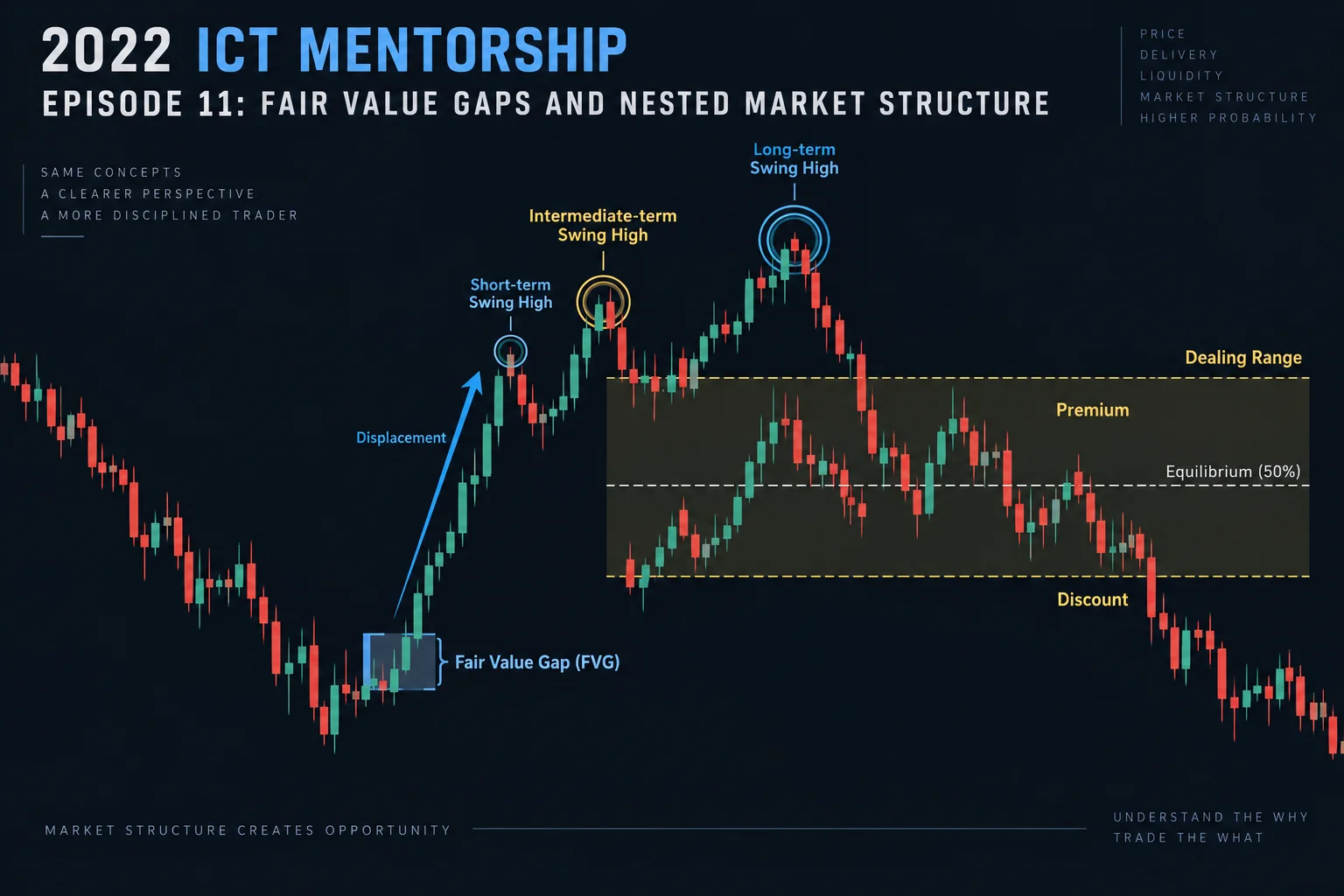
The presentation is a retrospective walkthrough built around charts shown in the video. The transcript records ICT's descriptions and reported execution details, but it cannot independently verify the chart levels, brokerage display, fills, or profitability. The useful educational focus is therefore the reasoning process ICT says he followed, not the result of one trade.
ICT Episode 11 Market Premium Discount and Liquidity
ICT begins with the March E-mini Nasdaq futures contract and a dealing range measured from a selected high to a low. At 1:40, he identifies the range’s 50% level as equilibrium. In his terminology, prices above that midpoint are at a premium and prices below it are at a discount [1].
He says price moved back above equilibrium to rebalance an earlier gap but failed to continue through a prior high. His bearish interpretation depended on liquidity resting beneath earlier lows. From that perspective, the consolidation and retracement into the gap represented a possible selling area rather than proof of a bullish reversal.
This establishes an important distinction in the lesson: a fair value gap is not treated as a self-sufficient signal. ICT evaluates it within a directional narrative involving the dealing range, an anticipated draw on liquidity, and the structure of nearby highs and lows.
ICT Episode 11 Market Opening Prices
At 7:26, ICT addresses confusion over his use of both midnight and 8:30 a.m. New York opening prices. He says the midnight open serves as a reference for the full daily range, while the 8:30 a.m. open is used when studying the morning session [1].
For the setup under review, he viewed the rally above the 8:30 open as a potentially deceptive move within a broader bearish outlook. He then looked for a short entry inside an imbalance visible on the lower-time-frame charts. This is presented as ICT’s market interpretation, not as a rule that every move above a session open must reverse.
ICT Episode 11 Nested Market Swing Highs
The central technical discussion starts near 9:56. ICT describes entering as price moved into the upper portion of a fair value gap, with the surrounding sequence of highs supporting his bearish thesis [1].
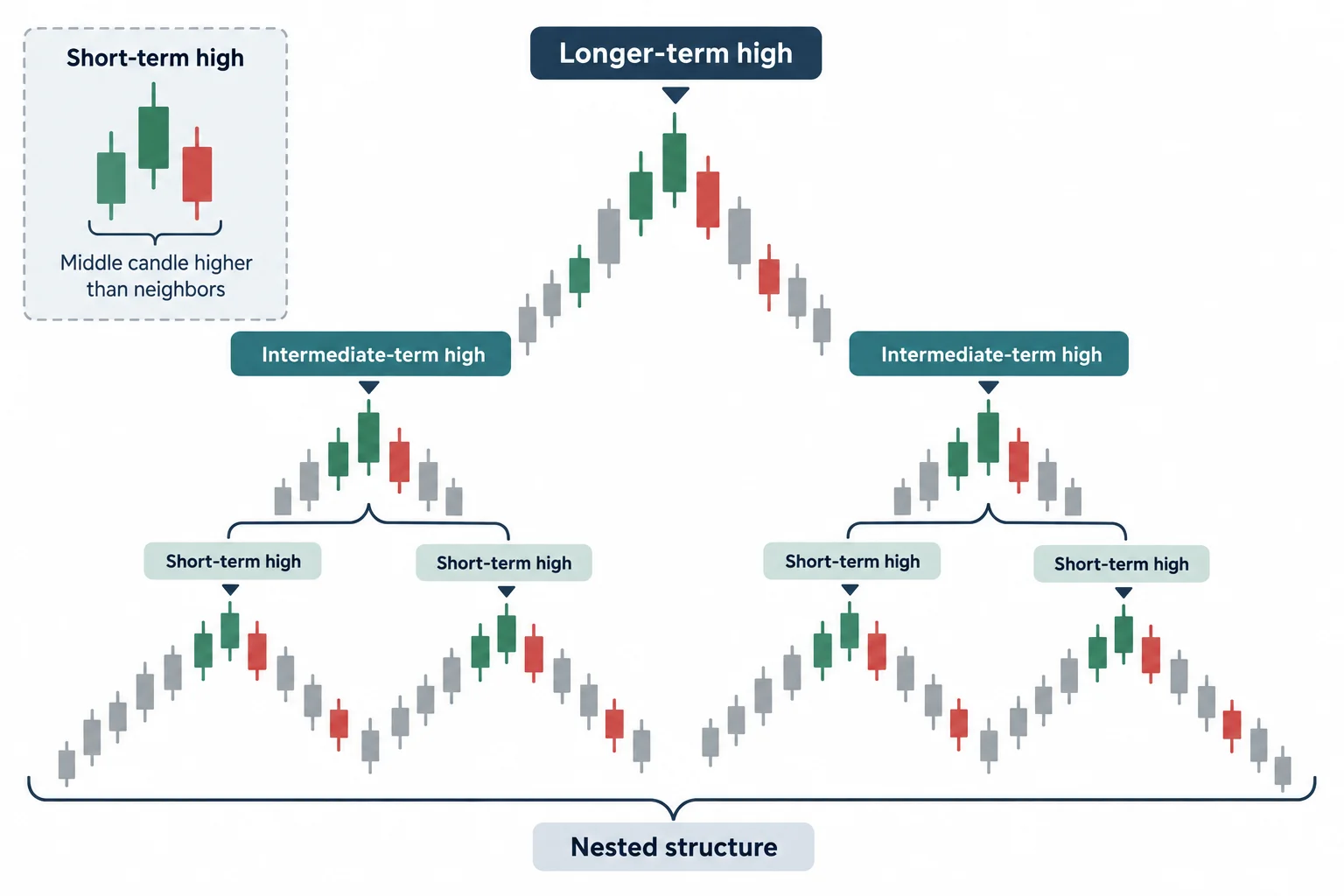
He defines a basic swing high as a candle whose high is higher than the highs immediately to its left and right. He then classifies structure through a nesting relationship:
- A short-term swing high is the basic three-candle formation.
- An intermediate-term high is a swing high positioned above nearby short-term swing highs.
- A longer-term high can be identified when that nesting process occurs at another structural level.
ICT gives a more explicit swing-high definition at 13:56. He also credits the short-, intermediate-, and long-term classification framework to material he learned from Larry Williams. His point is that “lower highs” alone do not capture the hierarchy he is trying to read.
A practical way to study this concept is to mark each local swing first and only then determine whether one swing sits above or below surrounding swings. That separates observation from directional prediction. The resulting classification still requires judgment and does not establish that a particular liquidity target will be reached.
ICT Episode 11 Market Displacement Confirmation
After outlining the entry area, ICT says he wanted to see displacement away from it. At 17:26, he explains that a decisive move lower would support the bearish interpretation. He also describes a possible later entry model: after structure is broken and an imbalance forms, a return into that area may offer another location from which to assess the same directional thesis [1].
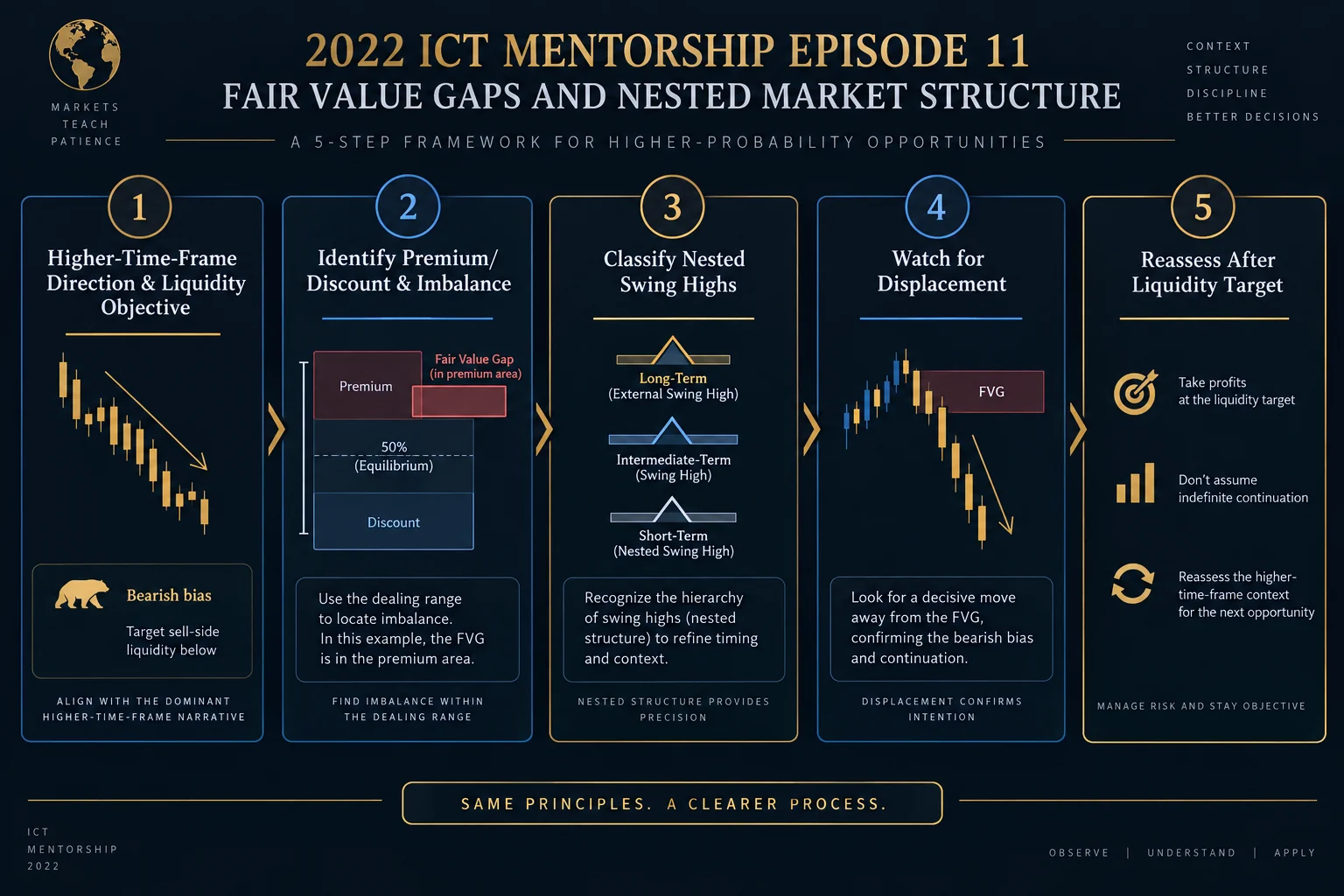
The sequence presented in the lesson can be summarized as follows:
- Establish a higher-time-frame directional idea and liquidity objective.
- Identify a premium area or imbalance consistent with that idea.
- Classify nearby swing highs rather than relying only on a generic lower-high label.
- Look for displacement away from the proposed entry area.
- Reassess after the anticipated liquidity has been reached instead of assuming continuation indefinitely.
This is a summary of ICT’s framework, not evidence that the sequence provides a repeatable trading edge.
ICT Episode 11 Market Execution Limits
ICT reports an entry at 13,858.25 and an exit at 13,612.25, discussed around 4:39. Later, beginning near 27:05, he shows what he describes as a live brokerage account and explains an account adjustment displayed alongside the transaction [1].
Those claims should be understood within the limits of the source. An audio transcript cannot authenticate the account, verify what appeared on screen, establish the complete trading history, or confirm the reported execution independently. A single selected example also says nothing about long-term expectancy, drawdowns, or risk.
ICT Episode 11 Overtrading Lesson
The final major theme is restraint. At 21:02, ICT says he avoids live trading after a large move and may use simulation to satisfy the impulse to remain active. He describes how a profitable trade can create a desire to repeat the emotional reward immediately, leading to unnecessary risk [1].
The broadly applicable educational takeaway is to define stopping conditions before emotions intensify. Examples might include a maximum number of attempts, a session endpoint, or a rule to pause after an unusually large outcome. These are general process controls rather than recommendations to enter any market.
2022 ICT Mentorship Episode 11 Summary
Episode 11 connects ICT’s premium-and-discount framework with fair value gaps and a nested classification of swing structure. The setup is not presented merely as selling a rectangle on a chart: ICT says the location mattered because it aligned with his bearish liquidity objective, the hierarchy of prior highs, and subsequent displacement. Equally important, the episode closes with a warning about chasing additional trades after a favorable result.
Watch the complete primary source: 2022 ICT Mentorship Episode 11. For the full 2022 ICT Mentorship series, see the official playlist [2] or The Inner Circle Trader’s YouTube playlists [4].
This commentary is educational and does not provide investment advice or promise trading performance. The author is not affiliated with The Inner Circle Trader. All trade results discussed are ICT’s self-reported figures and have not been independently verified. Trading carries substantial risk of loss.
Episode 11 Sources
- 2022 ICT Mentorship Episode 11 Primary transcript source (ASR: Whisper large-v3-turbo)
- 2022 ICT Mentorship Playlist Official playlist reference
- The Inner Circle Trader Official Website ICT's official site
- The Inner Circle Trader YouTube Playlists All ICT playlist index